1 of 5
Rare Giant Flag Company Advertising Banner, Vintage
$14,500List Price
About the Item
- Attributed to:Dettras Flag Products (Manufacturer)
- Dimensions:Height: 72 in (182.88 cm)Width: 46 in (116.84 cm)Depth: 1.5 in (3.81 cm)
- Style:American Classical (Of the Period)
- Materials and Techniques:Cotton Canvas,Machine-Made
- Place of Origin:
- Period:
- Date of Manufacture:1940
- Condition:Wear consistent with age and use. Very good condition for age, wear and use.
- Seller Location:Acworth, GA
- Reference Number:Seller: 219591stDibs: LU140527449513
Authenticity Guarantee
In the unlikely event there’s an issue with an item’s authenticity, contact us within 1 year for a full refund. DetailsMoney-Back Guarantee
If your item is not as described, is damaged in transit, or does not arrive, contact us within 7 days for a full refund. Details24-Hour Cancellation
You have a 24-hour grace period in which to reconsider your purchase, with no questions asked.Vetted Professional Sellers
Our world-class sellers must adhere to strict standards for service and quality, maintaining the integrity of our listings.Price-Match Guarantee
If you find that a seller listed the same item for a lower price elsewhere, we’ll match it.Trusted Global Delivery
Our best-in-class carrier network provides specialized shipping options worldwide, including custom delivery.You May Also Like
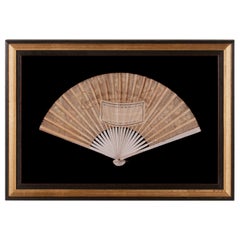
"Equal suffrage for Michigan in 1916" Advertising Fan for the Bissell Company
Located in York County, PA
"EQUAL SUFFRAGE FOR MICHIGAN IN 1916," ADVERTISING FAN FOR THE BISSELL 'CYCO BALL BEARING CARPET SWEEPER,' COMMISSIONED BY ANNA BISSELL (1846-1934), AMERICA'S FIRST FEMALE CEO
Oriental-made, twill-woven silk fan with gilt lettering that reads : "Bissell's 'Cyco Ball Bearing Carpet Sweeper' makes sweeping easy," set within an interesting, open, geometric design. A purposefully curved, paper label beneath was applied by the "Michigan Equal Suffrage Association, Kalamazoo, 405 So. Burdick St.," whose byline is along the bottom. On it, a terrific message reads:
"OVER 100,000 WOMEN pay taxes in Michigan on property assessed at $177,596,938. In 1910 OVER 175,000 MICHIGAN WOMEN signed a petition sent to Congress asking for Equal Suffrage. 247,373 MICHIGAN MEN voted...
Category
Vintage 1910s American Political and Patriotic Memorabilia
Materials
Silk
$3,250
H 16.75 in W 21 in D 3 in
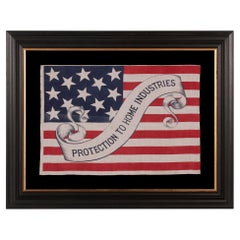
13 Star American Parade Flag with Rare Design, circa 1888 Ex Richard Pierce
Located in York County, PA
13 Star American parade flag in an extremely rare design, with “protection to home industries” slogan on a fanciful, scrolling streamer, made for the 1888 presidential campaign of Benjamin Harrison; formerly in the collection of Richard pierce.
1888 Benjamin Harrison campaign flag, printed on cotton, with 13 large stars in a 3-2-3-2-3 pattern, upon which a whimsical, scrolling streamer is superimposed that features the slogan: “Protection to Home Industries.”
There are numerous styles of both documented and undocumented, red, white, and blue bandanas and handkerchiefs, made for Harrison’s campaign in this year, as well as from the subsequent one, in 1892. Most bear variations of text to support the “Protection for American Industries” platform of the Republican Party. America was in the midst of the industrial age and there was a great deal of public interest, both in protecting growth and discouraging both imported goods and immigration. The constant stream of immigrants posed great challenges for a working families, competing for scarce jobs, in work environments that were already often far from ideal. In post-Civil War America, many of the working men were Civil War veterans.
Bandanas abound from Harrison’s Campaigns, but flags do not. This example, along with three others, were once part of an 1888 patriotic quilt that was disassembled by a dealer and sold piecemeal to collectors. I eventually acquired all four. Fifteen to twenty years ago, these were the only four known copies. A couple of others have since surfaced, but the total count known still stands closer to 5 than 10.
The use of 13 stars is seen in the flags of various candidates in the 19th century. Among these are Abraham Lincoln (1860 campaign), Henry Clay (1844 campaign), John Fremont (1856), and Benjamin Harrison’s grandfather, William Henry Harrison...
Category
Antique 1880s American Political and Patriotic Memorabilia
Materials
Cotton
Price Upon Request
H 28 in W 35.5 in D 2.5 in
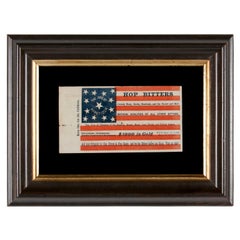
13 Star Rare Parade Flag, Advertising Hop Bitters, circa 1876
Located in York County, PA
13 STARS IN AN UNUSUAL PATTERN ON A RARE PAPER PARADE FLAG WITH ADVERTISING HOP BITTERS, PROBABLY DISTRIBUTED FOR THE 1876 CENTENNIAL; EXHIBITED AT THE MUSEUM OF THE AMERICAN REVOLUT...
Category
Antique 1870s American Political and Patriotic Memorabilia
Materials
Paper
Price Upon Request
H 14.5 in W 11 in D 2 in
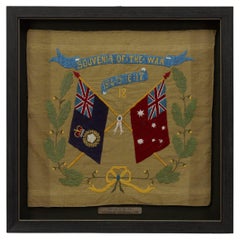
Souvenir of the War 1914-15-16-17-18 Banner
Located in Colorado Springs, CO
Presented is a stunning textile banner from the first World War, dating to 1918. The square tan cotton cloth is embroidered with two crossed flags, the ...
Category
Vintage 1910s Australian Political and Patriotic Memorabilia
Materials
Cotton
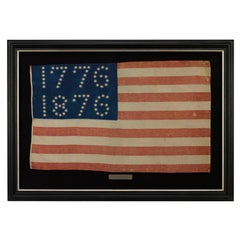
Centennial Celebration "1776-1876" American Flag Banner
Located in Colorado Springs, CO
Presented is a rare Centennial patriotic flag banner, dating to 1876. The flag’s brilliant blue canton is spectacular, with 81 five-pointed, rayed stars, arranged to read “1776” and “1876.” The flag’s design is completed with thirteen alternating red and white stripes. The flag is a three-piece, treadle-sewn sewn construction, printed on a thin wool and cotton blend. Along the edge, there is a narrow, treadle-sewn sleeve made of cotton tape.
In the lead up to the nation’s Centennial in 1876, flag makers and individuals looked to the past for designs to produce as part of the country’s many celebrations. Popular interpretation of the stars and stripes undoubtedly reached its climax of variety and originality at the time of our Nation’s first Centennial. Since no design restrictions were placed on flagmaker’s imaginations and no strict distinctions were drawn between official and unofficial star counts, it is no surprise that, on the occasion of the Centennial, creativity in flag design was not the exception, but the rule.
The cantons from this period presented an array of geometric abstractions. Great star patterns, referred to as the “starry flower of Liberty” by Oliver Wendell Holmes, that were popular from 1818 and on, resurfaced in Centennial flags...
Category
Antique 1870s American Political and Patriotic Memorabilia
Materials
Wool, Cotton
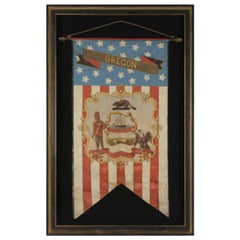
Hand-Painted Patriotic Banner with the Seal of the State of Oregon
Located in York County, PA
HAND-PAINTED PATRIOTIC BANNER WITH THE SEAL OF THE STATE OF OREGON AND GREAT FOLK QUALITIES, 1861-1876:
Swallowtail format, patriotic vertical banne...
Category
Antique Late 19th Century American Political and Patriotic Memorabilia
Materials
Canvas
Price Upon Request
H 78.75 in W 50.25 in D 4 in
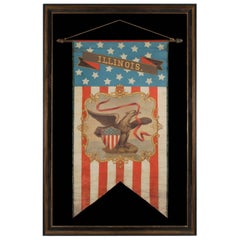
Hand-Painted Patriotic Banner With The Seal of the State of Illinois
Located in York County, PA
HAND-PAINTED PATRIOTIC BANNER WITH THE SEAL OF THE STATE OF ILLINOIS AND GREAT FOLK QUALITIES PROBABLY MADE FOR THE 1868 DEMOCRAT NATIONAL CONVENTION...
Category
Antique 1860s North American Political and Patriotic Memorabilia
Materials
Canvas
Price Upon Request
H 65 in W 34 in D 1 in
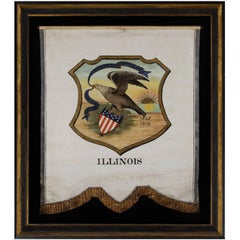
Hand-Painted 19th Century Banner with the 1867 Proposed Seal of Illinois
Located in York County, PA
HAND-PAINTED 19TH CENTURY BANNER WITH AN 1867 VERSION OF THE SEAL OF THE STATE OF ILLINOIS, PROPOSED IN THAT YEAR BY THE SECRETARY OF STATE, BUT IN A VARIATION NEVER FORMALLY ADOPTED
Banner with the Illinois State Seal, in a rare variation of the design, never adopted. In 1867 Illinois Secretary of State Sharon Tyndale proposed that the phrases in the state motto be reversed. In the wake of the Civil War, (which ended in 1865,) Tyndale suggested that the verbiage be changed from "State Sovereignty--National Union" to "National Union--State Sovereignty,” which made sense given the recent secession of the Southern States, which placed their own interests first. Illinois' own Abraham Lincoln had worked hard to preserve national interests, echoed here in the altering of the language. Though Tyndale’s suggestion was rejected, he was nonetheless charged with creating a new design, which he did and was soon adopted. This displayed the dates of "1818," when Illinois became a state, and "1868," when the seal was officially changed. Interestingly enough, Tyndale did manage to send a message in the new version by turning the word “sovereignty” upside-down , with the surmised explanation that this fit accordingly with the orientation / position of the streamer.
The banner is beautifully hand-painted on muslin and retains its original staff. The shape is beautifully scalloped at the bottom edge, which is painted to look as if there is an applied fringe. Most of the elements are congruent with the 1868 version, but there are various differences. Set within a shield-shaped medallion—usually circular—is the expected eagle in a side view, spread wing pose with beak uplifted. The eagle is supposed to be perched upon a rock with one talon, while gripping a Federal shield in the other. Here there is no rock and both talons grip the shield, which displays 13 stars. Note the date of "1867" and Tyndale's preferred order of the wording on the billowing ribbon in the eagle's beak. The foreground of the official design is all grass. Here there are olive branches—a peacetime reference appropriate for a country recovering from war—on a grassy area, set upon a sandy shore before Lake Michigan, with a rising sun on the horizon.
Mounting: The banner was mounted and framed within our own conservation department, which is led by masters degree trained staff. We take great care in the mounting and presentation of flags and have preserved thousands of examples; more than anyone worldwide.
The background is 100% cotton twill, black in color. The mount was placed in a black-painted, hand-gilded and distressed Italian molding. A shadowbox was created to accommodate the staff. The glazing is U.V. protective plexiglass. Feel free to contact us for more details.
Banner - 49" x 56.5"
Frame - 67.75" x 59.25"
About Jeff R. Bridgman Antiques, Inc.:
As an advisor to top museums and collectors alike, Jeff Bridgman is the world's leading expert and source for antique American flags and political textiles...
Category
Antique 1860s American Political and Patriotic Memorabilia
Materials
Cotton
Price Upon Request
H 67.75 in W 59.25 in D 3.5 in
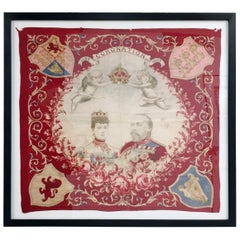
King Edward VII Coronation, June 1902 Framed Red Flag
Located in Hastings, GB
King Edward VII coronation, June 1902 framed scarf / flag.
This scarf is an original antique piece of British history and patriotic memorabilia.
...
Category
Antique Early 1900s British Edwardian Political and Patriotic Memorabilia
Materials
Cotton
Ohio State Parade Flag with a Civil War Veterans Overprint
Located in York County, PA
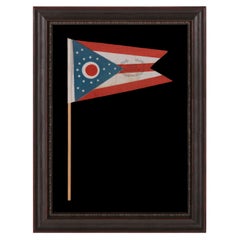
OHIO STATE FLAG WITH CIVIL WAR VETERANS' OVERPRINT FROM THE GRAND ARMY OF THE REPUBLIC POST IN COLUMBUS, MADE IN MOURNING OF THE 1925 PASSING OF NATIONAL G.A.R. COMMANDER IN CHIEF DANIEL M. HALL, WHO ALSO SERVED AS COMMANDER OF THE OHIO DEPARTMENT OF THE G.A.R., AS WELL AS THE LOCAL CHAPTER
Flag of the State of Ohio, printed on oilcloth-like cotton, affixed to its original wooden staff. Made for Civil War veteran's use, the flag bears a stamped overprint in the striped field that consists of an open wreath of laurel branches, inside which is the following text: “GAR [Grand Army of the Republic] Post, Dan Hall, Columbus, OH”.
Born on October 20th, 1842, Daniel M. Hall enlisted with the Union Army as a Private at the age of 18 on August 25th, 1861. On October 8th of that year he mustered into the Co. H of the 2nd Ohio Cavalry. Discharged for disability on June 28th, 1862, he reenlisted approximately 17 months later, on November 11th, 1863, and mustered into Co. F of the 12th Ohio Cavalry at Camp Cleveland. He was at some point promoted to the rank of Sergeant, and, on February 21st, 1864, to the rank of Corporal. He mustered out at Nashville on November 14th, 1865.
Hall mustered into the Hamlin Post of the Ohio G.A.R. on May 23rd, 1883. He would go on to serve not only as Commander of the Dept. of Ohio for the organization, but as National Commander of the entire Grand Army of the Republic.
The Grand Army of the Republic was the primary veterans association for Union Civil War soldiers. Founded in 1866, its members dressed up in Civil War uniforms, attended parades and reunions, and the organization was somewhat more fraternal in nature than today’s VFW or American Foreign Legion.
Flags overprinted for the purpose of advertising are a specialized form in American flag collecting. A flag with a basic G.A.R. overprint is the most common type. This might be accompanied by a post number and a date. More elaborate the overprints are more highly desired, such as this one, which is the only variation I know of that honors a particular person who was not the namesake of the chapter itself.
It is of interest to note that a sister variety of 48 star parade flag is known, printed on the same fabric, that bears the same overprint, accompanied by the words: “We Mourn Our Comrade." From the additional text on the 48 star variety, one can extrapolate that the flags were made to mourn the passing of this important leader of Civil War veterans on October 19th, 1925, just one day before his 83rd birthday.
The State Flag of Ohio was designed in 1901 by Cleveland architect John Eisenmann, who designed the Ohio building for the state's exhibition at the Pan American Exposition World's Fair in Buffalo, New York. It was officially adopted by the Ohio legislature on May 19th, 1902. It's elements are centered on a red disc, set against a circular white ground that forms a letter "O." This simultaneously represents a buckeye, the fruit of the state tree and an iconic Ohio symbol. The flag's 5 stripes are said to represent the state's waterways and roads, while the triangular shape of the union is said to illustrate hills and valleys. The presentation of 13 stars along the hoist end, arranged in a semi-circular medallion with two off-set stars above and below, reflects the original 13 colonies. The diamond of stars, towards the fly end. bring the overall count to 17 to reflect Ohio's admission. When the design was adopted by the state legislature, the position of these stars was changed slightly, moving them further around the circle to form a wreath.
Flag expert Whitney Smith, who coined the term Vexillology in the late 1950's (the accepted term for the study of flags), pointed out that the format of the flag itself was reminiscent of Civil War cavalry guidons, carried by Ohio regiments throughout the state. These were of swallowtail form, though with 13 stripes, all horizontal and 90 degrees to the hoist. Most often these had circular star patterns around an open center, which makes them even more similar to the Ohio flag...
Category
Vintage 1920s American Political and Patriotic Memorabilia
Materials
Cotton
Still Thinking About These?
All Recently ViewedMore Ways To Browse
Vintage Texas Flag
Vintage Defiance Flag
Vintage 50 Star Flag
Vintage Asafo Flags
Embroidered Flag Antique
Tar Bucket
50 American Flag
50 Star Flag
Black Americana Memorabilia
California State Flag
20 Star Flag
21 Star American Flag
40 Star American Flag
Temperance Sign
35 Star American Flag
31 Star Flag
Roosevelt Posters
Marine Corps Flag