Want more images or videos?
Request additional images or videos from the seller
1 of 6
Spectacular 38 Star Flag With A Very Rare Star Variation
About the Item
38 star American national flag, made following the addition of Colorado in 1876, with its stars arranged in an especially graphic rendition of what is known as the "Great Star" pattern. This consists of a large star in the very center, with a series of smaller stars around it, arranged in such a fashion that together they form the profile of a much larger star.
This rare variation of the Great Star has a star between each arm, where most do not. In fact, note that there are actually 2 stars between the arms on the hoist end. The basic pattern--with 1 star between each arm as opposed to 2--very clearly mimics printed parade flags of the 1850-60 era, which look distinctly like this 38-star example, but with fewer stars. The presentation is not unlike exploding fireworks and is particularly striking.
Among collectors, the Great Star is the most coveted of all geometric designs. It probably came about shortly after the War of 1812, when Congressman Peter Wendover, of New York, requested that Captain Samuel Reid, a War of 1812 naval hero, sought to create a new design that would become the third official format of the Stars Stripes. A recipient of the Congressional Medal of Honor, Reid became harbor master of New York following the war. During his lifetime, he created many innovations in signal use, including a system that could actually send messages from New York to New Orleans by sea in just two hours.
Use as a Naval signal had been the primary reason for the initial creation of an American national flag in the first place, in 1777, but since there was no official star design, the appearance of our flag varied greatly. So Reid and Wendover’s primary concern centered on both consistency and ease of recognition. Their hope was as more and more states joined the Union and more and more stars were added to the flag, that it would remain easily identified on the open seas. So in 1818, Reid suggested to Congress that the number of stripes permanently return to 13 (reduced from 15) and that the stars be grouped into the shape of one large star.
Reid’s proposal would have kept the star constellation in roughly the same format, in a pattern that could be quickly identified through a spyglass as the number of states grew. His concept for the stripes was ultimately accepted, but his advice on the star pattern was rejected by President James Monroe, due to the increased cost of arranging the stars in what would become known as the “Great Star”, “Great Flower”, or “Great Luminary” pattern. Monroe probably didn’t wish to impose this cost on either the government or civilians, so he suggested a simple pattern of justified rows. Never-the-less, the Great Star was produced by anyone willing to make it and its rarity today, along with its beauty, has driven the desirability of American flags with this configuration.
In summary, this is one of the most graphic great star flags that I have ever seen, which places it among the very best examples of the period.
Great Star designs take on many forms. In this particular example, note that there is a star between each arm of the large star and that there is a triangle of three stars in the very center.
The 38th state, Colorado, joined the Union on August 1st, 1876. This was the year of our nation’s centennial of independence from Great Britain. Although 37 was the official star count in 1876, flag-making was a competitive venture and no one wanted to be making 37 star flags when others were making 38’s. It is for this reason that 38 and 13 (to reference the original 13 colonies) are the two star counts most often seen during the centennial events.
The 38 star flag was generally used until 1889, when four new states joined the Union. Decorative star patterns, however, like this one, tend to be seen on 38 star flags that were made specifically for 1876 events, such as the Centennial International Exposition in Philadelphia, a six-month long, World’s Fair event, held in conjunction with the nation’s anniversary.
Construction: The stars of the flag are made of cotton, hand-sewn, and double-appliquéd. This means that they were applied to both sides of the canton. The stripes were joined with treadle stitching. There is a cotton sleeve with 2 brass grommets.
Mounting: The flag has been hand-sewn to 100% natural fabric for support on every seam and throughout the star field. Fabric of similar coloration was used for masking purposes. The flag was then hand-stitched to 100% cotton twill, black in color, which was washed to reduce excess dye. An acid-free agent was added to the wash to further set the dye and the fabric was heat-treated for the same purpose. The glazing is U.V. protective acrylic.
Condition: The binding along the hoist is not original to the flag. It is a blue and white, ticking stripe, herringbone weave cotton tape, period to the flag's construction, used to complete the unfinished edge. There is minor foxing and staining throughout, accompanied by minor fading.
- Place of Origin:
- Period:
- Date of Manufacture:1876-1889
- Condition:See Item Description.
- Seller Location:York County, PA
- Reference Number:Seller: 38j-9591stDibs: U1109198497456
About the Seller
5.0
Recognized Seller
These prestigious sellers are industry leaders and represent the highest echelon for item quality and design.
Established in 1991
1stDibs seller since 2008
71 sales on 1stDibs
Typical response time: Several days
Authenticity Guarantee
In the unlikely event there’s an issue with an item’s authenticity, contact us within 1 year for a full refund. DetailsMoney-Back Guarantee
If your item is not as described, is damaged in transit, or does not arrive, contact us within 7 days for a full refund. Details24-Hour Cancellation
You have a 24-hour grace period in which to reconsider your purchase, with no questions asked.Vetted Professional Sellers
Our world-class sellers must adhere to strict standards for service and quality, maintaining the integrity of our listings.Price-Match Guarantee
If you find that a seller listed the same item for a lower price elsewhere, we’ll match it.Trusted Global Delivery
Our best-in-class carrier network provides specialized shipping options worldwide, including custom delivery.You May Also Like
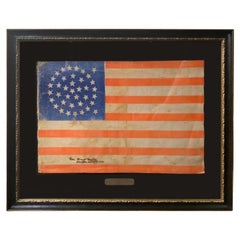
38-Star American Parade Flag, Flown at a Reception for President Grant, 1880
Located in Colorado Springs, CO
This is a beautifully colored 38-star American parade flag, flown at a public reception for Ulysses S. Grant in October of 1880. This printed flag features a rare, triple medallion s...
Category
Antique 1880s American Political and Patriotic Memorabilia
Materials
Cotton
$15,500
H 19.5 in W 24 in D 1.25 in
Large 48 Star Embroidered Flag Pillow
By American Flag
Banner Co.
Located in Los Angeles, CA
This monumental 48 star flag pillow is in great in great condition and has a red cotton linen pillow. The big pillow id down and feather fill.
Category
Mid-20th Century American Country Political and Patriotic Memorabilia
Materials
Cotton
13-Star Wool American Flag, with Zig-Zag Stars, Circa 1900
Located in Colorado Springs, CO
This is a beautiful 13-star American flag, each star sewn with zig-zag stitching. The wool flag was sewn at the turn of the century, circa 1900. The flag features 13 white stars rest...
Category
Antique Early 1900s American American Classical Political and Patriotic ...
Materials
Brass
13-Star Flag Waver for the Centennial Celebration
Located in Colorado Springs, CO
This small charming 13-star flag waver was made for and sold during the nation’s Centennial celebration in Philadelphia in 1876. All manner of flags were made for the official Centen...
Category
Antique 1870s American American Classical Political and Patriotic Memora...
Materials
Fabric
Early 20thc 48 Star Flag Hand Crochet Pillow
Located in Los Angeles, CA
This fine hand crochet 48 star flag pillow is made with a blue velvet background or frame front and back.The insert is down & feather fill.
Category
Early 20th Century American Adirondack Pillows and Throws
Materials
Wool
42-Star American Parade Flag, Commemorating Washington Statehood, 1889
Located in Colorado Springs, CO
This is an uncommon 42-star flag, commemorating the addition of the state of Washington to the Union. The flag dates to 1889-1890, and is printed on cotton. The canton consists of s...
Category
Antique 1880s American Political and Patriotic Memorabilia
Materials
Cotton
$5,850
H 28.38 in W 32.88 in D 2 in
36-Star American Printed Parade Flag, Circa 1865-1867
Located in Colorado Springs, CO
This is an antique 36-star American flag, as striking as it is scarce. The flag has a glazed cotton construction, with a blue canton printed with 36 white stars. The stars are arrang...
Category
Antique 1860s American Political and Patriotic Memorabilia
Materials
Cotton
19th Century American 42 Star Flag, circa 1889
Located in Nantucket, MA
19th Century American 42 Star Flag, circa 1889, printed on linen period flag in the "Dancing Star" pattern. This was never an official U.S. flag sanctioned b y congress, but was made...
Category
Antique 1880s American Federal Political and Patriotic Memorabilia
Materials
Linen
Antique Federal Eagle American 50 Star Flag with Brass Eagle Pole, 19th Century
Located in Oklahoma City, OK
Monumental 50 star American Flag with antique Federal Eagle brass and wood pole. A patriotic piece suitable for any home. This set includes both ...
Category
Antique 19th Century American Federal Political and Patriotic Memorabilia
Materials
Brass, Bronze
$4,500 Sale Price
25% Off
H 66 in W 69 in D 1.25 in
13-Star Bennington "76" Parade Flag, Early 20th Century
Located in Colorado Springs, CO
Presented here is a striking 20th century 13-star Bennington “76” style parade flag, modeled after the historic example preserved at the Bennington Museum in Vermont. This commemorat...
Category
Early 20th Century American American Colonial Political and Patriotic Me...
Materials
Fabric
More From This Seller
View All38 Star American Parade Flags with Stars in a Great Star Pattern
Located in York County, PA
38 STAR AMERICAN PARADE FLAG WITH A RARE AND BEAUTIFUL VARIATION OF THE “GREAT STAR” OR “GREAT FLOWER” PATTERN, 4 LARGE CORNER STARS, & AN ODD OUTLIER, 1876-1889, COLORADO STATEHOOD,...
Category
Antique Late 19th Century American Political and Patriotic Memorabilia
Materials
Silk
Price Upon Request
38 Star Parade Flag with Whimsical 6-Pointed Stars, Colorado Statehood
Located in York County, PA
38 WHIMSICAL STARS, WITH 6-POINTED PROFILES, SIMILAR TO THE STAR OF DAVID, ON AN ANTIQUE AMERICAN FLAG OF THE CENTENNIAL ERA; A REMARKABLE SPECIMEN, ONE-OF-A-KIND AMONG KNOWN EXAMPLE...
Category
Antique Late 19th Century American Political and Patriotic Memorabilia
Materials
Cotton
Price Upon Request
38 Star Antique American Flag, Colorado Statehood, circa 1876-1889
Located in York County, PA
38 star antique American parade flag with scattered star orientation, made of silk, with generous scale and vivid colors, Colorado Statehood, 1876-1889
38 star American national p...
Category
Antique Late 19th Century American Political and Patriotic Memorabilia
Materials
Silk
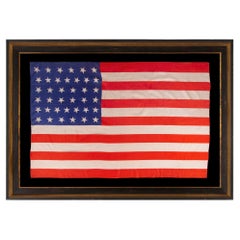
Price Upon Request
13 Star American Parade Flag with Rare Design, circa 1888 Ex Richard Pierce
Located in York County, PA
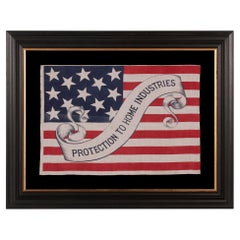
13 Star American parade flag in an extremely rare design, with “protection to home industries” slogan on a fanciful, scrolling streamer, made for the 1888 presidential campaign of Benjamin Harrison; formerly in the collection of Richard pierce.
1888 Benjamin Harrison campaign flag, printed on cotton, with 13 large stars in a 3-2-3-2-3 pattern, upon which a whimsical, scrolling streamer is superimposed that features the slogan: “Protection to Home Industries.”
There are numerous styles of both documented and undocumented, red, white, and blue bandanas and handkerchiefs, made for Harrison’s campaign in this year, as well as from the subsequent one, in 1892. Most bear variations of text to support the “Protection for American Industries” platform of the Republican Party. America was in the midst of the industrial age and there was a great deal of public interest, both in protecting growth and discouraging both imported goods and immigration. The constant stream of immigrants posed great challenges for a working families, competing for scarce jobs, in work environments that were already often far from ideal. In post-Civil War America, many of the working men were Civil War veterans.
Bandanas abound from Harrison’s Campaigns, but flags do not. This example, along with three others, were once part of an 1888 patriotic quilt that was disassembled by a dealer and sold piecemeal to collectors. I eventually acquired all four. Fifteen to twenty years ago, these were the only four known copies. A couple of others have since surfaced, but the total count known still stands closer to 5 than 10.
The use of 13 stars is seen in the flags of various candidates in the 19th century. Among these are Abraham Lincoln (1860 campaign), Henry Clay (1844 campaign), John Fremont (1856), and Benjamin Harrison’s grandfather, William Henry Harrison...
Category
Antique 1880s American Political and Patriotic Memorabilia
Materials
Cotton
13 Star Rare Parade Flag, Advertising Hop Bitters, circa 1876
Located in York County, PA
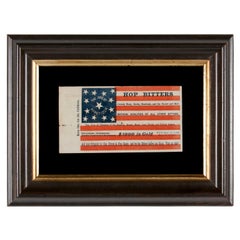
13 STARS IN AN UNUSUAL PATTERN ON A RARE PAPER PARADE FLAG WITH ADVERTISING HOP BITTERS, PROBABLY DISTRIBUTED FOR THE 1876 CENTENNIAL; EXHIBITED AT THE MUSEUM OF THE AMERICAN REVOLUT...
Category
Antique 1870s American Political and Patriotic Memorabilia
Materials
Paper
Price Upon Request
38 Star Antique American Parade Flag, Colorado Statehood, ca 1876-1889
Located in York County, PA
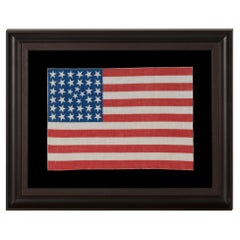
38 STARS IN AN EXTREMELY UNUSUAL CONFIGURATION THAT BEARS A CLUSTER OF 6 SMALL STARS WITHIN A LINEAL PATTERN OF LARGER STARS, 1876-1889, COLORADO STATEHOOD
38 star American national parade flag, printed on cotton. This is an extremely rare example of a lineal pattern flag with a wreath or cluster of smaller stars inserted in the center. A very small number of flags in this style are known to have survived, the colors of which are typically saturated and vibrant, like this example, in scarlet red and rich, royal blue.
The particular wreath in the center of the configuration is really more of a pentagon with a single, center star. The reason for the choice of the design and 6 smaller stars seems a curious one on the surface, but its purpose was probably nothing more than to simply augment a 36 star print block to one with 38 stars. One may observe how 4 stars, that would have comprised the center of a 6 x 6 pattern, could have simply been removed and 6 smaller stars inserted in their place, in an artful fashion.
At least two other similar 38-star patterns are known that incorporate 4 small stars intermingled between rows of what most certainly were two very similar 34-star flag print blocks originally. It was easier to modify these blocks rather than create brand new ones. In these particular instances, the results are rare, quirky configurations that are highly prized by collectors.
Colorado became the 38th state on August 1st, 1876. This was the year of our nation’s 100-year anniversary of independence. Per the Third Flag Act of 1818, stars were not officially added until the 4th of July following a state's addition. For this reason, 37 was the official star count for the American flag in 1876. Flag-making was a competitive venture, however, and few flag-makers would have been continuing to produce 37 star flags when their competitors were making 38’s. It is for this reason that 38 and 13 stars (to represent the original 13 colonies) are more often seen at the Centennial International Exposition, the six-month long World’s Fair held in Philadelphia in honor of the event. Some flag-makers would have been adding a star for the 38th state even before it entered the Union, in the early part of 1876 or even prior. In fact, many makers of parade flags were actually producing 39 star flags, in hopeful anticipation of the addition of two more Western Territories instead of one. But the 39th state would not join the Union for another 13 years, when the Dakota Territory entered as two states on the same day. The 38 star flag became official on July 4th, 1877 and was generally used until the addition of the Dakotas in 1889.
Provenance: Jeff R. Bridgman Antiques to the late collector Jim Ring...
Category
Antique Late 19th Century American Political and Patriotic Memorabilia
Materials
Cotton
Price Upon Request