Items Similar to Teddy Roosevelt Silk Kerchief Made for His 1912 Presidential Run
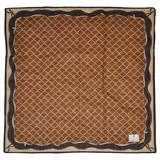
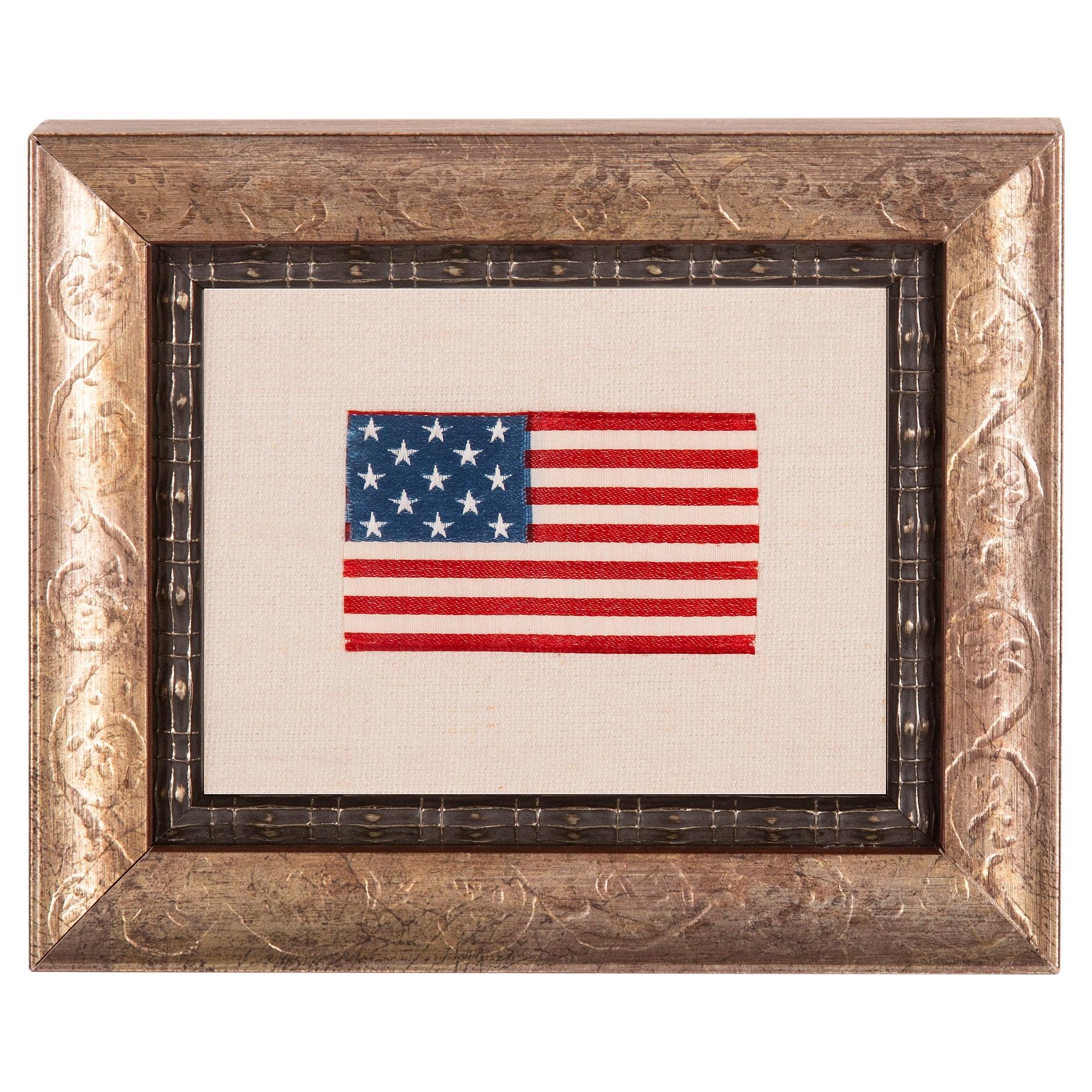
Want more images or videos?
Request additional images or videos from the seller
1 of 5
Teddy Roosevelt Silk Kerchief Made for His 1912 Presidential Run
Price Upon Request
Price Upon Request
Price Upon Request
Price Upon Request
Price Upon Request
Price Upon Request
Price Upon Request
Price Upon Request
Price Upon Request
Price Upon Request
About the Item
SILK CAMPAIGN KERCHIEF FEATURING A PROMINENT BULL MOOSE, MADE FOR THE 1912 PRESIDENTIAL RUN OF TEDDY ROOSEVELT, WHEN HE RAN ON THE NATIONAL PROGRESSIVE PARTY TICKET
Printed silk kerchief, made for the 1912 presidential campaign of Theodore Roosevelt when he ran on the Progressive Party ticket. In this scarce example, the typical geometric design of a western bandanna is made personal to Roosevelt by the inclusion of a large center medallion with the image of a bull moose. This is flanked by smaller medallions in each corner containing both bull moose and illustrations of his famous Rough Riders slouch hat.
Roosevelt nicknamed his the “Bull Moose Party” in comic yet serious notation to his bull-headed nature. This manner of choosing a mascot fell in line with the Republican and Democrat selections of the Elephant and Donkey. The presence of such a large moose makes this unlike other examples, none of which feature the mascot as prominently and many of which don’t feature it at all. Before 1912, no party mascots were illustrated on campaign textiles, so this is among the very first to do so.
Roosevelt had declined to run in 1908, following a long-standing tradition that Presidents were expected to leave office after two terms. He appointed his friend, William Howard Taft, as his successor, who won and served the next four years. During his forthcoming administration, a rift grew between Taft and Roosevelt, who each became leaders of the Republican Party's two ever-spreading wings. The progressives opposed the court system, favored restrictions on women's employment, favored conservation, were more favorable toward labor unions, and opposed tariffs. The conservatives were pro-business and insisted on judicial supremacy. Taft became identified with the conservative wing, while Roosevelt was the leader of the progressive wing.
By 1910 the split was deep. Roosevelt ran for nomination on the Republican ticket but lost to Taft, so in true T.R. fashion, he waved off defeat and set out on his own. Despite rather serious opposition from his many Republican friends, he jumped into the ring with no apparent reason to believe that he might actually lose. In the forthcoming election he did beat Taft, gaining 88 electoral votes versus Taft’s almost non-existent count of 8. In doing so he became the only man in history to place second on an independent ticket. He was slaughtered by Wilson, however, who received 435 votes in the Electoral College and served two terms in the nation’s highest office. A disgruntled Roosevelt retreated to what he loved best, risk and adventure. He traveled to the Amazon jungle, where he ran an uncharted river and nearly perished.
An example of the kerchief resides in the collection of the Smithsonian and is documented in “Threads of History” by Collins, Smithsonian Press, 1979 (item 939, pg. 373). Collins served as the Smithsonian's curator of political history and his landmark text is considered the definitive reference on political flag and textile collecting.
Mounting: The kerchief has been hand-stitched to 100% cotton twill, black in color, that has been was washed to reduce excess dye. An acid-free agent was added to the wash to further set the dye and the fabric was heat-treated for the same purpose. The mount was then placed in a very high quality gilded French molding with a distinctive early American profile, to which a black rippled liner with gold highlights was added. The glazing is U.V. protective Plexiglas.
Condition: Excellent.
- Dimensions:Height: 20 in (50.8 cm)Width: 23.5 in (59.69 cm)Depth: 2 in (5.08 cm)
- Materials and Techniques:
- Place of Origin:
- Period:1910-1919
- Date of Manufacture:1912
- Condition:See Item Description.
- Seller Location:York County, PA
- Reference Number:Seller: ker-2481stDibs: LU849744942322
About the Seller
5.0
Recognized Seller
These prestigious sellers are industry leaders and represent the highest echelon for item quality and design.
Established in 1991
1stDibs seller since 2008
71 sales on 1stDibs
Typical response time: Several days
- ShippingRetrieving quote...Shipping from: York County, PA
- Return Policy
More From This Seller
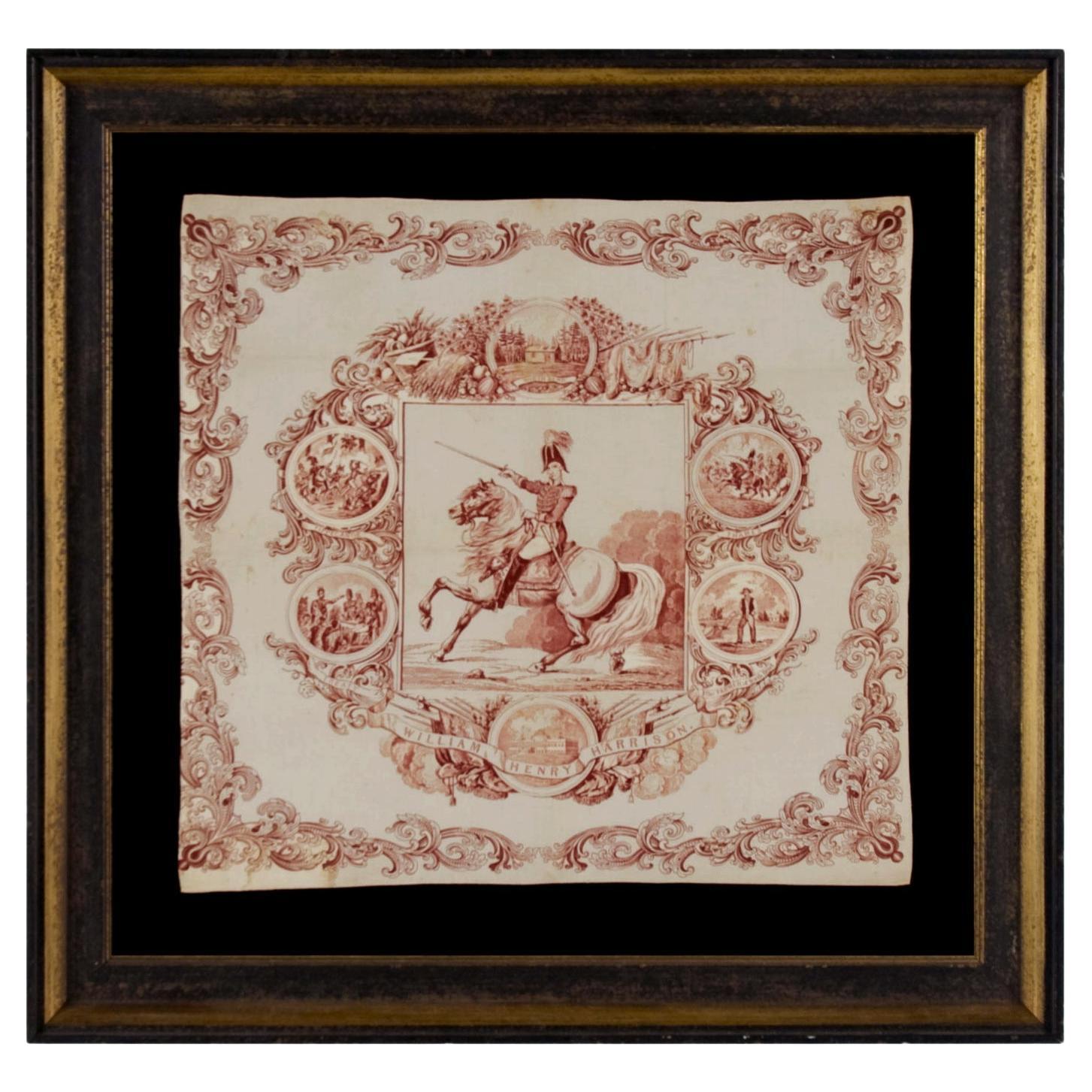
View All1840 Campaign Kerchief of William Henry Harrison on Horseback
Located in York County, PA
1840 campaign kerchief featuring an image of William Henry Harrison on horseback in military garb, one of the first known campaign textiles in e...
Category
Antique Mid-19th Century American Political and Patriotic Memorabilia
Materials
Cotton
Price Upon Request
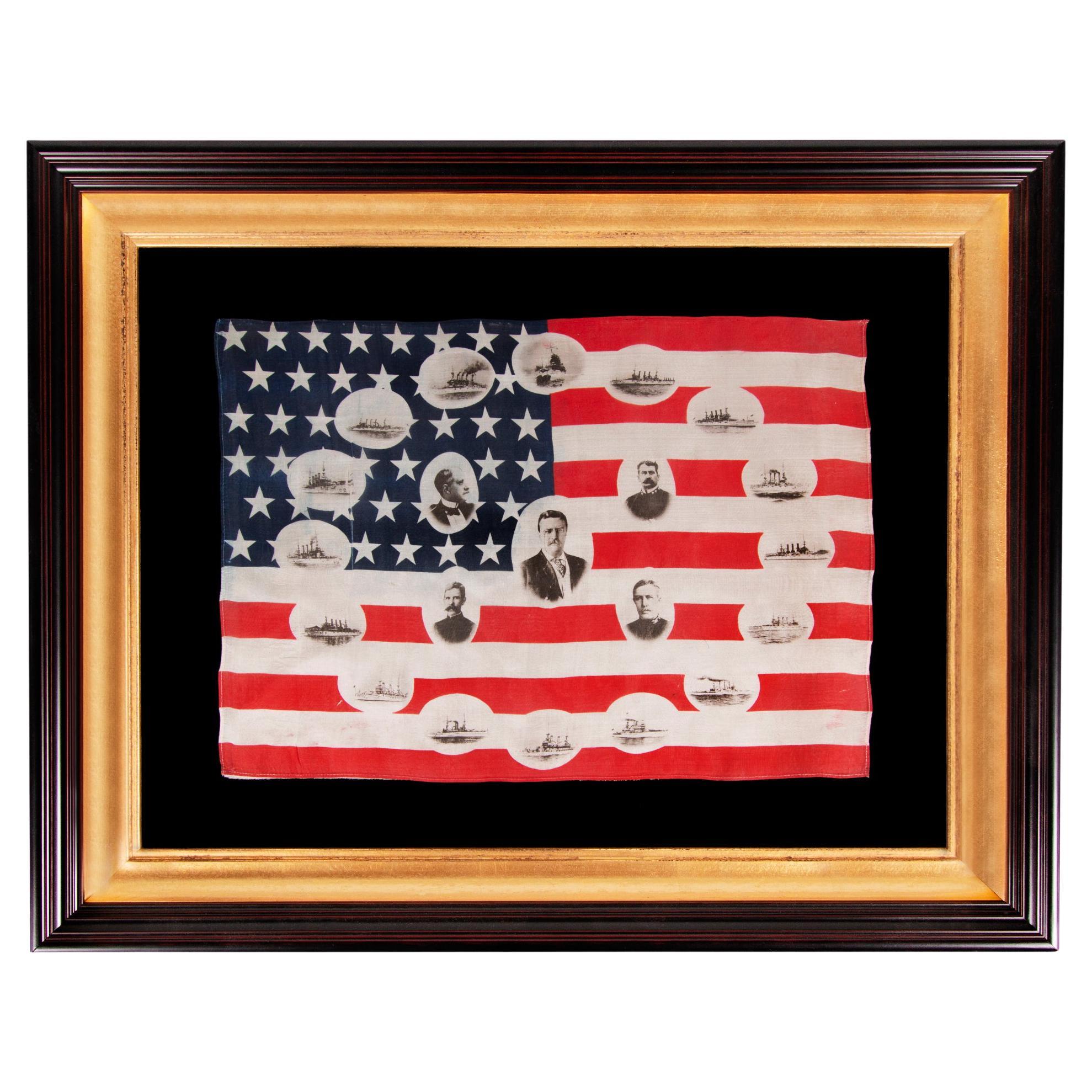
Teddy Roosevelt and His Great White Fleet American Flag, circa 1907-1909
Located in York County, PA
Rare & Beautiful American Parade Flag With Images Of Teddy Roosevelt And His Great White Fleet, 1907-1909, Ex-richard Pierce Collection:
46 star parade ...
Category
Antique Early 1900s American Political and Patriotic Memorabilia
Materials
Silk
Price Upon Request
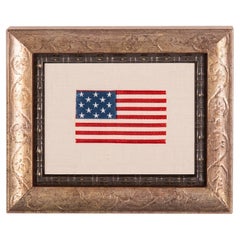
13 Star Woven Silk Ribbon, ca 1876-1910
Located in York County, PA
13 STAR RIBBON, WOVEN SILK, circa 1876-1910
13 star antique American flag ribbon, made of woven silk, of the type encountered in military, political, and fraternal badges and ribbon...
Category
Antique 1870s American Political and Patriotic Memorabilia
Materials
Silk
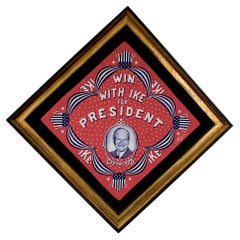
Eisenhower
s 1952 Portrait Style Presidential Campaign Kerchief
Located in York County, PA
PORTRAIT STYLE KERCHIEF FROM THE 1952 PRESIDENTIAL CAMPAIGN OF REPUBLICAN IKE EISENHOWER, FORMER SUPREME COMMANDER OF ALLIED FORCES IN EUROPE DURING WWII (NATO)
Printed cotton kerch...
Category
Vintage 1950s American Political and Patriotic Memorabilia
Materials
Cotton
1806 Printed Linen Kerchief Glorifying George Washington, Germantown, Penn
Located in York County, PA
EXTRAORDINARILY EARLY (1806) PRINTED LINEN KERCHIEF GLORIFYING GEORGE WASHINGTON, PRINT WORKS, GERMANTOWN, PENNSYLVANIA
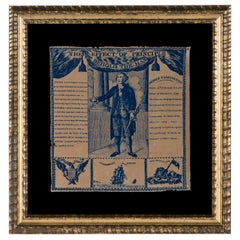
Printed in blue ink on coarse, white linen, this patriotic kerchief shows a standing portrait of George Washington, above which is a swag valance and the words “The Effect of Principle, Behold the Man”. The portrait is based on a mezzotint after Gilbert Stuart’s very famous painting of Washington in his later years, most often referred to as the Landsdowne portrait. Stuart painted three versions of it in oil on canvas, one of which was completed in 1796 for a wealthy merchant by the name of William Constable, who commissioned the work for Alexander Hamilton.
The kerchief is interesting because it is both American-made and documented. This is exceptionally unusual for any printed textile of the 19th century or prior and the earlier the time period the more unlikely an object is to be identified. This kerchief and a companion piece entitled “The Love of Truth Mark the Boy” (also glorifying Washington, through the fabled story of the cherry tree), were made circa 1806 by Germantown Print Works in Germantown, Pennsylvania.
To the left of Washington's image is a portion of his infamous farewell address to his troops at the end of the Revolutionary War. To the right is a short excerpt from his eulogy. Below these are three images. In the center is a square-rigged tall ship with “Commercial Union” above it, flanked by the American eagle on the left and the British lion on the right. It is reasonable to assume that the textile may have been produced in demonstration of the maker's desire, and/or that of others, to advance trade with England. Commercial printers were very influential in early America, as they possessed the means by which to disseminate information.
This kerchief and its companion piece are documented in Threads of History, Americana Recorded on Cloth, 1775 - the Present, by Herbert Ridgeway Collins (1979, Smithsonian Press), p. 63, items 38
39.* The two pieces pictured are in the collection of Cornell University, but the Collins text also cites an uncut pair to be present in the collection of the Western Reserve Historical Society, Cleveland, OH. The name "Germantown Print Works" is printed on the Western Reserve examples. Another example of the textile in question is documented in "Running for President, The Candidates and Their Images, 1789-1896" by Schlesinger, Israel, and Frendt, (1994, Simon
Schuster), p. 15.
I have seen three different color variations of this textile, including sepia, mulberry red, and blue. This particular example has a hand-sewn binding along the top, lower, and left edges.
Mounting: The textile was mounted and framed within our own conservation department, which is led by expert staff. We take great care in the mounting and preservation of flags and have framed thousands of examples.
The gilded molding has a rippled profile and dates to the period between 1825 and 1850.The background is 100% cotton twill, black in color. The glazing is U.V. protective plexiglass. Feel free to contact us for more details.
Condition: There is an all-over golden oxidation of the white fabric and there is very minor staining. There are tiny tack holes in each corner and there are minor nicks around the perimeter.
* Collins relates that Germantown Printworks was operated by the Hewsons. In doing so he cites one of Worthington Chauncey Ford's books on George Washington, but it isn't clear which one (there are many) and no page numbers are given. John Hewson was an Englishman who came to America and opened his printing business on the advice of Benjamin Franklin. He was one of the first “calico printers” and is the earliest documented to have advertised printed kerchiefs. His ads for bandanas appear as early as June 20th, 1774. He is suspected of having produced the very first American kerchief that pictured an American president, which is documented in Collins as item 1 on page 48. Linda Eaton, curator at Winterthur, in 2012, is currently doing in depth research on the three printers of fabrics that were operating in Germantown in early America. She discovered that the owner and/or operator of Germantown Print Works, while not currently known, was not John Hewson. This information is not yet published. She also noted that Winterthur possessed examples of the two George Washington textiles...
Category
Antique Early 1800s American Political and Patriotic Memorabilia
Materials
Cotton
Commission Pennant with 13 Stars, like for Private Vessel, Ca 1892-1910
Located in York County, PA
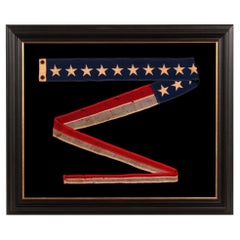
Commission pennants are the distinguishing mark of a commissioned U.S. Navy ship. Flown at the topmast, the typical American format is a long blue field, usually with a single row of white stars, although sometimes with their total divided into two rows, followed by two long stripes, red-over-white. A ship became commissioned when this pennant was hoisted. Flown during both times of peace and war, the only time the pennant is not flown is if a flag officer or civilian official was aboard and replaced it with their own flag.
Sometimes the owners of private ships mimicked the use of Navy signals. Some seafaring men would have served in the Navy and become privy to various practices in that capacity. Others flew them purely for stylistic reasons, either on a regular basis or while the boat was dressed for special occasion. Hudson River steamers regularly flew pennants of this nature, as evidenced by period photography as well as the paintings of artists such as John and James Bard...
Category
Antique Late 19th Century American Political and Patriotic Memorabilia
Materials
Wool
Price Upon Request
You May Also Like
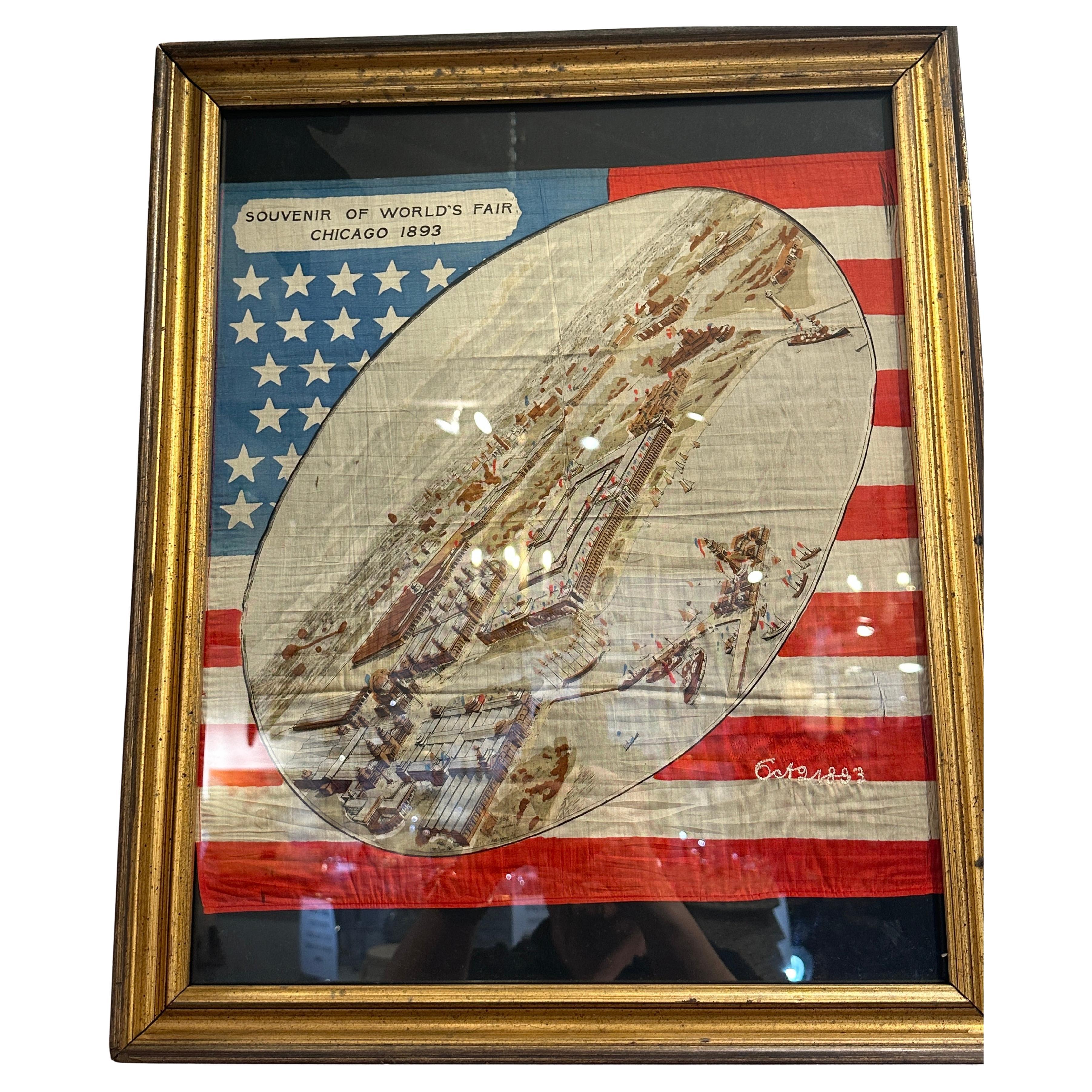
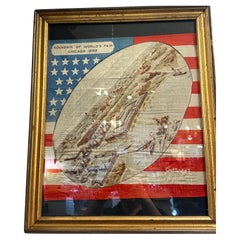
World Fair Chicago Bandana Signed and Dated 1893
Located in Los Angeles, CA
Souvenir of Chicago Worlds Fair Bandana Dated 1893
framed behind glass. This bandana is in fine condition.
Category
Antique 19th Century American Folk Art Political and Patriotic Memorabilia
Materials
Fabric, Wood
$1,196 Sale Price
20% Off
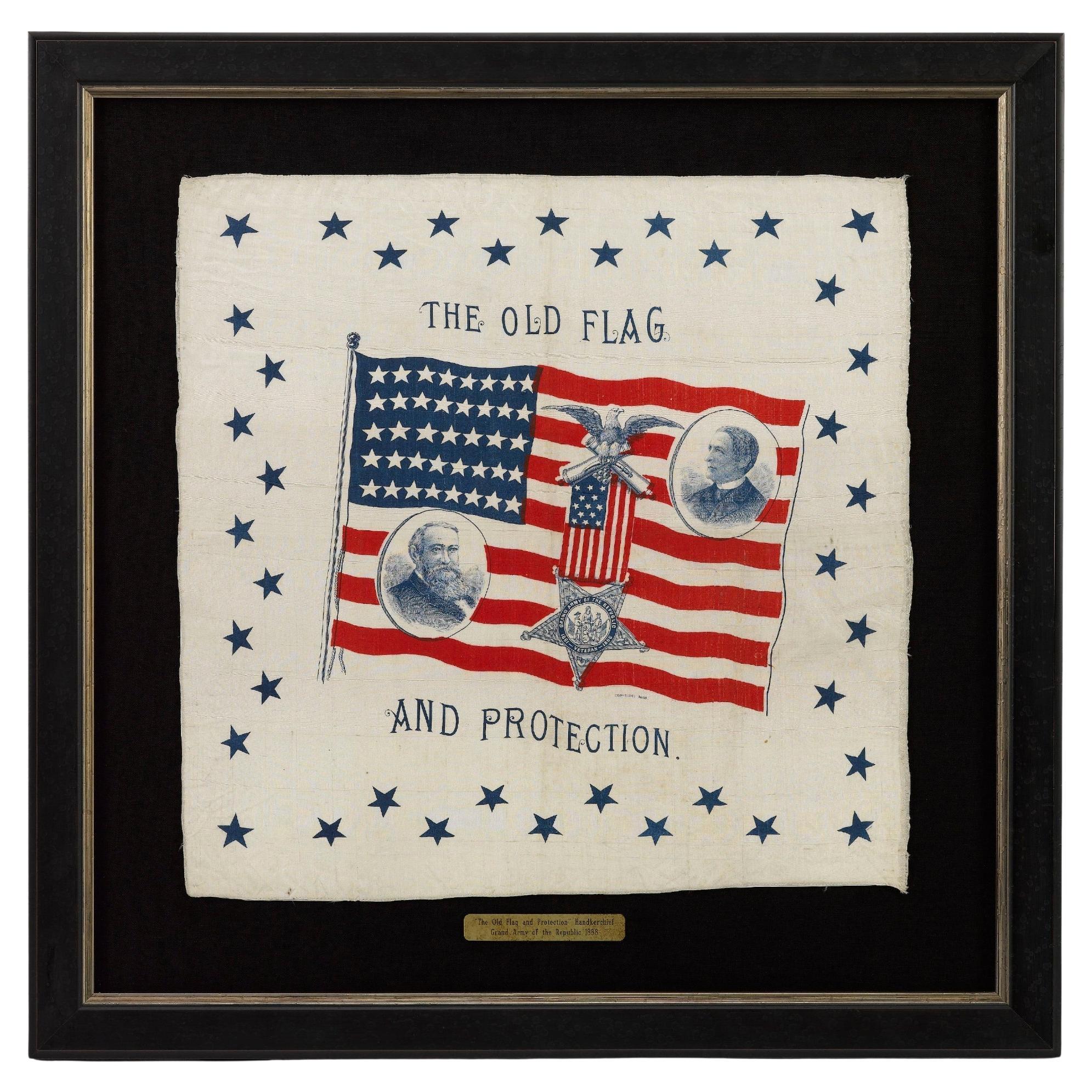
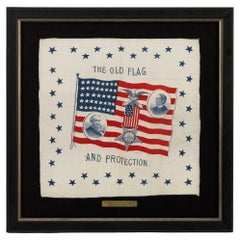
"The Old Flag and Protection" Benjamin Harrison Campaign Handkerchief, 1888
Located in Colorado Springs, CO
Presented is an original Benjamin Harrison campaign handkerchief, from the 1888 presidential election. Printed on white silk, this design features a waving 39-star American flag and ...
Category
Antique 1880s American Political and Patriotic Memorabilia
Materials
Silk
Roberta di Camerino Signature Cotton Men
s Handkerchief
By Roberta Di Camerino
Located in New York, NY
Roberta di Camerino signature 100% cotton men's handkerchief is finished with hand-rolled edges and measures 18 1/2" x 18 1/2" of Swiss cotton.
Category
1970s Italian Handkerchiefs
Karl Lagerfeld Vintage Delicacies Print Wool and Silk Shawl
By Karl Lagerfeld
Located in Nice, FR
KAR LAGERFELD vintage rare shawl depicting delicacies and waiters wearing a livery.
- Colors: Saffron background / Multicolored motif.
- Fringed borders.
- Composition label reads :...
Category
20th Century French Scarves
$479 Sale Price
20% Off
Daniel La Foret Detailed Coco Brown
Ivory Palsey Silk Handkerchief
Located in New York, NY
Daniel La Foret wonderfully detailed coco-brown & ivory palsey silk handkerchief accented with hand-rolled edges, measures 18 1/2 inches by 18 1...
Category
1980s Italian Handkerchiefs
Exceptional Hermès Vintage Silk Scarf Les Amours Hugo Grygkar 1947 Rare
By Hermès
Located in Corcoué Sur Logne, Loire-Atlantique
Absolutely Gorgeous Authentic Hermès Scarf
Called "Les Amours"
This scarf has been designed by Hugo Grygkar in 1947
Super Rare Scarf. Collectible ! No reissue
Rated 1A in the Hermès Scarves Book...
Category
