Neoclassical Outsider and Self Taught Art

NEOCLASSICAL STYLE

Neoclassical design emerged in Europe in the 1750s, as the Age of Enlightenment reached full flower. Neoclassical furniture took its cues from the styles of ancient Rome and Athens: symmetrical, ordered, dignified forms with such details as tapered and fluted chair and table legs, backrest finials and scrolled arms.

Over a period of some 20 years, first in France and later in Britain, neoclassical design — also known as Louis XVI, or Louis Seize — would supersede the lithe and curvaceous Rococo or Louis XV style.

The first half of the 18th century had seen a rebirth of interest in classical antiquity. The "Grand Tour" of Europe, codified as a part of the proper education of a patrician gentleman, included an extended visit to Rome. Some ventured further, to sketch the ruins of ancient Greece. These drawings and others — particularly those derived from the surprising and rich archaeological discoveries in the 1730s and ’40s at the sites of the Roman cities of Pompeii and Herculaneum — caused great excitement among intellectuals and aesthetes alike.

Neoclassical furniture is meant to reflect both grace and power. The overall appearance of neoclassical chairs, tables and cabinetry is strong and rectilinear. These pieces are, in effect, classical architecture in miniature: chair and table legs are shaped like columns; cabinets are constructed with elements that mirror friezes and pediments.

Yet neoclassicism is enlivened by gilt and silver leaf, marquetry, and carved and applied ornamental motifs based on Greek and Roman sculpture: acanthus leaves, garlands, laurel wreaths, sheaves of arrow, medallions and chair splats are carved in the shapes of lyres and urns. Ormolu — or elaborate bronze gilding — was essential to French design in the 18th and 19th centuries as a cornerstone of the neoclassical and Empire styles.

As you can see from the furniture on these pages, there is a bit of whimsy in such stately pieces — a touch of lightness that will always keep neoclassicism fresh.

Find antique neoclassical furniture today on 1stDibs.

to
1
1
87
19
11
6
4
4
1
1
1
1
1
1
1
1
1
1
1
1
1
Style: Neoclassical
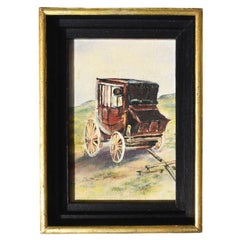
Rectangular Still Life Framed Painting of a Stagecoach, Oklahoma
Located in Oklahoma City, OK
A small American Classical framed painting of a stagecoach. This piece is framed in a deep wooden frame, with gilt gold around the edges and brown and black on the inside and outside...
Category

20th Century American Neoclassical Outsider and Self Taught Art

Materials

Gold

Related Items
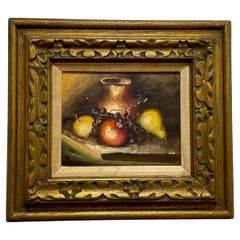
Framed Fruit Still Life Oil Painting, c. 1920 s
Located in Weehawken, NJ
Vintage framed Still Life Oil Painting of Fruit with Pitcher. Framed in a lovely wooden frame. Ready to hang with wire along the back. French, circa 1920. Size of frame: 16 x 18 i...
Category

1920s Vintage Neoclassical Outsider and Self Taught Art

Materials

Wood

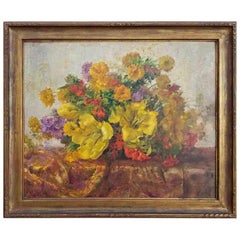
Floral Still Life Oil Painting with Beautiful Original Frame, 1940s
Located in Fulton, CA
Artist signed still life oil painting of flowers and tablecloth, circa. 1940s. Appears to be signed J. W. Arthur? Retains original period frame. Partial exhibit label on verso. Measu...
Category

Mid-20th Century Neoclassical Outsider and Self Taught Art

Materials

Wood, Masonite, Paint

Outsider Art "Man in Carriage" Oil on Panel by Bruno Del Favero
Located in Brooklyn, NY
Oil on panel depicting a man in a horse-drawn carriage by acclaimed outsider artist, Bruno Del Favero (b. Italy 1910, d. USA 1995), circa 1970. Fine example showcasing Del Favero's ...
Category

1970s American Vintage Neoclassical Outsider and Self Taught Art

Materials

Paint

Small Framed Acrylic on Wood Still-Life Oil Painting, signed
Located in Haddonfield, NJ
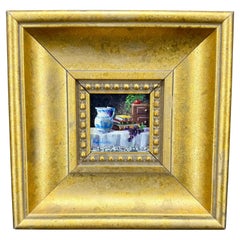
This miniature oil painting, titled Delft Pitcher is signed by the artist Alva Holcombe. The scene includes the blue and white Delft pitcher, books and fruit all sitting on a white d...
Category

Late 20th Century American Neoclassical Outsider and Self Taught Art

Materials

Wood, Paint

Ornate Gilt Framed Oil Painting Floral Bouquet Still Life Signed James Moran
Located in Miami, FL
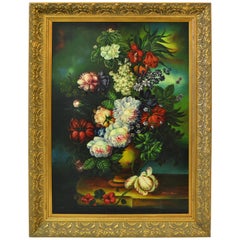
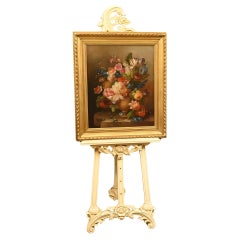
Large ornate gilt wood framed oil on canvas painting floral bouquet still life by American Artist James Moran. Skillfully applied textured flowers in a vas...
Category

Late 20th Century American Neoclassical Outsider and Self Taught Art

Materials

Canvas, Paint, Wood

Italian Rococo 1770s Framed Still-Life Painting Depicting a Bouquet of Flowers
Located in Atlanta, GA
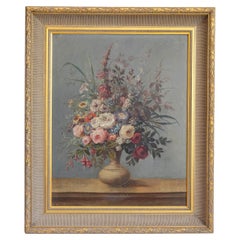
An Italian Rococo period framed still-life oil on canvas painting from the late 18th century, depicting a colorful bouquet. Created in Italy during the third quarter of the 18th cent...
Category

Late 18th Century Italian Antique Neoclassical Outsider and Self Taught Art

Materials

Canvas, Paint

Framed Bag of Apples Still Life Oil Painting
Located in Queens, NY
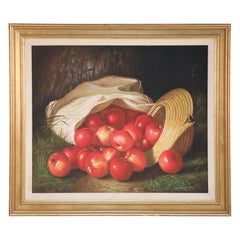
Vintage (20th Century) still life oil painting of apples spilling from a bag on the forest floor, alongside a straw hat, painted on stretched canvas in a rectangular giltwood frame w...
Category

20th Century American Neoclassical Outsider and Self Taught Art

Materials

Canvas, Wood, Giltwood

Framed Bag of Apples Still Life Oil Painting
$2,550
H 27.75 in W 31.75 in D 2 in
1960s American Giltwood Framed Signed Floral Oil On Board - Still Life Roses
Located in Kennesaw, GA
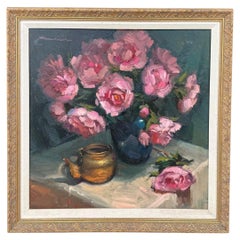
This is a framed oil on board depicting a still life of peonies in a vase. It was complete by Richard Fillhouer , an American artist. It is in a giltwood frame. It is in very good co...
Category

Mid-20th Century American Neoclassical Outsider and Self Taught Art

Materials

Canvas, Wood, Paint

Sumptuous Large Original William Foster Still Life Painting of a Banquet Table
Located in Tustin, CA
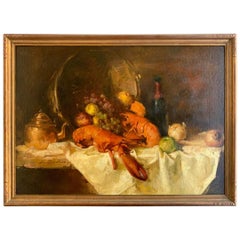
Sumptuous, very large, original oil on canvas board, still life painting depicting a banquet table. This painting is a virtuoso display of how artist William Frederick Foster (1883-1953) captures texture in paint. You can see this in the mouth watering fruit, crustacea and other samplings laid upon the table as well as the masterfully painted reflective surfaces of the copper tea pot, wine bottle and the gathered table cloth. Painting is framed in the original wood frame. Painting framed measures 34.5” high x 46” wide x 1.5” deep. Painting unframed measures 30.5” high x 42.5” wide. William Foster was born in Cincinnati, Ohio, in 1883. He became a noted figure painter and illustrator, living the last twenty-one years of his career in Los Angeles, California. At age 12, he moved with his family to Colorado, but in 1898, he returned to Cincinnati and enrolled at the Art Academy where he studied with Joseph Henry Sharp and Frank Duveneck. His early ambition was to be a violinist, but he was re-focused on fine art when he saw a painting by Albert Ceck Wenzell. In 1902, he went to New York City where he painted scenery for theaters, auditoriums, and large department stores. He also studied at the New York School with Robert Henri and William Merritt Chase, and from 1903 to 1931, he worked as an illustrator and with a brief teaching stint in 1919 at the Art Institute of Chicago. In 1903, he sold his first illustration, a depiction of high society, to Life magazine, and the style was very similar to Wenzell. From that time, he worked for most of the major magazines including Collier's, The Saturday Evening Post and Harper's Monthly. In 1926, he won the National Academy of Design's Thomas B. Clarke Prize for the best figure composition painted in the United States by a non-academician. The following year, he was voted an Associate Member based on his recognition for a figure work titled The Girl in Brown. During World War I, he operated his own ambulance in France as a member of the American Volunteer Motor Ambulance Corps and also received mention as a camoufleur artist. Returning to the U.S., he resumed his illustration work and moved to Chicago, where he taught at the Art Institute. Foster moved to Los Angeles in 1932 and devoted his energy to painting, exhibiting and teaching. He taught at the Chouinard School of Art in Los Angeles and gave private classes in his studio. He also worked on a mural project at the Hearst estate...
Category

Early 20th Century American Neoclassical Outsider and Self Taught Art

Materials

Masonite

Still Life Painting Oil on Board Framed, Signed
Located in Clifton Springs, NY
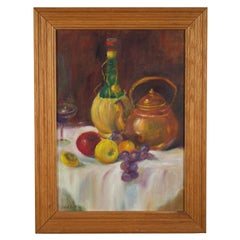
Vintage oil on board still life painting features calm, collected composition of a wine bottle, glass, teapot, and fruits on a white tablecloth. The painting is signed in lower lef...
Category

Mid-20th Century American Neoclassical Outsider and Self Taught Art

Materials

Canvas, Wood

Still Life Painting Oil on Board Framed, Signed
$360
H 16.75 in W 12.75 in D 1 in
Vintage Modernist Still Life Oil Painting, Signed, Framed
Located in Clifton Springs, NY
Vintage small Modernist still life painting features a composition of fruits and flowers in a blue vase. Jewel-like colors of burnt orange background juxtapose the intense blue colo...
Category

Mid-20th Century American Neoclassical Outsider and Self Taught Art

Materials

Fabric, Wood, Giltwood

Georgian Floral Oil Painting Still Life Gilt Frame
Located in Potters Bar, GB
Gorgeous hand painted still life oil painting in the Georgian manner Very vivid and bright, will add light and energy to any room Comes in elegant gilt frame Offered in great shape r...
Category

1980s Vintage Neoclassical Outsider and Self Taught Art

Materials

Canvas

Neoclassical outsider and self taught art for sale on 1stDibs.

Find a broad range of unique Neoclassical outsider and self taught art for sale on 1stDibs. Many of these items were first offered in the 20th Century, but contemporary artisans have continued to produce works inspired by this style. If you’re looking to add vintage outsider and self taught art created in this style to your space, the works available on 1stDibs include folk art, wall decorations and other home furnishings, frequently crafted with canvas, fabric and other materials. If you’re shopping for used Neoclassical outsider and self taught art made in a specific country, there are North America, and United States pieces for sale on 1stDibs. It’s true that these talented designers have at times inspired knockoffs, but our experienced specialists have partnered with only top vetted sellers to offer authentic pieces that come with a buyer protection guarantee. Prices for outsider and self taught art differ depending upon multiple factors, including designer, materials, construction methods, condition and provenance. On 1stDibs, the price for these items starts at $350 and tops out at $350 while the average work can sell for $350.