Items Similar to American Portrait Miniature of a Woman in a White Gown, Thomas Story Officer
Video Loading
Want more images or videos?
Request additional images or videos from the seller
1 of 11
American Portrait Miniature of a Woman in a White Gown, Thomas Story Officer
$7,500
£5,711.09
€6,576.17
CA$10,628.16
A$11,432.11
CHF 6,109.65
MX$134,751.97
NOK 77,028.37
SEK 70,418.55
DKK 49,135.09
About the Item
American Portrait Miniature: Woman in a White Gown
Thomas Story Officer (1810–1859)
Watercolor on Ivory, Gilded Frame
Circa 1830–1836,
Philadelphia
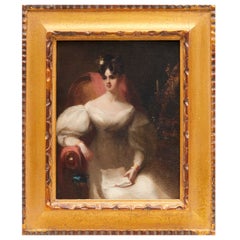
This exquisite American portrait miniature, signed by Thomas Story Officer, captures the likeness of a confident young woman during the height of the Romantic era in American fashion. The subject is rendered in the demanding medium of watercolor on ivory, a tradition deeply rooted in intimacy and remembrance.
The sitter, whose identity is now lost, is depicted three-quarters left, her gaze directed outward with a striking directness. Her striking red hair is styled high in a complex, fashionable knot, reminiscent of the popular Coiffure à la Chinoise. She is clad in an elegant white gown, likely a silk or fine muslin evening dress, distinguished by short, full, puffed sleeves and a low, horizontal neckline. A small, decorative pin secures the fabric at the center of her chest. The woman is seated in what appears to be a plush red chair, contrasting with the soft, atmospheric background.
The miniature's power lies in Officer’s masterful command of watercolor applied to ivory. Since ivory is non-absorbent, the artist achieved the subtle gradations of skin tone and the luminous translucency of the white gown through meticulous stippling and thin layers of wash. This technique allows the ivory ground itself to serve as the inherent light source, giving the sitter an idealized, ethereal glow. The artwork is secured in an ornate, possibly gilded, frame designed to be intimate and portable. The reverse features a small oval glass pane, a characteristic element in period miniatures often reserved for a private memento, typically a lock of the sitter's hair.
Signature: The work is signed to the lower right, "T.S. Officer, Pinxt." The Latin abbreviation Pinxt (Pinxit, meaning 'he painted it') was a conventional academic flourish used by skilled artists to affirm their professional status and distinguish their handcrafted work from purely commercial likenesses—a subtle but important assertion of legitimacy in a market increasingly threatened by new technology.
The Zenith of Romantic Fashion (c. 1830–1836)
The style of the sitter's dress and hair are crucial chronological indicators, firmly placing this miniature in the earliest phase of Officer’s career in Philadelphia. The 1830s represented the peak of Romanticism in fashion, characterized by "ebullient energy" and bold forms.
• High-Volume Aesthetic: The short, voluminous puffed sleeves, low neckline, and dramatic verticality of the hairstyle epitomize the popular early 1830s silhouette.
• The Victorian Pivot: The portrait predates a significant cultural shift that occurred around 1836. Following Queen Victoria’s ascension in 1837, fashion retreated from exuberance into a "drooping sentimentality," prioritizing modesty, simplicity, and restraint. The boldness of the woman in the miniature is stylistically antithetical to the subsequent Victorian ideal, confirming the c. 1830–1836 dating.
The Artist’s Philadelphia Practice
Born in Carlisle, Pennsylvania, in 1810, Thomas Story Officer established his career in the competitive metropolitan art scene of Philadelphia. He trained under Thomas Sully , one of America’s foremost portrait painters, absorbing Sully’s celebrated Romantic style that prioritized soft modeling and idealized grace. Although the Carlisle Weekly Herald noted in May 1834 that Officer was "...principally self-taught, and although young, already evinced a degree of taste, judgment, and talent...”, formal training with Sully was essential for Officer to establish a "thriving practice" in the city during the mid-1830s.
III. The End of a Profession: Officer and the Photographic Threat
Officer’s career tragically spanned the moment when the art of miniature painting reached its apex and then suffered a near-fatal collapse due to technological change.
The Daguerreotype Rupture: With the introduction of the daguerreotype in 1839, "Daguerreotypemania" quickly swept the nation. The ability of the camera to capture an accurate likeness quickly and affordably destroyed the market for handcrafted portraits on ivory. As the historian James Miller McKim later noted, Officer was "one of the last miniature painters of any eminence produced by this country, the daguerreotype and photographer having come in to sweep away the entire profession."
The Itinerant Survival Strategy: The instability of the portrait market forced Officer into a life of constant travel, seeking commissions in locations less saturated by competitors or less immediately influenced by photography. His itinerancy took him from Philadelphia to Mobile, Alabama (1837), Richmond, Virginia (1845), and New York City (1846–1849), with documented plans for travel to Mexico in 1842.
Final Adaptation: By the 1850s, after traveling as far as Australia, Officer settled in San Francisco. Here, he pragmatically joined the burgeoning photographic industry, setting up a portrait painting department within James Johnson’s photographic gallery. This final professional pivot—applying his miniature skills (such as delicate hand-coloring and stippling) to hand-finish and embellish mechanically produced photographs—is emblematic of how traditional artists had to adapt to retain economic value in the new era of mechanical image-making.
Despite his adaptability, Officer's life ended tragically. His career, cut short by a documented drinking problem, concluded in "pecuniary distress" and death in poverty in San Francisco in 1859. The existence of Woman in a White Gown is therefore a moving historical document, representing not only a beautiful artistic achievement but also the professional ideal of a craft that was rapidly rendered obsolete by the march of technology. Officer's biography can also be found in Theodore Bolton's Early American Portrait Painters in Miniature, published in 1921.
Primary and Documentary Sources
• Carlisle Weekly Herald. May 28, 1834. (Reported on Officer’s early portrait commissions).
• McKim, James Miller. Reminiscences published in the Carlisle Herald, 1872. (Commentary on Officer as one of the last eminent miniature painters before the rise of photography).
Biographical and Scholarly Monographs
• Bolton, Theodore. Early American Portrait Painters in Miniature. New York: F. F. Sherman, 1921. (Contains a biography of Thomas S. Officer on page 117).
• Schaumann, Merri Lou. “Thomas S. Officer: Miniature and Portrait Painter.” Gardner Digital Library Encyclopedia. (Details Officer's birth, training with Thomas Sully, itinerancy, San Francisco career, and contains reference to primary newspaper sources).
Institutional and Art Historical Context
• Metropolitan Museum of Art. Artwork Details for Holy Eyes (1848) by Thomas Story Officer. (Confirms the medium of watercolor on ivory in later works).
• Nelson-Atkins Museum of Art. “The History of Portrait Miniatures.” (Provides context on the intimate function, the medium of watercolor on ivory, and the technical skill required for the non-absorbent ground).
• Smithsonian American Art Museum (SAAM). Artist Page for Thomas S. Officer (1810–1859). (Confirms training with Thomas Sully, subsequent itinerancy, and notes the impact of alcoholism and poverty on his later career).
Art, Fashion, and Photography History
• Big Think. “How Photography Changed Painting and Vice Versa.” (Discusses the impact of the 1839 Daguerreotype introduction, or “Daguerreotypemania,” and the resulting competition and subsequent alliance between art and photography).
• Fashion History Timeline, Fashion Institute of Technology (FIT). “1830–1839.” (Provides analysis of the 1830s fashion silhouette, the low neckline, puffed sleeves, and the chronological shift toward modesty after 1836/1837).
• Matthews, Mimi. “The 1830s in Fashionable Gowns: A Visual Guide to the Decade.” (Further details on the “exuberantly romantic” early 1830s aesthetic and the specific elements of short, full sleeves in evening attire).
• Wikipedia contributors. “Hand-colouring of photographs.” (Explains the practice of artists applying watercolor and other paints to photographic surfaces in the mid-19th century, representing Officer's final adaptation).
(Ref: NY9919-knrr)
- Dimensions:Height: 2.5 in (6.35 cm)Width: 2 in (5.08 cm)Depth: 0.25 in (6.35 mm)
- Style:American Empire (Of the Period)
- Materials and Techniques:Ivory
- Place of Origin:
- Period:
- Date of Manufacture:1830s
- Condition:Wear consistent with age and use.
- Seller Location:Downingtown, PA
- Reference Number:Seller: NY9919-knrr1stDibs: LU861030839282
About the Seller
5.0
Recognized Seller
These prestigious sellers are industry leaders and represent the highest echelon for item quality and design.
Gold Seller
Premium sellers maintaining a 4.3+ rating and 24-hour response times
Established in 1916
1stDibs seller since 2009
438 sales on 1stDibs
Typical response time: 1 hour
Associations
The Art and Antique Dealers League of AmericaAntiques Associations Members
- ShippingRetrieving quote...Shipping from: Downingtown, PA
- Return Policy
More From This Seller
View AllWax Portrait of Queen Charlotte of Great Britain, Attributed to John Flaxman
Located in Downingtown, PA
The Gardener Queen: Charlotte in Wax Relief
This large and extremely rare Wax Portrait of Queen Charlotte (1744-1818), the wife of King George III, ...
Category
Antique Late 18th Century English Georgian Decorative Art
Materials
Other
French Silk Textile Portrait, Marie Thérèse of France, Louis XV
s Daughter
Located in Downingtown, PA
French Royal painted silk textile portrait,
Marie Thérèse of France,
Madame D' Angoulême,
Eldest daughter of Louis XVI and Marie Antoinette and o...
Category
Antique Mid-19th Century French Charles X Decorative Art
Materials
Silk
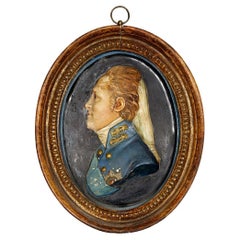
Terracotta Portrait Plaque of a Nobleman with Order of the Garter
Located in Downingtown, PA
Continental Terracotta Plaque,
Early 19th Century
The large painted plaque depicts a view of the left side torso of a Continental Nobleman wearing the British Order of the Garter...
Category
Antique Late 18th Century English Georgian Historical Memorabilia
Materials
Terracotta
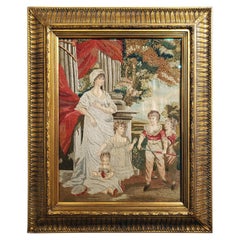
Regency Silk and Wool Picture of Mother and Her Children, after John Hoppner RA
By Sir John Hoppner
Located in Downingtown, PA
Superb large English silk and wool portrait,
A Mother and Her Four Children,
after John Hoppner R.A.,
circa 1810-20,
Within gilt frame.
Silk over linen fabric ground, silk floss, worsted wool yarn, Merino wool yarn and oil paint.
A remarkable silk picture with painted sky background and each figure with a painted face and hands with the remaining portions of the picture finished in wool. The design comes from a mezzotint after John Hoppner made in the 1790s. John Hoppner specialized in painting mothers and children.
The picture depicts a large standing female figure dressed in a white dress and wearing a turban. She stands by two classical columns with her four children in front of her.
The youngest child is sitting on the ground playing with her red shoe in her hands with a tambourine by her side. Her elder sister stands behind her. Both girls are dressed in Empire-style muslin dresses...
Category
Antique 19th Century English Georgian Decorative Art
Materials
Wool, Silk
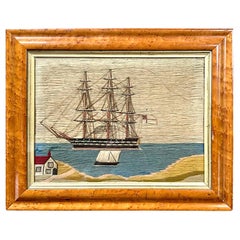
British Sailor
s Woolwork of Royal Navy Ship in Bay with House
Located in Downingtown, PA
British Sailor's Woolwork of Royal Navy Ship in Bay,
Circa 1860-75
This meticulously crafted sailor's woolwork, often called a "woolie," is rendered in Berlin wool and portrays a Ro...
Category
Antique 1860s Folk Art Nautical Objects
Materials
Wool
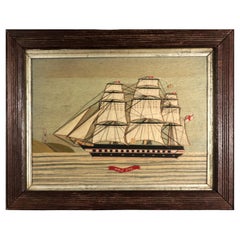
British Sailor
s Woolwork of the Screw Frigate H.M.S. Fox
Located in Downingtown, PA
"Homecoming": British Sailor's Woolwork of the Screw Frigate H.M.S. Fox,
Circa 1875
A charming and detailed British sailor's woolwork (or "woolie"), depicting a portside view of the...
Category
Antique 1870s English Folk Art Nautical Objects
Materials
Wool
You May Also Like
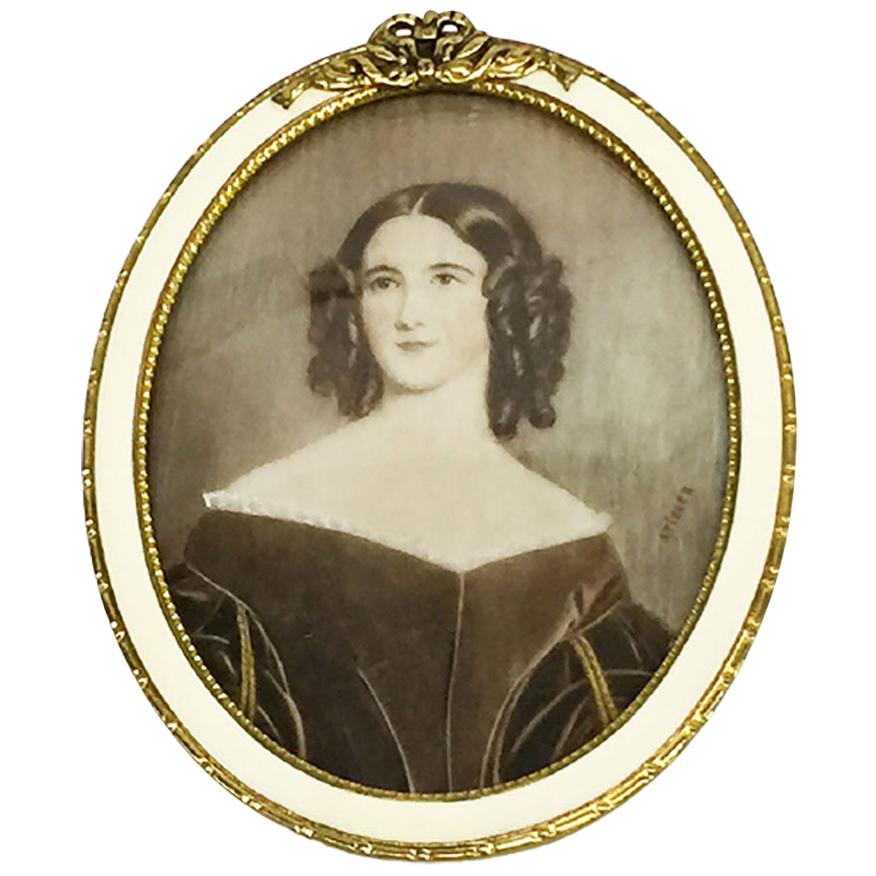
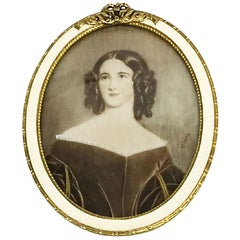
Miniature Portrait of a Distinguished Lady, Signed Stieler
Located in Delft, NL
Miniature portrait of a distinguished lady, signed Stieler.
Bronze frame behind oval round glass, 19th century
Signed Stieler, Joseph Karl Stieler (1781- Mainz - 1858 Munich) was a German painter.
The size is 10 cm x 7.5 cm x 1 cm
1820-1830
From 1820 until 1855 he worked as royal court painter of the Bavarian kings. He is known for his Neoclassical portraits, especially for the Gallery of Beauties at Nymphenburg Palace in Munich.
Born in the city of Mainz to a long-established family of engravers, punchcutters and die makers, Stieler received some artistic training from his father, August Friedrich Stieler (1736–1789). After the early death of his father, Joseph Karl autodidactically completed his apprenticeship and began his career as a painter of miniatures, which were increasingly sought after by bourgeois circles After Mainz had been occupied by French revolutionary troops in 1792, Stieler followed the expelled court of Prince-Archbishop Friedrich Karl Joseph von Erthal to Aschaffenburg. Here he met with the later Archbishop Karl Theodor Anton Maria von Dalberg, who became his most important patron and sponsor.
From 1802 to 1805 he attended the Academy of Fine Arts Vienna in the master class of Heinrich Füger. Stieler's portrait style was most especially shaped during his work in the Parisian atelier of François Gérard, a student of Jacques-Louis David. In 1808, he established himself as an independent portraitist in the city of Frankfurt and in 1810 travelled through Italy. From 1812 he worked at the court of King Maximilian I Joseph of Bavaria.
In 1816, he again travelled to Vienna to paint the portrait of Emperor Francis I of Austria. Between February and April 1820, he worked on his portrait of Ludwig van Beethoven, which is probably the most well-known representation of the composer today. In 1847 he also painted the portrait of Lola Montez...
Category
Antique 19th Century German Picture Frames
Materials
Bronze
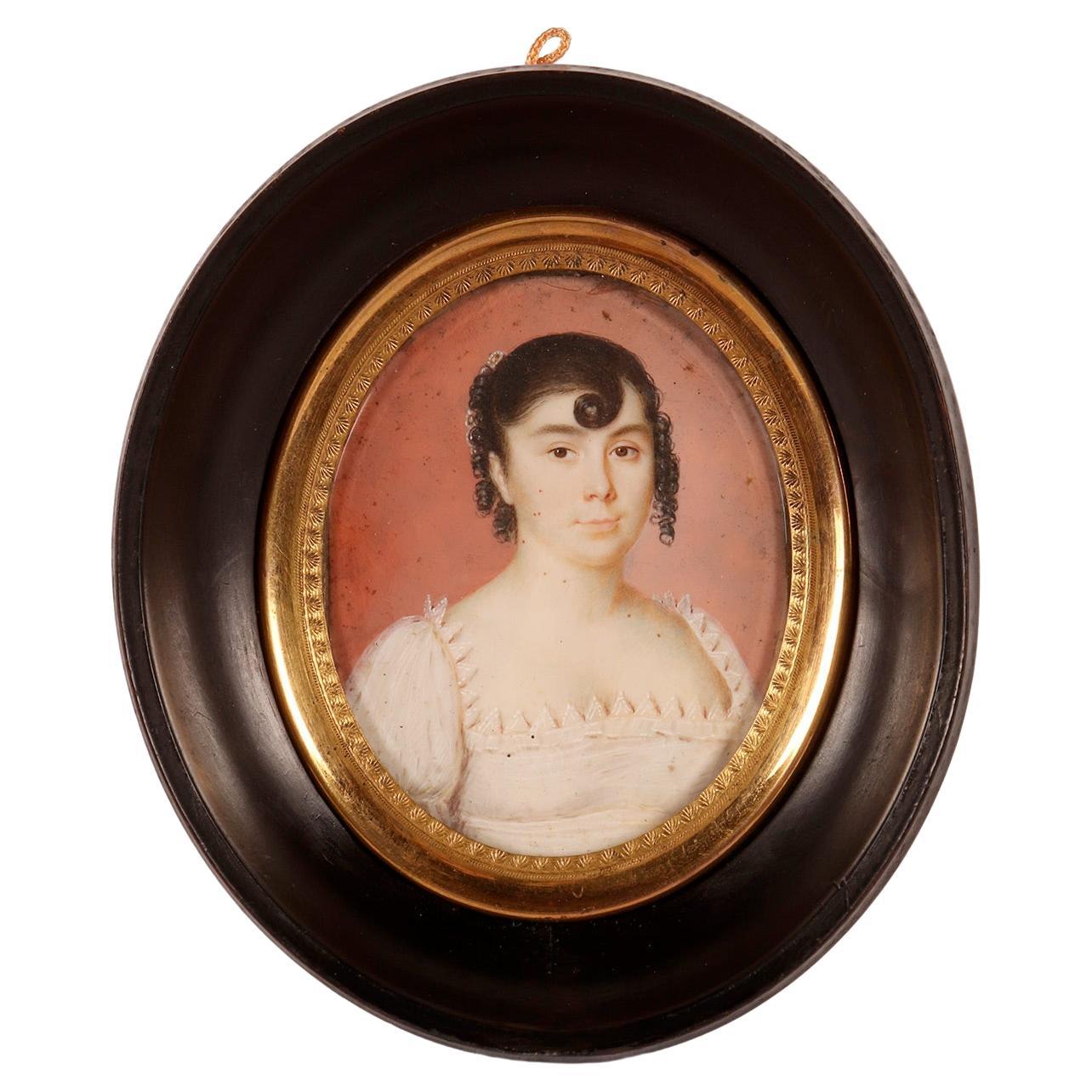
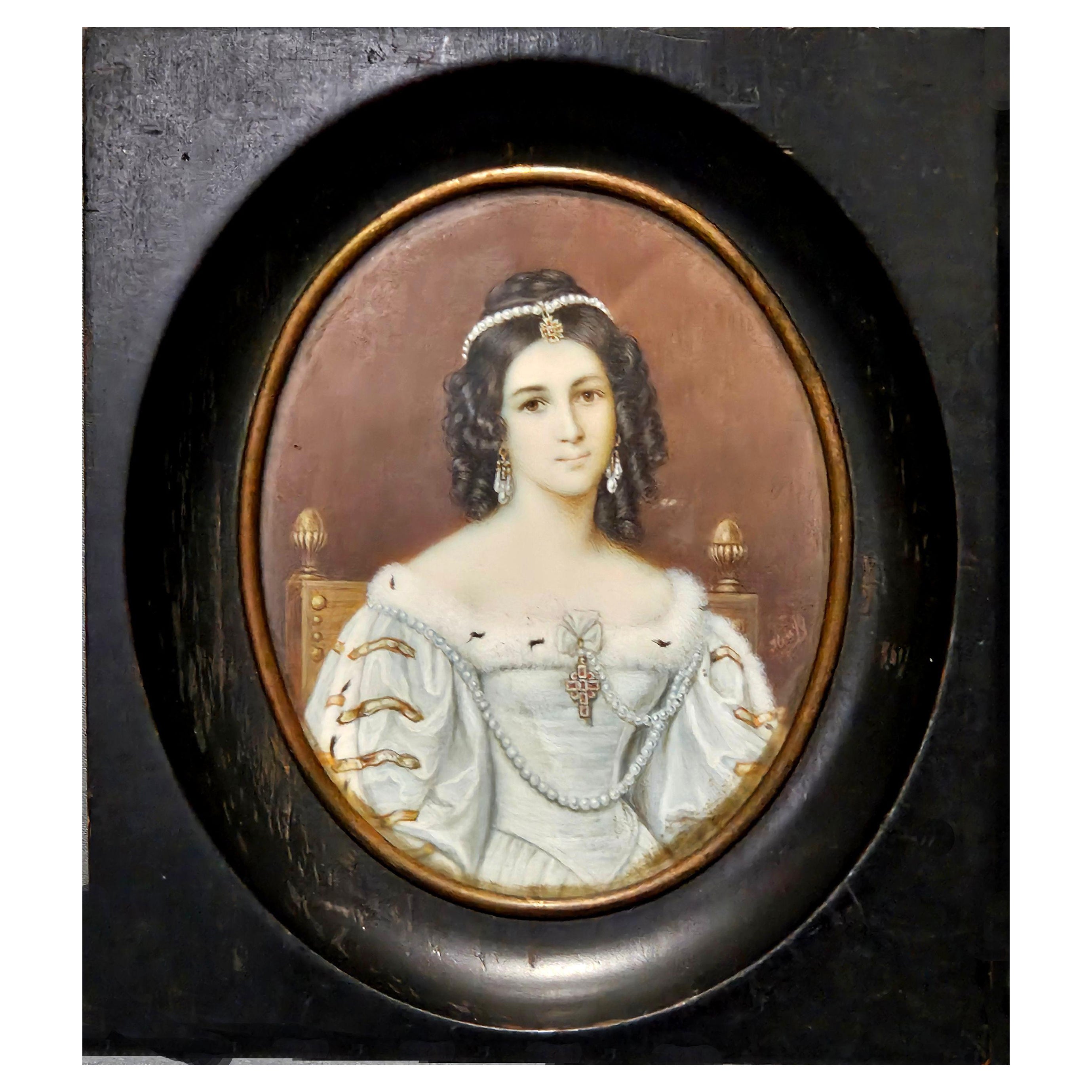
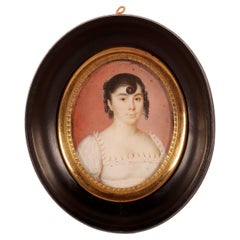
Miniature with female subject, watercolor on ivory, France 1800.
Located in Milan, IT
Miniature with female subject, watercolor on ivory.
The frame, in waxed fruit wood, black in colour, is oval shaped with the oval interior delimited by a golden brass decorated frame...
Category
Antique Early 19th Century French Paintings
Materials
Brass
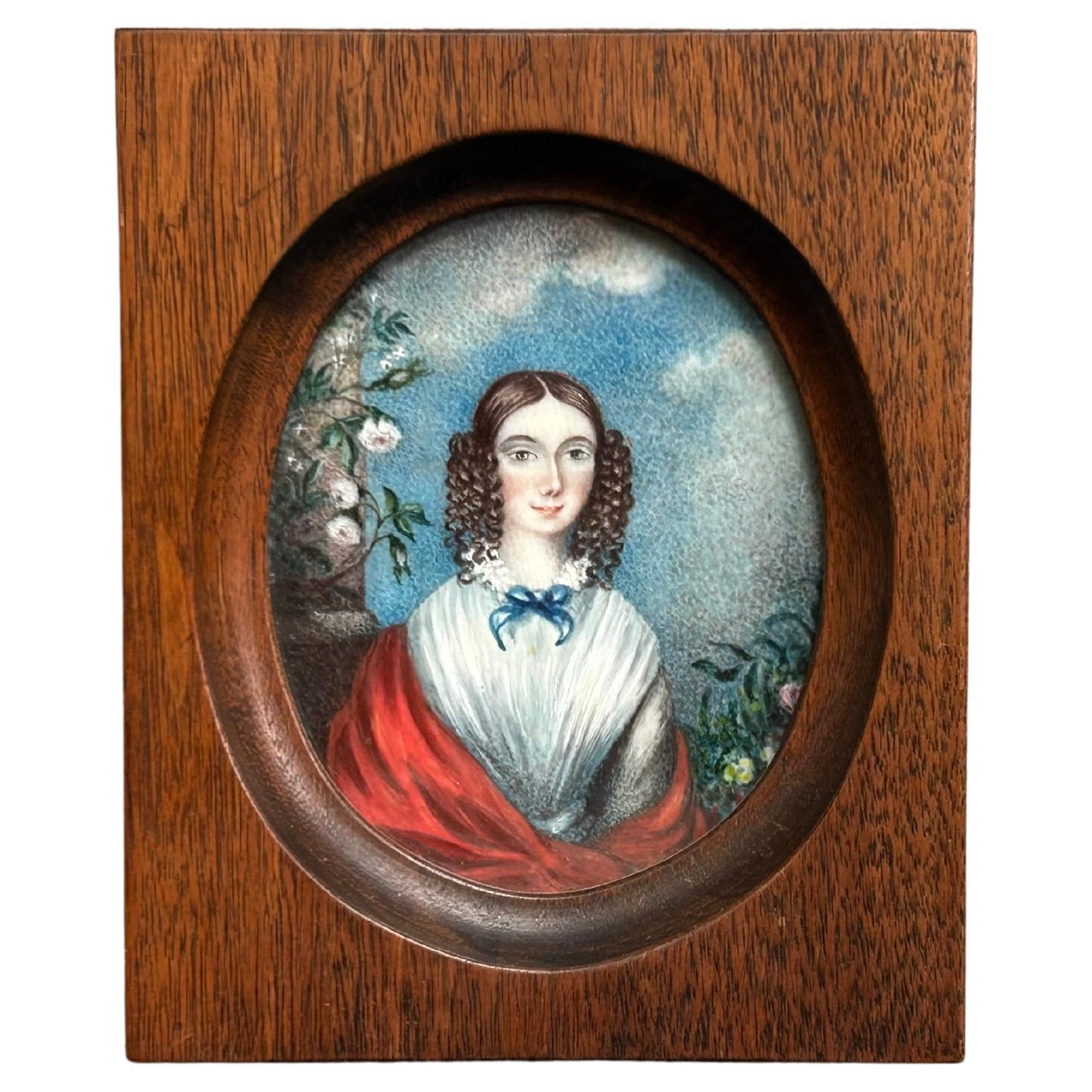
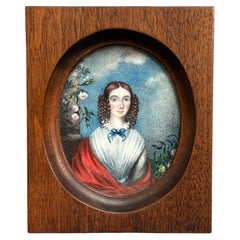
Miniature Portrait of a Young Girl, 19th Century
Located in Toronto, CA
This is an exquisite miniature portrait of a young girl. From the nineteenth century and most probably American, set in a lovely oak frame. Unsigned.
The young girl's face is framed ...
Category
Antique 19th Century American American Colonial Paintings
Materials
Wood, Paint
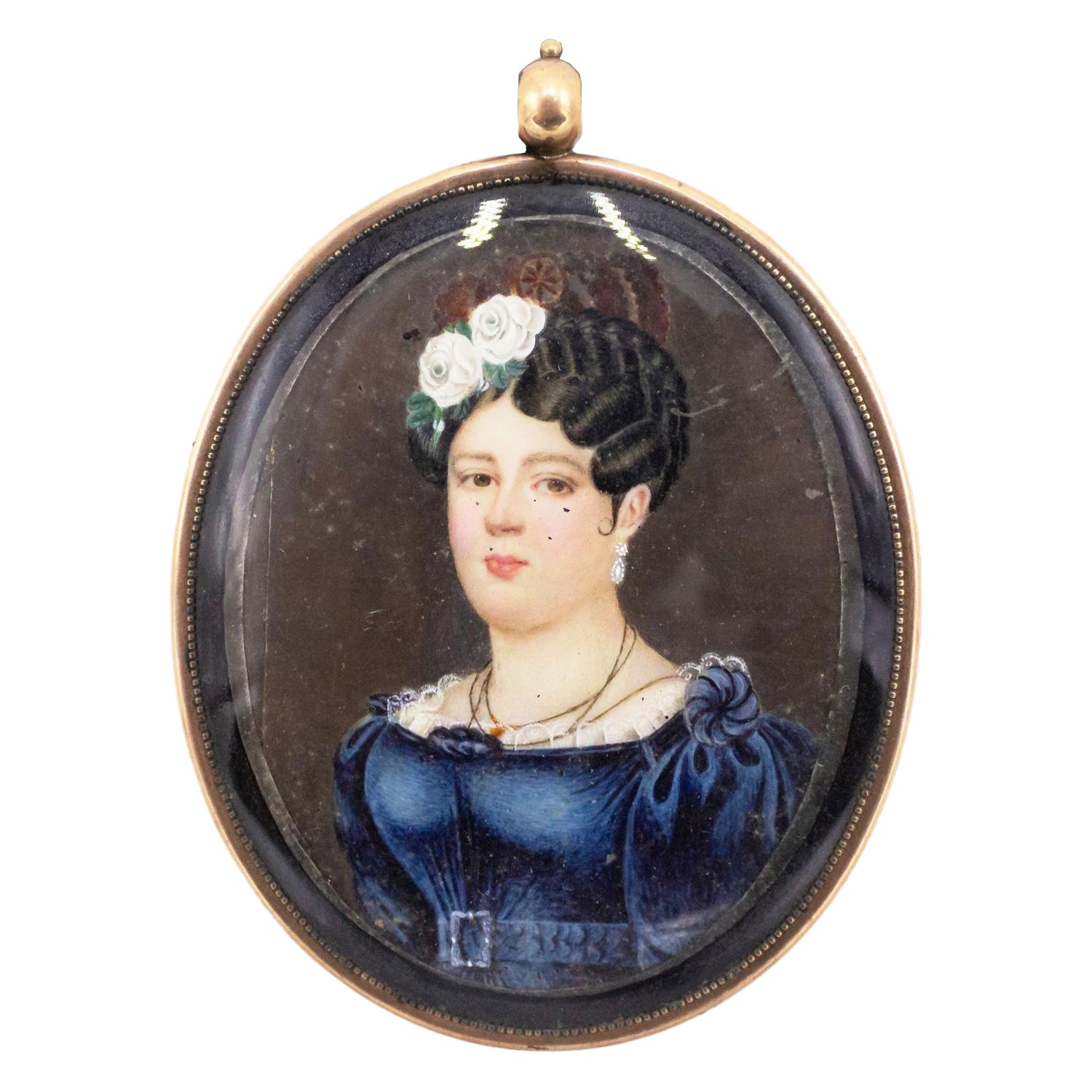
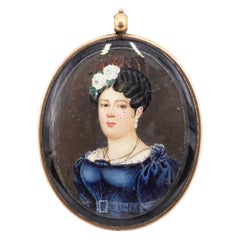
French Miniature Watercolor Female Portrait
Located in Queens, NY
French Victorian miniature watercolor on paper portrait of lady with blue dress and white flowers in copper oval case
Category
Antique 19th Century French Victorian Paintings
Materials
Copper
19th C. Portrait of Young Lady Manner of George Chinnery
English
, Oil on Board
Located in Morristown, NJ
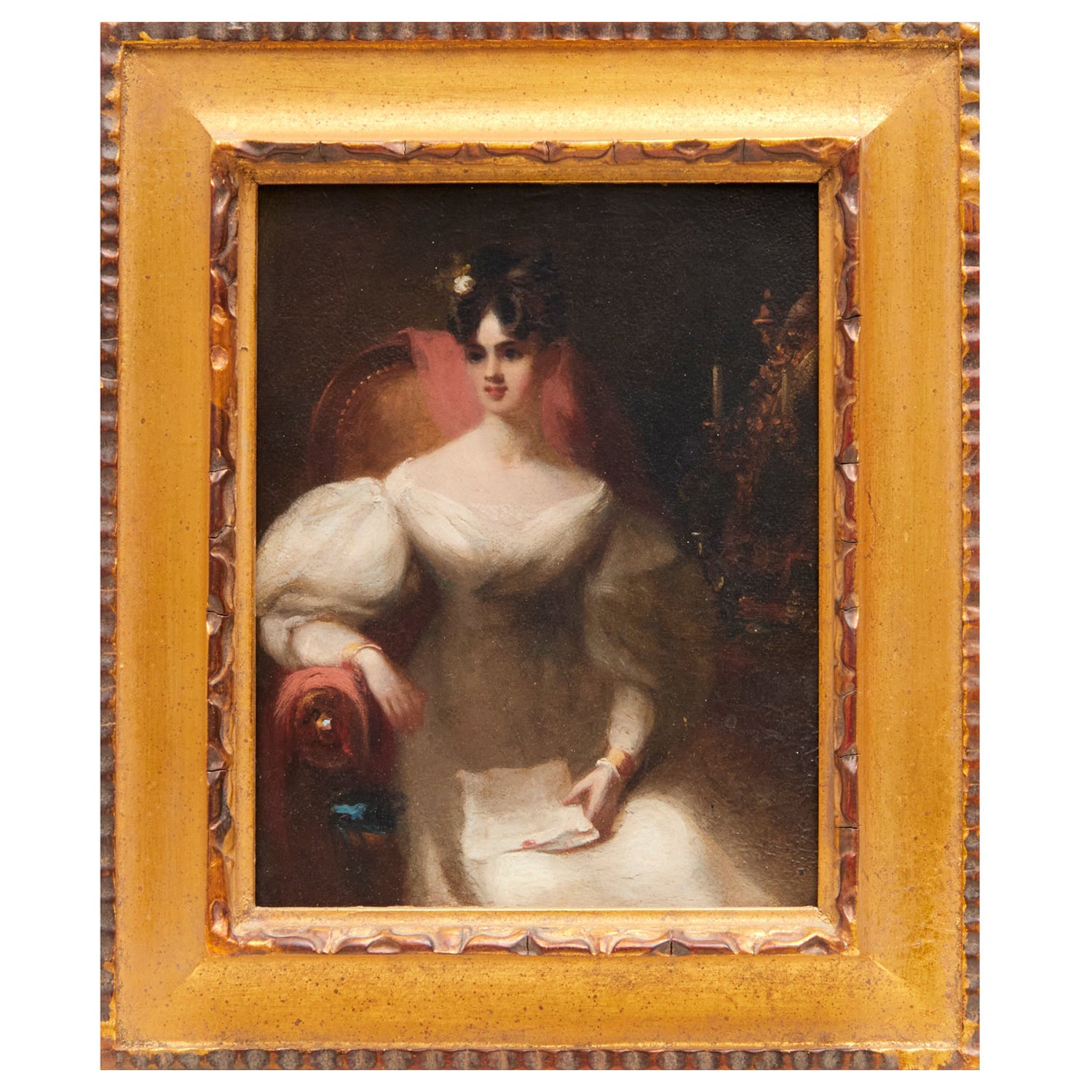
Manner of George Chinnery (English, 1774-1852), a softly rendered portrait of a young woman, unsigned, in carved and gilded wood frame A remnant "...R. Davy, Colourman to Artists, 83, Newman Street, London" label on verso. Christie's inventory tags also on verso. A little gem of a portrait, this painting also contains lovely details such as a flower adorning the young woman's hair, a pink shawl draped on the chair, and an ornate gilt mirror with candelabra visible in the background.
Robert Davy (c.1771-1843) established his business in the 1790s. He began his career as a carver and gilder...
Category
Antique Early 19th Century English Greek Revival Paintings
Materials
Wood, Paint
Antique Miniature French Portrait Painting, Signed 19th Century
Located in Norton, MA
19th-century Artist Signed Miniature French Portrait Painting.
Dimensions: Height: 5.5 inches, Width: 4.75 inches. --
Category
Antique 19th Century French Paintings
Materials
Canvas, Wood
More Ways To Browse
Antique Miniature Painting
Antique Portrait Miniature
Portrait Miniatures
Miniature Portrait Painting
S Thomas
Miniature Portrait Of A Lady
Richmond Virginia
Set Of 4 Library Chair
Snyders Antique
Ivory Black Gown
Signed Portrait Miniature
Antique Ivory Portrait Miniatures
Ivory Miniature Portrait
Miniature Libraries
Thomas Ivory
Endi Poskovic
Enzo Mari Print
Eye Portrait Miniature