Items Similar to Bronze sculpture of Umberto Mastroianni
Want more images or videos?
Request additional images or videos from the seller
1 of 20
Bronze sculpture of Umberto Mastroianni
$3,314.82
$4,143.5220% Off
£2,476.42
£3,095.5320% Off
€2,800
€3,50020% Off
CA$4,615.72
CA$5,769.6520% Off
A$4,959.33
A$6,199.1620% Off
CHF 2,660.67
CHF 3,325.8420% Off
MX$58,426.63
MX$73,033.2920% Off
About the Item
Sculpture Umberto Mastroianni
Head made of bronze by lost-wax casting.
Probable 1930s era, a time when a Mastroianni in the early days of his career used to practice with female faces.
Signed on the neck at right U. Mastroianni.
Umberto Mastroianni is a very important Italian artist of the 20th century, considered the first Italian abstract sculptor.
The sculpture is in excellent state of preservation.
- Creator:Umberto Mastroianni (Designer)
- Dimensions:Height: 11.82 in (30 cm)Width: 7.88 in (20 cm)Depth: 11.03 in (28 cm)
- Materials and Techniques:
- Place of Origin:
- Period:
- Date of Manufacture:unfamiliar
- Condition:Wear consistent with age and use.
- Seller Location:Torino, IT
- Reference Number:1stDibs: LU9356143099032
Umberto Mastroianni
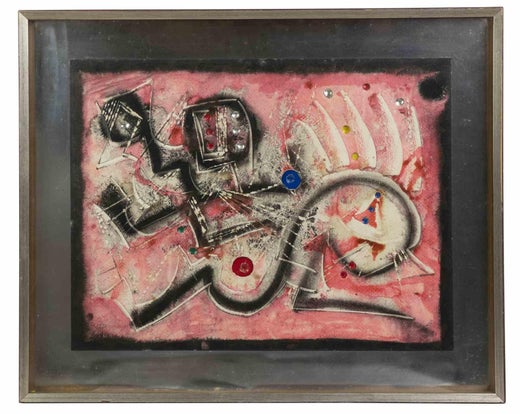
Umberto Mastroianni (September 21, 1910 in Fontana Liri – February 25, 1998 in Marino, Italy), was an Italian abstract sculptor. In 1989, he received the first Praemium Imperiale for sculpture. During World War II, he was in the Italian resistance movement. He was the uncle of the actor Marcello Mastroianni and the film editor Ruggero Mastroianni. The Museo Civico Umberto Mastroianni was established in his honour. The son of Vincenzo Mastroianni and his second wife Luigia Maria Vincenza Conte, Umberto was an uncle of the actor Marcello Mastroianni: in fact, his father Vincenzo had had a son named Ottone from his first wife, Concetta Conte, sister of his second wife, who was Marcello's father. Umberto arrived in Rome as a 14-year-old in 1924, where he attended drawing courses at the Accademia di San Marcello at the same time as his uncle Domenico's studio. He moved two years later, in 1926.
The young Umberto modelled portraits of archaic taste, in terracotta, which were later transferred to bronze castings: myth and religious subjects were Umberto Mastroianni's stylistic hallmark in the pre-war period, alongside stylistic exercises with little boy heads and his favourite subject being masks of young women, with light and persuasive features. In 1930 came the first official recognition, the Tourism Prize, offered by the Ministry of Education and, shortly afterwards, the first exhibitions at national and European level. His first solo exhibition in 1931 at the ‘Galleria Genova’ in Genoa. From 1933 onwards, he regularly exhibited at national trade union exhibitions and was invited to all the Quadriennali in Rome, the Promotrici in Turin and the Biennali in Venice. In 1935 he took part in the Quadriennale in Rome for the first time, the following year in the Venice Biennale. His pictorial works on poor materials also date back to the early 1940s: he is the first Italian abstract sculptor, the leader of the 20th century revolution and an artist of absolute international importance. These are dynamic abstract-geometric forms that acquire depth in terracotta, plaster, cardboard and rough sacks (jute), coloured and scraped. Mastroianni's poetics decisively took up the echoes of the plastic dynamism of Boccioni's ascendancy, revisiting and broadening its contents and cultural references. Some of his early post-war works in worn-out jute (works of very small dimensions, almost as if they were relics of ancient civilisations, later found) are preserved in the Galleria d'arte moderna in Rome, the Tate Gallery in London, and the Salomon Guggenheim Museum in New York. In fact, his research, starting from direct references to the Futurist season, to Brancusi's Cubist season, to John Arp's and Henry Moore's plastics, hinges on the study and rendering of dynamic values, understood and conferred in the structures understood as a clot of lines of force, the generative nucleus of an explosion of gestures blocked by the weight of matter, trapped in matter. The subsequent evolution is the landing to the Informal season, (1950-1961) a completely autonomous phase, another act of his extraordinary creative personality.
About the Seller
5.0
Vetted Professional Seller
Every seller passes strict standards for authenticity and reliability
Established in 2021
1stDibs seller since 2023
14 sales on 1stDibs
Typical response time: 1 hour
- ShippingRetrieving quote...Shipping from: Torino, Italy
- Return Policy
More From This Seller
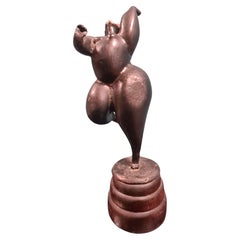
View AllBronze sculpture depicting sinuous female body
Located in Torino, IT
Bronze sculpture depicting female nude.
Small statue made of bronze with parts, such as the face, gilded with mercury and wooden base.
The sculpture depicts a sinuous female figure...
Category
Vintage 1970s Italian Sculptures and Carvings
Materials
Bronze
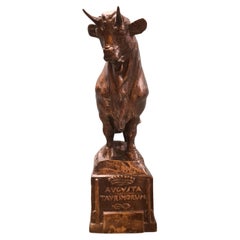
Bronze bull by sculptor Emilio Musso
Located in Torino, IT
Bronze sculpture depicting young bull made by Emilio Musso.
Vigorous young bull, sculpted in all his massive, muscular beauty.
The bull figure towers above a plinth honoring the ci...
Category
Vintage 1920s Italian Sculptures and Carvings
Materials
Bronze
$2,557 Sale Price
20% Off
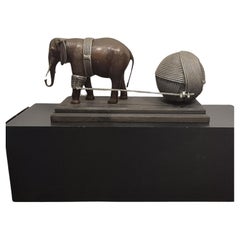
Sculpture by artist Valeriano Trubbiani
Located in Torino, IT
Sculpture by master Valeriano Trubbiani.
The sculpture depicts an Elephant made of bronze pulling a huge aluminum ball to which it is chained.
In this work, the artist's intention ...
Category
Vintage 1980s Italian Sculptures and Carvings
Materials
Aluminum, Bronze
$2,074 Sale Price
20% Off
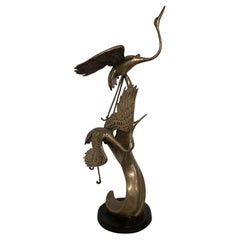
Scultura in ottone, raffigurante Aironi Cenerini in volo, anni 40
Located in Torino, IT
Scultura in ottone raffigurante aironi cenerini.
Elegante e raffinata scultura in ottone, degli anni 40'.
La scultura è in pieno stile Art Deco'
Raffigurante Aironi Cenerini in vo...
Category
Vintage 1940s French Animal Sculptures
Materials
Brass
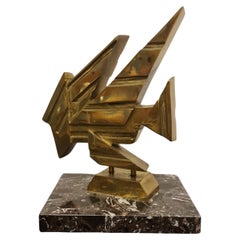
Scultura in ottone e marmo di Giuseppe Banfi 1988
Located in Torino, IT
Scultura realizzata in ottone e firmata G. Banfi 88.
Opera astratta con base in marmo realizzata da un corpo di ottone fuso che è poi stato lavorato con scanalature e particolari ch...
Category
Vintage 1980s Italian Abstract Sculptures
Materials
Marble, Brass
$1,306 Sale Price
20% Off
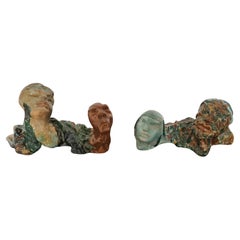
Pair of terracotta sculptures by Savino Tripodi
Located in Torino, IT
Pair of sculptures made by artist Savino Tripodi.
Sculptures made of glazed and painted terra cotta amano.
The two sculptures each depict two faces with ancient, deformed features....
Category
Vintage 1980s European Sculptures and Carvings
Materials
Pottery
$1,243 / set
You May Also Like
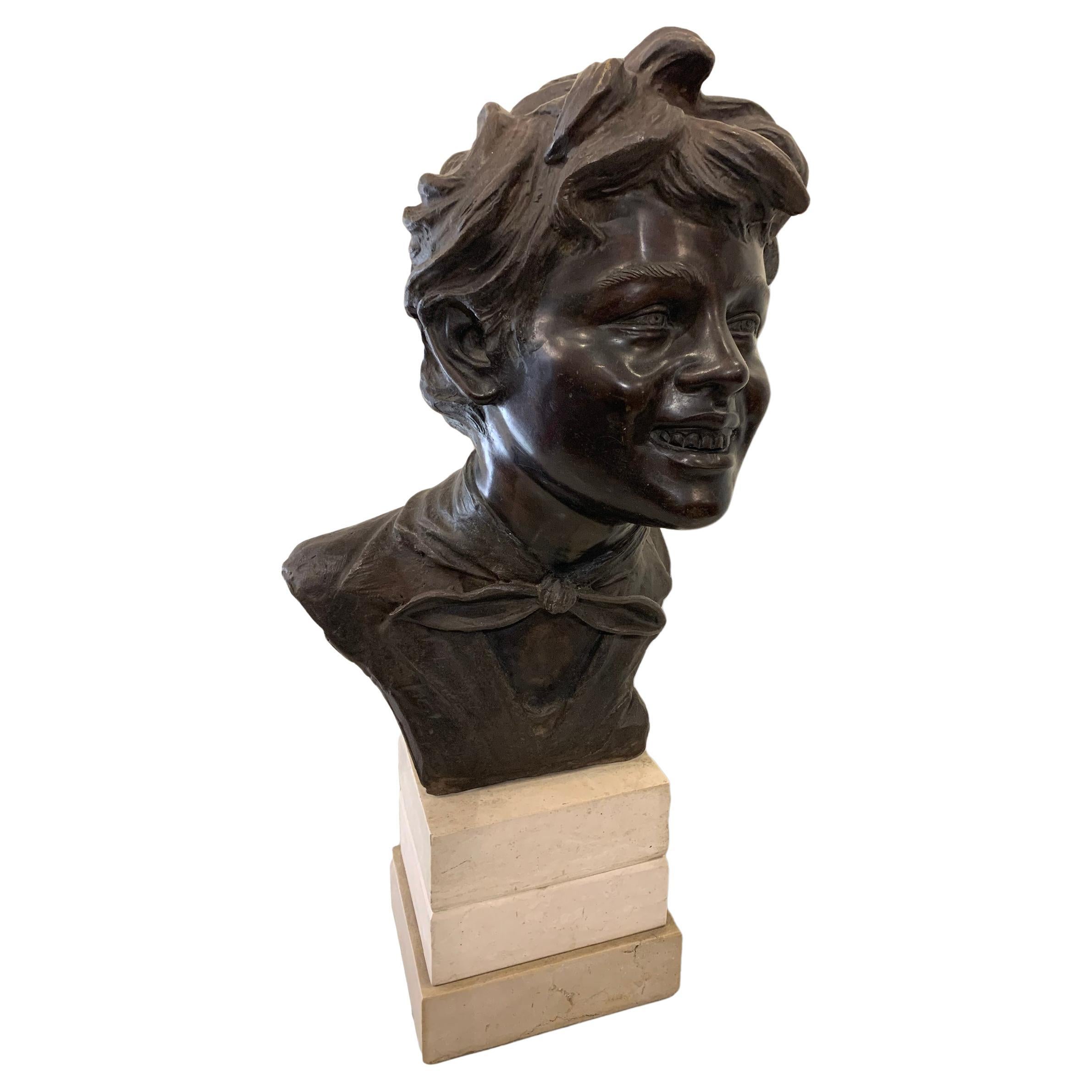
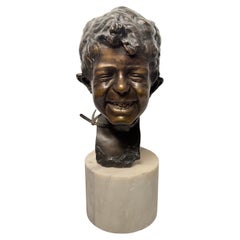
Bronze sculpture depicting head of Neapolitan street urchin - late 19th century
Located in Fidenza, IT
This 19th-century sculpture depicts the face of a Neapolitan street boy (scugnizzo in dialect), characterized by a cheerful, smiling expression. We can see the attention to detail in...
Category
Antique 19th Century Italian Figurative Sculptures
Materials
Carrara Marble, Bronze
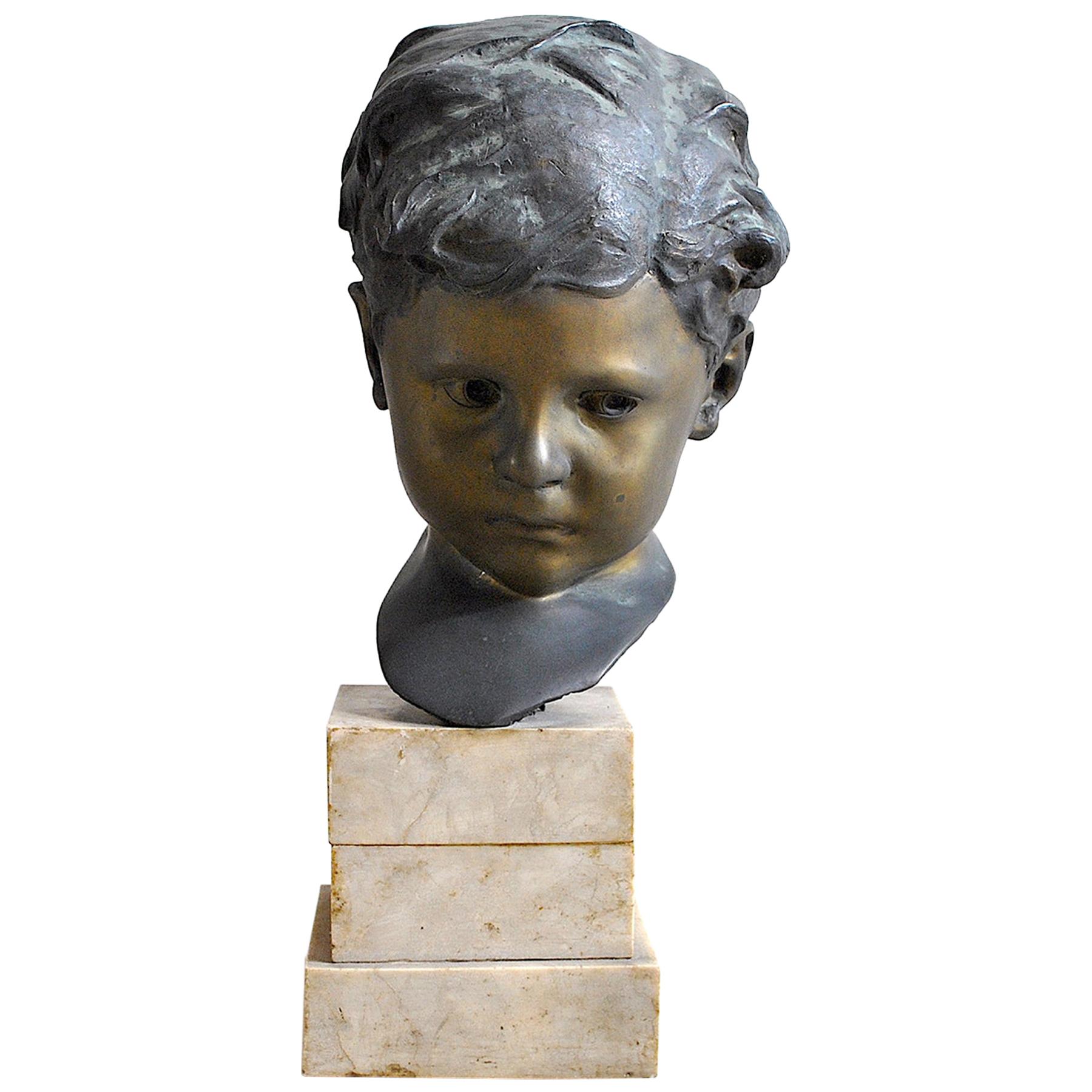
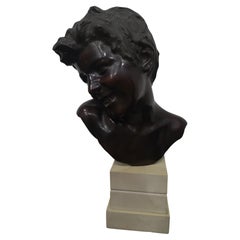
Scultura in bronzo Testa di giovane di Giuseppe Franzese inizi 900
Located in Catania, IT
Scultura in bronzo di Giuseppe Franzese dei primi del 900 che raffigura
la testa di un giovanotto su una base di marmo.
Le misure della scultura sono:
Altezza cm 30
Larghezza cm...
Category
Vintage 1920s Busts
Materials
Marble, Bronze
$1,420 Sale Price
20% Off
Bronze Head Sculpture
Located in Long Island City, NY
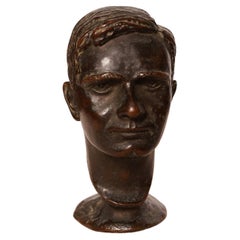
This bronze head sculpture signed by artist O. Ramsburg can be displayed as an elegant table top art piece.
Category
20th Century Mid-Century Modern Sculptures and Carvings
Materials
Bronze
$1,536
Early 20th Century, V. Cinque Bronze Sculpture
Scugnizzo
Located in Firenze, FI
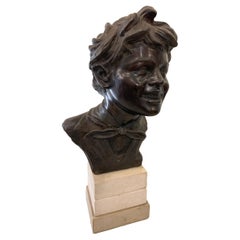
Beautiful lost wax cast bronze sculpture on a white marble base. It is signed by V. Cinque (1852-1929), part of the Neapolitan school of the early 1900s.
It depicts the classic Ne...
Category
Early 20th Century Italian Busts
Materials
Carrara Marble, Bronze
Bronze Casting from the 1930s Giovanni De Martino
By Giovanni De Martino
Located in bari, IT
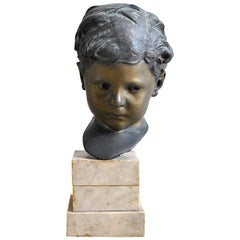
De Martino is a classical artist, known for the production of sculptures of small bronze busts, in particular (“scugnizzi”, fishermen, commoners) with realistic features.
He trained at the Academy of Fine Arts in Naples under the guidance of Stanislao Nome, Gioacchino Toma, and Achille D ’Orsi, from whom he learned the ability to portray the most realistic details using them on very young subjects. Very young he moved to Paris where he performed small sculptural groups, exhibiting frequently at the "Paris Salon" where he won the prize of the Louvre Museum for the bronze work Le Pêcheur de criquets (The Fisher of locusts, Naples, private collection).
Returning to Naples, he returned to a socialist realism and produced sculptures depicting characteristic Neapolitan types, especially urchins, “street urchins”, little boys and young fishermen. From 1916-1931 he was master of the sculptor Angelo Frattini.
Later the dominant theme of his production was childhood, in particular thoughtful, sad, gaunt children were represented in his works, on whose faces the signs of abandonment and suffering emerged. De Martino became known with the nickname of “The sculptor of children”.
Category
Vintage 1930s Italian Other Figurative Sculptures
Materials
Bronze
$757 Sale Price
20% Off
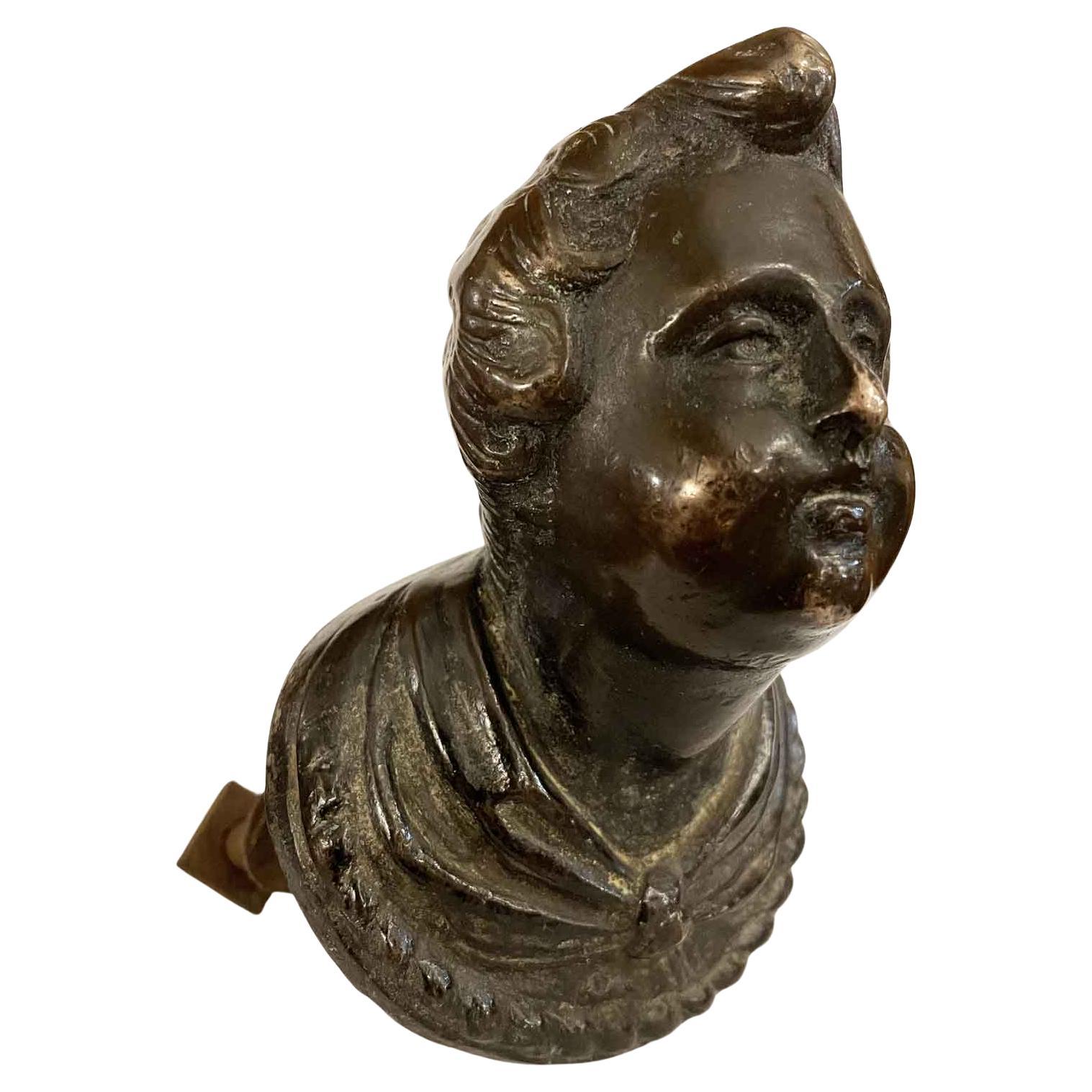
Figurative Knob in Bronze 1600 Italian Handle with Bust of Boy
Located in Milano, MI
Bronze Bust Of 1600s, cast depicting a young boy with curly hair and a gathered robe over his neck ending in an oval section with beaded border. This antique bronze knob of Italian ...
Category
Antique 17th Century Italian Baroque Figurative Sculptures
Materials
Bronze