Items Similar to Eagle Weathervane, ca 1852-1870, Waltham Massachusetts
Want more images or videos?
Request additional images or videos from the seller
1 of 9
Eagle Weathervane, ca 1852-1870, Waltham Massachusetts
$25,000
£18,993.83
€21,827.90
CA$35,115.57
A$38,222.41
CHF 20,252.69
MX$459,682.30
NOK 257,507.75
SEK 235,977.36
DKK 163,053.07
About the Item
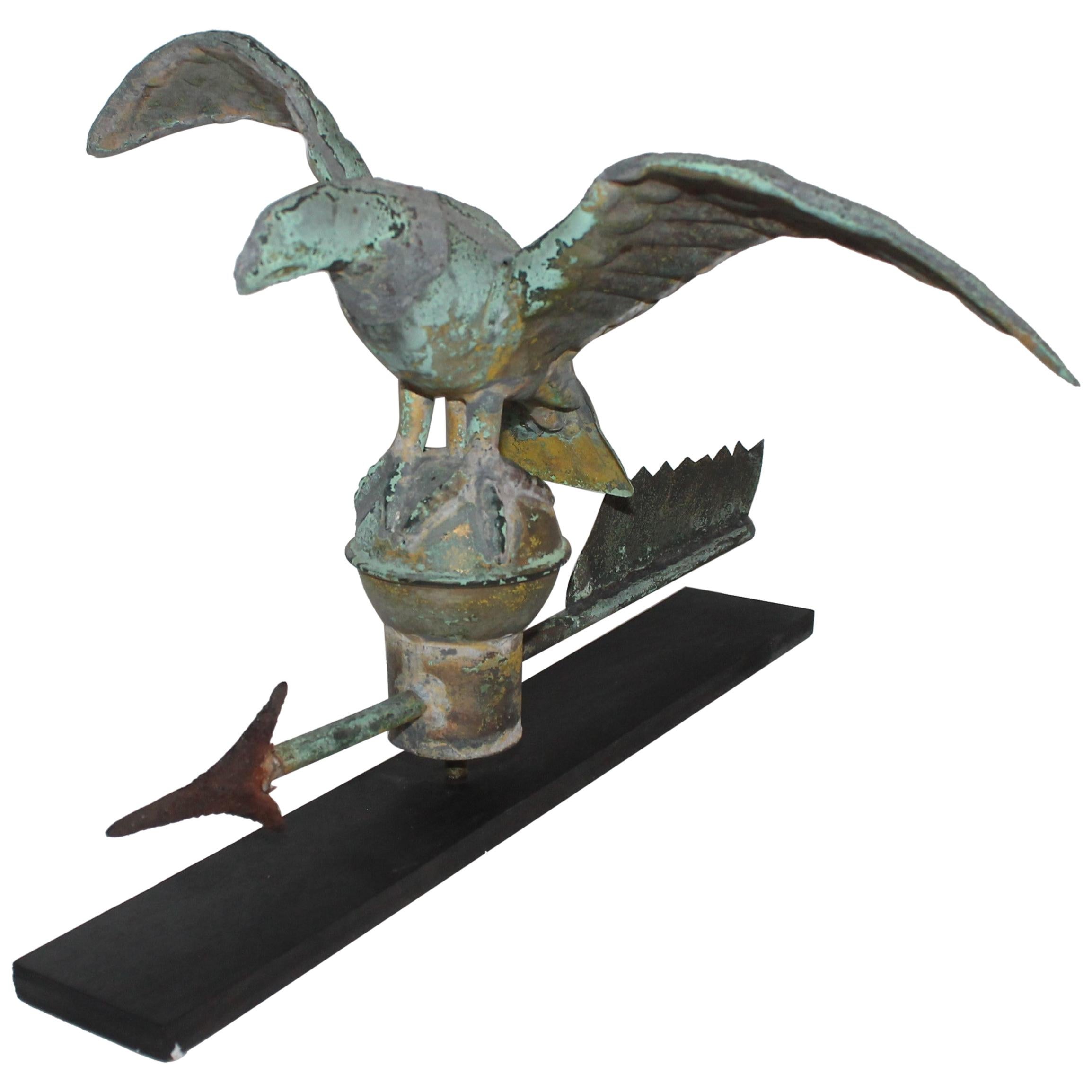
Eagle weathervane in a beautiful form with great folk presence, possibly made by A.L. JEWELL
CO. (1852-1867) or its predecessor, Cushing
White / L.W. Cushing (1867-1870’s), Waltham, Massachusetts:
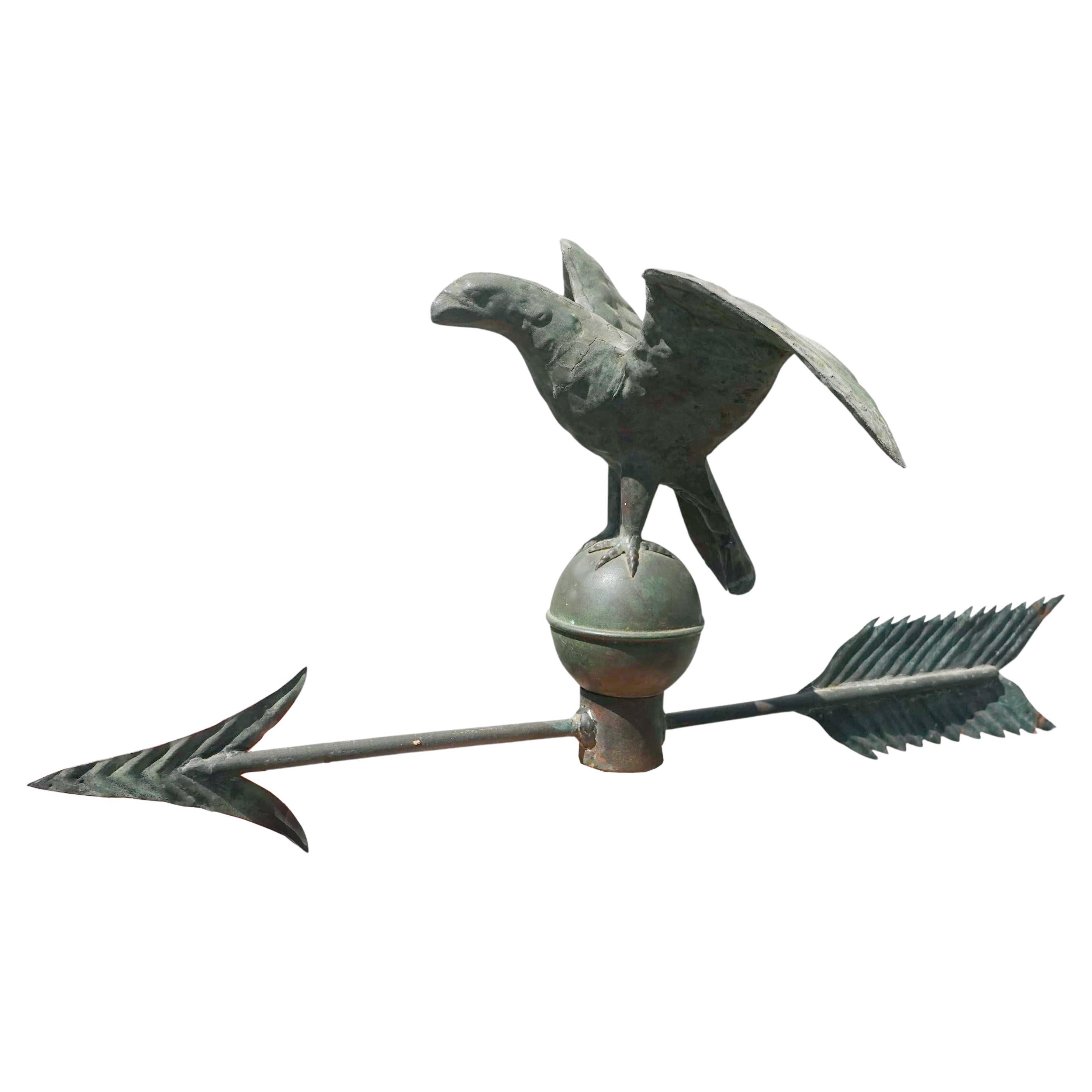
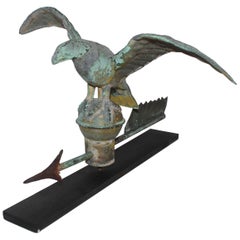
Eagle weathervane, made of hammered copper with a cast zinc head and talons, in a beautifully stylized, war-like form. The narrow, hollow body form is comprised of two mirror image sides, in typical fashion, with single sheet copper wings applied, bent as if poised for takeoff. With beak open and a curved tongue, the majestic bird is positioned as if perched on the copper ball beneath.
This basic form is universally attributed to A.L. Jewell
Co. of Waltham, Massachusetts, active 1852-1867, and known to have been produced in five sizes, measuring between 17 and 51 inches in length (Massachusetts Capital development Fund, Annual Report, 1979). According to American folk art expert Bob Bishop and co-author Patricia Coblentz (A Gallery of American Weathervanes
Whirleygigs, 1984 edition, Bonanza Books / Crown Publishers, p. 51), a similar form, slightly downward-facing, is known to have been produced in the 3rd quarter of the 19th century by Boston Metal-Workers Company.
The reality is that weathervane makers copied one-another extensively and maker’s marks were in no way standard practice. Of the three similar examples illustrated in weathervane reference text, two by Bishop
Coblentz (p. 50
51) and one by Charles Klamkin (Weathervanes, 1973, Hawthorne Books, New York, p. 88), none are alike. Two appear to be slightly downward-facing, yet two are attributed to A.L. Jewell and one to Boston Metal-Workers Co. The basic design is one that I have occasionally encountered over many years in the antiques trade, usually attributed to Jewell, who, if nothing else, can at least be said to have probably come up with the original design. Jewell was in on the ground floor of commercial weathervane production. This was a transitional period, bridging the gap between when weathervanes were largely singular and bench-made by anyone that could, during the first half of the 19th century and prior, and the emergence of large firms that mass-produced in the last quarter of the 19th century and afterwards. Jewell pioneered that field. In 1867, when Jewell and a business associate were killed in a work-related accident, the firm was acquired by Leonard Cushing, a civil engineer from Providence, Rhode Island, and Stillman White, a machinist. Both were of Waltham originally and took the opportunity to return. White left the company not long after and L.W. Cushing became the new name in 1872. While I have not encountered the form attributed to Cushing
White or featured in Cushing catalogues, it is certainly conceivable that the form continued to be produced, as the two men bought the designs with the business.
I previously acquired and sold a similar vane in this form, in another slight variant from the illustrated examples, with a cast iron head and talons. The one I am offering here is, yet again, not precisely like any of the above. The feathers differ slightly, as does the cast head, in zinc. Some have a hollow head, formed as simply an extension of the body, in molded copper.
Past the beautiful form, the most wonderful thing about this weathervane is its tremendous, early, weathered surface. Note the combination of green verdigris and black oxidation. All-in-all, a visually compelling bird with just the sort of legitimate patina that connoisseurs of early weathervanes hope to find.
Condition: Past the aforementioned verdigris and oxidation, there are a few minor breaks and bends in the wings. The ball was dented. I was able to work the ball back into its proper, spherical shape, from the interior. In doing so I created some surface loss on the exterior, mostly where creases were reversed. When this occurred, I applied a bit of black pigment to restore the immediately previous state of appearance.
- Dimensions:Height: 27 in (68.58 cm)Width: 27.5 in (69.85 cm)Depth: 14.75 in (37.47 cm)
- Materials and Techniques:
- Period:
- Date of Manufacture:1852-1870
- Condition:See Item Description.
- Seller Location:York County, PA
- Reference Number:Seller: wv-0521stDibs: LU849726478382
About the Seller
5.0
Recognized Seller
These prestigious sellers are industry leaders and represent the highest echelon for item quality and design.
Established in 1991
1stDibs seller since 2008
71 sales on 1stDibs
Typical response time: Several days
- ShippingRetrieving quote...Shipping from: York County, PA
- Return Policy
More From This Seller
View AllPressed Brass Eagle, Parade Flag Holder and Bunting Tie Back, ca 1880-1895
Located in York County, PA
Pressed brass eagle, an early parade flag holder & bunting tie-back, an especially attractive example, circa 1880-1895
Pressed brass eagles decorated the interiors of Civil War ve...
Category
Antique Late 19th Century American Political and Patriotic Memorabilia
Materials
Brass
Merino Sheep Weathervane, Attributed to A.J Harris
Co, Boston, ca 1875
Located in York County, PA
MERINO SHEEP WEATHERVANE, THE VERY BEST OF ITS KIND AND WITH PERHAPS THE BEST SURFACE THAT EXISTS ON SURVIVING EXAMPLES, ATTRIBUTED TO A.J. HARRIS & CO., BOSTON, circa 1875
This fan...
Category
Antique 1870s American Weathervanes
Materials
Metal
Price Upon Request
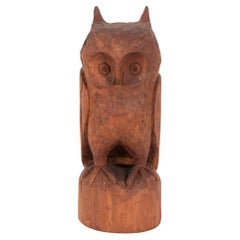
Carved Owl by Henry Winter, Setauket, New York ca 1920-1930
Located in York County, PA
CARVED OWL BY HENRY WINTER, SETAUKET, NEW YORK, circa 1920-1930's
Carving of an owl by folk artist Henry Winter (1897-1982) of Setauket (Long Island), New York, with pleasant, reddi...
Category
Mid-20th Century American Sculptures and Carvings
Materials
Wood, Softwood
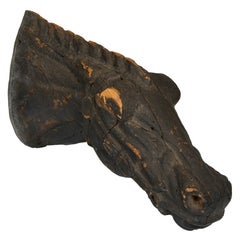
Horse Head Trade Sign, Last Quarter of the 19th Century
Located in York County, PA
An exceptional, painted American trade sign made from carved wood in the full-bodied form of a race horse’s head. Wonderful movement, tremendous f...
Category
Antique 19th Century American Folk Art Sculptures
Materials
Wood
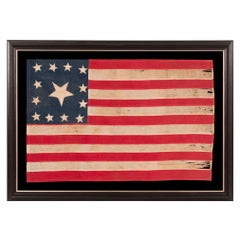
Rare 13 Star Civil War Flag in the Trumbull Pattern w/ 36 Stars on the Reverse
Located in York County, PA
EXTRAORDINARY CIVIL WAR ERA FLAG, WITH 13 HAND-SEWN STARS ARRANGED IN A VARIANT OF WHAT IS KNOWN AS THE TRUMBULL PATTERN, FEATURING A HUGE, UPSIDE-DOWN CENTER STAR, AND THE EXTREMELY...
Category
Antique Mid-19th Century American Political and Patriotic Memorabilia
Materials
Cotton
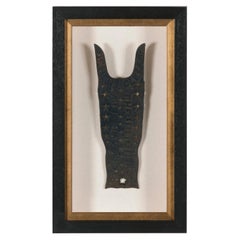
Cast Iron Boot Jack Made for 1864 Presidential Campaign of George McClellan
Located in York County, PA
CAST IRON BOOT JACK, MADE FOR THE 1864 PRESIDENTIAL CAMPAIGN OF GENERAL GEORGE B. MC CLELLAN, WITH A FANTASTIC SLOGAN THAT READS "THE UNION AT ALL HAZZARDS"
Made for the 1864 presidential run of George B. McClellan, this cast iron bootjack is both rare and graphically exceptional. Displaying the original black-painted surface, with attractive and desirable patina, the stylized profile has a wonderful folk art quality. Molded block letters that wrap around the heel clasp read simply "Gen. Mc Clellan. These are accompanied by a prominent Civil War-associated slogan: "The Union at all Hazards." The text is intermingled with 34 stars, which was equivalent to the number of states during the opening two years of the war, but was one star short by mid-1863 and two stars short by the time of the actual election in 1864. It's not unusual to encounter this feature in civil war campaign parade flags as well as all manner of flag-related ephemera.
The iron was reportedly cast by G. & D. Cross of Morrisville, New York, though it is unsigned and I have not yet verified the attribution. I have seen two other examples, one of which had a broken and repaired tine on the U-shaped horns and newly painted surface, while the other appeared to have broken lifters and inferior, rusted patina. This is, hands-down, the best of the identified examples.
Brief History of the 1864 Campaign:
President Abraham Lincoln had a checkered relationship with his 1864 opponent, who he had formerly chosen as General-in-Chief of the entire Union Army. The career officer repeatedly knocked heads with his Commander-in-Chief. Having raised a well-trained and organized military force, McClellan often seemed reluctant to use it. By 1862, after losses in Virginia during the Peninsula Campaign, Lincoln grew frustrated with McClellan and the progression of the war and removed him from command.
By the early part of 1864 the American people shared some of the same frustrations and Lincoln was no longer the clear choice for the White House. The nation was tired of war and the remains of the Democratic Party...
Category
Antique 1860s American Political and Patriotic Memorabilia
Materials
Iron
You May Also Like
47" Three Dimensional 19th Century Eagle Weather Vane
Located in Coeur d
Alene, ID
Copper eagle form weather vane. Very large, hollow body, spread wing eagle form with open beak, resting on a ball for support above a directional arrow. Rotating later iron base. Min...
Category
Antique 19th Century American Weathervanes
Materials
Copper
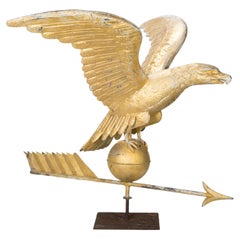
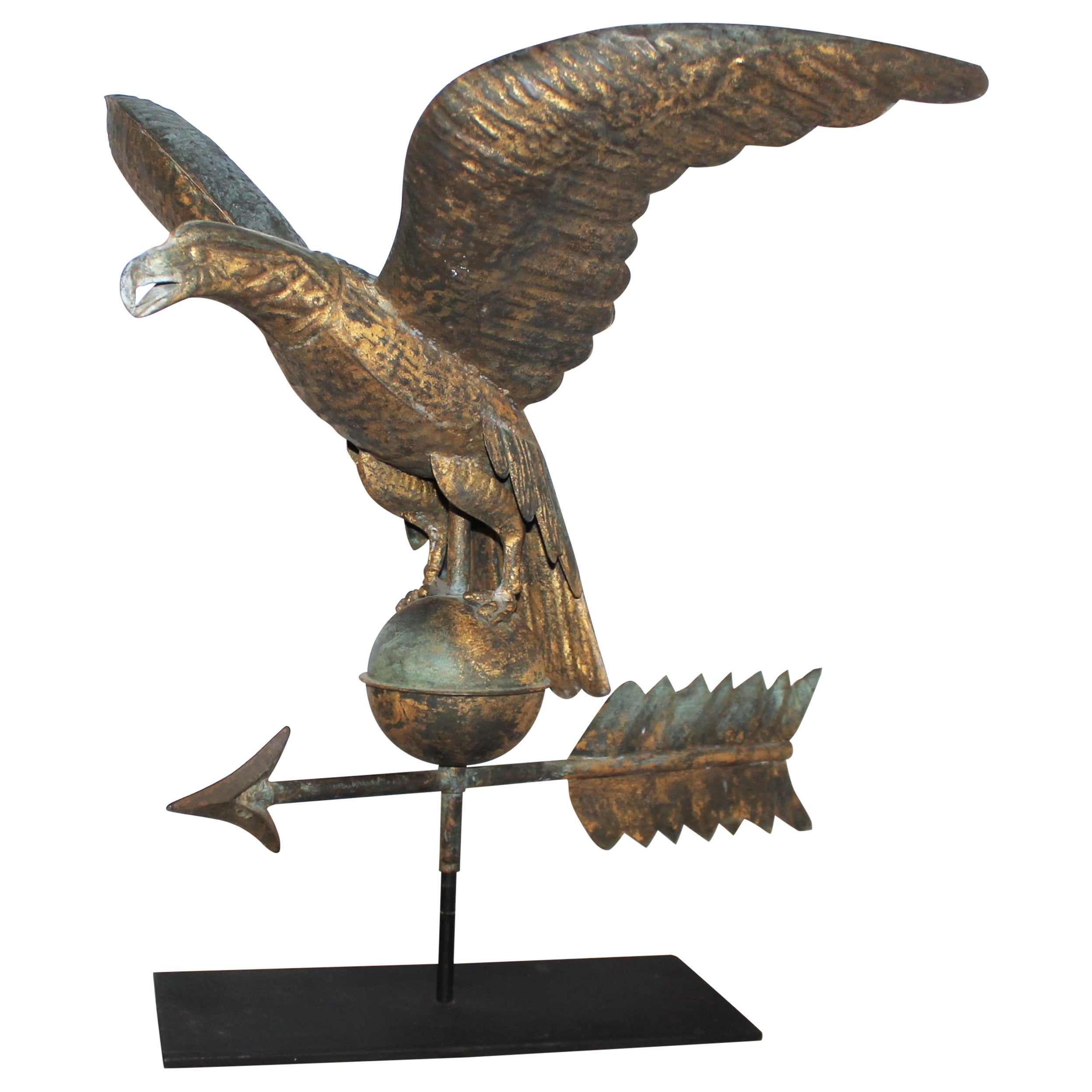
19th Century Eagle Weathervane, Attributed to Cushing
White
By Cushing and White
Located in Nantucket, MA
Full body molded copper spread wing eagle with cast zinc talons perched on a copper sphere. Great proportions with outstretched wings, showing wonderful detailing to the body and win...
Category
Antique Late 19th Century American Folk Art Weathervanes
Materials
Copper, Zinc
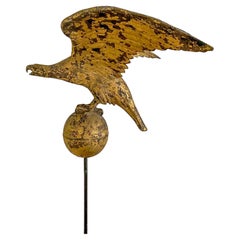
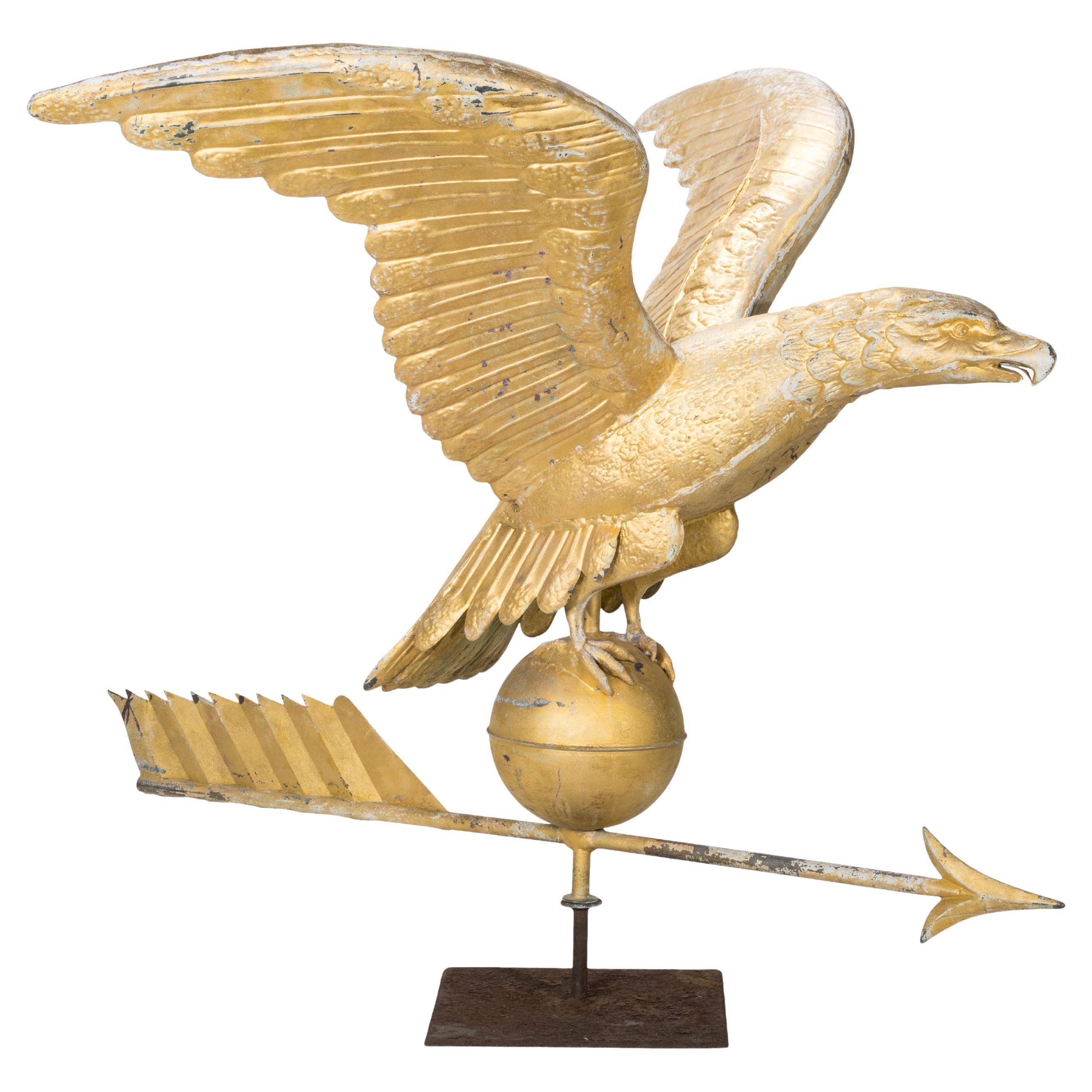
19th C Original Surface Eagle Weather Vane on Stand
Located in Los Angeles, CA
19th C original gilded surface full body eagle weather vane with the best undisturbed surface.The base is custom made iron stand.This eagle is attr...
Category
Antique 19th Century American Adirondack Weathervanes
Materials
Copper, Iron
$2,796 Sale Price
20% Off
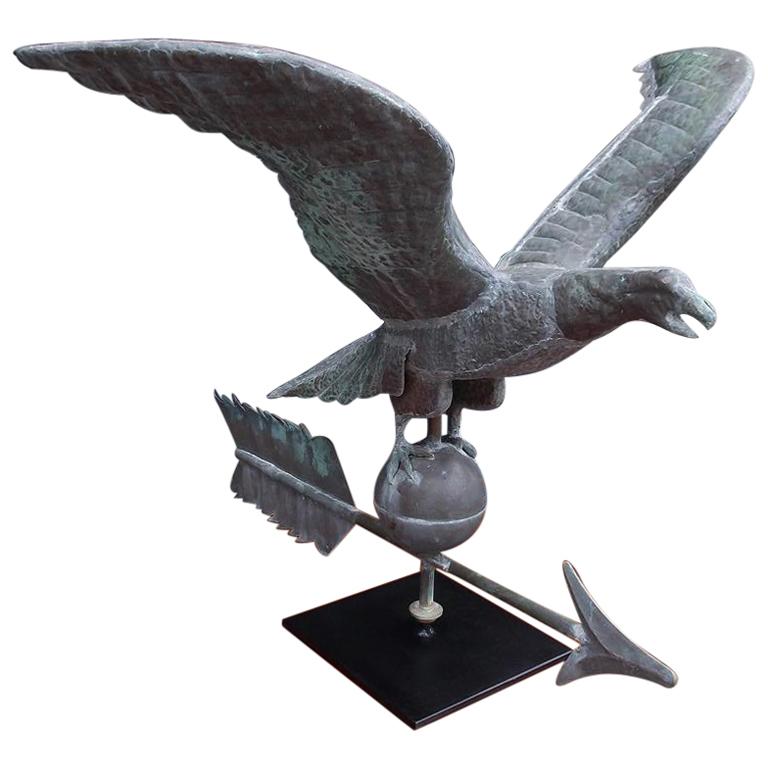
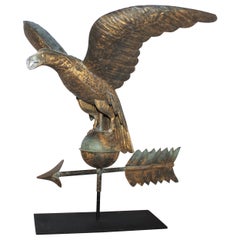
American Copper Spread Winged Eagle Weathervane with Sphere and Arrow, C. 1880
Located in Charleston, SC
American molded copper spread winged eagle weathervane with circular sphere, arrow, and mounted on cast iron squared base. Weathervane has a fine natural verdigris patina in the orig...
Category
Antique 1880s American Folk Art Weathervanes
Materials
Copper, Iron
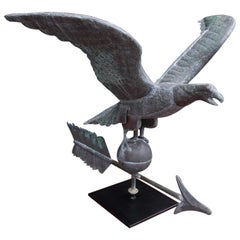
19th Century Mini Eagle Weather Vane on Stand
Located in Los Angeles, CA
19th century Mini eagle weather vane on stand with a great patina. This fine eaglet is in very good condition. The bottom feathers of the arrow are...
Category
Antique Mid-19th Century American Adirondack Weathervanes
Materials
Copper, Metal
$1,996 Sale Price
20% Off
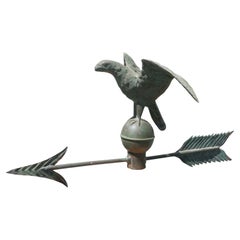
19th century Hollow Body Eagle Weather Vane
Located in Leesburg, VA
19th century Hollow Body Eagle Weather Vane
Anonymous
ca. 1870; probably New England area, USA
Copper
Approximate size: 11.5 (h) x 23.5 (w) x 16 (d) in.
This evenly patinated holl...
Category
Antique Late 19th Century American Folk Art Weathervanes
Materials
Copper
More Ways To Browse
Used Weathervanes
Antique Weathervanes
American Folk Art Cast Iron
Antique Furniture Massachusetts
Massachusetts Antiques
Eagle Weathervane
Used Furniture Waltham
Antique Metal Sheets
Running Horses
Used Weathervanes
Antique Weathervanes
Folk Art Rooster
Antique Copper Weathervanes
Weather Vane Used Weather Vanes
Antique Weather Vanes
Folk Art Weather Vane
Copper Weather Vane
Rooster Weathervanes