Items Similar to Pair 19th Century Japanese Imari Porcelain
Gilt-Bronze Torchere Candelabra
Video Loading
Want more images or videos?
Request additional images or videos from the seller
1 of 22
Pair 19th Century Japanese Imari Porcelain
Gilt-Bronze Torchere Candelabra
$18,950per set
$48,750per set61% Off
£14,458.38per set
£37,195.05per set61% Off
€16,459.73per set
€42,343.62per set61% Off
CA$26,634.43per set
CA$68,518.66per set61% Off
A$29,277.73per set
A$75,318.71per set61% Off
CHF 15,370.67per set
CHF 39,541.97per set61% Off
MX$348,133.29per set
MX$895,593.54per set61% Off
NOK 197,394.34per set
NOK 507,808.66per set61% Off
SEK 179,804.91per set
SEK 462,558.81per set61% Off
DKK 122,980.57per set
DKK 316,374.82per set61% Off
About the Item
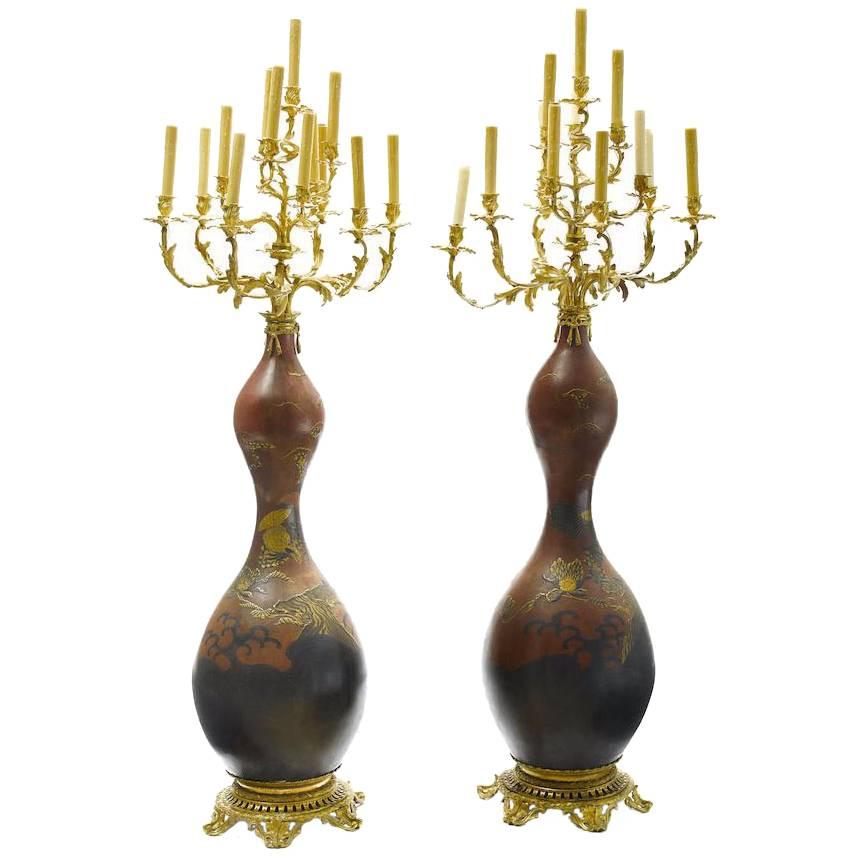
A fine Pair of 19th century Japanese Imari Porcelain and French Gilt-Bronze Mounted Thirteen-Light Celadon Torchere Candelabra. The bottle-shaped Japonisme vases with a Royal red background, decorated with parcel-gilt and black soaring eagles in the hunt within a forestall scene. Each Vase fitted and surmounted with a French 19th century Louis XV Style 13-Light scrolled candelabrum and all raised on a circular pierced gilt-bronze plinth. circa: 1880.
Imari Porcelain (????) is the name for Japanese porcelain wares made in the town of Arita, in the former Hizen Province, northwestern Kyushu. They were exported to Europe extensively from the port of Imari, Saga, between the second half of the 17th century and the first half of the 18th century. The Japanese as well as Europeans called them Imari. In Japanese, these porcelains are also known as Arita-yaki (???). Imari or Arita porcelain has been continously produced up through the present day.
Characteristics
Though there are many types of Imari, Westerners' conception of Imari in the popular sense is associated only with a type of Imari produced and exported in large quantity in mid-17th century. This type is called Kinrande. Kinrande Imari is colored porcelain with cobalt blue underglaze and red and gold overglaze. The color combination was not seen in China at that time. Traditional Ming dynasty color porcelain used dominantly red and green, probably due to scarcity of gold in China, whereas gold was abundant in Japan in those days. The subject matter of Imari is diverse, ranging from foliage and flowers to people, scenery and abstractions. Some Imari design structures such as kraak style were adopted from China, but most designs were uniquely Japanese owing to the rich Japanese tradition of paintings and costume design. The porcelain has a gritty texture on the bases, where it is not covered by glaze. There is also blue and white Imari. Kakiemon style Imari is another type of Imari, but it tends to be categorized separately in Europe.
History
"Imari" was simply the trans-shipment port for Arita wares. It was the kilns at Arita which formed the heart of the Japanese porcelain industry.
Arita's kilns were set up in the 17th century, when kaolin was discovered in 1616 by the immigrant Korean potter, Yi Sam-pyeong (1579–1655). (He may also be known by the name, "Kanage Sambei".) Yi Sam-Pyeong, along with his extended family of 180 persons, left Korea on the offer of a privileged position in Japan. This decision was made after the occurrence of certain Japanese invasions of Korea. After Yi Sam-Pyeong's discovery, his kilns began to produce revised Korean-style blue and white porcelains, known as "Shoki-Imari".
In the mid-17th century there were also a lot of Chinese refugees in Northern Kyushu due to the turmoil on Chinese continent, and it is said one of them brought coloring technique to Arita. Thus Shoki-Imari developed into Ko-KutaniImari. Ko-Kutani was produced around 1650 for both export and domestic market. Blue and white porcelain continued to be produced and they are called Ai-Kutani. Ko-Kutani Imari for the export market usually adopted Chinese design structure such as kraak style, whereas Ai-Kutani for the domestic market were highly unique in design and are accordingly valued very much among collectors.
Ko-Kutani style evolved into Kakiemon style Imari, which was produced for about 50 years around 1700. Imari achieved its technical and aesthetic peak in Kakiemon style, and it dominated European market. Blue and white Kakiemon is called Ai-Kakiemon. Kakiemon style transformed into Kinrande in the 18th century. Kinrande used blue underglaze and red and gold overglaze, and later some other colors.
Imari began to be exported to Europe because the Chinese kilns at Ching-te-Chen were damaged in the political chaos and the new Qing dynasty government stopped trade in 1656–1684. Exports to Europe were made through the Dutch East India Company, but the designation "Imari Porcelain" in Europe connotes Arita wares of mostly Kinrande Imari.
Export of Imari to Europe stopped in mid-18th century when China began export to Europe again, since Imari was not able to compete against China due to high labor cost. By that time, however, both Imari and Kakiemon style were already so popular among Europeans, Chinese export porcelain copied both Imari and Kakiemon style, which is called Chinese Imari. At the same time, European kilns, such as Meisen also tried to copy Imari and Kakiemon.
Export of Imari surged again in late 19th century (Meiji era) when Japonism flourished in Europe. Thus in western world today, two kinds of Imari can be found: that exported in the mid-Edo period, and that exported in the Meiji. From the viewpoint of collectors these two types are completely different, though Kinrande appearances are similar.
Nabeshima is the other category of Imari. Nabeshima is a kind of Imari produced in Lord Nabeshima's official kiln only for the official use of Lord Nabeshima throughout Edo period. As such, Nabeshima is characterized by its distinctively noble design.
In Japanese mythology has an eagle god, appearing in the "Nihon Shoki" and "Kogo Shui" as "Amenohiwashi-no-kami". Japanese ancestors felt a special respect for large birds like eagles and hawks. In Japanese culture, the eagle is a symbol of the great power of nature that has existed since ancient times.
Measures: Overall Height (to top of light bulb): 72 1/4 inches (183.5 cm)
Top of candelabra height: 64 1/4 inches (163.2 cm)
Diameter: 24 1/4 inches (61.6 cm)
Gilt-Bronze Base: 14 inches by 14 inches (35.6 cm by 35.6 cm).
- Attributed to:Imari Porcelain (Maker)
- Dimensions:Height: 72.25 in (183.52 cm)Diameter: 24.25 in (61.6 cm)
- Sold As:Set of 2
- Power Source:Plug-in
- Voltage:110-150v
- Lampshade:Not Included
- Style:Japonisme (In the Style Of)
- Materials and Techniques:
- Place of Origin:
- Period:
- Date of Manufacture:circa 1880
- Condition:Additions or alterations made to the original: Electrified. Some old nicks, scratches, rubbing, wear and age discoloration to the porcelain vases as expected for their age and use. The gilt-bronze candelabra has had some minor restorations. Please view all images. Wear consistent with age and use. Minor losses. Minor fading. A truly beautiful and very impressive pair of torchere lamps. Overall condition is good with some age wear, scratches, slight discoloration and other as noted above. Finely decorated with fine attention to detail. Please view all images.
- Seller Location:Los Angeles, CA
- Reference Number:Seller: Ref.: A2127 - Lot 94691stDibs: LU1796233337312
About the Seller
5.0
Vetted Professional Seller
Every seller passes strict standards for authenticity and reliability
Established in 1982
1stDibs seller since 2016
137 sales on 1stDibs
Typical response time: <1 hour
- ShippingRetrieving quote...Shipping from: Los Angeles, CA
- Return Policy
More From This Seller
View AllPair 19th Century Japanese Porcelain and Gilt Bronze Mounted Torchere Floor Lamp
By Imari Porcelain
Located in Los Angeles, CA
A fine pair of 19th century Japanese porcelain and French gilt bronze mounted thirteen-light celadon torchiere, floor lamp candelabra. Wired for ...
Category
Antique 19th Century Japanese Rococo Floor Lamps
Materials
Bronze
Pair of 19th Century Gilt-Bronze
Faience Porcelain Table Lamp Candelabras
Located in Los Angeles, CA
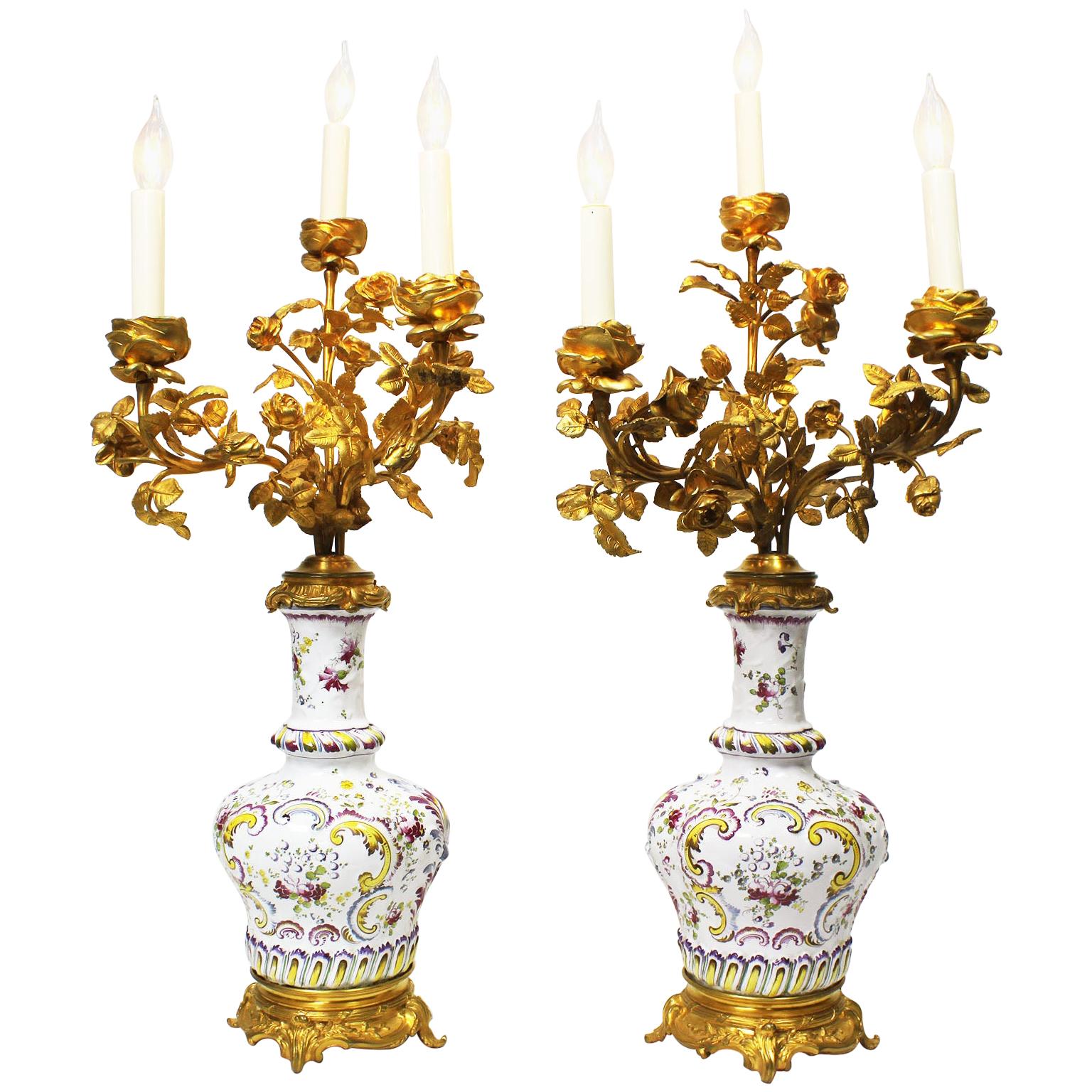
A fine pair of French 19th-20th century Louis XV style gilt bronze and Faience porcelain three-light candelabra table lamps. The ovoid porcelain urn hand decorated in floral burgundy...
Category
Antique Early 1900s French Louis XV Table Lamps
Materials
Bronze, Ormolu
Pair of 19th Century Rococo Ormolu
Griotte Marble Candelabra, Barbedienne
By Ferdinand Barbedienne
Located in Los Angeles, CA
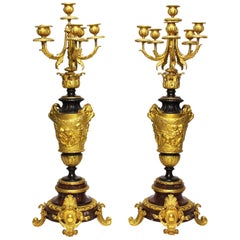
A fine pair of French 19th century Rococo Revival style gilt bronze and Rouge Griotte marble six-light candelabra attributed to Ferdinand Barbedienne (French, 1810-1892) After a mode...
Category
Antique Late 19th Century French Rococo Revival Table Lamps
Materials
Griotte Marble, Bronze, Ormolu
$12,950 Sale Price / set
30% Off
Pair of French 19th Century Louis XVI Style Ormolu
Marble Candelabra Beurdeley
By Alfred Emmanuel Louis Beurdeley
Located in Los Angeles, CA
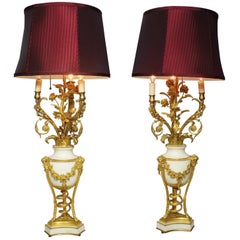
Alfred Emmanuel Louis Beurdeley (French, 1847-1919) A very fine pair of French 19th century Louis XVI style ormolu-mounted and white marble three-light candelabra (now electrified), ...
Category
Antique 19th Century French Louis XVI Table Lamps
Materials
Marble, Ormolu
$14,250 Sale Price / set
48% Off
Pair of French 19th Century Louis XV Style Marble
Ormolu Candelabra Henri Vian
By Henri Vian
Located in Los Angeles, CA
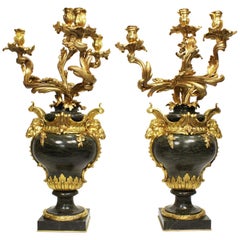
A very fine and palatial pair of French 19th century Louis XV style marble and gilt bronze mounted four-light figural candelabra by Henri Vian, (French, 1860-1905). The ovoid marble ...
Category
Antique 19th Century French Louis XV Candelabras
Materials
Marble, Bronze, Ormolu
$29,850 Sale Price / set
37% Off
Pair of French 19th Century Marble and Ormolu Mounted Candelabra Lamps
Located in Los Angeles, CA
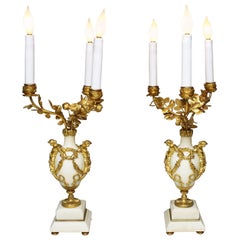
A fine pair of French 19th century marble and ormolu mounted figural urn three-light table lamp candelabra. The ovoid white marble body surmounted with a pair of mermaids holding han...
Category
Antique 19th Century French Louis XV Candelabras
Materials
Marble, Ormolu
$6,950 Sale Price / set
46% Off
You May Also Like
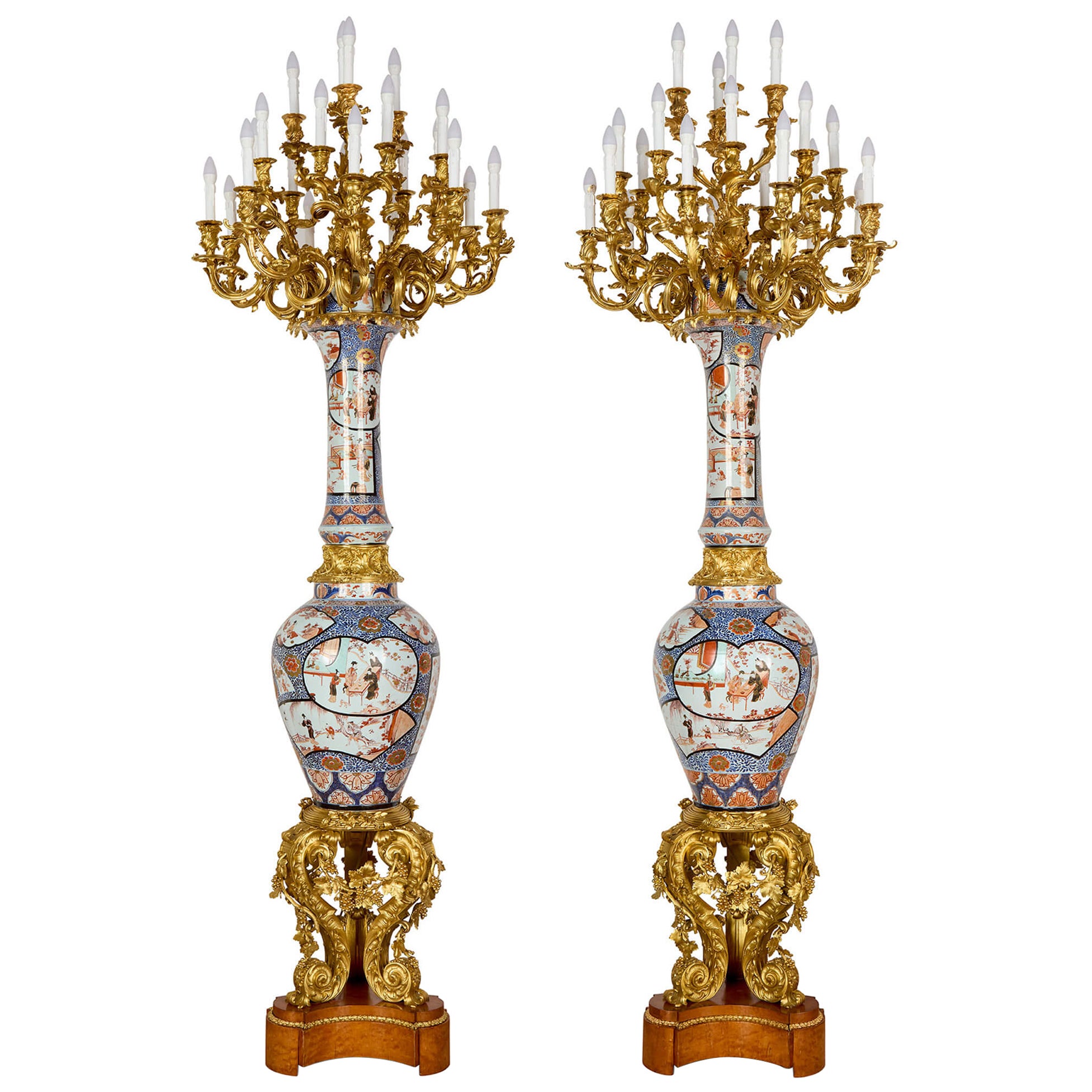
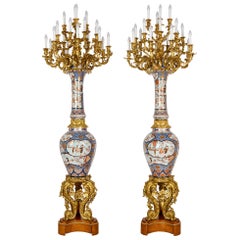
Pair of Monumental Large Japanese French Imari Porcelain Ormolu Candelabra
Located in London, GB
Pair of Monumental Large Japanese French Imari Porcelain Ormolu Candelabra
Porcelain: Japanese, 18th Century
Ormolu: French, Mid-19th Century
Height 260cm, diameter 86cm
This exce...
Category
Antique Late 18th Century Japanese Napoleon III Floor Lamps
Materials
Ormolu
Pair of Imari Lamps Mounted in 19th Century Bronze
Located in Marseille, FR
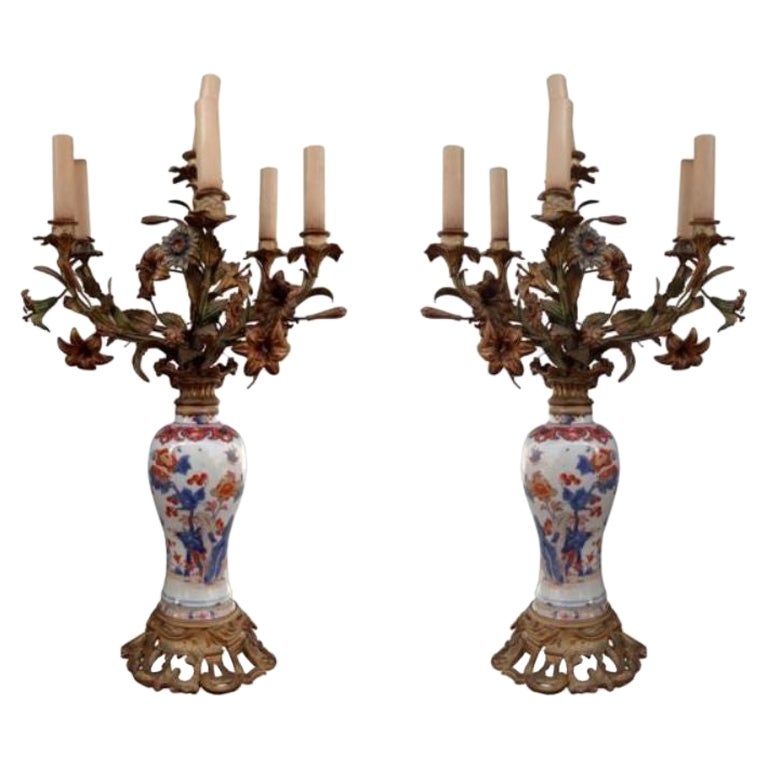
Pair of Arita porcelain lamp called Imari on gilt bronze frame decorated with flowers in polychrome sheet metal from the 19th century. Imari porcelain is a style of Japanese ceramics...
Category
Antique 19th Century Japanese Table Lamps
Materials
Porcelain
19th Century Pair of Imari Porcelaine Lamp Mounted Gilt Bronze
By Imari Porcelain
Located in Marseille, FR
19th century pair of porcelain lamp from Imari. Frame gilt bronze decorations of metal polychrome flowers.
Category
Antique 19th Century Chinese Chinese Export Ceramics
Materials
Porcelain
Pair of Chinese Porcelain and French Chinoiserie Style Gilt Bronze Candelabra
Located in London, GB
Pair of Chinese porcelain and French Chinoiserie style gilt bronze candelabra
Chinese and French, 19th Century
Height 72cm, width 47cm, depth 35cm
This superb pair of candelabra...
Category
Antique 19th Century French Chinoiserie Candelabras
Materials
Ormolu, Bronze
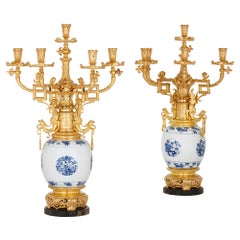
Pair of Japanese Export Cloisonné
Ormolu Candelabra Vases
Located in Los Angeles, CA
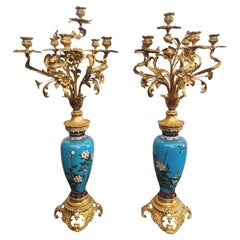
A pair of wonderful blue porcelain vases, having hand-made English Cloisonné enamel; each piece having six gilt-bronze ormolu candelabra sockets and botanical motif details.
The porc...
Category
Antique 19th Century English Candelabras
Materials
Bronze
Pair of Lamps in Imari Porcelain and Gilt Bronze, circa 1880
Located in Saint-Ouen, FR
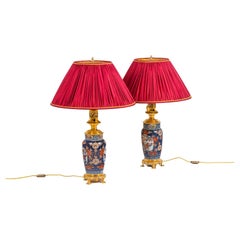
Pair of lamps in Imari porcelain with floral decor adorned with decorative bronze, ovoid shaped with neck. Frame in chiseled and gilt bronze standing on a circular quadripod base. La...
Category
Antique Late 19th Century Table Lamps
Materials
Bronze
More Ways To Browse
Antique Lamps Porcelain
Porcelain Lamps Pair
Antique Imari
19th Century Japanese Porcelain
Antique Imari Porcelain
Porcelain Hand Painted Lamps
19th Century Japanese Imari
Porcelain And Gold Lamps
French Porcelain And Bronze Lamp
19th Century Chinese Porcelain Lamp
19th French Porcelain Lamp
Lamps Black And Gilt Pair
17th Century Chinese Japanese Porcelain
Japanese Imari Porcelain 18th Century
Japan Imari Vase Blue Red Gold
Japanese Antique Lighting
White Lamps With Blue Flowers
Imari China