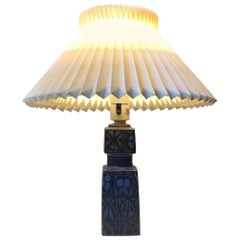
Items Similar to Blue Art Deco Table Lamp by Tyra Lundgren for ALP, Sweden, 1920s. Swedish Grace.
Want more images or videos?
Request additional images or videos from the seller
1 of 13
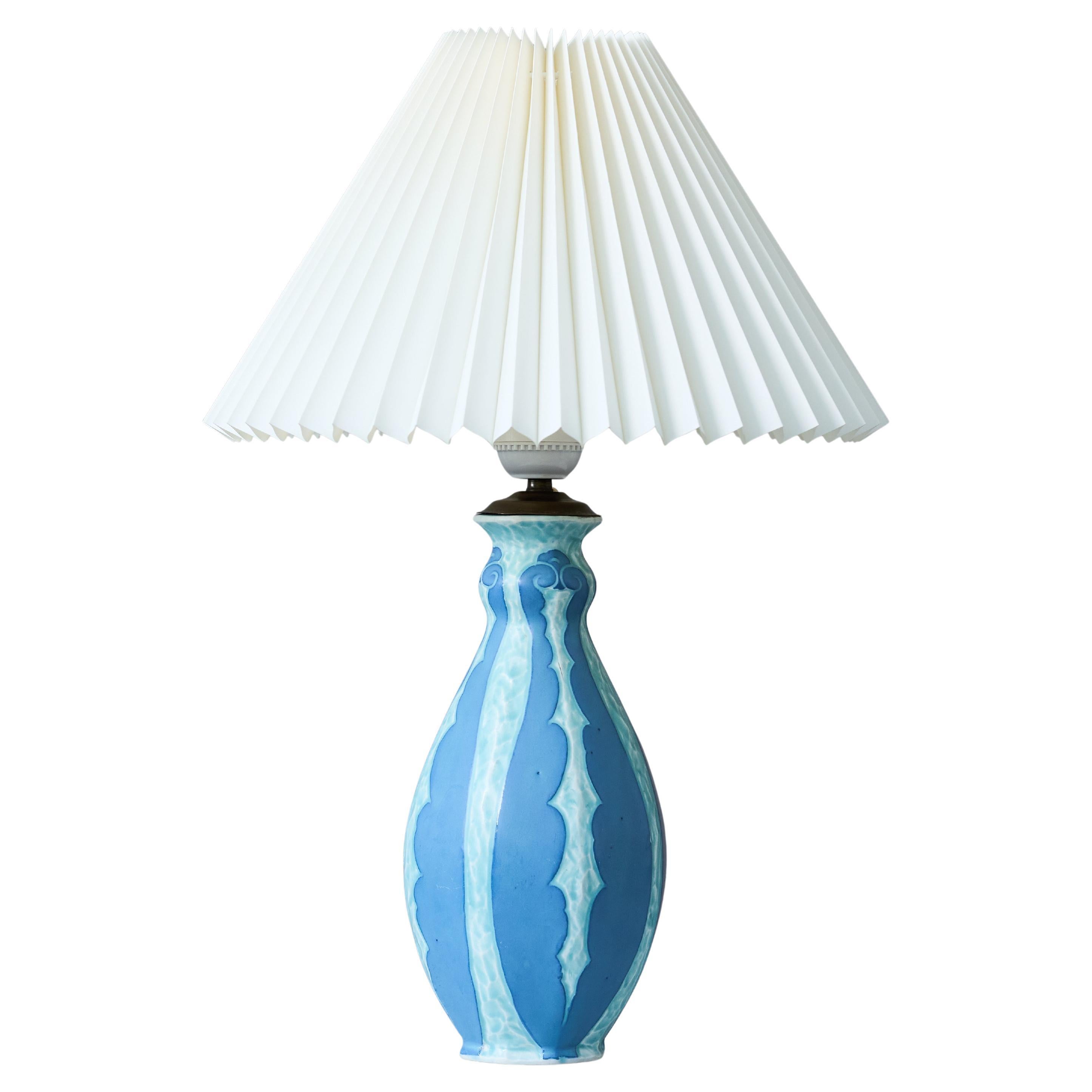
Blue Art Deco Table Lamp by Tyra Lundgren for ALP, Sweden, 1920s. Swedish Grace.
$2,271.38
£1,699.14
€1,895
CA$3,127.21
A$3,422.35
CHF 1,808.41
MX$40,848.03
NOK 23,077.60
SEK 21,106.34
DKK 14,437.76
About the Item
A stunning stoneware Swedish Grace / Art Deco table lamp. Amazing relief decor with hand-painted details in gold.
Attributed to Tyra Lundgren. This model was produced in the 1920s by both the factories ALP (Lidköpings Porslinsfabrik) in Sweden and Arabia in Finland, which at this time belonged to the same group of companies.
Great condition. No chips or cracks, but it has some crazing in the glaze.
Stamped 'MADE IN SWEDEN' and makers mark.
Sold without lampshade.
Dimensions of the lamp (without the shade):
Height (incl. the socket): 22,2 cm (8.74 in.)
Diameter: 15,5 cm (6.1 in.)
Light source: E26/E27 screw bulb.
Working original switch on the socket
Tyra Lundgren (1897-1979) was one of the most multifaceted artists and modernists of the twentieth century. She was a painter, drawer, sculptor, ceramist, glass- and textile designer, as well as an author and an art critic. She was the first woman who designed glass for Paolo Venini at Murano in Venice and she also served as the artistic leader at Arabia in Helsinki at a time when men tended to hold those kinds of positions.
Tyra Lundgren grew up in Djursholm, near Stockholm. Her parents were John Petter Lundgren, professor at Veterinärinstitutet (institute of veterinary sciences) in Stockholm, and Edith Lundgren née Åberg, who was a housewife and raised their six children. The bourgeois home also comprised a nanny and a female cook. The family were very socially active, travelled often, and enjoyed the outdoor lifestyle. Tyra Lundgren’s schooling began at Djursholm coeducational school, where her teachers included Natanael and Elsa Beskow and Alice Tegnér. Her school friends included Greta Knutson-Tzara, Stellan Mörner, and Ingrid Rydbeck-Zuhr.
Tyra Lundgren knew from the time she was five years old that she wanted to be an artist. She first became aware of the profession through Axel Fahlcrantz, who rented a studio on the plot of land where she lived with her family. In 1913 she began to attend Högre konstindustriella skolan (HKS, now known as Konstfack, college of arts, crafts and design) where she studied decorative art as well as handicrafts in various forms until 1917. One of her fellow students and friends there was Estrid Ericson, who later founded Svenskt Tenn AB in 1924. Whilst attending HKS Tyra Lundgren also took painting lessons at the Althin school of painting. In 1917 she was accepted as a candidate at the Royal Swedish Academy of Fine Arts where, apart from breaks during which she undertook studies abroad, she remained until 1922. She spent a couple of months taking lessons from Anton Hanak in Vienna and from 1920–1923 she was a student of André Lhote in Paris.
Tyra Lundgren was primarily active in four countries: Sweden, Finland, France, and Italy. She spent much of her professional life travelling and considered herself to be a European. Greece and Mexico also formed important centres in her artistic life, as did the USA. She had an extensive social network which included focal individuals within twentieth century-European and American artistic and cultural circles.
Tyra Lundgren’s main artistic motifs were birds, fish, and people which she depicted through different techniques and materials. Her artistic expression involved a variety of different directions and styles. She was a pioneer of the 1920s Swedish Grace style, the name of which had been coined by the art critic Morton Shand at the Stockholm Exhibition of 1930. This was a Swedish Art Deco style, characterised by elegance and traditional art which contrasted with the current artistic ideals of functionalism.
Tyra Lundgren made her debut at a group exhibition held at Kungliga Akademien för de fria konsterna in 1921. She went on to show her work at various exhibitions throughout the 1920s. After that period she only very rarely exhibited her paintings.
Tyra Lundgren’s painted output can be divided into different periods or stylistic directions. The first of these, and the most extensive, was her post-Cubist period which began in 1920 on her arrival in Paris. Her paintings from this time and right up to the mid-1930s typically comprise portraits, self-portraits, live-model painting, still-lifes, interiors, and landscapes in the Cubist style. Many of the great number of self-portraits she painted were produced in the New Objective style, displaying broad variation in terms of clothes, poses and techniques. Two of these – Huvud med vit duk and Självporträtt both from 1921 – can be seen at Moderna Museet in Stockholm, although the majority of these works are at Gotlands Museum.
Tyra Lundgren’s second artistic period comprises the years of 1927 to 1929 and is characterised by the New Objective style inspired by medieval techniques and materials (Giotto, Piero della Francesca). Her motifs were still-lifes and landscapes. At this point she was living in Rome and was close to the circle involved in the Valori plastici: rivista d’arte art journal. This period saw a breakthrough in her development as a painter. From the 1950s through the 1970s her work can almost be described as belonging to the Concrete style. Using light pastel colours her paintings sought light in a sometimes non-figurative expression, but often depicting abstract bird-shapes or other nature-inspired imagery. Her paintings from this period are outsized and display powerful colours, in yellows, reds, and blues.
Tyra Lundgren maintained a constant production of drawings, both in terms of individual artworks and sketches for patterns and designs. She also produced the illustrations for her book Fagert i Fide. Årstiderna på en gammal gotlandsgård, published in 1961. During her early years she also produced advertising illustrations. She spent the final years of her life primarily working with lithographs which were printed at Galleri Prisma and depicted images of doves, swallows, magpies and crows.
Tyra Lundgren is meanwhile best known for her work as a ceramist and in this sphere she was one of Sweden’s leading exponents. She worked in the porcelain industry as a designer and as an artisan and ceramic sculptor. Her first job was at St Eriks Lervarufabrik in Uppsala from 1922–1924, she then worked at Arabia from 1924–1937, and at Rörstrand and Lidköping Porslinsfabrik. She was the artistic leader at Arabia ahead of the 1930 Stockholm Exhibition and she exhibited her work at the World’s Fairs. During the 1934–1938 period she was connected to the Manufacture nationale de Sèvres porcelain factory in Paris.
Tyra Lundgren was a pioneer when it came to giving ceramic art a public space in Sweden. She produced around 20 outsized reliefs in stoneware, so-called monumental reliefs. One of these is Märkeskvinnor, from 1947, for the former girls’ school at Bohusgatan in Stockholm. From the 1940s onwards Tyra Lundgren produced sculptural objects in Chamotte clay and stoneware, with various glazings. Her small birds are well-known and popular with many. When her ceramic efforts became too much for her during the 1970s she then produced models for sculptures in bronze. There are six of these in various places around the globe, including Solfågel in Almedalen, Visby.
Tyra Lundgren began to work as a glassware designer at Moser in Karlsbad in 1922 where she designed new table services and modernised older ones. She also worked freelance for Riihimäki factory in Finland during the 1924–1929 period. From 1934 to 1938 she was employed by Kosta glass factory where she mainly designed thick-walled bowls and vases, engraved with classical motifs. She was introduced to the glassmaker Paolo Venini at Murano during the Triennale di Milano of 1936 and they began a collaboration that lasted into the 1950s. As part of this collaboration Tyra Lundgren became the first woman to design glassware and, in conjunction with the glassblower Arturo Biasutto, she developed new techniques of glass production. Her motifs at this point were birds, fish, snail-shaped designs and leaf-patterned bowls using traditional techniques as well as in new designs. It was during this time that she created the so-called tissue-shaped bowls and it remains unclear as to who specifically came up with the design but Tyra Lundgren claimed it was of her making.
Tyra Lundgren was active as textile designer for Licium (now HV Licium), the sacred textiles company, and for NK’s Textilkammare led by Astrid Sampe for which she designed 13 models. During the 1940s and 1950s printed flowery textiles were all the rage and Tyra Lundgren designed a number of patterns called Strelizior och duvor and Solrosor. She was also connected to Hemslöjden for which she designed woollen throws and other textiles. Tyra Lundgren was approached by Märta Måås-Fjetterström in 1937 and this led to a collaborative effort in textiles. Tyra Lundgren was also involved in the setting up of the MMF AB limited company after Märta Måås-Fjetterström’s death in 1941 and some of her tapestry patterns produced in her weaving studio, such as Trädet i Oaxaca.
During the first half of the twentieth century Tyra Lundgren was also an active art critic and writer. Through her close contact with Ingrid Rydbeck-Zuhr, editor of Konstrevy, she ended up providing regular articles for the journal. She also regularly wrote for Form during the 1930s and 1940s. Further to that she wrote a number of reports for Svenska hem i ord och bilder. She published three books of her own: Lera och eld. Ett keramiskt vagabondage i Europa, from 1946, Fagert i Fide. Årstiderna på en gammal gotlandsgård, from 1961, and Märta Måås-Fjetterström och väv-verkstaden i Båstad, from 1968, as well as the autobiographical exhibition catalogue Tyra Lundgren. Ett liv i konst, from 1978. She was awarded the Litteris et Artibus medal in 1950 in recognition of her extensive output and activities and in 1951 she was presented a gold medal at the Triennale di Milano.
Tyra Lundgren remained single throughout her long life and never had children. In 1949 she purchased Bredkvie farm on Gotland where she spent certain times of the year. Her friend, and fellow artist, Margit Graffman also had use of the farm.
Tyra Lundgren died in 1979 and is buried at Fide cemetery. Her tombstone is a framed stoneware relief decorated with a flower motif created by the artist. She left large parts of her artwork, papers, and personal belongings to the Gotlands Fornvänner association, which is now part of Gotlands Museums collections.
- Creator:
- Attributed to:Tyra Lundgren Carolina (Artist)
- Dimensions:Height: 8.75 in (22.2 cm)Diameter: 6.11 in (15.5 cm)
- Power Source:Plug-in
- Voltage:110-150v,208v,220-240v
- Lampshade:Not Included
- Style:Art Deco (Of the Period)
- Materials and Techniques:
- Place of Origin:
- Period:
- Date of Manufacture:1928-1932
- Condition:Wear consistent with age and use.
- Seller Location:Malmö, SE
- Reference Number:Seller: 9321stDibs: LU8317247175792
About the Seller
5.0
Platinum Seller
Premium sellers with a 4.7+ rating and 24-hour response times
1stDibs seller since 2023
166 sales on 1stDibs
Typical response time: <1 hour
- ShippingRetrieving quote...Shipping from: Malmö, Sweden
- Return Policy
More From This Seller
View AllBlue Art Deco
Sgrafitto
Table Lamp by Josef Ekberg. Gustavsberg, Sweden, 1920
By Gustavsberg, Rörstrand, rorstrand studio, Josef Ekberg
Located in Malmö, SE
A beautiful art deco stoneware table lamp with amazing glaze.
Made by Josef Ekberg for Gustavsberg, Sweden, 1920.
Great original condition. This is a vase made into a lamp.
Signed '...
Category
Vintage 1920s Swedish Art Deco Table Lamps
Materials
Ceramic, Stoneware
Blue Stoneware Table Lamp by Gertrud Lönegren. Rörstrand, Sweden, 1930s
By Gertrud Lönegren, Gunnar Nylund, Rörstrand, rorstrand studio, Gustavsberg
Located in Malmö, SE
A rare and beautiful stoneware table lamp with amazing decor.
Made by Gertrud Lönegren for Rörstrand, Sweden, 1930s.
Great original condition.
Signed 'GL', 'HANDDREJAD' and makers...
Category
Mid-20th Century Swedish Scandinavian Modern Table Lamps
Materials
Ceramic, Stoneware
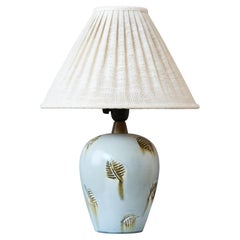
Blue Mid-Century Ceramic Table Lamp by Rolf Palm, Sweden, 1960s.
By Carl-Harry Stålhane, Gustavsberg, Gunnar Nylund
Located in Malmö, SE
A beautiful mid-century stoneware table lamp with amazing glaze.
Made by Rolf Palm, in the artist's studio, Mölle, Sweden, 1960s.
Great original condition.
Signed 'Palm'.
Sold wit...
Category
Mid-20th Century Swedish Scandinavian Modern Table Lamps
Materials
Ceramic, Stoneware
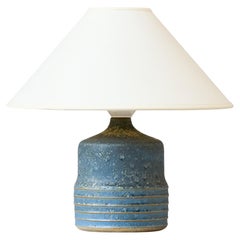
Erik Fleming, Art Deco / Swedish Grace Pewter Table Lamp, Sweden, 1932.
By Just Andersen, Norrahammars Tenn, Erik Fleming, GAB Guldsmedsaktiebolaget
Located in Malmö, SE
A beautiful and rare Swedish Grace pewter table lamp.
Designed by renowned silversmith Erik Fleming for Norrahammar Tenn, Sweden. Produced 1932.
Great condition with amazing patina,...
Category
Vintage 1930s Swedish Scandinavian Modern Table Lamps
Materials
Pewter
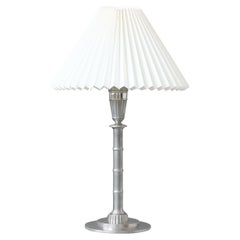
Large
Unique Lotte Lindahl Stoneware Table Lamp, Bing
Gröndahl Denmark 1930s
By Royal Copenhagen, Palshus, Bing
Grøndahl, Saxbo, Lotte Lindahl
Located in Malmö, SE
Unique and elegant stoneware table lamp with exceptional dark brown & black glaze.
The lamp was made by Lotte Lindahl at Bing & Grondahl, Copenhagen, Denmark, 1930s.
Great original...
Category
Mid-20th Century Danish Art Deco Table Lamps
Materials
Ceramic, Stoneware
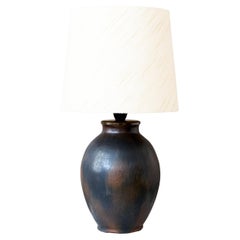
Scandinavian Art Deco Brass Table Lamp, 1930s.
By Arvid Böhlmarks Lampfabrik, Bohlmarks, Hans-Agne Jakobsson, Harald Notini, Nordiska Kompaniet
Located in Malmö, SE
An elegant Art Deco / Swedish Grace brass table lamp.
Made by an unknown designer and produced in Sweden or Denmark, 1930s.
Good original condition. Wear consistent with age and use...
Category
Vintage 1930s Swedish Scandinavian Modern Table Lamps
Materials
Brass
You May Also Like
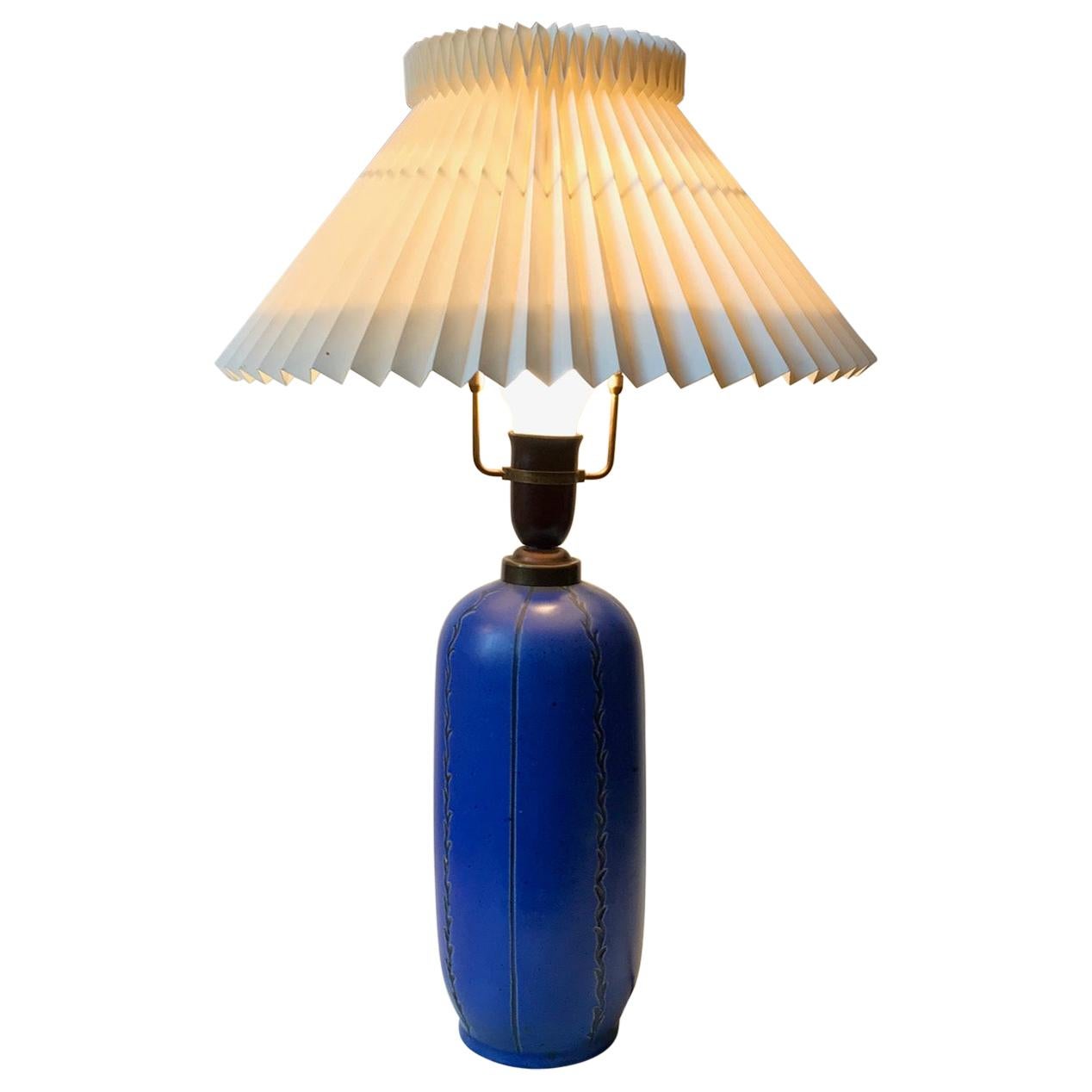
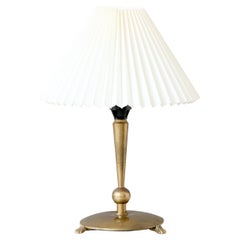
Blue Ceramic Art Deco Table Lamp by Søholm, Denmark, circa 1940
By Søholm Stentøj
Located in Esbjerg, DK
Perfect organically shaped ceramic table lamp by Søholm, Denmark. It has a vibrant blue glaze and is decorated with stripes and stylised branches. This light comes with its shade hol...
Category
Vintage 1930s Danish Art Deco Table Lamps
Materials
Stoneware
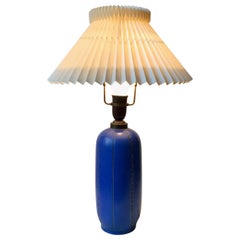
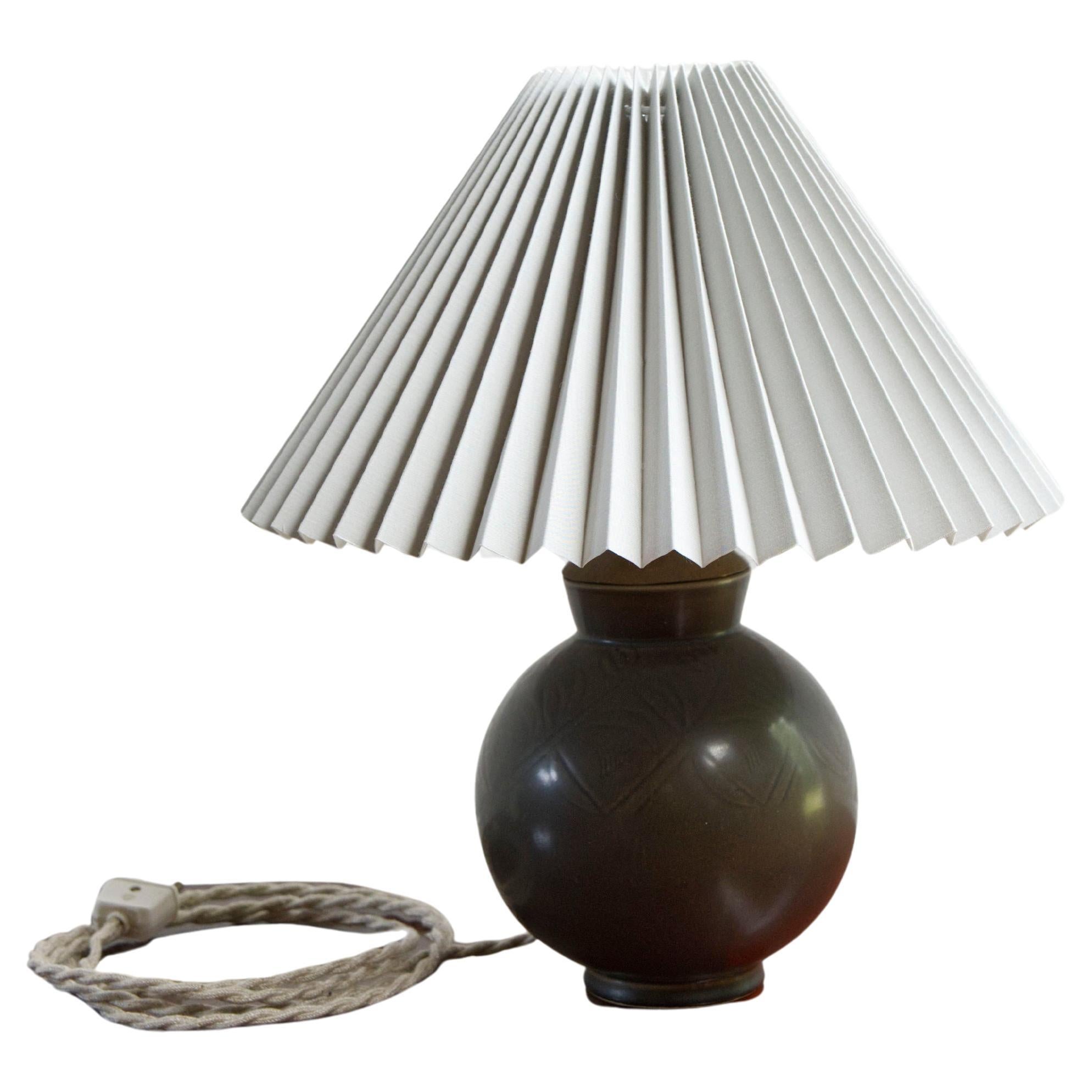
Art Deco Ceramic table lamp by Nils Thorsson for Aluminia Royal Copenhagen, 1950
By Aluminia, Nils Thorsson
Located in Balen, BE
A beautiful spherical ceramic table lamp by Aluminia, Royal Copenhagen. It originally was a vase by Nils Thorsson that had been transformed with a nice brass cap to a functional tabl...
Category
Vintage 1950s Danish Art Deco Table Lamps
Materials
Ceramic
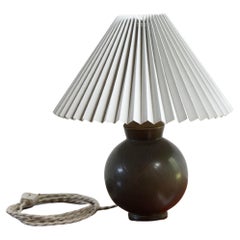
Art Deco Ceramic Organic Table Lamp by Upsala Ekeby, Sweden
By Upsala Ekeby
Located in Hillringsberg, SE
This wonderful ceramic Art Deco table lamp was made by Upsala Ekeby in Sweden, 1930s-1940s.
It has an incredible form and figure and nice glaze. The organic look makes it a nice edi...
Category
Vintage 1930s Swedish Art Deco Table Lamps
Materials
Brass
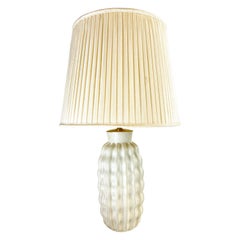
Le Klint Blue Table Lamp Stoneware Ole Bøgild Hand Folded Shade, Denmark, 1970s
By Le Klint
Located in Odense, DK
Elegant light blue table lamp made in the 1970s by Ole Bøgild for Le Klint, Denmark. The base is made from stoneware and is mounted with the original hand folded Le Klint shade. Wond...
Category
Vintage 1970s Danish Scandinavian Modern Table Lamps
Materials
Stoneware
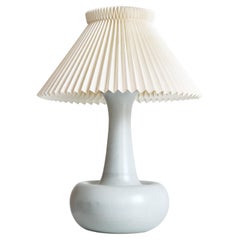
Søholm Stentøj Small Sculptural Blue Table Lamp by Einar Johansen, Danish 1960s
By Søholm Stentøj, Einar Johansen
Located in Silkeborg, Silkeborg
Sculptural mid-century Danish ceramic table lamp designed by Einar Johansen for Søholm Stentøj, Denmark. Made circa 1960s.
The lamp has a vivid glossy glaze in a dark blue with pa...
Category
Vintage 1960s Danish Mid-Century Modern Table Lamps
Materials
Stoneware, Plastic
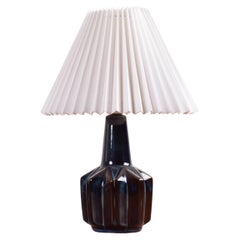
Blue Nils Thorsson Ceramic Table Lamp for Royal Copenhagen/Fog
Mørup, 1970s
By Nils Thorsson
Located in Esbjerg, DK
Ceramic table lamp designed by Nils Thorsson for Royal Copenhagen and Fog & Mørup, circa 1970. It features a tactile abstract decor with black on a almost purple tinted blue. The hei...
Category
Vintage 1960s Danish Mid-Century Modern Table Lamps
Materials
Ceramic