Video Loading
Want more images or videos?
Request additional images or videos from the seller
1 of 12

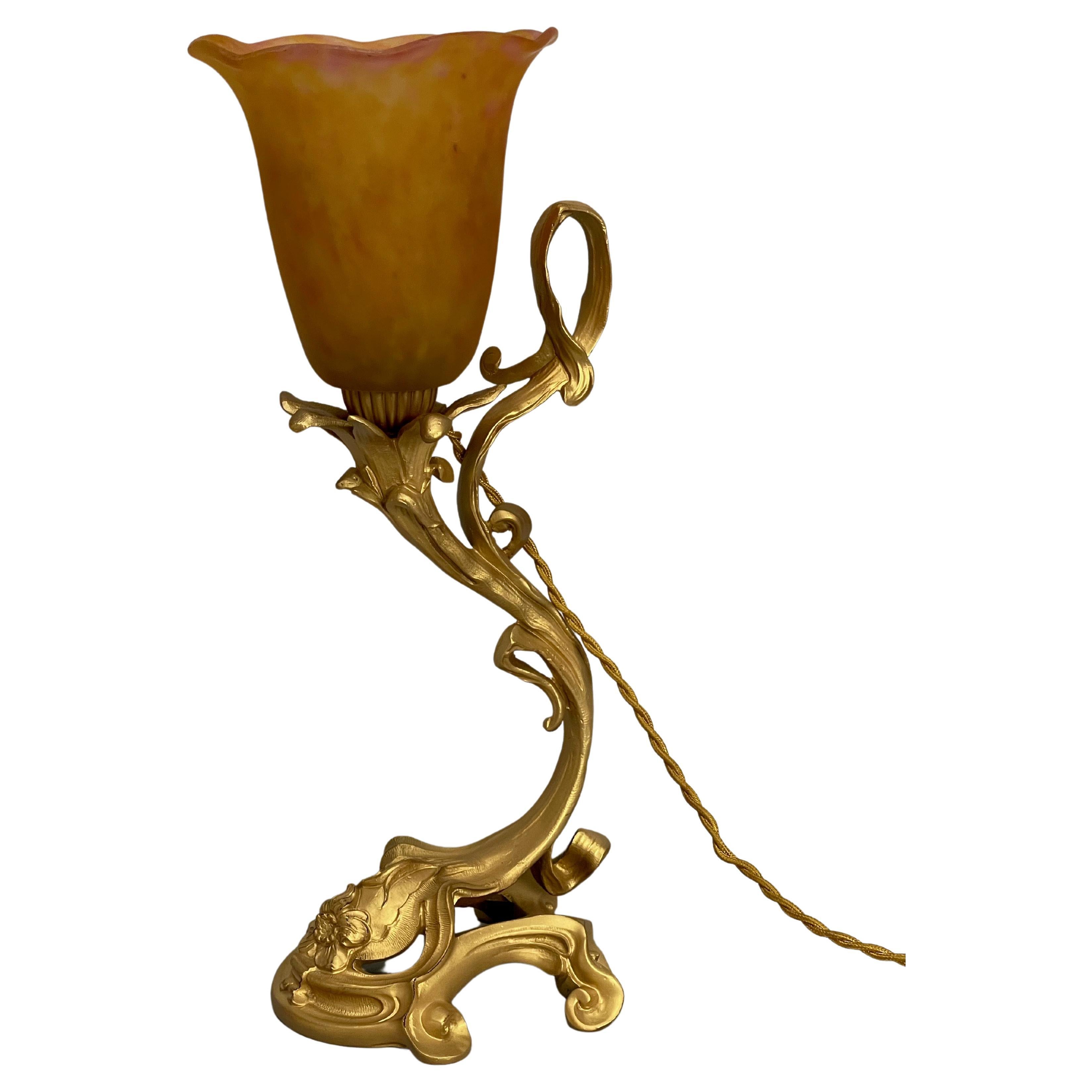
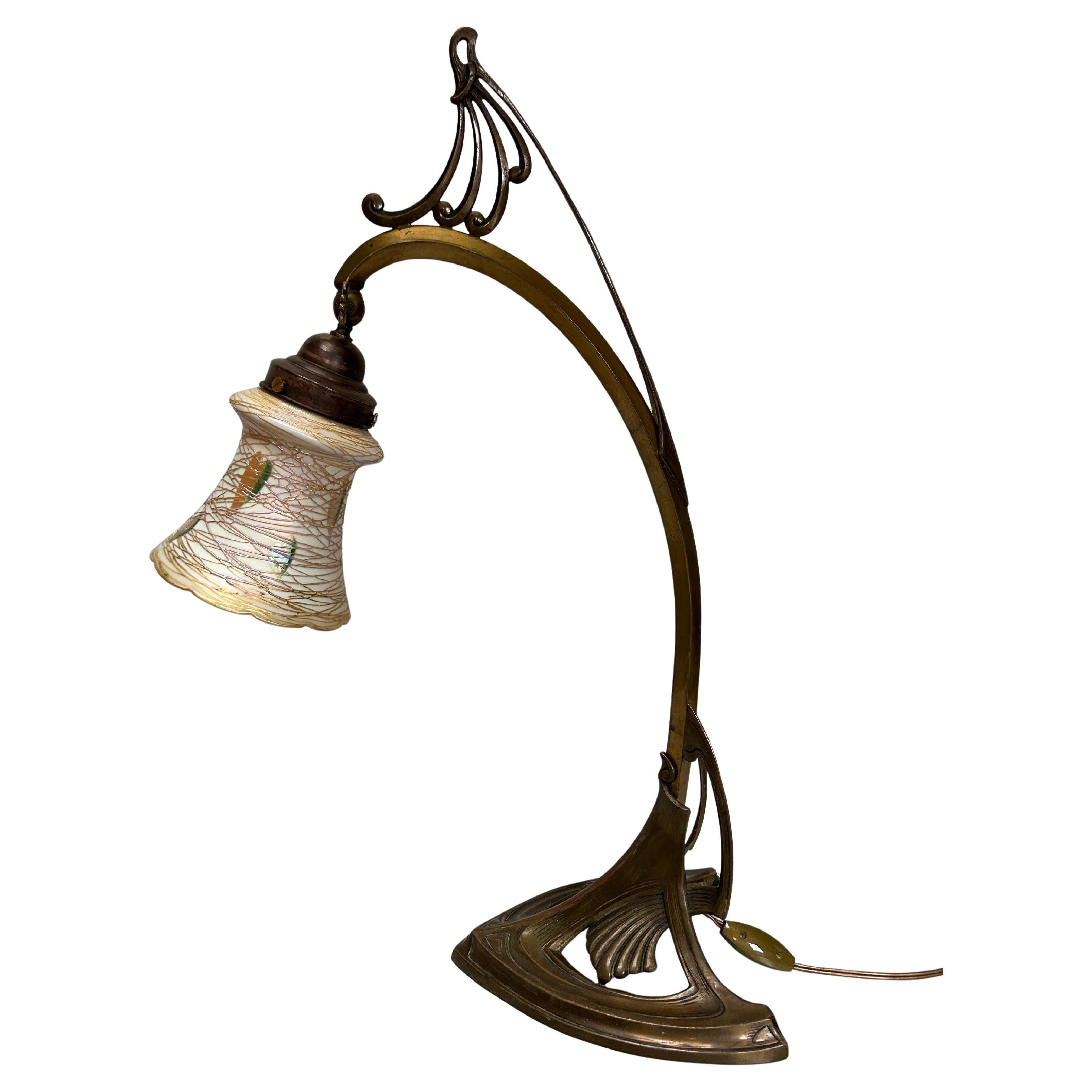
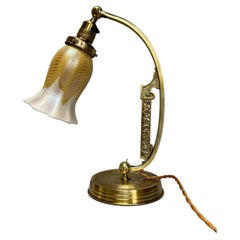
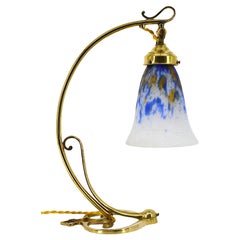
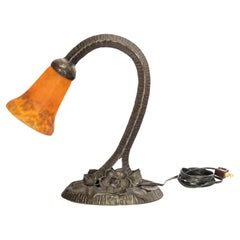
Daum Nancy Art Nouveau Lamp Probably by Majorelle

$3,559.67
£2,657.47
€3,000
CA$4,945.46
A$5,319.55
CHF 2,842.92
MX$62,702.31
NOK 35,842.57
SEK 32,766.91
DKK 22,863.37

About the Item

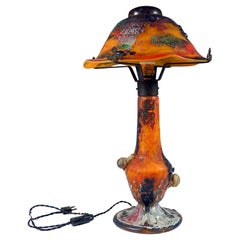
Art nouveau lamp circa 1900. Gilt bronze base probably by Louis Majorelle. Glass paste tulip signed Daum Nancy. In perfect condition. Electrified, B22 socket, bayonet bulb. Height: 40 cm Width: 10.5 cm Length: 19 cm Daum (French establishment created in 1878) is a glass and crystal workshop located in Nancy. Founded by the industrialist and notary Jean Daum, the workshop was then taken over by his sons Auguste and Antonin, who ran it during the Art Nouveau period. It was only from the 1900 Universal Exhibition that the company was at the forefront of the decorative art scene, when Daum received the prestigious Grand Prix medal. At this time, Daum glass became more complex, often using acid treatment in the cutting, enameling and engraving of a piece to produce glass masterpieces. Daum also made applied glass elements, such as handles and ornamental designs in naturalistic forms. The Daum brothers quickly became great names in Art Nouveau, rivaling the famous designer Émile Gallé, and established themselves as leaders in the field of decorative glass after his death. In 1906, Daum revived pâte de verre, a process in which glass is transformed into a paste, then applied to the surface of a mold and fired. This technique has its origins in ancient Egypt. Today, Daum is the only industrial crystal manufacturer that uses the pâte de verre process for its glass objects and crystal sculptures. Following World War I, Paul Daum began to develop works in the Art Deco style, moving away from naturalistic forms and turning towards linear, angular, simplified forms and geometric patterns characteristic of the movement. After World War II, Henri and Michel Daum became interested in the transparency of glass and pure lines. Daum collaborated with a large number of famous artists, such as Louis Majorelle, Salvador Dalí, Hilton Mac Connico, Elizabeth Garouste and Mattia Bonetti to create objects in glass paste. French cabinetmaker and designer 1859 - 1926 Louis Majorelle studied at the Ecole des Beaux-Arts in Paris from 1877, in 1879 he took over his father's furniture and ceramics factory. After the 1889 World's Fair, he abandoned the classical style and began to search for his own style. Louis Majorelle, French cabinetmaker, born in Toul in 1859 - Died in Nancy in 1926. He took over from his father Auguste (1825-1879), upon his death, interrupting his studies at the École des Beaux-Arts in Paris where he studied under Jean-François Millet. He was converted to Art Nouveau by Émile Gallé. He was the most important representative of the École de Nancy from 1894. His work is characterized by the use of naturalist elements in his forms and marquetry. He evolved towards simpler and more stripped-down forms shortly after his great success at the 1900 World's Fair and at the same time launched into mass production, which allowed him to quickly expand his catalog. He worked mainly with Jacques Gruber. He opened many exhibition stores, notably in Paris, Lyon and Oran, one of which he bought from Samuel Bing. His creations are sold all over the world. The more common furniture is the work of the workshops entrusted to Pierre Majorelle in Bouxières aux Dames in 1905 He continued in the same style after the war of 1914 despite the change in fashion towards Art Deco.
  • Creator:
    Daum (Manufacturer)
  • Attributed to:
    Louis Majorelle (Metalworker)
  • Dimensions:
    Height: 15.75 in (40 cm)Width: 7.49 in (19 cm)Depth: 4.14 in (10.5 cm)
  • Power Source:
    Plug-in
  • Voltage:
    110-150v,220-240v
  • Lampshade:
    Included
  • Style:
    Art Nouveau (Of the Period)
  • Materials and Techniques:
  • Place of Origin:
  • Period:
  • Date of Manufacture:
    1900
  • Condition:
  • Seller Location:
    NANTES, FR
  • Reference Number:
    1stDibs: LU7403240568712

More From This Seller

View All
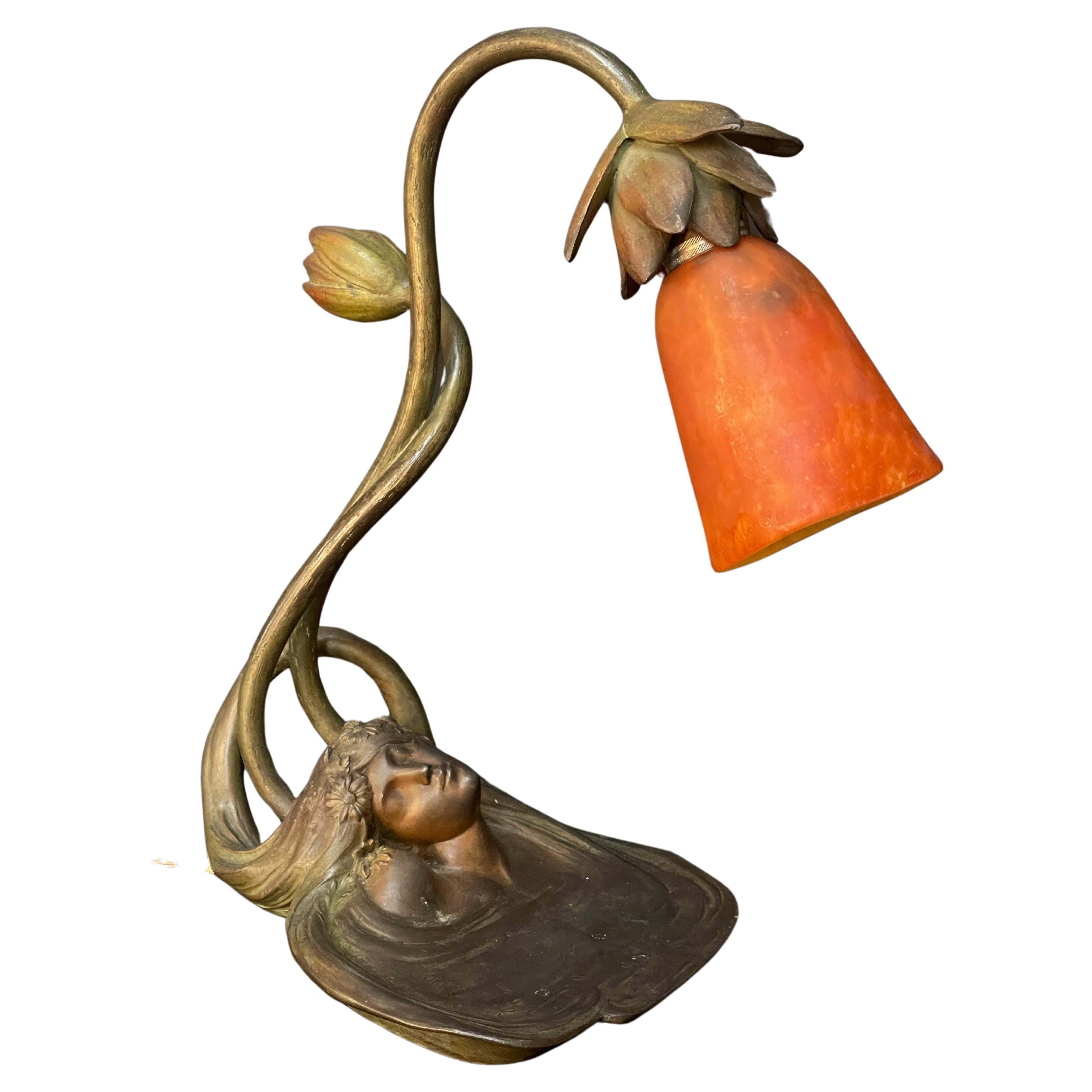
L. Bessin and Daum Nancy Art Nouveau Lamp
By Daum, Paul-Lucien Bessin
Located in NANTES, FR
Art Nouveau lamp circa 1900. Patinated regula representing a nymph, signed L. Bessin for Paul Lucien Bessin. Glass paste tulip signed Daum Nancy. Electrified and in perfect condition...
Category

Early 20th Century French Art Nouveau Table Lamps

Materials

Spelter

Art Nouveau Lamp by Victor Saglier and Daum Nancy
By Victor Saglier, Daum
Located in NANTES, FR
Gilt bronze lamp around 1900, probably by Majorelle executed by Victor Saglier. Stamped on the foot VS. Glass paste tulip signed Daum Nancy. Lamp electrified and in perfect condition. Total height: 38.5 cm - 15.15 in width: 15cm depth: 13cm weight: 2.3kg Victor Saglier (1809 - 1894) Victor Saglier is a ceramist and goldsmith known in particular for his creations in the Art Nouveau style of the late 19th century. He produces, among other things, objects in enamelled glass, gilded metal and numerous pieces of silverware. On his death, the company was bought by his brothers who continued production until 1948. Victor Saglier's objects are signed by the "VS" brand. Known for his Art Nouveau work, Saglier made several pieces for Louis Majorelle, Daum and Émile Gallé. Its style is typically French Art Nouveau in the language of the École de Nancy. He often drew inspiration from nature for his work, the logic of which helped design both forms and settings. The sign of master goldsmith Victor Saglier is an oval-shaped three-master sailboat surrounded by the letters V and S in a rectangle. Saglier made everyday objects such as glass vases, bowls and pitchers with metal mounts, planters, tea and coffee services and candlesticks in bronze or silver-yellow metal or cast zinc. On his death, the Victor Saglier company at 12 rue d'Enghien in Paris became Saglier Frères. It was run by his brothers Eugène and André until his death in 1948. Daum (French establishment created in 1878) is a glass and crystal workshop located in Nancy. Founded by the industrialist and notary Jean Daum, the workshop was then taken over by his sons Auguste and Antonin, who ran it during the Art Nouveau period. It was not until the Universal Exhibition of 1900 that the company was at the forefront of the decorative art scene, when Daum received the prestigious Grand Prix medal. At this time, Daum glass became more complex, acid treatment was often used in the cutting, enameling and etching of a piece to produce glass masterpieces. Daum also produces applied glass elements, such as handles and ornamental motifs in naturalistic shapes. The Daum brothers quickly became big names in Art Nouveau, rivaling the famous designer Émile Gallé, and established themselves as leaders in the field of decorative glass after his death. In 1906, Daum revived glass paste, a process by which glass is transformed into paste, then it is applied to the surface of a mold and fired. This technique originates from ancient Egypt. Today, Daum is the only industrial crystal manufacturer that uses the glass paste process for its glass objects and crystal sculptures. Following the First World War, Paul Daum began to develop works in the Art Deco style, moving away from naturalistic forms and turning to linear, angular, simplified forms and geometric patterns characteristic of the movement. After the Second World War, Henri and Michel Daum became interested in the transparency of glass and pure lines. Daum collaborates with a large number of famous artists, such as Louis Majorelle, Salvador Dalí, Hilton Mac Connico, Elizabeth Garouste and Mattia Bonetti to create glass paste objects.
Category

20th Century French Art Nouveau Table Lamps

Materials

Bronze

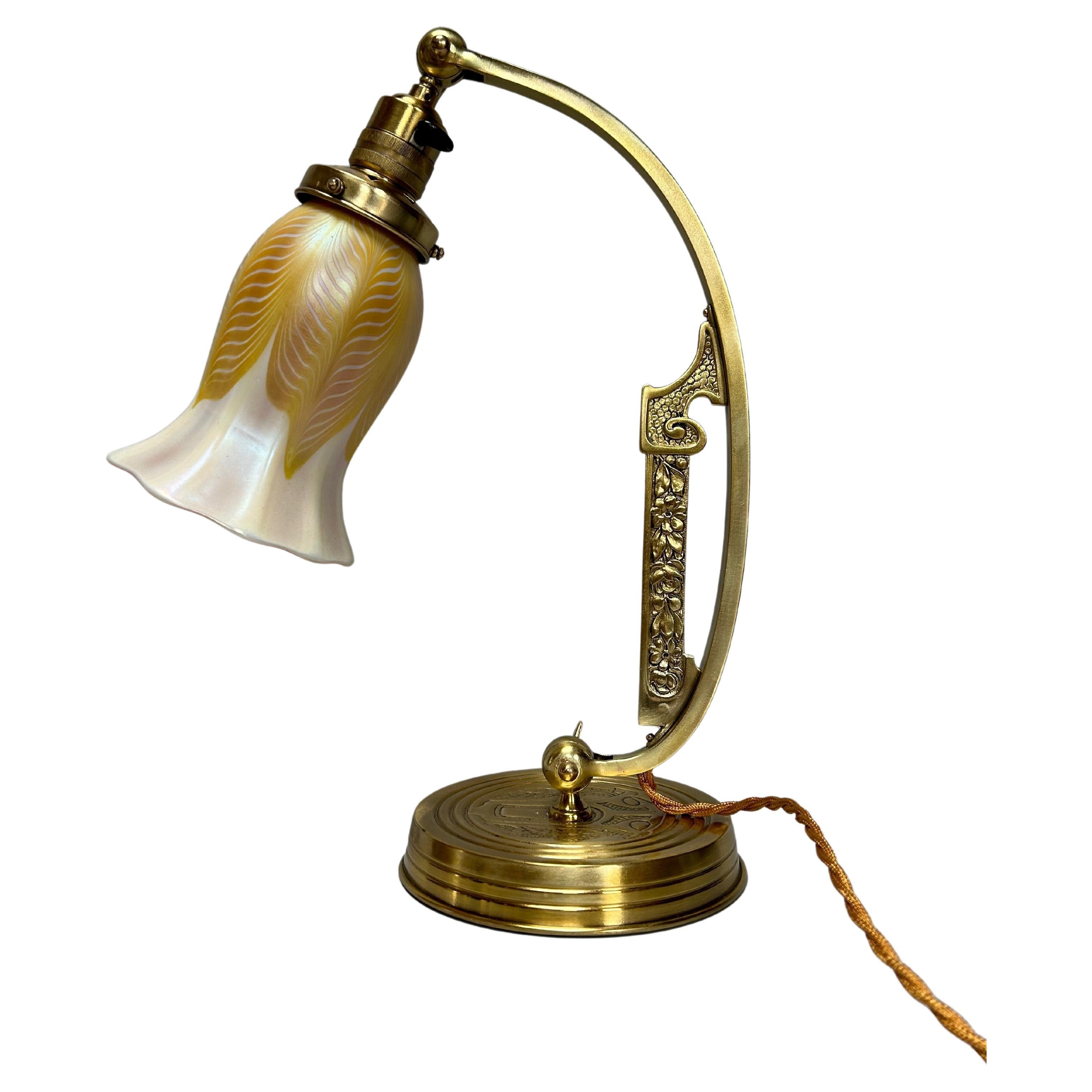
Quezal Art Nouveau Lamp
By Quezal
Located in NANTES, FR
Art nouveau lamp circa 1910. Brass and copper base. Iridescent glass tulip signed Quezal. In perfect condition and electrified. Total height: 38.5 cm Base diameter: 15.5 cm Width: 30 cm Quezal Art Glass Quezal Art Glass – The Journal of Antiques and Collectibles – April 2003 By Malcolm Mac Neil Some of the most beautiful and alluring art glass made in America during the early part of the 20th Century was made by the Quezal Art Glass and Decorating Company. Often in the shape of blossoming lilies with brilliant gold interiors and colorfully decorated with floral and other motifs inspired by nature, Quezal art glass ranks right alongside the iridescent glass of Louis Comfort Tiffany and Frederick Carder. Quezal artisans created an extensive range of decorative and useful items, including vases, compotes, finger bowls, open salts, candle holders, and shades for lighting fixtures, which are equivalent in terms of beauty and quality of craftsmanship to Tiffany’s Favrile and Carder’s Aurene glass. In recent years, glass collectors have discovered anew the special charms and appeal of Quezal art glass, and collector desirability for this lovely glassware has increased dramatically. The Quezal Art Glass and Decorating Company was incorporated a century ago, on March 27, 1902. It was founded by Martin Bach, Sr., Thomas Johnson, Nicholas Bach, Lena Scholtz, and Adolph Demuth. The factory was located on the corner of Fresh Pond Road and Metropolitan Avenue in Maspeth, Queens, New York. In October 1902, the trademark “Quezal” was successfully registered. By 1904, roughly fifty glassworkers were employed at the works. Martin Bach, Sr. was the president, proprietor, and guiding force behind this successful company. Born in 1862 in Alsace-Lorraine to German parents, he emigrated to the United States in 1891. Before his emigration, Bach worked in Saint-Louis, France, at the Saint-Louis Glass Factory. After Bach arrived in this country, he was hired by Louis C. Tiffany as the latter’s first batch-mixer or chemist at the newly established Tiffany Glass and Decorating Company, in Corona, Queens. After a period of about eight years, Bach left Tiffany and established his own glassworks. By this time, Bach had already started his small family. He and his German-born wife, Anne-Marie Geisser, whom he married in the fall of 1889, in Paris, France, had three children. Two daughters, Jennie and Louise, were born in France and a son, Martin, Jr., was born in Corona. Bach was assisted by Thomas Johnson, an English immigrant, and Maurice Kelly, a native of Corona, both of whom were gaffers or master glassblowers. Johnson and Kelly helped pave the way for Quezal’s early accomplishments and later recognition. Thomas Johnson, like Bach, was a founding member and also previously employed by Louis C. Tiffany. Johnson’s association with Quezal, however, was relatively short lived. Around 1907, Johnson left for Somerville, Massachusetts, where he became involved in making Kew Blas glass, under William S. Blake at the Union Glass Company. Maurice Kelly’s tenure with Quezal was also brief. Kelly worked at Quezal from January 1902 until July 1904, but by November 1904, he was making Favrile glass at Tiffany Furnaces, where he would happily remain until 1918. To this day, the belief still exists that there once existed a man named Quezal, who worked for Louis C. Tiffany, and it is after him that Quezal glass is named. In truth, however, the founders of the Quezal Art Glass and Decorating Company named the company and its products after one of the world’s most beautiful birds, the elusive and rare quetzal, which dwells in the treetops of the remote tropical forests of Central America. A rare company promotional brochure provides a vivid description of the quetzal: Of all the birds of the America’s, it is the most gorgeous. No more splendid sight is to be seen in all the world than a quezal, flying like a darting flame through the depths of a Central American forest. Its back is of a brilliant metallic green, so vivid it shines even in the twilight of the woods like a great emerald and its breast is a crimson so deep and bright that every motion of the wonderful creature is a flashing of rubies among the trees and giant creepers. It bears a true golden crown upon its head – a helmet of bright yellow and green, shaped just as the helmet of old Aztec kings were shaped. Its tail is composed of lacelike plumes, extending more than two and one-half feet beyond its body. The quezal was certainly an appropriate designation for the company’s resplendent glassware. One of the most prized characteristics of Quezal art glass is the shimmering and dazzling brilliance reflected in the iridescent surfaces on the interior as well as exterior of the glass. The radiant rainbow colors in metallic hues, including gold, purple, blue, green, and pink, to name only a few, were certainly inspired by the quetzal and its feathers. Not surprisingly, lustrous feathers, in shades of opal, gold, emerald, and blue, are among the most common decorative motifs encountered on Quezal glass. The enduring hallmark of Quezal art glass is its unique expression of the Art Nouveau style, based on organic shapes and naturalistic motifs coupled with technical perfection in the execution. Vases, compotes, drinking vessels, and shades for lighting fixtures were often fashioned to resemble flowers such as crocuses, tulips, calla lilies, casablanca lilies, and jack-in-the-pulpits. Variously colored inlaid threads of glass, pulled and twisted by hooks, simulate naturalistic floral and leaf patterns, lily pads, clover leafs, and vines. Opal, gold, and green colors prevail and the glass is generally opaque. Red is the rarest color of all. Compared with Tiffany’s Favrile glass, the crisp, vivid, and colorful decoration of Quezal art glass is distinctively precise, symmetrical, and restrained. Other Quezal wares recall shapes and styles favored in ancient Egypt, Persia, Greece, and Rome, as well as the Italian Renaissance and the Georgian period in England. This is especially true of classic-shaped vases and bowls of translucent amber glass, which have a single surface color such as iridescent gold or blue. Still, others were inspired by traditional Chinese and Japanese forms. The Gorham Manufacturing Company in Providence, Rhode Island, and the Alvin Silver Manufacturing Company in Sag Harbor, Long Island, purchased Quezal art glass, which they in turn embellished in their shops with silver overlay decoration in the fashionable Art Nouveau style and later resold. Gorham’s silver overlay designs mostly include stylized floral motifs. Alvin’s silver designs are wonderfully organic. One sumptuous design is of a group of sinuous iris blossoms with carefully articulated petals surrounded by attenuated meandering vines. Collectors should note that not all silver-deposit pieces are marked with a maker’s mark since the silversmith had to be quite careful not to damage the glass underneath. A rare 1907 retail catalog survives from Bailey, Banks, and Biddle Company, a luxury goods retailer in Philadelphia, which reveals original retail prices of Quezal art glass. A surprising revelation provided by this catalog is that Quezal art glass was nearly twice as expensive as comparable French imported glass made by such renowned firms as Gallé and Daum. Hock glasses, a stemmed glass used primarily for drinking German white wine, were sold by the dozen and retailed between $50 and $75. Fingerbowls were also sold by the dozen and retailed between $50 and $100. These high retail prices were nearly the same as those charged for Tiffany’s Favrile glass, and suggest Quezal art glass was also marketed towards the high-end or luxury market. Electricity was a brand new invention in the late 1800s and American glass manufacturers developed novel approaches for concealing the electric light bulb, which was rather harsh to the eye and perhaps unflattering to the domestic interior. Tiffany, Steuben, and Quezal responded to this need with the most extraordinary and beautiful art-glass shades, all of which were  hand-made and exquisitely fashioned. Many other companies also made art glass shades for table and floor lamps, electroliers, hallway fixtures, and wall sconces, but it was Quezal that excelled in this area and was the most prolific. Quezal art glass shades were available in an infinite variety of shapes, sizes, colors, and decorations. Some shades are formed and decorated as lilies while others are bell-shaped and have ribbed or textured decoration. Rims are usually plain but sometimes are notched or ruffled. Common motifs include feather or hooked feather, leaf and vine, applied flowers, drape, fishnet, King Tut, and spider webbing. The workmanship shown on most Quezal shades...
Category

Vintage 1910s French Art Nouveau Table Lamps

Materials

Brass, Copper

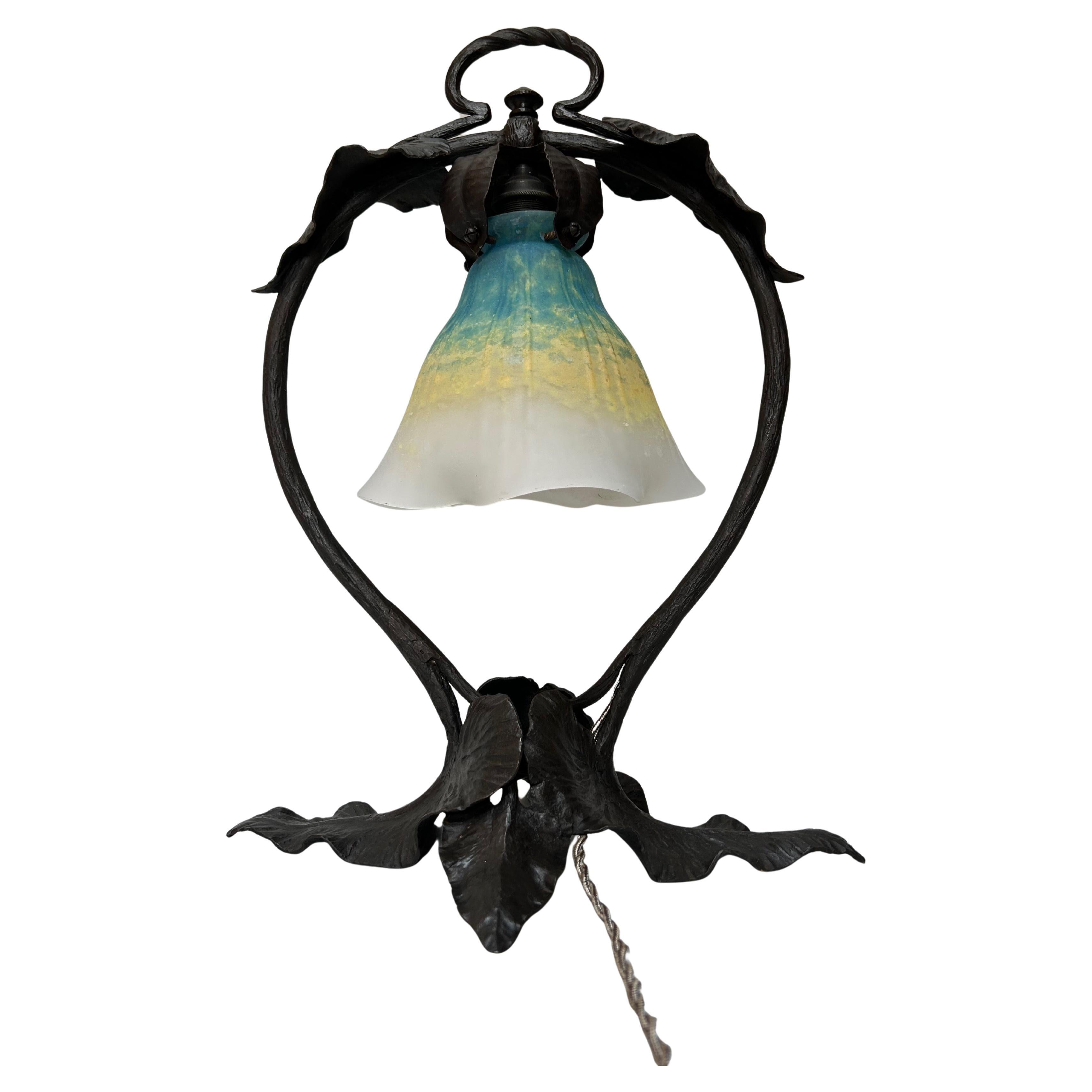
Daum Nancy Art Nouveau Lamp
By Daum
Located in NANTES, FR
Daum Nancy Art Nouveau table lamp, circa 1910. High-quality wrought iron base, stamped (illegible). Powder tulip signed Daum Nancy. Electric and in perfect condition. Height: 40.5 c...
Category

Vintage 1910s French Art Nouveau Table Lamps

Materials

Wrought Iron

Art Nouveau Lamp by Quezal
By Quezal
Located in NANTES, FR
Art Nouveau desk lamp, circa 1905. Brass and copper frame. Rare iridescent glass shade signed Quezal. Electrified and in very good condition. Height: 60.5 cm Width: 21 cm Depth: 35 cm Weight: 2.6 kg Quezal Art Glass Quezal Art Glass – The Journal of Antiques and Collectibles – April 2003 By Malcolm Mac Neil Some of the most beautiful and alluring art glass made in America during the early part of the 20th Century was made by the Quezal Art Glass and Decorating Company. Often in the shape of blossoming lilies with brilliant gold interiors and colorfully decorated with floral and other motifs inspired by nature, Quezal art glass ranks right alongside the iridescent glass of Louis Comfort Tiffany and Frederick Carder. Quezal artisans created an extensive range of decorative and useful items, including vases, compotes, finger bowls, open salts, candle holders, and shades for lighting fixtures, which are equivalent in terms of beauty and quality of craftsmanship to Tiffany’s Favrile and Carder’s Aurene glass. In recent years, glass collectors have discovered anew the special charms and appeal of Quezal art glass, and collector desirability for this lovely glassware has increased dramatically. The Quezal Art Glass and Decorating Company was incorporated a century ago, on March 27, 1902. It was founded by Martin Bach, Sr., Thomas Johnson, Nicholas Bach, Lena Scholtz, and Adolph Demuth. The factory was located on the corner of Fresh Pond Road and Metropolitan Avenue in Maspeth, Queens, New York. In October 1902, the trademark “Quezal” was successfully registered. By 1904, roughly fifty glassworkers were employed at the works. Martin Bach, Sr. was the president, proprietor, and guiding force behind this successful company. Born in 1862 in Alsace-Lorraine to German parents, he emigrated to the United States in 1891. Before his emigration, Bach worked in Saint-Louis, France, at the Saint-Louis Glass Factory. After Bach arrived in this country, he was hired by Louis C. Tiffany as the latter’s first batch-mixer or chemist at the newly established Tiffany Glass and Decorating Company, in Corona, Queens. After a period of about eight years, Bach left Tiffany and established his own glassworks. By this time, Bach had already started his small family. He and his German-born wife, Anne-Marie Geisser, whom he married in the fall of 1889, in Paris, France, had three children. Two daughters, Jennie and Louise, were born in France and a son, Martin, Jr., was born in Corona. Bach was assisted by Thomas Johnson, an English immigrant, and Maurice Kelly, a native of Corona, both of whom were gaffers or master glassblowers. Johnson and Kelly helped pave the way for Quezal’s early accomplishments and later recognition. Thomas Johnson, like Bach, was a founding member and also previously employed by Louis C. Tiffany. Johnson’s association with Quezal, however, was relatively short lived. Around 1907, Johnson left for Somerville, Massachusetts, where he became involved in making Kew Blas...
Category

Antique Early 1900s American Art Nouveau Table Lamps

Materials

Brass, Copper

Art Nouveau Lamp Attributed to Majorelle
By Atelier Majorelle
Located in NANTES, FR
Art nouveau lamp circa 1900. Gilded bronze, alabaster shells. Electrified and in perfect condition. Height: 44 cm Shell diameter: 22 cm Weight: 4.5 kg French cabinetmaker and desig...
Category

Early 20th Century French Art Nouveau Table Lamps

Materials

Alabaster, Bronze

You May Also Like

Daum Nancy Art Nouveau Table Lamp
By Daum
Located in Dallas, TX
Daum Cameo Glass and Wrought Iron Maple Leaf Table Lamp, circa 1920 Art Nouveau Art Deco design. Mottled and variegated glass base with with carve...
Category

Vintage 1920s French Art Deco Table Lamps

Materials

Art Glass

Antique French Art Nouveau Period Glass Lamp by Daum Studio
By Daum
Located in London, GB
This exquisite Art Nouveau lamp is by the celebrated French glasswork studio Daum which was founded in 1878 in Nancy, France. The lamp is inscribed ‘DAUM, NANCY’. The lamp is of ...
Category

Antique Early 1900s French Art Nouveau Table Lamps

Materials

Glass

Daum French Art Deco Nouveau Table Lamp, 1920
By Daum
Located in Saint-Amans-des-Cots, FR
French Art Deco / Nouveau Table Lamp, Nancy, France, Circa 1920 This exquisite French Art Deco / Nouveau table lamp, crafted in Nancy, France, circa 1920, features a stunning blown ...
Category

Vintage 1920s French Art Deco Table Lamps

Materials

Brass

Art Nouveau Table Lamp, Pate De Verre Glass, 1900s
Located in Bingen am Rhein, RP
Art Nouveau table lamp - 1900s This heartshaped (two identical lamps make a heart shape) table lamp is an original item of the Art Nouveau period. The table lamp has a beautiful a...
Category

Antique Early 1900s European Art Nouveau Table Lamps

Materials

Bronze

Art Nouveau Table Lamp Vignes Et Escargots , Daum Nancy, France, Circa 1905
By Daum
Located in Vienna, AT
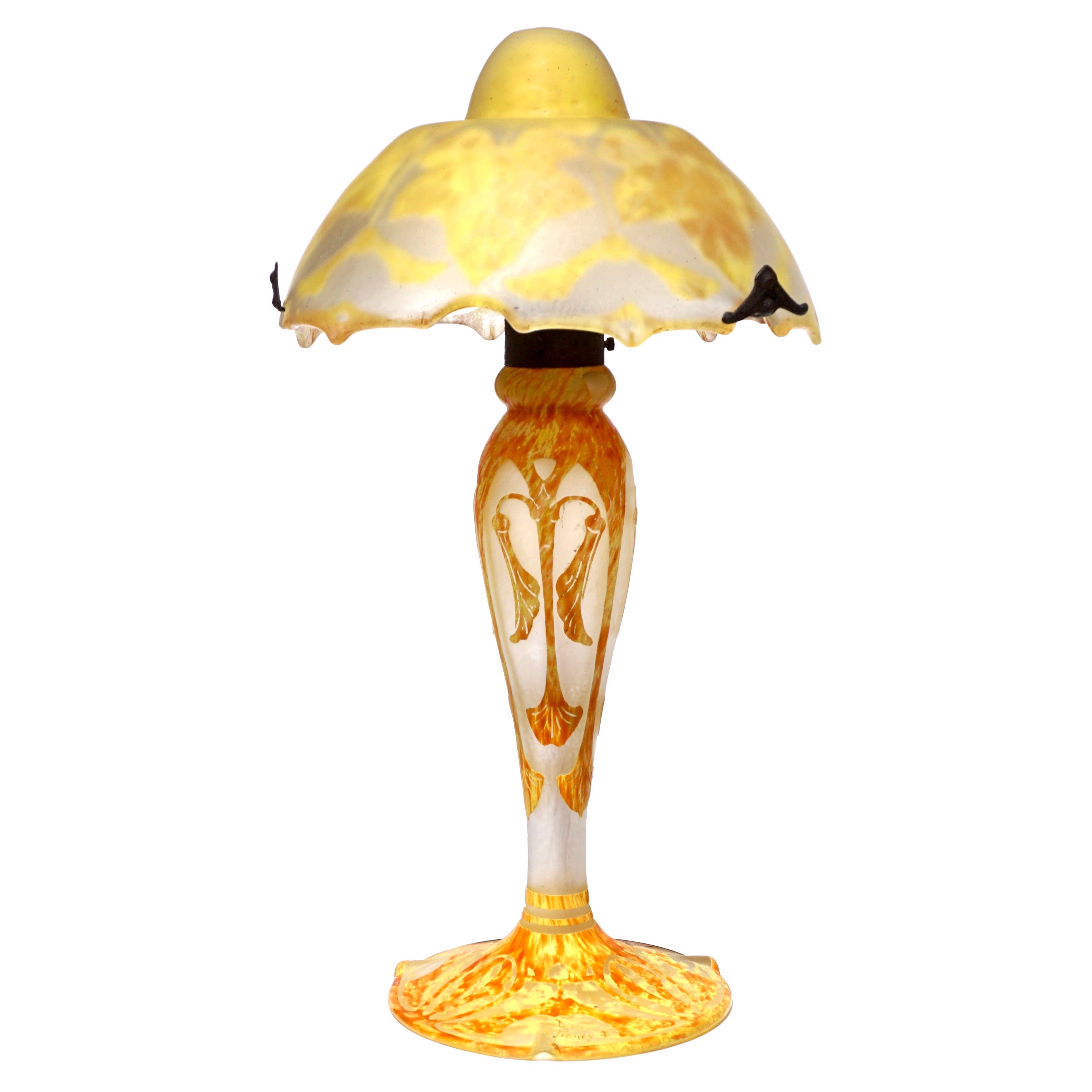
A museum piece of French Art Nouveau glass art: Lamp with baluster-shaped foot on a stepped, flat, round stand raised in the centre, hemispherical shade, slightly heat-stretched and pressed upwards on four sides, made of multi-layered glass with coloured powder fusions, predominantly in yellow-orange, red, brown, green and blue-violet tones, with highly etched vine leaves and grapevine decoration, two fully sculpted snails on the foot as a special accent, Cameo signature ‘DAUM NANCY’ with Lorraine cross on the foot in the lower area, and on the shade, which rests on a patinated metal mount, which also carries the threads for the light sources, one at the top and one inside the foot. Technique: Handmade cameo glass Glass overlaid with several layers, with high-cut worked out motifs. Since the middle of the 19th century, the design has also been done by etching. Cameo glass vessels were already being made in antiquity; cameo glass vessels were already being made in ancient times, and at the end of the 19th century this glass art was further developed, especially in Nancy. Manufactory: Daum Frères / Nancy, Lorraine, France Dating: Circa 1905 Dimensions: Height: 53,5 cm / 21.06 in Diameter: 32,0 cm / 12.59 in Bibliography: Carolus Hartmann, Glasmarken-Lexikon / Encyclopedia of Glass Marks, Stuttgart / Germany 1997, Signature number 2984 on page 148, and page 561: Daum Frères Cie, Verreries de Nancy Condition: Very good The electrification is functional, but should be renewed for safety reasons. About the design: The development of Art Nouveau glass art coincides with a revolution in lighting, the significance of which we can no longer fully appreciate today in the 21st century. Around 1880-1890, oil lamps and paraffin lamps were still almost unrivalled in every household. It was not until the beginning of the 20th century that the ‘electricity fairy’ emerged as a remarkable advance and gradually found its way into the daily lives of all social classes. The glassmakers at the Ecole de Nancy were true pioneers and eagerly seized the opportunity to use electricity to illuminate the colours applied to the glass. Colour was one of the main concerns of the master glassmakers at the Ecole de Nancy. Emile and Antonin Daum returned to the colours that had made the stained glass of the Middle Ages so splendid and extended the palette of colours in the glass mass as they needed it for the floral motifs and exact representations of nature. But the modulation of the colours, their arrangement in juxtaposed patches, the technique that the Impressionist painters practised on their canvases at the same time, was difficult to achieve due to the nature of the glass melted in a large mass. To achieve this richness of expression, around 1900 Daum developed ‘the process of applying glass powder and enamel to the outside of the vases to create coloured backgrounds or decorative spots’, according to the report of the jury of the 1900 World Exhibition. The field of naturalistic, contrasting and shimmering colours was one in which Antonin Daum excelled. This new technical process made it possible to create the symphonies of colour that we find on the ‘Vignes et escargots’ lamp...
Category

Antique Early 1900s French Art Nouveau Glass

Materials

Glass

Antique French Art Nouveau Glass Iron Table Desk Lamp Muller Freres 1910
By G.V. de Croismarre, Muller Frères
Located in Portland, OR
A very good antique French Art Nouveau Glass & iron desk table lamp, by Muller Freres, circa 1910. This is a very elegant "Pate de Verre" lamp made and designed by Muller Freres and ...
Category

Vintage 1910s French Art Nouveau Table Lamps

Materials

Iron