Items Similar to Théodore DECK (1823-1891), Pair of “Blue Deck” Vases mounted in Lamps circa 1870
Video Loading
Want more images or videos?
Request additional images or videos from the seller
1 of 8
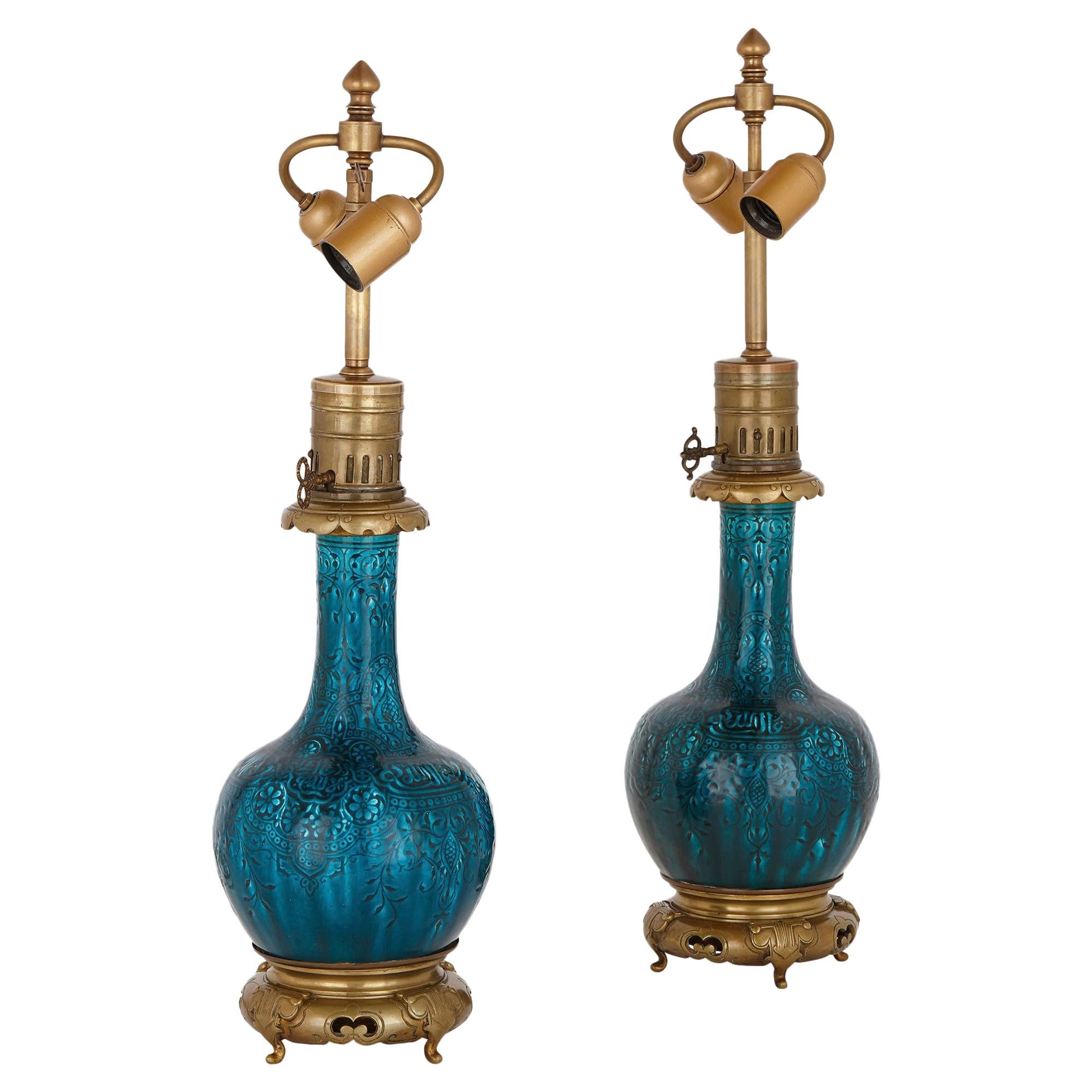
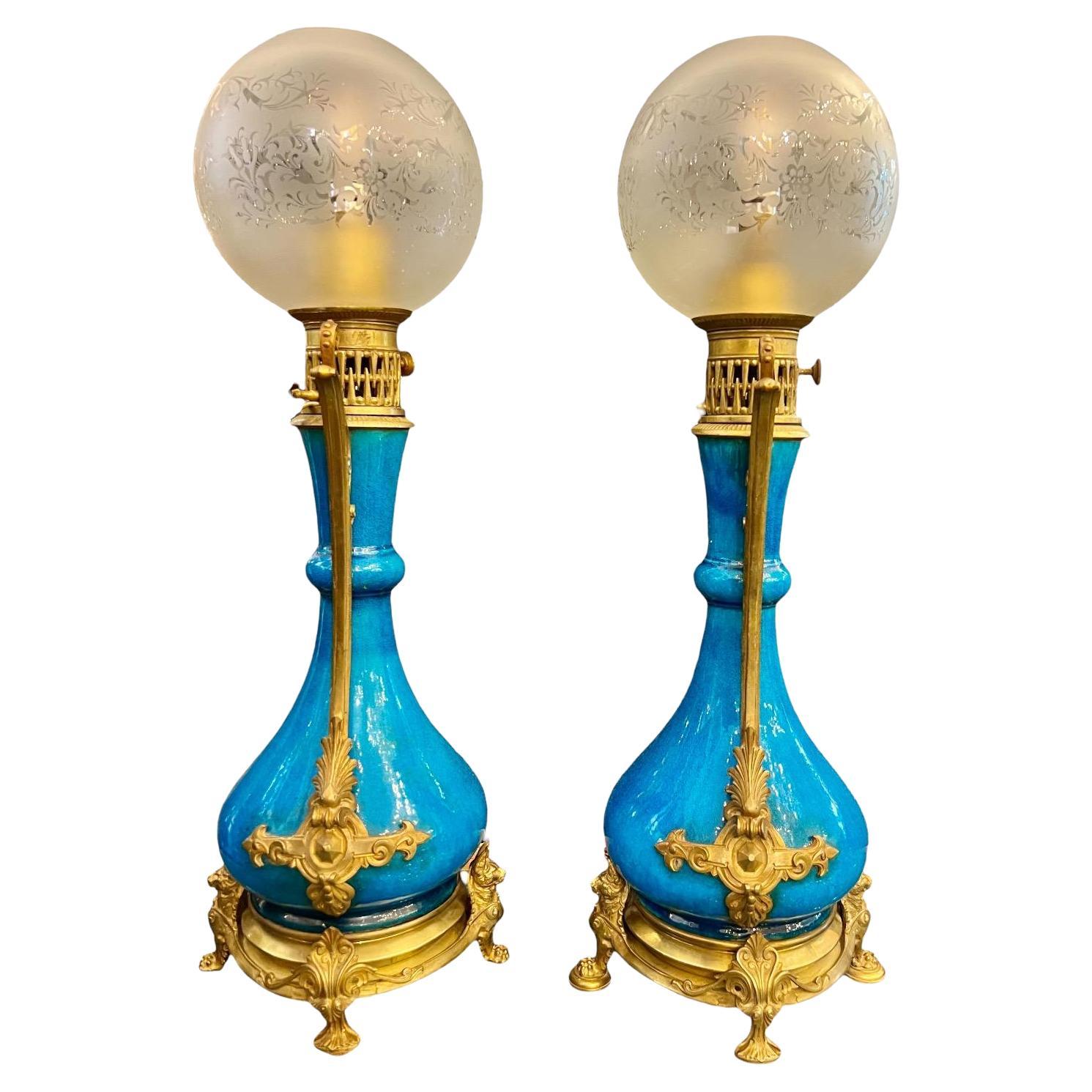
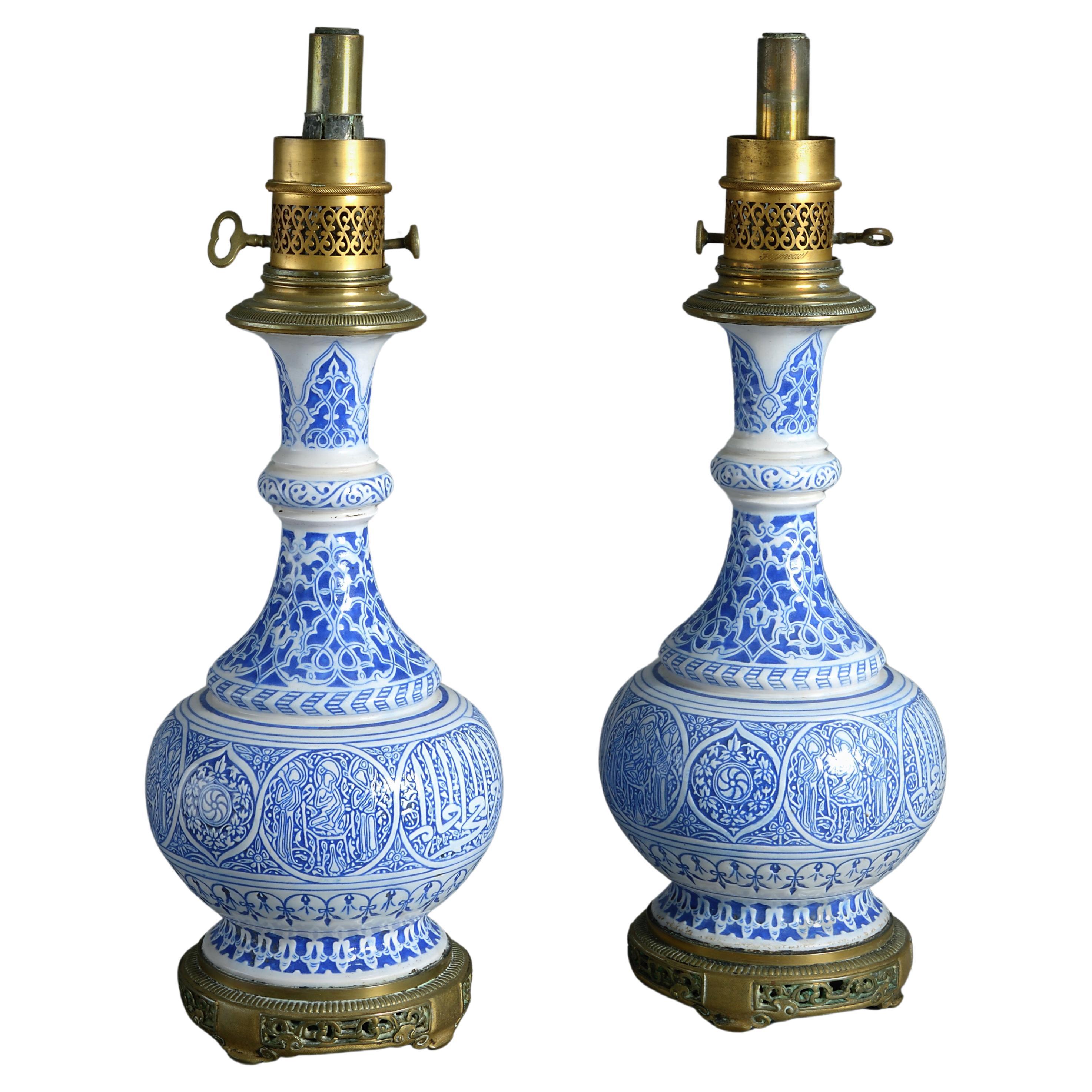
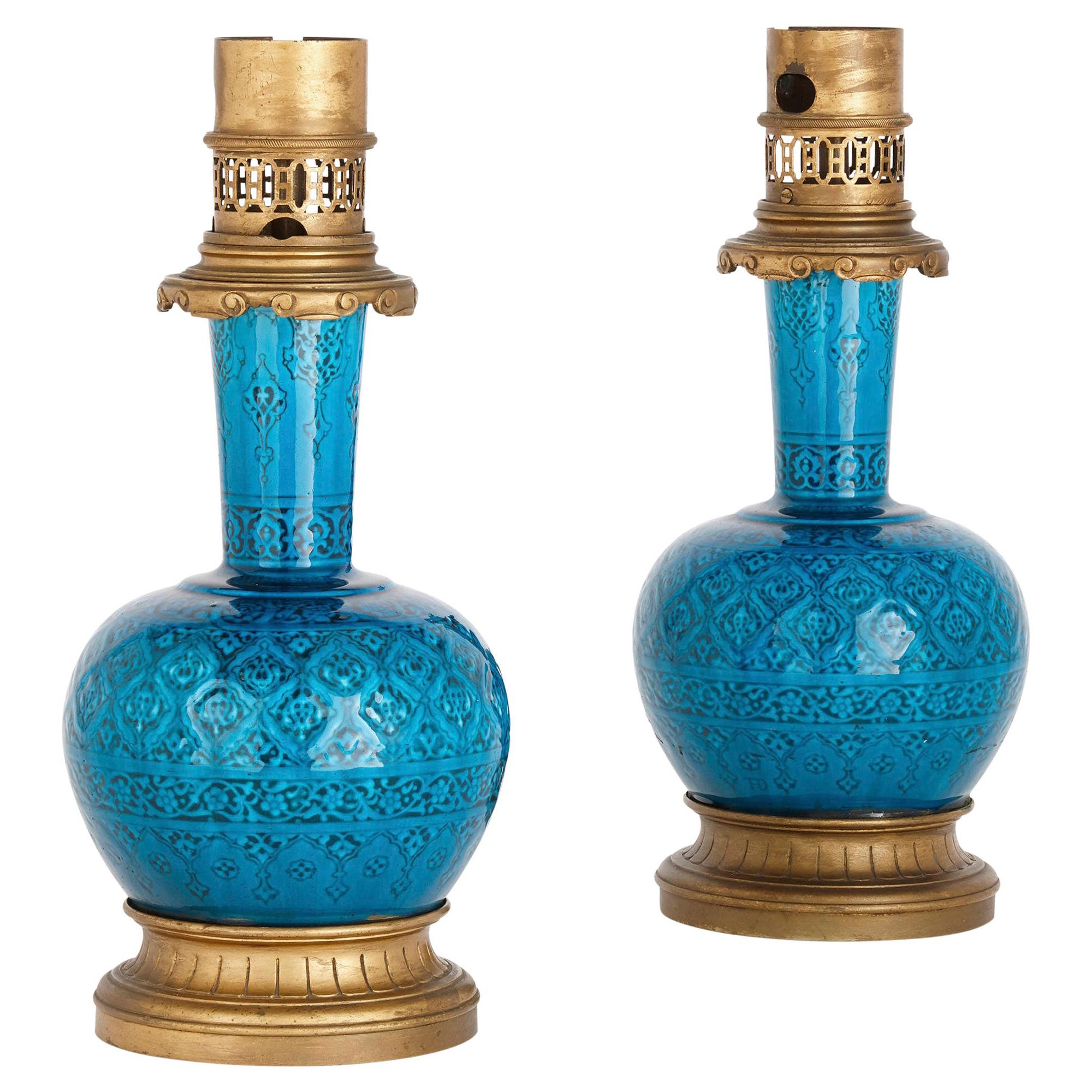
Théodore DECK (1823-1891), Pair of “Blue Deck” Vases mounted in Lamps circa 1870
$3,357.91per set
$6,929.11per set51% Off
£2,559.72per set
£5,178.47per set51% Off
€2,924.29per set
€5,800per set51% Off
CA$4,725.05per set
CA$9,559.06per set51% Off
A$5,175.40per set
A$10,470.13per set51% Off
CHF 2,724.85per set
CHF 5,512.52per set51% Off
MX$61,766.65per set
MX$124,957.54per set51% Off
NOK 34,725.74per set
NOK 70,252.19per set51% Off
SEK 31,744.56per set
SEK 64,221.09per set51% Off
DKK 21,852.28per set
DKK 44,208.43per set51% Off
About the Item
Théodore DECK (1823-1891)
Pair of “Blue Deck” Lamps circa 1870
Pair of vases mounted in lamps
Oval body and flared right neck in turquoise “blue Deck-turquoise” enameled faience
Oriental decor of floral motifs and stylized foliage
Archaic Asian Style Base.
Monogrammed THD
Circa 1870-1875
28 cm high, the ceramic vases only
Theodore Deck (1823-1891) is a French ceramist born in Guebwiller in Alsace. He is passionate about chemistry and the physical sciences. In 1841, he joined the master stove maker Hügelin father as an apprentice in Strasbourg. In two years, he learned of the methods inherited from the 16th century, such as the encrustation of colored pastes in the style of Saint-Porchaire. This apprenticeship did not prevent him from spending his free time drawing or modeling clay in the studio of sculptor André Friederich. Escaping military service, he made a tour of Germany as is the tradition with fellow Alsatian stove-makers. The quality of his work allows him to obtain important orders in Austria for the castles of the provinces and the imperial palaces, in particular for the palace of Schönbrunn. He continues his journey in Hungary to Pest, to Prague, then, going north through Dresden, Leipzig, Berlin and Hamburg. On the strength of his apprenticeship, he arrived in Paris in 1847. Recommended by Hügelin, he went to the stove factory of the Bavarian potter Vogt, located rue de la Roquette. The Revolution of 1848 interrupts production and Deck decides to return to his hometown. His family then advised him to set up a small terracotta workshop: he made a few busts, statuettes, vases, lamps and copies of famous antiques there. Aware that this situation would not allow him to provide for himself properly, he returned to Paris in 1851 where he was employed by the widow Dumas, daughter of the earthenware maker Vogt for whom he had worked. Hired as a foreman, he supplied the drawings and models to the workers, while working the land himself.
The following year, he made the decision to settle not far from his former employer at 20, rue de la Fontaine-au-Roi, probably using his ovens. His brother, Xavier Deck, joins him. It was officially in 1858 that the Deck brothers created their business and settled in Paris at 46, boulevard Saint-Jacques. Initially, the brothers only carry out coatings for stoves. But the business is going so well that barely a year after their installation, they want to diversify their production and engage in ceramics for the cladding of buildings as well as in shaped parts. Deck is interested in politics. In 1870, he opted for French nationality and was elected deputy mayor in the 15th arrondissement of Paris.
In 1861, at the Salon des arts et industries de Paris, which was held on the Champs-Élysées, Théodore Deck exhibited his works for the first time: these were pieces with an inlay decoration called “Henri II” and others. pieces covered with turquoise blue enamel or decoration in the style of Iznik ceramics.If he wins a silver medal, reviews are mixed, however. The following year, on the occasion of the Universal Exhibition of 1862 in London, he won over English customers. He surprised by presenting, like the previous year, his Alhambra Vase of exceptional dimensions (1.36 m in height and 2.25 m in circumference) which was purchased by the South Kensington Museum a few years later. At this same exposure, however, we notice the numerous cracks in its glaze and its poor adhesion to the dough. At the Industrial Arts Exhibition of 1864, Deck managed to present pieces coated with transparent, non-cracked enamels, and then made his first attempts at reliefs under transparent enamels. He developed a bright turquoise colour, which he named "Bleu Deck".
Théodore Deck explained the manufacture and qualities of these transparent enamels when he published his treatise La faïence in 1887. A year later, he made the first tests of reliefs in transparent enamels. He will never abandon this technique which will also be taken up by a number of large manufacturers. Inspired to pastiche by Islamic, Egyptian, Chinese, Japanese ceramics or majolica, he makes characters, birds, flowers, ornaments of all kinds evolve under a turquoise, green, yellow or manganese glaze. It is above all a characteristic blue that the public retains from this technique: a dazzling turquoise shade that it immediately adopts under the name of Bleu de Deck or Bleu Deck.
Théodore Deck continues to innovate, on the occasion of the Universal Exhibition of 1867, the factory received a silver medal thanks, among other things, to the metallic reflections it obtained on certain pieces. If these exhibitions become the engine of these technical advances, they nonetheless represent heavy expenses. In 1869, Théodore Deck opened a sales store on rue Halévy in the Parisian district of the Opera , which was run by his sister. On the occasion of the 1873 World's Fair in Vienna, he presented a spectacular two-meter-wide planter, leaning against a panel nearly four meters high. The whole, kept in Geneva at the Ariana Museum, was made from the drawings of Émile-Auguste Reiber.
Théodore Deck was appointed in 1875 at the head of the improvement commission of the Manufacture de Sèvres. As soon as they settle in, the Deck brothers bring together their artist friends at home and set up a principle of collaboration. Following this principle, Deck makes dishes, tiles or plates (very rarely vases) that he gives to paint to artists who have for many already proven themselves at the Salon. The sales gains are divided into two equal parts. Deck also trains apprentices who will in turn go to school. The most famous of them, Edmond Lachenal, will continue the work of the great ceramist by developing his art in the spirit of Art Nouveau. Author of a masterful treatise on earthenware, he became in 1887 - supreme recognition - director of the National Manufacture of Sèvres and left to his brother Xavier, as well as his nephew Richard, the management of their company. He produced soft porcelain there and, by improving the manufacturing technique, succeeded in giving them grandiose dimensions, covering them with his celadon glazes and turquoise blue. Théodore Deck has been resting since 1891 in Paris in the Montparnasse cemetery. It was his friend Auguste Bartholdi who made his funeral monument on which is engraved the sentence: "He snatched fire from the sky". The Deck workshops will close a few years after his death. It was his friend Auguste Bartholdi who made his funeral monument on which is engraved the sentence: "He snatched fire from the sky". The Deck workshops will close a few years after his death. It was his friend Auguste Bartholdi who made his funeral monument on which is engraved the sentence: "He tore fire from the sky". The Deck workshops will close a few years after his death.
Joseph-Théodore Deck was born in 1823 in Guebwiller, a commune in Haut-Rhin. He dreamed of becoming a sculptor but his humble origins oriented him towards a more prosaic profession: that of ceramic potter. He learned the technique of ceramics as a manufacturer of covered ovens with ceramic tiles and traveled to Germany, Hungary and Austria to improve his skills. At the age of 24, he moved to Paris to practice his art and worked in a factory that made ceramic kilns. He opened his own earthenware workshop in 1856 with his brother and his nephew and specialized in the oriental style and more particularly in the Iznik style. In the 1880s he explored the Chinese tradition and collaborated with Raphaël Collin, an academic painter professor at the Academy of Fine Arts recognized for the links he forged between French art and Japanese art both in painting. and ceramic. He published a treatise on the art of earthenware in 1887.
Deck's contemporary sculptors and painters made frequent visits to the Deck workshop, which thus became an experimental laboratory to promote ceramics as an art and no longer simply as an industrial application. It was while attending the National Porcelain Museum in Sèvres that Deck studied Islamic art. Deck discovered that the brilliance of oriental ceramics was due to an alkaline base containing tin oxide. The decorations are covered with a transparent coating which produces a shiny and translucent effect. After many trials and experiments, Deck succeeded in perfecting this technique and created Deck Blue, his famous turquoise blue using potash, soda ash and chalk. Deck presented his first collection of louvered earthenware at the Paris Exhibition of 1861, but it was at the London Exhibition of 1862 that he was officially recognized as an artist when the Victoria and Albert Museum bought three of his works. He received a silver medal at the Universal Exhibition of 1867. Deck copied many Iznik ceramics but also created his own variations around the oriental theme by assembling various patterns on a single work.
- Creator:Theodore Deck (Maker)
- Dimensions:Height: 13.78 in (35 cm)Diameter: 7.09 in (18 cm)
- Sold As:Set of 2
- Power Source:Plug-in
- Voltage:220-240v
- Lampshade:Not Included
- Style:Islamic (In the Style Of)
- Materials and Techniques:
- Place of Origin:
- Period:
- Date of Manufacture:circa 1875
- Condition:Wear consistent with age and use.
- Seller Location:Saint-Ouen, FR
- Reference Number:1stDibs: LU2612341519812
About the Seller
4.8
Gold Seller
Premium sellers maintaining a 4.3+ rating and 24-hour response times
1stDibs seller since 2017
73 sales on 1stDibs
Typical response time: 9 hours
- ShippingRetrieving quote...Shipping from: Saint-Ouen, France
- Return Policy
More From This Seller
View AllThéodore Deck (1823-1891), Pair of Blue Deck and Eggplant Enameled Vases c.1875
By Theodore Deck
Located in Saint-Ouen, FR
Théodore Deck (1823-1891) Pair of Blue Deck and Eggplant Enameled Vases
Rarissima pair of polylobed shape enameled faïence vases
Very avant-garde and modern design of alternating B...
Category
Antique 1870s French Napoleon III Vases
Materials
Faience
$8,362 Sale Price / set
22% Off
Free Shipping
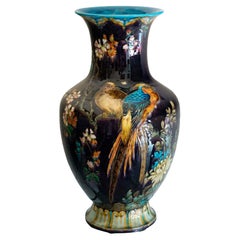
Théodore deck (1823-1891), An Impressive Enameled Faïence Vase, circa 1875
By Theodore Deck
Located in Saint-Ouen, FR
Théodore deck (1823-1891)
Impressive Enameled Faïence Vase, circa 1875
Large baluster shape vase with eggplant enameled background
Rich hand-painted polychrome decor of two birds re...
Category
Antique 1870s French Aesthetic Movement Ceramics
Materials
Faience
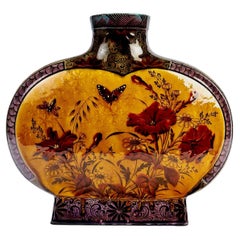
Théodore deck (1823-1891), A Gourd Shape Enameled Faïence Vase, circa 1885
By Theodore Deck
Located in Saint-Ouen, FR
Théodore Deck (1823-1891)
Gourd shape vase with a spherical body and straight neck
Polychrome glazed earthenware designed on both sides with a bird, butterflies, a bee, and flowers o...
Category
Antique 1880s French Aesthetic Movement Ceramics
Materials
Faience
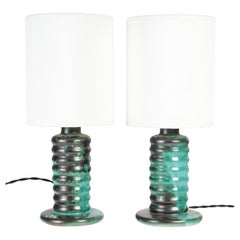
Atelier Primavera, Pair of Lamps 1926-1929
By Primavera
Located in Saint-Ouen, FR
Atelier Primavera, Pair of Glazed Ceramic Lamps
By French Design House, Primavera, Atelier d’Art du Printemps, or the French department Store “Le Printemps”
Embossed stamp, 'PRIMAVERA' and numbered '17769'
Model created 1926-1929
Bibliography : Primavera 1912-1972, Atelier d'Art du Printemps, A-R. Hardy, Faton ed.,
Primavera 1912-1972: Atelier d’Art du Printemps
Primavera, “Spring” in Italian, was the first French department store to set up a creative workshop at the beginning of the 20th century.
The adventure began in 1912 with two Decorative Arts enthusiasts:
Pierre Laguionie (1884-1978), director of “Printemps” Department Store and lawyer René Guilleré (1878-1931), founder of the Salon des Artistes Dé-corateurs.
Their objective is to promote the craft of Art in the daily life of the French people on the motto of the beautiful and the useful.
Decorative objects and furniture (furniture, ceramics, glassware, carpets, up-holstery, wallpapers, etc.) must be beautiful, modern, of high quality and at affordable prices.
The studio acquired young decorative artists such as Marcel Guillemard (1886-1932) and Louis Sognot (1892-1969) for furniture, and for works of art and ceramics by Madeleine Sougez (1891-1945)active from 1920 to 1928, Claude Lévy (1895-1942) from 1919 to 1929, Paule Petitjean (1895-1989) de 1913 à 1929, Hélèné Gatelet de 1924 à 1930, Marcelle Thiénot...
Category
Vintage 1920s French Art Deco Vases
Materials
Earthenware
$3,404 Sale Price
25% Off
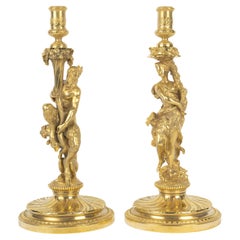
Pair of French 19th Century Regence Style Ormolu Candlesticks
Located in Saint-Ouen, FR
Pair of French 19th Century Regence Style Candlesticks
In chased and gilded bronze, the shaft of one depicting a faun riding a fantastic animal, the other one a woman with cupid, re...
Category
Antique 1880s French Régence Candlesticks
Materials
Ormolu
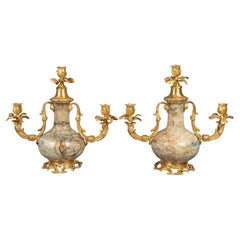
A 19th Century French Pair of Ormolu-Mounted Rare Fluorite Candelabras
By Maison Millet
Located in Saint-Ouen, FR
A French Napoléon III pair of three-lights candelabras
Ormolu-mounted Rare Fluorite also called Fluorspar Vases
The baluster shape body flanked by two arms and surmounted by a lid en...
Category
Antique 1870s French Louis XV Candelabras
Materials
Quartz, Ormolu
You May Also Like
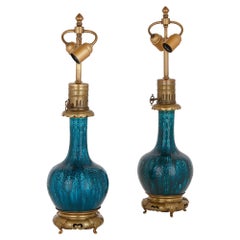
Pair of Gilt Bronze and Faience Lamps, Attributed to Théodore Deck
By Theodore Deck
Located in London, GB
These beautiful table lamps have been attributed to Joseph-Théodore Deck, one of the most important ceramicists of the 19th century. Deck was the director of a prestigious faience workshop which was based in France. He was well known for his high-quality ceramic wares, which were often designed in Islamic and Chinese styles.
The lamps are designed in a Persian manner. Each lamp is fitted with a gilt bronze (ormolu) light fixture which holds two bulbs. The lamps' bodies are crafted from faience (tin-glazed earthenware) and feature cylindrical necks and bulbous lower bodies. These bodies are decorated with stylised flowers, leafy vines, and Persian script...
Category
Antique Late 19th Century French Islamic Table Lamps
Materials
Bronze, Ormolu
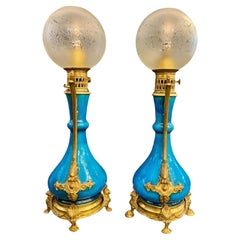
Pair Of Blue-glazed earthenware lamps in the Théodore Deck style, 19th century
By Theodore Deck
Located in NICE, FR
A very beautiful pair of Louis XVI-style baluster-shaped lamps in “Deck” blue glazed ceramic.
Each lamp is adorned with large openwork gilded bronze mounts.
On either side of each ...
Category
Antique 1880s French Louis XVI Table Lamps
Materials
Bronze
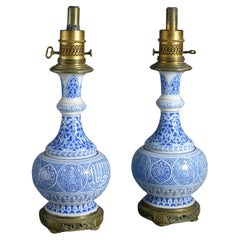
Pair of Persian Style Lamps by Theodore Deck and Gagneau Et Cie
Located in London, GB
A FINE PAIR OF PERSIAN STYLE ORMOLU-MOUNTED BLUE-AND-WHITE LAMPS BY THEODORE DECK (1823-1891) AND GAGNEAU ET CIE, CIRCA 1875.
Signed with monogram THD and Gagneau.
Category
Antique 19th Century Table Lamps
Materials
Ormolu
Pair of Turquoise 19th Century Antique Porcelain Table Lamps
Located in London, GB
A superb pair of late Qing Dynasty Chinese porcelain vases, with a wonderful turquoise glaze and subtle swirling foliate and floral line pattern decoration, now mounted as lamps with...
Category
Antique 19th Century Chinese Table Lamps
Materials
Porcelain
Pair of Gilt Bronze Mounted Faience Lamps by Deck
By Theodore Deck, Gagneau Frères
Located in London, GB
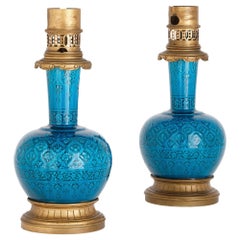
These beautiful table lamps are by Théodore deck, one of the most important ceramicists of the 19th Century, and Gagneau Frères, a leading bronzier. Deck was the director of a prestigious faience workshop which was based in France. He was well known for his high-quality ceramic wares, which were often designed in Islamic and Chinese styles.
The lamps are designed in a Persian manner. Each lamp is fitted with a gilt bronze light fixture, signed Gagneau Frères. The lamps' bodies are crafted from faience (tin-glazed earthenware) and feature cylindrical necks and bulbous lower bodies. These bodies are decorated with stylized flowers, leafy vines, and Persian script...
Category
Antique Late 19th Century French Vases
Materials
Ormolu, Bronze
$16,377 / set
Pair of 19th Century Qing Dynasty Chinese Blue and White Vases Turned to Lamps
Located in New York, NY
A magnificent and large pair of 19th century Qing Dynasty Chinese blue and white porcelain vases mounted as lamps. Each i...
Category
Antique 19th Century Chinese Qing Ceramics
Materials
Porcelain