Want more images or videos?
Request additional images or videos from the seller
1 of 9
Carl Schlieper 1920 Germany Art Deco Antique Multi Purpose Folding Pocket Knife
Price:$478.40
$598List Price
About the Item
- Creator:Carl Schlieper (Maker)
- Dimensions:Height: 0.37 in (9.4 mm)Width: 3.5 in (8.89 cm)Depth: 0.83 in (2.11 cm)
- Style:Art Deco (In the Style Of)
- Materials and Techniques:
- Place of Origin:
- Period:
- Date of Manufacture:1920
- Condition:Wear consistent with age and use. The overall condition of this piece is excellent. Beside the little normal wear, there is no damage to the metal. All parts are secured in the settings. This piece has been carefully inspected to guarantee the condition and authenticity.
- Seller Location:Miami, FL
- Reference Number:Seller: D060823MCEH/.32141stDibs: LU8303235613922
About the Seller
5.0
Gold Seller
Premium sellers maintaining a 4.3+ rating and 24-hour response times
1stDibs seller since 2023
248 sales on 1stDibs
Authenticity Guarantee
In the unlikely event there’s an issue with an item’s authenticity, contact us within 1 year for a full refund. DetailsMoney-Back Guarantee
If your item is not as described, is damaged in transit, or does not arrive, contact us within 7 days for a full refund. Details24-Hour Cancellation
You have a 24-hour grace period in which to reconsider your purchase, with no questions asked.Vetted Professional Sellers
Our world-class sellers must adhere to strict standards for service and quality, maintaining the integrity of our listings.Price-Match Guarantee
If you find that a seller listed the same item for a lower price elsewhere, we’ll match it.Trusted Global Delivery
Our best-in-class carrier network provides specialized shipping options worldwide, including custom delivery.You May Also Like
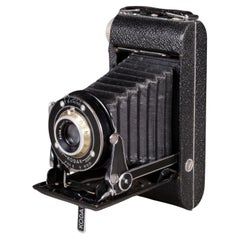
Antique Eastman Kodak "No. 1 Pocket Kodak" Folding Camera c.1909-1920
By Eastman Kodak
Located in San Francisco, CA
ABOUT
A "No. 1 Pocket Kodak" folding camera. The body of camera is all leather with a leather handle and it folds smoothly closed to 1.25 inches. This camera has retained its orig...
Category
Early 20th Century Industrial Photography
Materials
Chrome
$90 Sale Price
21% Off
H 6.25 in W 3.5 in D 5 in
Gentleman
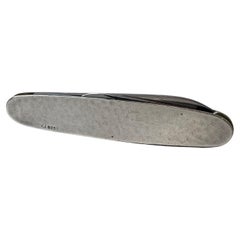
s Art Deco Pocket Knife in Sterling Silver, by H.J
Co Denmark
Located in Esbjerg, DK
A stylish gentlemans pocket knife featuring a hammered silver frame in hall-marked sterling. The two knives are made by G. Felix in Solingen Germany. Suitable for pipe cleaning or fr...
Category
Early 20th Century Danish Art Deco Tobacco Accessories
Materials
Sterling Silver, Steel
$300
H 3.15 in W 0.79 in D 0.2 in
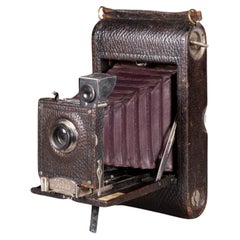
Antique "No. 3 Folding Pocket Kodak, Model AB" Camera c.1900
By Eastman Kodak
Located in San Francisco, CA
ABOUT
The Kodak No.3 Model AB is an early model. The body of camera is all leather with a leather handle and unique leather covered lens. it folds smoothly closed to 1.75 inches.
...
Category
Early 20th Century Art Deco Scientific Instruments
Materials
Metal, Chrome
$150 Sale Price
33% Off
H 8 in W 6.5 in D 4.75 in
German Art Deco 1920
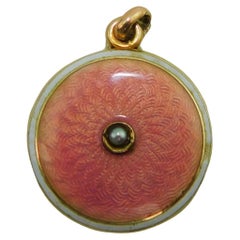
s 10 Karat Gold Guilloche Enamel Locket Pendant
By Ernst Gideon Bek 1
Located in Hamilton, Ontario
Attributed to German jeweler Ernst Gideon Bek (1872-1945) 10K gold beautiful pink floral design enamel locket pendant, with a single pearl in the middle and two black and white pictures of a couple inside. Measure's 1.6 cm round, 2 cm to top of clasp.
German Jewelry Designer Ernst Gideon Bek
Born on April 18, 1872 in Pforzheim, Ernst Gideon Bek (1872-1945) was best known for making mesh handbags in silver, gold and platinum. Pforzheim in Germany, like Providence in the United States, was the center of jewelry manufacture at the time. Young Ernst had the opportunity to study jewelry and gain good practical experience in well-known local companies and workshops. In particular, at Rothacker, Kinzinger in Pforzheim and Baer in Hanau. A talented jeweler, he was CEO of the Pforzheim jewellery industry at the Chicago World’s Fair at the age of 24. At the age of 25 he founded his own company with branches in Birmingham, Paris, Toronto, New York, and India (1897).
Noteworthy, Ernst’s wife, Emily, was the sister of one of the founders of the American jewelry company Binder Bros...
Category
Early 20th Century German Art Deco Collectible Jewelry
Materials
Gold, Enamel
$1,036 Sale Price
20% Off
H 0.3 in Dm 0.63 in
1920
s Alpacca Art Deco Black Enamel Geometric "German Silver" Cigarette Case
Located in Red Lion, PA
This 1920s Alpacca Art Deco Black Enamel Cigarette Case is a standout example of early 20th-century German design, crafted in the alloy historically referred to as “German Silver”, a...
Category
Vintage 1920s German Art Deco Tobacco Accessories
Materials
Copper, Enamel, Nickel, Zinc
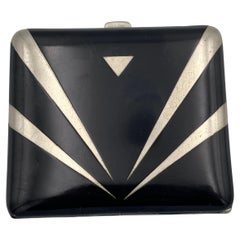
$490
H 0.5 in W 3.13 in D 3.5 in
Antique Eastman Kodak 3A Folding Pocket Camera with Leather Case
By Eastman Kodak
Located in Moreno Valley, CA
Collectible antique 1920s Kodak film camera in hard leather case.
With original leather case stamped made in Belgium.
Antique No. 3A Special Autographic Folding Pocket Model C Kodak with Zeiss Kodak Anastigmat Lens 6.3.
The 3A Folding Pocket Kodak, Eastman Kodak...
Category
Early 20th Century American Art Deco Scientific Instruments
Materials
Aluminum

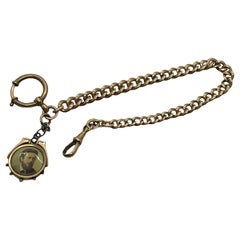
Antique German Art Nouveau Jewelry Pocket Watch Chain with Fob, 1900s
Located in Nuernberg, DE
This lovely pocket watch chain with sentimental FOB, pendant with a picture of a loved one, is still a beauty. It is circa 1900s or older.
A very pretty antique jewellery item whic...
Category
Antique Early 1900s German Art Nouveau Collectible Jewelry
Materials
Ormolu, Metal
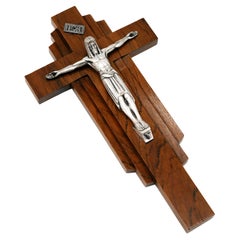
French Art Deco Crucifix, 1920
Located in Saint-Amans-des-Cots, FR
French Art Deco Crucifix Walnut and Silver-Plated Spelter Circa 1920.
This exquisite French Art Deco crucifix from circa 1920 showcases fine craftsmanship with walnut wood and s...
Category
Vintage 1920s French Art Deco Religious Items
Materials
Spelter
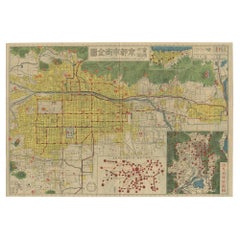
Antique Folding Map of Kyoto, Japan, 1920
Located in Langweer, NL
Antique folding map of Kyoto, Japan. On the verso of this map photos of buildings, other structures and informative text can be found.
Category
20th Century Maps
Materials
Paper
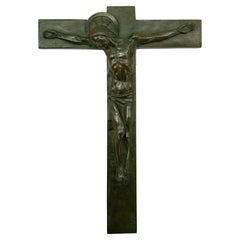
French Art Deco Bronze Crucifix, 1920
By Peter Hartmann
Located in Saint-Amans-des-Cots, FR
French Art Deco Bronze Crucifix by Peter Hartmann, Switzerland, 1920s. Elegant and rare French Art Deco bronze crucifix by Swiss sculptor Peter Ha...
Category
Vintage 1920s French Art Deco Religious Items
Materials
Bronze
More From This Seller
View AllWRIGLEY
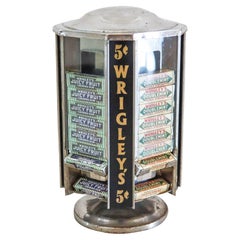
S 1920 Art Deco Antique Revolving Counter Display For Gum Candy Packs
By Wrigley
s Spearmint Pepsin Gum
Located in Miami, FL
Revolving counter display for gum candy by Wrigley's.
This is an antique revolving counter display of five sides created in America during the art deco period, back in 1920's. The d...
Category
Vintage 1920s American Art Deco Historical Memorabilia
Materials
Steel, Chrome
$1,398 Sale Price
30% Off
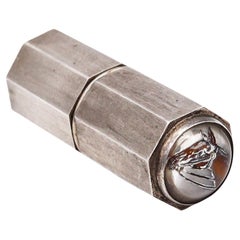
Naldun 1930 Art Deco Pocket Lighter Sterling Silver
Essex Glass Horse Intaglio
Located in Miami, FL
An art deco petrol lighter designed by Naldun.
Very beautiful and useful petrol lighter, created in America by the Naldun Company, back in the 1930. It was crafted as a slider piece in the art deco style, with an octagonal shape in solid .925/.999 sterling silver. Embellished on top with an Essex glass piece depicting the intaglio carving of a horse. It is in great shape with minimal trace of wear, with no dings, marks or bumps. The Essex glass piece is in perfect shape with remains of all the vibrant colors.
Weight: 16.40 Grams, (10.51 Dwt).
Size: Octagonal Small.
Measurements: 15 mm by 15 mm by 43 mm (0.59 x 0.59 x 1.70 Inches).
Hallmarks: Stamped with the maker's mark, the mark for the assay of the silver and signed, "NALDUN REG. MADE IN U.S.A PAT. PEND. STERLING".
Essex Glass
Essex crystal pieces are formed from a rock crystal cabochon (polished domes of rock crystal with a flat base), an image or motif is then reverse carved into the flat base, and then painted, to give them impression of a three dimensional object or image encapsulated in the cabochon when viewed from above. Production of a reverse crystal intaglio begins with the mining and cutting of fine rock crystal from Brazil or Madagascar. A well-formed cabochon is the key to a beautifully made reverse intaglio and the tedious process of hand polishing it to perfection had to be completed before the design work could begin. A watercolor rendering of the image was painted on the underside of the cabochon and an oil and diamond dust mixture was used along with up to 250 scribing tools to carve the design into the interior of the crystal “…the deeper the carving the more pronounced trompe l’oeil effect.” Once the carving was established the painting process began with extremely fine brushes and paint working in reverse to create incredibly detailed images. This process of carving into the back of the cabochon is sometimes referred to as reverse intaglio, not be to mistaken with intaglio, which is designed to be viewed from the same side on which it is carved, unlike Essex crystal. Particularly when the image is of something which is itself small in reality, such as an insect, they can be very convincing when created by skilled craftsman. Thomas Cook was believed to be responsible for introducing them to Britain from the continent in the 1860s, and there were initially sold by Hancock’s in London. During the same period the artist William...
Category
Vintage 1930s American Art Deco Tobacco Accessories
Materials
Silver, Sterling Silver
$472 Sale Price
30% Off
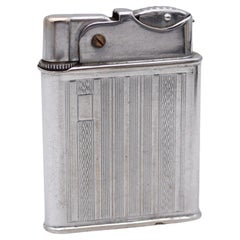
BENEY 1940 Art Deco Penge Model Petrol Pocket Lighter In Chromed Steel
Located in Miami, FL
Petrol pocket lighter designed by Robert Ernest Beney.
This is an unusual petrol pocket lighter, created in London England by the Beney company back in the 1940. This lighter is the Penge semiautomatic model and has been crafted with modernist art deco patterns in solid chromed steel with engine turned geometric designs. The lighter is in near mint condition with very little trace of use. This lighter is a treasure from the past, that embodies the elegance and style of its era, making it a must-have for collectors and enthusiasts alike.
Brand & Model: Beney, Penge
Mechanism: Petrol, push button semi-automatic.
Material: Chrome, steel and brass.
Year: 1940-1946.
Weight: 49.5 Grams, (31.75 Dwt).
Measurements: 53 mm by 40 mm by 10 mm (2.09 x 1.58 x 0.39 Inches).
Hallmarks: The lighter is stamped at the base with British marks and signed in full, "BENEY PENGE MODEL MADE IN ENGLAND".
The Beney Company
The Beney Company was founded by Robert Ernest Beney in 1918, who invented and sold the first Beney mechanical lighter in 1919, three years prior to Dunhill. Beney also designed an automatic mechanism for Dunhill's hunting horn lighter...
Category
Vintage 1940s English Art Deco Sports Equipment and Memorabilia
Materials
Brass, Steel, Chrome
$418 Sale Price
30% Off
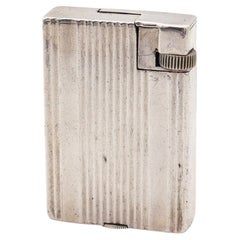
ALFRED DUNHILL Paris 1936 Art Deco The Handy / Savory Petrol Pocket Lighter
By Alfred Dunhill
Located in Miami, FL
A Savory lighter designed by Alfred Dunhill.
This is a very scarce petrol pocket lighter, created in Switzerland by La Nationale for the Alfred Dunhill Company in Paris, back in the 1935. This semi-automatic full-size lighter is the iconic and popular Savory model, crafted with art deco patterns in solid silver-plate with high polished finish. This very early Dunhill lighter is highly collectible, is decorated with linear patterns and is accompanied by the Dunhill's fitted box. This model was marketed with two names, The Savory in France and The Handy in the rest of the world
Brand: Dunhill-Paris.
Model: Savory Semi-automatic, full size.
First Produced: 1936.
Material: Plated .925 Sterling silver over brass.
Weight: 48.95 Grams, (31.40 Dwt).
Measurements: 50 mm by 34 mm by 12 mm (1.97 x 1.34 x 0.47 Inches).
Hallmarks: Stamped with the maker's mark and signed in full as follow, "ALFRED DUNHILL PARIS FAB. SUISSE MECAN AD SAVORY PATENT".
Alfred Dunhill
He inherited his father’s London saddlery in 1893. Following the increase in motor car ownership, Alfred developed the business to include motoring accessories, which he called ‘Dunhill’s Motorities’. This included goggles, timepieces, picnic sets, and leather coats, and it wasn’t long before the brand became associated with men’s general motoring attire. They opened two shops in Mayfair and had a catalogue of over 1300 items. Between the 1904 and 1905, Dunhill introduced their ‘Windshield Pipe’, to help drivers combat the effect of wind and travel on their ability to smoke. This marked both the end of the ‘motorities’ focus and their entry into the world of smoking ephemera, and they shortly opened their first tobacconist in 1907 on Duke Street. The proximity to several esteemed Private Members Clubs around the Mayfair, St James’ area ensured that the venture was a success. (From Nicholas Wells With Thanks).
Literature: Blei-Bottoni, The Dunhill Petrol Lighter "A Unique Story", Unique SRL 2004 first edition. Figure-52 Pp-256-259 for this model illustrated in several materials and finishes.
Note: This pocket lighter is empty of any flammable, gas or butane substances and is ready to be ship by any carrier. This lighter just need a new flint and proper lighter fluid. Was tested and is in working condition.
Collateral: This lighter is accompanied by the designer's presentation fitted box
Condition: The overall condition of this Alfred Dunhill lighter...
Category
Vintage 1930s French Art Deco Tobacco Accessories
Materials
Silver, Sterling Silver, Brass
$908 Sale Price
30% Off
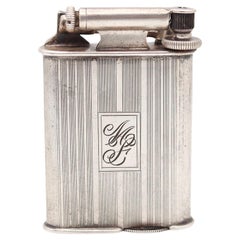
NAPIER Surefire 1928 Art Deco Asymmetric Pocket Petrol Lighter In .925 Sterling
By Napier Co.
Located in Miami, FL
The Surefire petrol lighter made by Napier.
This a very rare antique pocket petrol lighter created in Meriden United States by The Napier Company during the art deco period, back in the 1928. This is the Surefire pocket lighter model, which was masterfully designed with an unusual asymmetric shape. It was crafted in solid .925/.999 sterling silver and the sides are embellished with engine turned linear geometric patterns. This model itself is rare and just a few specimens are known in sterling silver or yellow gold. The lighter feature an unusual lift-arm, since the spring for the lift-arm is integrated in the arm. It was patented in 1929 in Canada by Emil Schuelke and Arthur Ross. The lighter is in excellent and near mint collectable condition.
Country: United States.
Period: Art-Deco 1928.
Material: .925/.999 Sterling silver
Finish: Engine turned and engraved with linears patterns.
Model: The Surefire Lighter. Pocket petrol.
Inventor & Patents: Emil Schuelke and Arthur Ross.
Manufacturer: The Napier Company.
Weight: 53.3 Grams, (34.20 Dwt).
Measurements: 51 mm by 34 mm by 15 mm (2.01 x 1.35 x 0.59 Inches). Measures taken from the longer and wider sides.
Marks: Stamped with the maker's mark, the mark for the assay and warranty of the .925/.999 silver and signed in full as follows, "NAPIER THE SUREFIRE LIGHTER STERLING...
Category
Vintage 1920s American Art Deco Tobacco Accessories
Materials
Sterling Silver, Silver
$1,715 Sale Price
30% Off
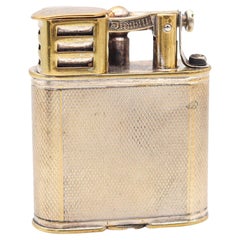
ALFRED DUNHILL 1930 England Art Deco Unique Sport Pocket Petrol Lighter Silver
By Alfred Dunhill
Located in Miami, FL
Unique A sport petrol lighter designed by Dunhill.
This is a beautiful antique lift arm petrol lighter designed by the Alfred Dunhill Company during the Art Deco period, back in 193...
Category
Vintage 1930s English Art Deco Tobacco Accessories
Materials
Silver, Silver Plate, Brass
$698 Sale Price
30% Off
Still Thinking About These?
All Recently ViewedMore Ways To Browse
Antique Coffe Grinder
Antique Coffee Grinder
Antique Knife Steel
German Knife
Antique Solingen
Pocket Knife
Collectible Antique Knife
Folding Knife
Antique German Knife
Antique Folding Knife
Straight Razor
Antiques Fans
Antique Safe Locks
Silver Folding Knife
Silver Pocket Knife
Antique Pocket Knife
Spear Weapon
Brass Swords