Want more images or videos?
Request additional images or videos from the seller
1 of 9
Irish Percussion Pocket Pistol, Dublin, circa 1840
$1,395List Price
About the Item
- Dimensions:Height: 3 in (7.62 cm)Width: 5 in (12.7 cm)Depth: 0.75 in (1.91 cm)
- Style:Greek Revival (Of the Period)
- Place of Origin:Ireland, Republic of
- Period:
- Date of Manufacture:circa 1840
- Condition:Wear consistent with age and use. One screw has been replaced as you can see in the picture.
- Seller Location:Hamilton, CA
- Reference Number:1stDibs: LU135522401662
About the Seller
5.0
Platinum Seller
Premium sellers with a 4.7+ rating and 24-hour response times
Established in 2010
1stDibs seller since 2015
1,365 sales on 1stDibs
Typical response time: 5 hours
Authenticity Guarantee
In the unlikely event there’s an issue with an item’s authenticity, contact us within 1 year for a full refund. DetailsMoney-Back Guarantee
If your item is not as described, is damaged in transit, or does not arrive, contact us within 7 days for a full refund. Details24-Hour Cancellation
You have a 24-hour grace period in which to reconsider your purchase, with no questions asked.Vetted Professional Sellers
Our world-class sellers must adhere to strict standards for service and quality, maintaining the integrity of our listings.Price-Match Guarantee
If you find that a seller listed the same item for a lower price elsewhere, we’ll match it.Trusted Global Delivery
Our best-in-class carrier network provides specialized shipping options worldwide, including custom delivery.You May Also Like
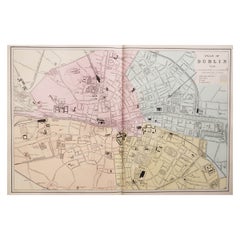
Large Original Antique City Plan of Dublin, Ireland, circa 1880
Located in St Annes, Lancashire
Great city plan of Dublin
Published circa 1880
Unframed
Free shipping.
.
Category
Antique 1880s Scottish Maps
Materials
Paper
$90
Free Shipping
H 13.5 in W 20 in D 0.07 in
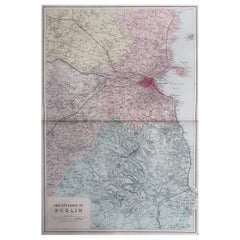
Large Original Antique Map of The Environs of Dublin, Ireland, circa 1880
Located in St Annes, Lancashire
Great map of The Environs of Dublin
Published circa 1880
Unframed
Free shipping.
Category
Antique 1880s Scottish Maps
Materials
Paper
$90
Free Shipping
H 20 in W 13.5 in D 0.07 in
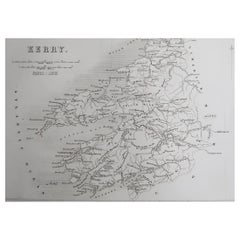
Original Antique Map of Ireland- Kerry. C.1840
Located in St Annes, Lancashire
Great map of Kerry
Steel engraving
Drawn under the direction of A.Adlard
Published by How and Parsons, C.1840
Unframed.
Category
Antique 1840s English Maps
Materials
Paper
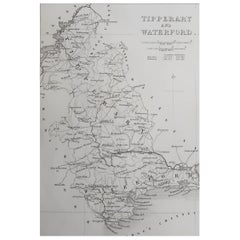
Original Antique Map of Ireland- Tipperary and Waterford. C.1840
Located in St Annes, Lancashire
Great map of Tipperary and Waterford
Steel engraving
Drawn under the direction of A.Adlard
Published by How and Parsons, C.1840
Unframed.
Category
Antique 1840s English Maps
Materials
Paper
$35
Free Shipping
H 9.5 in W 6.25 in D 0.07 in
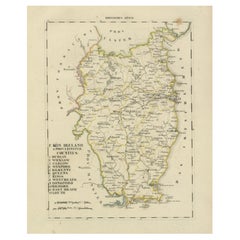
Antique 1830 Map of Leinster, Ireland with Dublin, Kilkenny, Wexford and Kildare
Located in Langweer, NL
Title: Antique 1830 Map of Leinster, Ireland with Dublin, Kilkenny, Wexford, and Kildare
Description: This 1830 German-language map, titled Britisches Reich – C. Kon: Ireland, f...
Category
Antique 1830s Maps
Materials
Paper
$407
H 12.88 in W 10.44 in D 0.01 in
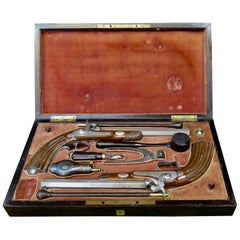
Vintage Parisian Dueling Pistols
By G. None
Located in Bronx, NY
These vintage early to mid-19th century French percussion cap dueling pistols are presented in their original carrying case. Each is beautifully design...
Category
Antique Mid-19th Century French Arms, Armor and Weapons
Materials
Steel
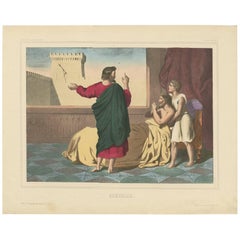
Antique Religious Print
No. 19
Hezekiah, circa 1840
Located in Langweer, NL
Antique print titled ‘Histoire Sainte, Ancient Testament, Ézéchias.’ This plate shows a scene from the Old Testament; Hezekiah.’
This print originates from a rare set of plates sh...
Category
Antique Mid-19th Century Prints
Materials
Paper
$249 Sale Price
20% Off
H 15.44 in W 19.22 in D 0.02 in
An English Flintlock Screwbarrel Boxlock Pistol
Located in Huntington, NY
Early 19th Century English Flintlock Pocket or Muff pistol. Marked Baker on one side with banner engraved on the other
Here we present an antique Baker Marked Boxlock Screw Barre...
Category
Antique Early 1800s George III Arms, Armor and Weapons
Materials
Steel

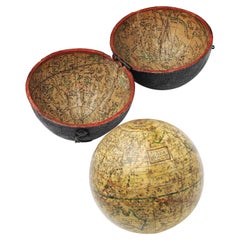
English Pocket Globe, London, Circa 1775-1798
By Herman Moll
Located in Milano, IT
Pocket globe
London, between 1775 and 1798
Re-edition of the globe of Hermann Moll (1678-1732) dated 1719
The globe is contained in its original case, which itself is covered in shark skin.
There are slight gaps in the original paint on the sphere. The case no longer closes.
The sphere measures 2.7 in (7 cm) in diameter whereas the case measures 2.9 in (7.4 cm) in diameter.
lb 0.22 (kg 0.1)
The globe is made up of twelve printed paper gores aligned and glued to the sphere.
In the North Pacific Ocean there is a cartouche with the inscription:
A Correct
Globe
with the new
Discoveries.
The celestial globe is depicted on the inside of the box and is divided into two hemispheres with the cartouche:
A correct globe
with ye new cons
relations of Dr.
Halley & c.
It shows the ecliptic divided into the days of the zodiacal calendar and the constellations represented as animals and mythological figures.
On the globe are delineated the equinoctial line, divided by degrees and hours, the ecliptic and the meridian (passing west of Greenwich). The continents are shaded and outlined in pink, green and yellow. It shows: the Cook routes; a wind rose in the Southern Indian Ocean; Antarctica without land; Africa with Negroland (Hermann Moll is considered the first geographer to name the West African region in his 1727 map. (Encyclopaedia Britannica, ed. 1902, under "States of Central Africa"); Tartary in Central Asia; the Mogul kingdom in northern India; in North America only New England, Virginia, Carolina, Florida, Mississippi are identified; California is already a peninsula; the northwest coast of America is "unknown parts" (Alaska is not described and it is only partially delineated, it was to become part of the United States in 1867); Mexico is named "Spain"; Central South America "Amazone America". Australia (which was to be so named after 1829) is called New Holland. The route of Admiral Anson is traced (1740) and the trade winds are indicated by arrows. (See Van der Krogt, P., Old Globes in the Netherlands, Utrecht 1984, p. 146 and Van der Krogt, P. - Dekker, E., Globes from the Western World, London 1993, pp. 115.)
Elly Dekker, comparing Moll’s 1719 globe and his re-edition (of which the one described above is a sample), identifies the differences between them: the two editions are quite similar to each other, but in the "anonymous" globe, compared to the previous globe of 1719, California looks like a proper peninsula - the reports of the Spanish explorers of the region had given rise to uncertainty over whether it was connected to the mainland or not. The geographical nature of California was confirmed after the explorations of Juan Bautista de Anza (1774-1776). The routes of Dampier's journey were partially erased and the route of Captain James Cook's first voyage was superimposed on them, and the geography of Australasia was adapted accordingly, including the denomination of the Cook Strait. See Dekker, Elly, Globes at Greenwich, 1999.
An important ante quem element is represented by Tasmania: it is not separated from Australia by the Bass Strait...
Category
Antique Late 18th Century English George III Globes
Materials
Shagreen, Paper
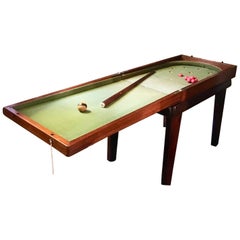
19th Century Child’s Mahogany Bagatelle Table, circa 1840
Located in Nantucket, MA
19th century child’s mahogany Bagatelle table, circa 1840, mounted on a period custom base. The shallow rectangular mahogany case is hinged to open as ...
Category
Antique 1840s English Regency Games
Materials
Mahogany
More From This Seller
View AllAntique French Bronze
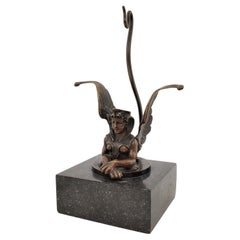
Polished Marble Egyptian Revival Pocket Watch Stand
Located in Hamilton, Ontario
This antique pocket watch stand is unsigned, but presumed to have originated from France and date to approximately 1920 and done in the period Egypt...
Category
Early 20th Century French Egyptian Revival Collectible Jewelry
Materials
Marble, Bronze
Antique English Georgian Sterling Silver Pocket Cigar Case
Located in Hamilton, Ontario
This sterling silver and intricately engraved cigar case was made in London England in circa 1831, during the reign of King George IV. The top and bottom are both ornately engraved w...
Category
Antique Early 19th Century English George III Tobacco Accessories
Materials
Sterling Silver

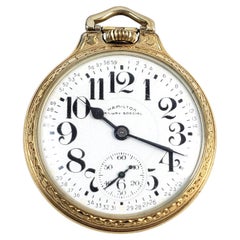
Antique Hamilton 21 Jewel Railway Special Pocket Watch
By Hamilton
Located in Hamilton, Ontario
This antique pocket watch was made by the well known Hamilton watch company of the United States in approximately 1920. The watch is in good working order with a white porcelain face...
Category
Early 20th Century American Victorian Collectible Jewelry
Materials
Metal, Gold Plate
19th Century, Irish Marine Botany Specimens Made for the Niagara Falls Museum
Located in Hamilton, Ontario
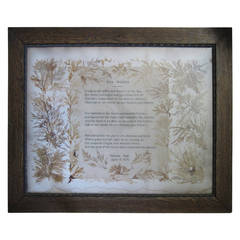
19th century Irish Marine Botany Specimens made for Thomas Barnett of the Niagara Falls Museum. Seaweed samples were collected off the West Coast of Ireland in 1871 by Mrs. Maria J.W. Kirkwood and presented to Thomas Barnett Esquire, proprietor of the Niagara Falls Museum. These come as two separately framed pieces with hand embroidered lettering surrounded by seaweed and a poem written by Victoria Hall.
Free shipping within the United States and Canada.
The Niagara Falls Museum was a museum most notable for being the oldest Canadian museum (1827), as well as for having housed the mummy of Ramesses I for 140 years before its return to Egypt in 2003. It was founded by Thomas Barnett of Birmingham, England and underwent a few vocational changes in its history.
More on Thomas Barnett and the Niagara Falls Museum.
Thomas Barnett was born on December the 4th, 1799 near Birmingham, England. He moved to Canada in the early 1820s and opened the Niagara Falls Museum in 1827 at the base of the Canadian Horseshoe Falls. Barnett had a passion for collecting oddities. He retrofitted a former brewery house to exhibit his private collection. Although Barnett was aware of the collection patterns of his North American contemporaries, his own approach bore an uncanny similarity to the British tradition, such as the Ashmolean Museum in Oxford, the first traditional museum in Britain.
The Niagara Falls Museum had humble beginnings. In 1827, the first museum contained Thomas Barnett's own cabinet of taxidermic curiosities. Although the details were not documented, the collection was likely composed of a number of mounted animals of local origin, combined with a smattering of Native American artifacts. Barnett's collection however rapidly grew. Prior to 1844, an account of the museum's contents stated that there were over 5000 items, including bipeds, quadrupeds, birds, fish, insects, reptiles, shells, minerals, and Native American curiosities. Through the first fifty years of its existence, the Niagara Falls Museum continued to acquire similar artifacts through the diligent efforts of the Barnett family and their associates.
In 1854, Sydney Barnett (son of Thomas Barnett) made the first of his three trips to Egypt (two by himself and one with Dr. J. Douglas of Montreal) and purchased four mummies as well as a host of other Egyptian antiquities. In 1857, mastodon remains were discovered in St. Thomas, Ontario and later placed in the museum. In 1859 an inventory of the museum's contents included, in addition to the previously mentioned artifacts, an egg collection...
Category
Antique 19th Century Decorative Art
$3,250 Sale Price / set
27% Off
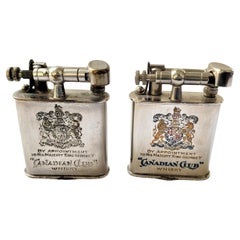
Pair of Antique Canadian Club Whiskey Advertising Swing Arm Pocket Lighters
Located in Hamilton, Ontario
This pair of antique pocket lighters show no maker's signature, but originated from Germany and date to approximately 1920 and done in the period Art Deco style. The lighters are done with a chromed metal and have an egraved and cold-painted logo featuring the Canadian coat of arms...
Category
Early 20th Century German Art Deco Tobacco Accessories
Materials
Metal
Antique English Wood
Brass Dresser Top Pocket Watch Stand
Vide Poche
Located in Hamilton, Ontario
This large wooden dresser top pocket watch stand and vide poche is unmarked, but believed to have been made in England in approximately 1890 in th...
Category
Antique Late 19th Century English Victorian Collectible Jewelry
Materials
Brass