Items Similar to Pair of Antique English Naval Cannon
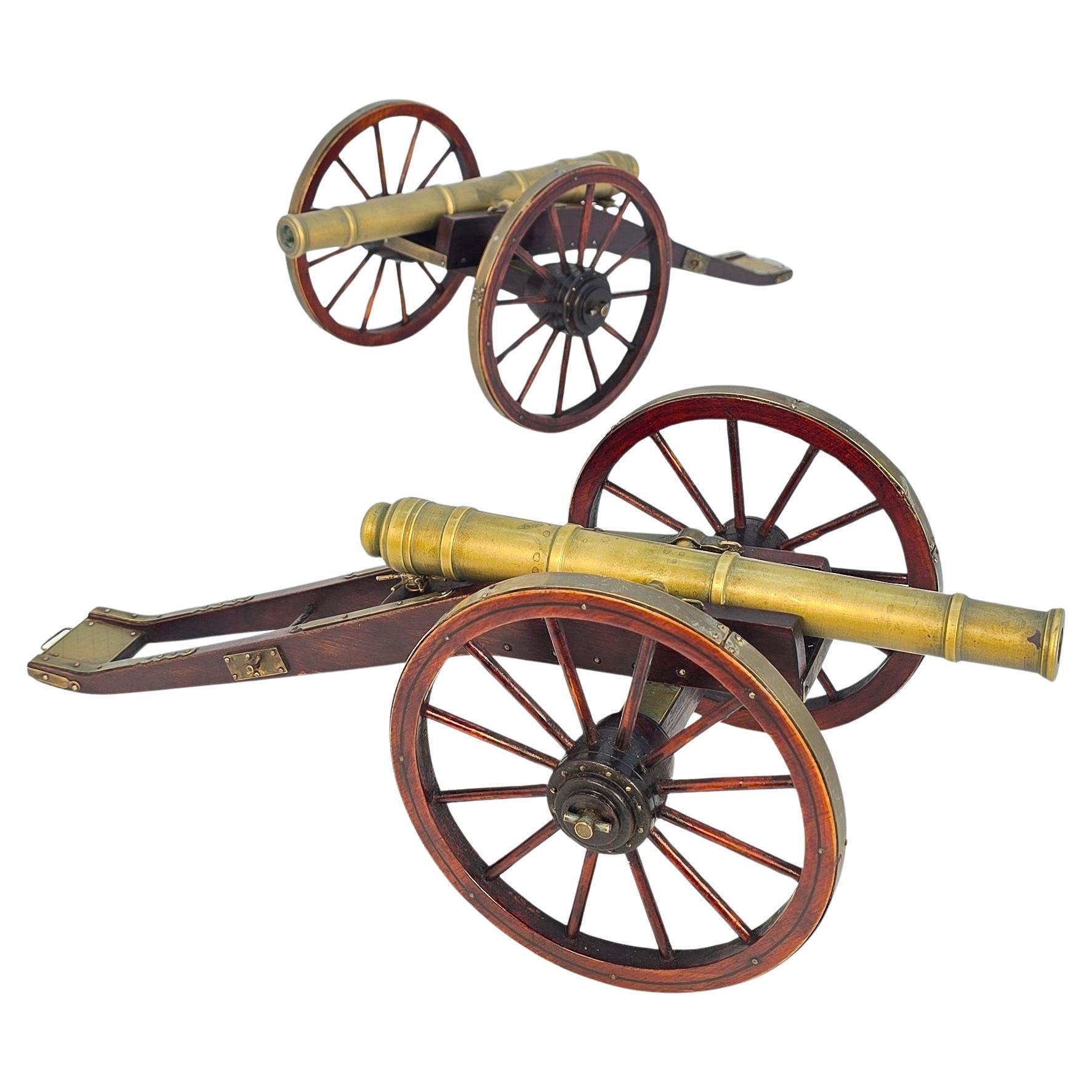
Want more images or videos?
Request additional images or videos from the seller
1 of 10
Pair of Antique English Naval Cannon
$181,684.96per set
£132,000per set
€154,437.66per set
CA$248,310.10per set
A$270,305.79per set
CHF 143,478.43per set
MX$3,252,360.60per set
NOK 1,818,066.87per set
SEK 1,665,863.02per set
DKK 1,153,331.21per set
About the Item
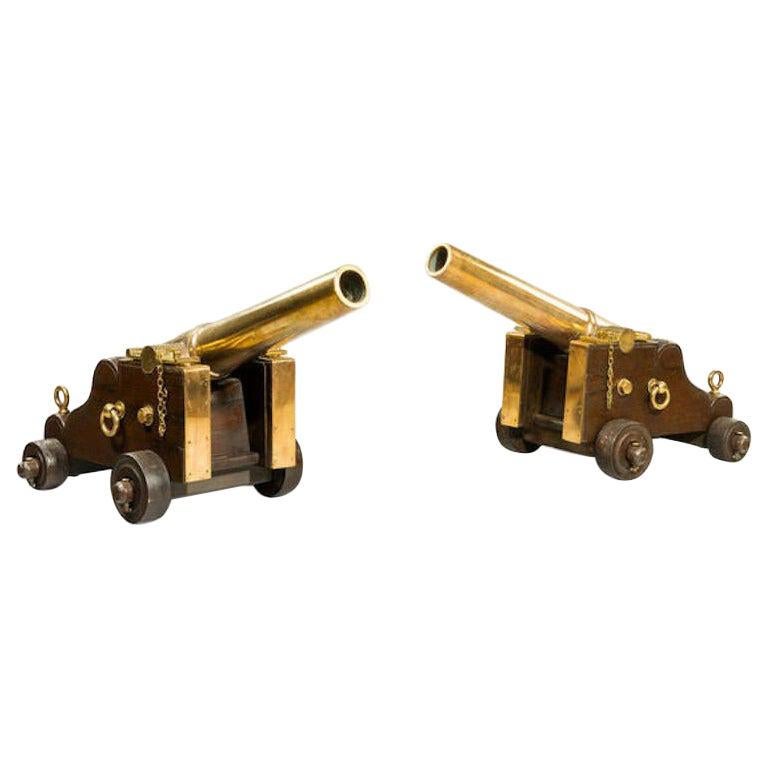
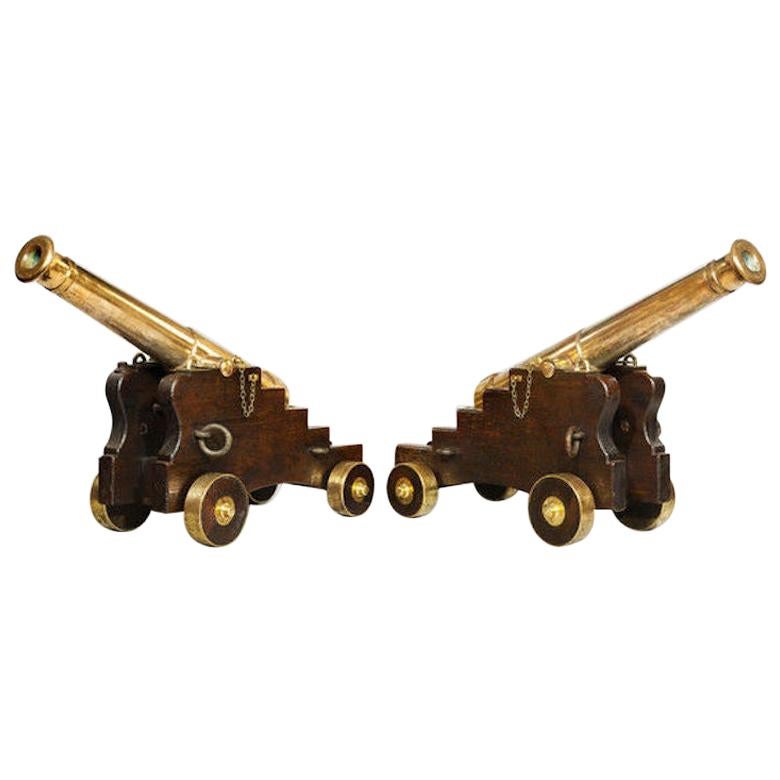
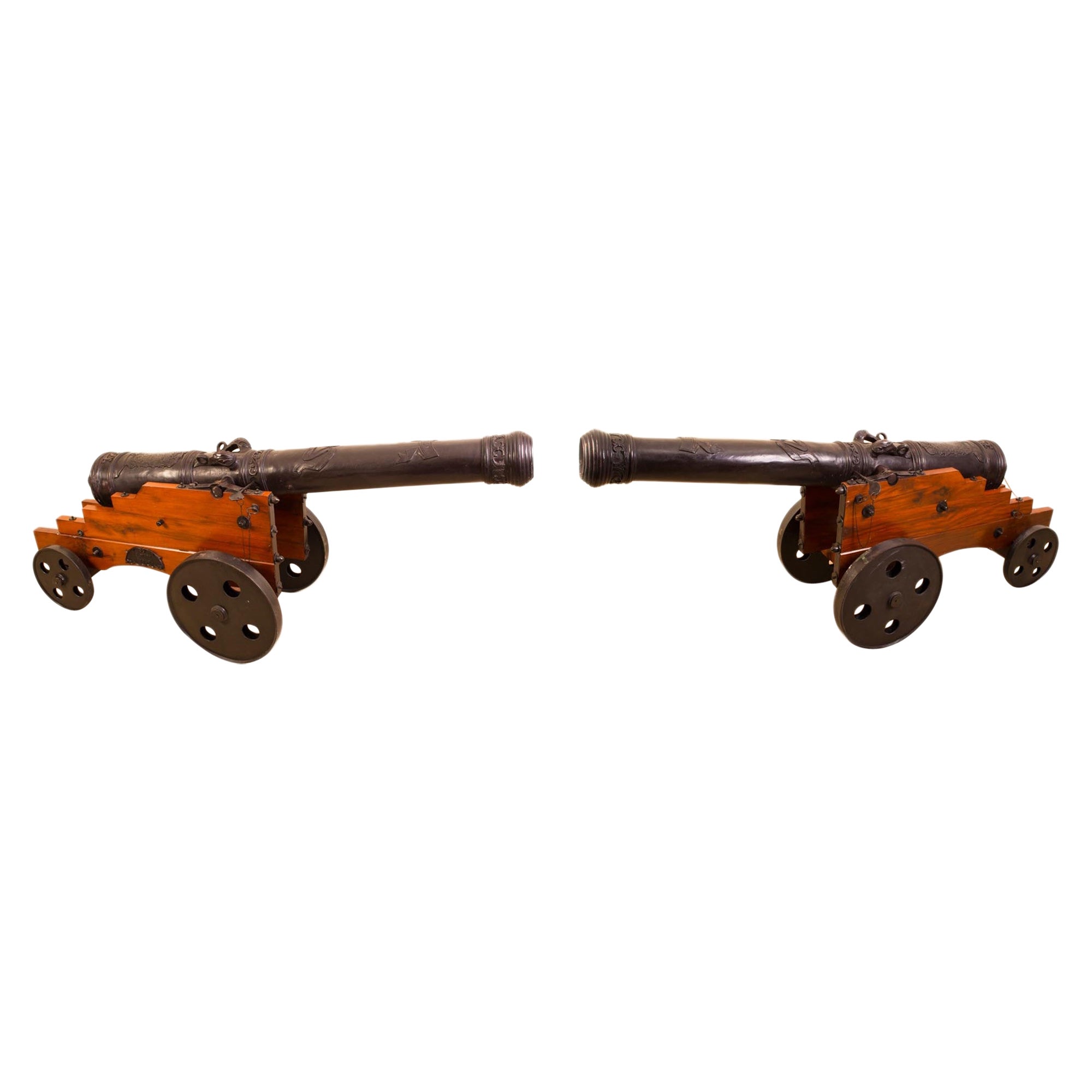
Pair of antique English naval cannon each with a tapering three stage barrel flanked by plain trunnions, with a knob shaped cascabel button before a shaped rectangular raised vent and ending in a 3 1/2” bore muzzle, enclosing a removable conforming wood plug, circa 1800.
Stood upon a naval type bronze-mounted four wheeled wooden carriage, including its wedge shaped quoin with knob handle.
The Earls of Lonsdale, Lowther Castle, Cumbria, presumably by descent to Hugh Cecil Lowther, 5th Earl of Lonsdale (1857-1944), until sold by his heir and brother, Lancelot, 6th Earl, as part of the contents of Lowther Castle, Maple
Co. Ltd./Thomas Wyatt, Tuesday 14 April 1947 and two following days, lot 558: ‘A pair of Old Gun Metal Cannons on teakwood carriages, 3ft. 6in. long’.
Mrs. P.M. Adie-Shepherd, sold Christie’s, London, 29 May 1970, lot 96.
Lowther Castle is a castellated mansion built by Robert Smirke between 1806 and 1814 for William Lowther, 1st Earl of Lonsdale (1757-1844). It was constructed on the foundations of the former 17th century family seat, Lowther Hall, but it was only in the early 19th century that it was afforded the name ‘castle’ in keeping with the Europe-wide fashion for romanticism and which was promoted by influential characters such as William Beckford at Fonthill Abbey, Wiltshire in England and by the writer Sir Walter Scott at Abbotsford, Roxburghshire, Scotland. While it’s not known when these naval cannon were acquired for Lowther they would have been entirely fitting in the castle or its approaches and it’s likely that they were in place soon after the castle was completed, or perhaps acquired later by the 5th Earl. A tantalising possibility is that the cannon were originally aboard the East Indiaman Lowther Castle which was active in the early 19th century.
HUGH CECIL LONSDALE, 5TH EARL OF LONSDALE (1857-1944) AND THE DEMISE OF LOWTHER CASTLE
In 1882 at the age of 25 Hugh Lonsdale (1857-1944) unexpectedly inherited the earldom and with it the extensive Lonsdale estate, including tens of thousands of acres of Cumberland and Westmorland and coalfields at Whitehaven. However, despite his spectacular inherited wealth – he was suddenly one of the wealthiest men in England, over the course of his lifetime he managed to decimate the family fortune. He led a full and colourful life, one of adventure and luxury. An early intrepid escapade took place in July 1888 when, as part of an expedition called the Scotch Naturalist Society, he set embarked on horse sleigh, dog sleigh and boat to reach the Arctic circle, travelling 6000 km up the Mackenzie mirror and across northern Alaska. On his return and with new-found understanding of the Indian and Inuit peoples whose way of life was being destroyed, he presented his ethnographic collection the Arctic to the British Museum; one hundred years after his death they formed an exhibition about him.
The press named him ‘the Yellow Earl’ because of his favourite colour which he used for his carriages, Rolls Royce, servants’ livery and even the gardenia button hole he wore and when he became the first president of the Automobile Association they took the colour yellow for their distinctive badge. He was a keen huntsman and sportsman, in 1907 he was elected the first president of the International Horse Show at Olympia and in 1909 he became first president of the National Sporting Club, who introduced a boxing championship trophy named the Lonsdale Belt. During the First World War he helped to found the Blue Cross and recruited both men and horses for the army. After the war he became more involved in horse-racing, in 1922 his colt Royal Lancer won both the St. Leger and the Irish St. Leger, and he became a senior steward of the Jockey Club. Throughout his life, Lonsdale was known as a larger than life, flamboyant character, and he was much liked by his tenants who called him ‘Lordy’.
Such were his interests, yet as a peer he was rarely seen in the House of Lords and by 1921 the extravagant spendthrift was running short of money. His mansions, Whitehaven Castle and Barleythorpe, were sold, the family’s west Cumberland coalmines closed, and in 1936, Lonsdale was finally forced to leave the principal Lonsdale seat, Lowther Castle. In 1939 or 1940 the castle was requisitioned or the war effort and used for tank development. When it was returned to the family the cost of maintaining the house was way beyond their means and so, despite their desire to offer it to the National Trust and other heritage bodies, the contents were sold (including the cannon), and then, for the avoidance of onerous taxes, the castle was stripped and the roof removed to leave an empty shell.
- Dimensions:Height: 22.5 in (57.15 cm)Width: 27 in (68.58 cm)Depth: 48 in (121.92 cm)
- Sold As:Set of 2
- Materials and Techniques:
- Place of Origin:
- Period:
- Date of Manufacture:circa 1800
- Condition:Wear consistent with age and use.
- Seller Location:Lymington, GB
- Reference Number:1stDibs: LU973018861972
About the Seller
5.0
Recognized Seller
These prestigious sellers are industry leaders and represent the highest echelon for item quality and design.
Established in 1982
1stDibs seller since 2013
140 sales on 1stDibs
Typical response time: <1 hour
Associations
LAPADA - The Association of Arts
Antiques Dealers
- ShippingRetrieving quote...Shipping from: Lymington, United Kingdom
- Return Policy
More From This Seller
View AllPair of English Bronze Signal Cannon
Located in Lymington, Hampshire
A fine pair of English bronze signal cannon, the tapering 36 inch two stage barrels set upon original mahogany carriages with bronze fittings and ...
Category
Antique 1850s English Arms, Armor and Weapons
Materials
Bronze
$47,274 / set
Fine Pair of 19th Century English Barrel Bronze Cannon on Oak Carriages
Located in Lymington, Hampshire
Fine pair of mid-19th century English bronze cannon with tapering 41" barrels and flared muzzles, the top of each breech engraved with the family crest o...
Category
Antique 1850s English Arms, Armor and Weapons
Materials
Bronze
A pair of ships’ Bronze Cannon from the S. V. Jura 1875
Located in Lymington, Hampshire
A pair of ships’ Bronze Cannon from the S. V. Jura, 1875, Built by Charles Connell & Co, Glasgow, for Sandbach, Tinne & Co. of Liverpool. These fine four pounder cannon, on their ori...
Category
Antique Late 19th Century English Nautical Objects
Materials
Bronze
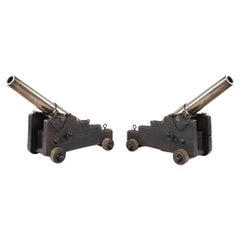
Fine Pair of Bronze Cannon by McAndrew and Woore English, circa 1850
Located in Lymington, Hampshire
A fine pair of bronze cannon by McAndrew and Woore, set on their original brass bound black painted oak carriages with brass spider wheels, also with a p...
Category
Antique 1850s English Arms, Armor and Weapons
Materials
Bronze
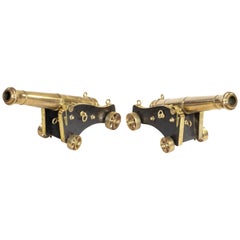
Mid-Victorian Model of a Field Cannon
Located in Lymington, Hampshire
A mid-Victorian model of a field cannon, the bronze barrel set on an oak carriage with large iron-bound wheels, with traces of the original black, red an...
Category
Antique 1870s English Arms, Armor and Weapons
Materials
Bronze

Royal Southampton Yacht Club Cannon
Located in Lymington, Hampshire
This pair of early Victorian three-stage bronze signal cannon are set on elm carriages with bronze fittings.
Each 39 inch tapering barrel has one reduction and a ball cascabel. Th...
Category
Antique 1840s English Historical Memorabilia
Materials
Bronze
You May Also Like
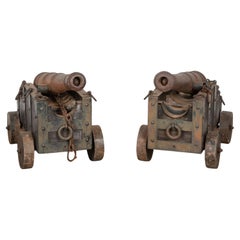
Pair of 19th Century Country House Naval Canons
Located in Folkestone, GB
A magnificent pair of full size replica 19th Century naval canons.
These full size '3-pound' ship' canons are replicas of the 17th and 18th Century guns that would have lined the s...
Category
Antique Late 19th Century Portuguese Country Nautical Objects
Materials
Iron
$7,983 / set
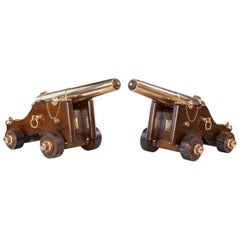
Antique 18th century style pair of desk cannon English circa 1920
Located in Central England, GB
This superb pair of model desk cannons has been beautifully handmade in mahogany with nailed brass fittings and heavy cast bronze barrels. The attention to...
Category
Early 20th Century British Louis Philippe Models and Miniatures
Materials
Brass, Bronze
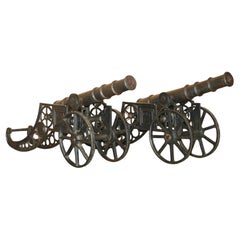
Vintage Pair Decorative 6ft Bronze Artillery Cannons 20th Century
Located in London, GB
This is an interesting vintage pair of French bronze cannons dating from the late 20th century.
The cannons have highly decorative barrels and splendid openwork carriages.
They ar...
Category
Late 20th Century Desk Sets
Materials
Bronze

Pair Of Large 19th Century English Bronze Artillery Signal Cannons
Located in Dublin, IE
A magnificent pair of 19th century British Artillery signal cannons, each with tapered bronze barrel segmented by hoops, cannon muzzle and stepped breechblock with drop-shaped cascab...
Category
Antique 19th Century English Arms, Armor and Weapons
Materials
Brass, Bronze
PAIR OF VICTORIAN STYLE VINTAGE CAST IRON DECORATIVE 153CM LONG GARDEN CANNONs
Located in West Sussex, Pulborough
Royal House Antiques
Royal House Antiques is delighted to offer for sale this stunning pair of Vintage Victorian style English cast Iron cannons
Please note the delivery fee listed...
Category
Vintage 1940s British Late Victorian Arms, Armor and Weapons
Materials
Iron
A Fine Model of a 19th C. British 24-Pounder Muzzle-Loading Smoothbore Cannon
Located in Ottawa, Ontario
A finely cast model of an early 19th century British 24-pounder smoothbore muzzle-loading artillery cannon, together with its garrison style carriage.
Both cast in heavy gauge 'bell...
Category
Early 20th Century British Victorian Arms, Armor and Weapons
Materials
Bronze
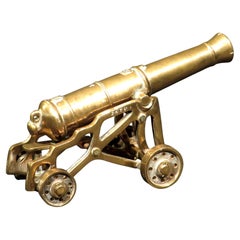
$1,600 Sale Price / set
20% Off