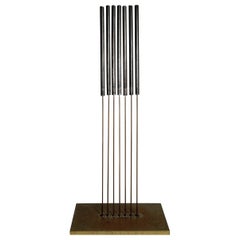
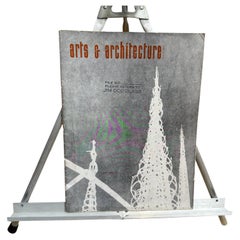
July 1961 Playboy Magazine f/t Masters of Midcentury Design Eames Saarinen
About the Item
- Creator:
- Dimensions:Height: 11 in (27.94 cm)Width: 8.5 in (21.59 cm)Depth: 1 in (2.54 cm)
- Style:Mid-Century Modern (Of the Period)
- Materials and Techniques:
- Place of Origin:
- Period:
- Date of Manufacture:1961
- Condition:Wear consistent with age and use.
- Seller Location:BROOKLYN, NY
- Reference Number:1stDibs: LU1793217025072
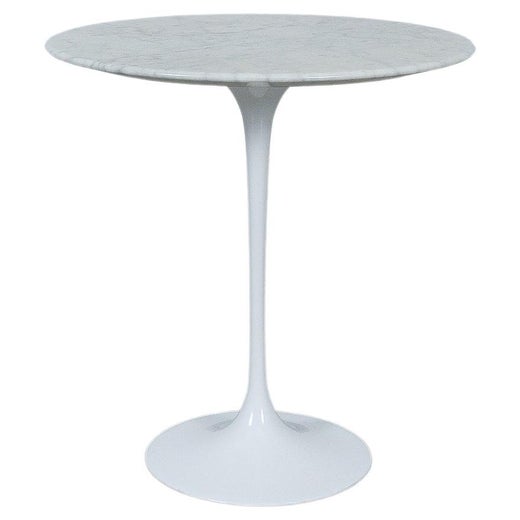
Eero Saarinen
Through his work as an architect and designer, Eero Saarinen was a prime mover in the introduction of modernism into the American mainstream. Particularly affecting were the organic, curvilinear forms seen in Saarinen’s furniture and his best-known structures: the gull-winged TWA Flight Center at John F. Kennedy airport in New York (opened 1962), Dulles International Airport in Virginia (1962) and the Gateway Arch in St. Louis, Missouri (1965).
Saarinen had a peerless modernist pedigree. His father, Eliel Saarinen, was an eminent Finnish architect who in 1932 became the first head of the Cranbrook Academy of Art in suburban Detroit. The school became synonymous with progressive design and decorative arts in the United States, and while studying there the younger Saarinen met and befriended several luminaries of mid-century modernism, among them Harry Bertoia and Charles and Ray Eames.
At Cranbrook, Saarinen also met Florence Schust Knoll, who, as director of her husband Hans Knoll's eponymous furniture company, would put Saarinen’s best designs into production. These include the Grasshopper chair, designed in 1946 and so named because its angled bentwood frame resembles the insect; the Tulip chair (1957), a flower-shaped fiberglass shell mounted on a cast-aluminum pedestal; and the lushly contoured Womb lounge chair and ottoman (1948). In his furniture as in his architecture, the keynotes of Eero Saarinen’s designs are simplicity, strength and grace.
Find vintage Eero Saarinen tables, chairs and other furniture on 1stDibs.
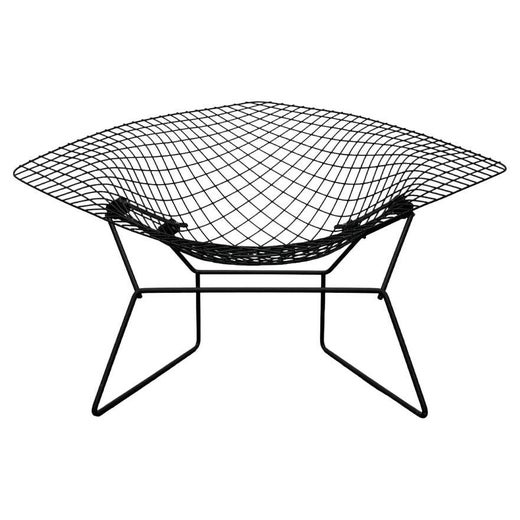
Harry Bertoia
Sculptor, furniture and jewelry designer, graphic artist and metalsmith, Harry Bertoia was one of the great cross-disciplinarians of 20th-century art and design and a central figure in American mid-century modernism. Among furniture aficionados, Bertoia is known for his chairs such as the wire-lattice Diamond chair (and its variants such as the tall-backed Bird chair) designed for Knoll Inc. and first released in 1952.
As an artist, he is revered for a style that was his alone. Bertoia’s metal sculptures are by turns expressive and austere, powerful and subtle, intimate in scale and monumental. All embody a tension between the intricacy and precision of Bertoia’s forms and the raw strength of his materials: steel, brass, bronze and copper.
Fortune seemed to guide Bertoia’s artistic development. Born in northeastern Italy, Bertoia immigrated to the United States at age 15, joining an older brother in Detroit. He studied drawing and metalworking in the gifted student program at Cass Technical High School. Recognition led to awards that culminated, in 1937, in a teaching scholarship to attend the Cranbrook Academy of Art in suburban Bloomfield Hills, one of the great crucibles of modernism in America.
At Cranbrook, Bertoia made friendships — with architect Eero Saarinen, designers Charles and Ray Eames and Florence Schust Knoll and others — that shaped the course of his life. He taught metalworking at the school, and when materials rationing during World War II limited the availability of metals, Bertoia focused on jewelry design. He also experimented with monotype printmaking, and 19 of his earliest efforts were bought by the Guggenheim Museum.
In 1943, he left Cranbrook to work in California with the Eameses, helping them develop their now-famed plywood furniture. (Bertoia received scant credit.) Late in that decade, Florence and Hans Knoll persuaded him to move east and join Knoll Inc. His chairs became and remain perennial bestsellers. Royalties allowed Bertoia to devote himself full-time to metal sculpture, a medium he began to explore in earnest in 1947.
By the early 1950s Bertoia was receiving commissions for large-scale works from architects — the first came via Saarinen — as he refined his aesthetic vocabulary into two distinct skeins. One comprises his “sounding sculptures” — gongs and “Sonambient” groupings of rods that strike together and chime when touched by hand or by the wind. The other genre encompasses Bertoia’s naturalistic works: abstract sculptures that suggest bushes, flower petals, leaves, dandelions or sprays of grass.
As you will see on these pages, Harry Bertoia was truly unique; his art and designs manifest a wholly singular combination of delicacy and strength.
Find vintage Harry Bertoia sculptures, armchairs, benches and other furniture and art on 1stDibs.
You May Also Like
Vintage 1950s American Mid-Century Modern Books
Paper
Vintage 1980s Brazilian Mid-Century Modern Books
Paper
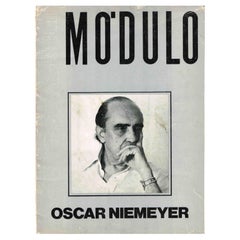
Mid-20th Century Mid-Century Modern Books
Paper
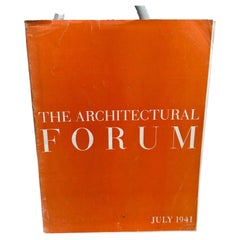
Vintage 1960s American Mid-Century Modern Scientific Instruments
Stone
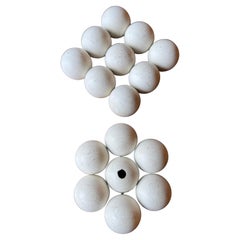
Mid-20th Century American Mid-Century Modern Musical Instruments
Metal
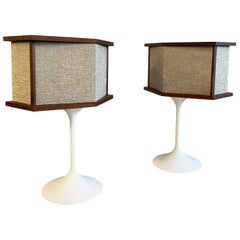
21st Century and Contemporary English Books
Paper

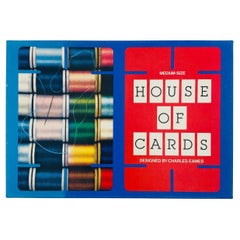
1990s American Mid-Century Modern Games
Paper
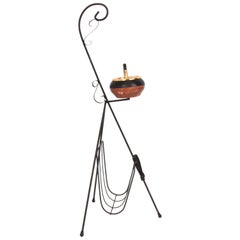
Vintage 1950s Italian Mid-Century Modern Tobacco Accessories
Brass, Metal
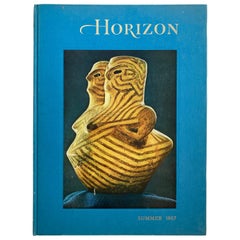
Vintage 1960s American Archaistic Books
Paper
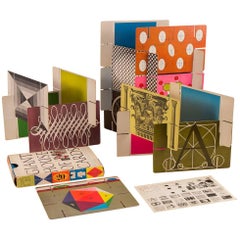
Vintage 1950s Mid-Century Modern Games
Paper
More From This Seller
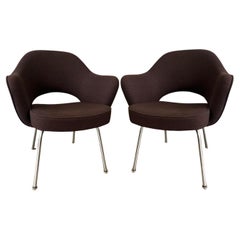
View AllMid-20th Century American Mid-Century Modern Chairs
Metal
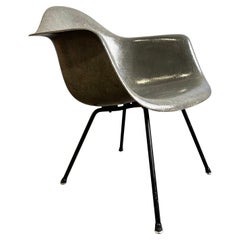
Mid-20th Century American Mid-Century Modern Chairs
Iron
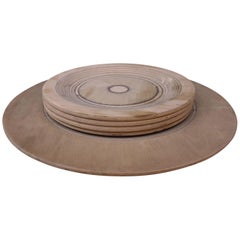
Vintage 1960s Finnish Mid-Century Modern Dinner Plates
Wood, Plywood
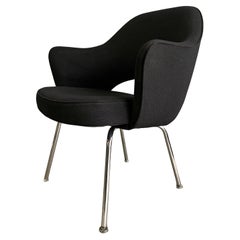
Mid-20th Century American Mid-Century Modern Chairs
Metal
Mid-20th Century American Mid-Century Modern Side Chairs
Aluminum
Mid-20th Century American Mid-Century Modern Abstract Sculptures
Brass, Copper