1 of 8
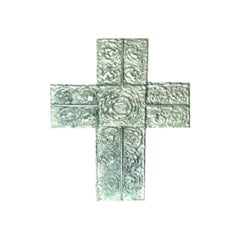
1960s Florenza Maltese Cross Brooch or Slide
Price:$109
$119List Price
About the Item
- Creator:Florenza (Jeweler)
- Dimensions:Height: 1 in (2.54 cm)Width: 2 in (5.08 cm)Depth: 2 in (5.08 cm)
- Period:
- Date of Manufacture:circa 1960s
- Condition:Wear consistent with age and use.
- Seller Location:West Palm Beach, FL
- Reference Number:1stDibs: LU182935961303
Authenticity Guarantee
In the unlikely event there’s an issue with an item’s authenticity, contact us within 1 year for a full refund. DetailsMoney-Back Guarantee
If your item is not as described, is damaged in transit, or does not arrive, contact us within 7 days for a full refund. Details24-Hour Cancellation
You have a 24-hour grace period in which to reconsider your purchase, with no questions asked.Vetted Professional Sellers
Our world-class sellers must adhere to strict standards for service and quality, maintaining the integrity of our listings.Price-Match Guarantee
If you find that a seller listed the same item for a lower price elsewhere, we’ll match it.Trusted Global Delivery
Our best-in-class carrier network provides specialized shipping options worldwide, including custom delivery.You May Also Like
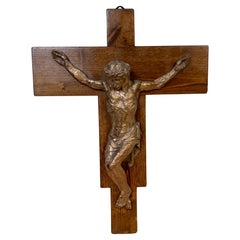
Modernist Cast Bronze Crucifix on Walnut Cross, French or Belgian, Circa 1960s
Located in West Palm Beach, FL
Modernist Cast Bronze Crucifix on Walnut Cross, French or Belgian, circa 1960s
A striking mid-20th century Modernist crucifix, featuring a cast bronze corpus of Christ mounted on a ...
Category
20th Century European Modern Religious Items
Materials
Metal, Bronze
$2,770
H 26 in W 19.75 in D 5.5 in
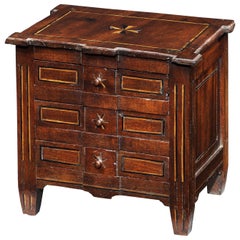
Commode Minature Long Walnut Maltese Cross Ebonised Fruitwoo
Located in BUNGAY, SUFFOLK
An exceptionally rare, museum quality Maltese, Neoclassical walnut chest of drawers with ebonised & fruitwood inlaid maltese cross on the top and drawer fronts
Maltese furniture of this period is exceptional reflecting the status and affluence of the island.
Given the size of the island relatively little Maltese furniture was made in comparison to Europe & American mainland.
Minature furniture is rare made either as a model or an apprentice's piece so it is extremely rare to find a minature piece from Malta bearing the Maltese cross.
This minature commode is highly original with beautiful proportions, ornamentation and patination.
The 'H' shaped top with a large centered inlaid Maltese Cross and a border of stringing. The breakfront fitted with three drawers each with stringing and inlaid six point stars centrally positioned behind the wooden knobs. The uprights with two continuous vertical bands of stringing ebonised and fruitwood from the top to the bottom of the drawers in walnut to match the front of the chest and then reverting to ebonising and fruitwood down the feet. Terminating in tapering feet. The panelled sides with a repeat of the double banding on the uprights and rectangular borders within the panels. The oak lined drawers with the original 18th century blue paper lining.
Measures: length 27 cm 10 1/2", height 24 cm 9 1/2", depth 20 cm 8".
Maltese Cross:
The Maltese cross is a symbol that is most commonly associated with the Knights of Malta (also known as the Knights Hospitallers...
Category
Antique 18th Century Maltese Neoclassical Commodes and Chests of Drawers
Materials
Fruitwood, Walnut
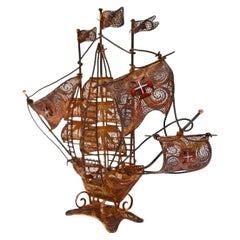
Caravel in gilded silver filigree with Maltese crosses
Located in Porto, PT
Description: Gilded silver filigree caravel with enameled Maltese crosses on the sails and resting on a scalloped base. Metal: Silver. Origin: Portuguese. Mark: standing eagle. Weigh...
Category
20th Century European Models and Miniatures
Materials
Silver
$875 Sale Price
50% Off
Free Shipping
H 8.67 in W 7.49 in D 7.49 in
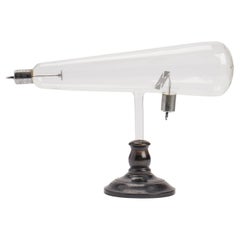
Glass scientific instrument: Crookes maltese cross tube, Italy 1900.
Located in Milan, IT
Blown glass scientific instrument. An example of the Crookes tube with Maltese Cross, in chromed metal, a precursor to the cathode ray tube. It was used to demonstrate the rectilinea...
Category
Early 20th Century Italian Scientific Instruments
Materials
Metal
$1,859
H 8.5 in W 10.5 in D 3.5 in
Mid-Century Brutalist Metal Sakral Cross Sculpture, 1960s
Located in Hamburg, DE
Mid-Century Brutalist Metal Sakral Cross Sculpture, 1960s, in Very Good conditions. Designed 1960 to 1969.
Additional information:
Materials: Metal
Color: Gold
Styles: Brutalist, Mi...
Category
20th Century Mid-Century Modern Religious Items
Materials
Metal
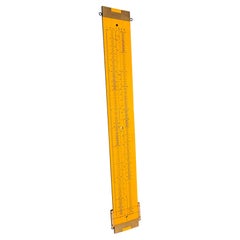
7 Foot Industrial Giant Slide Ruler by Pickett in the 1960s
Located in New York, NY
A giant vintage industrial slide ruler that was manufactured by Pickett in the 1960s for schools and teaching . It works and slides and has ring holes to m...
Category
Mid-20th Century American Schoolhouse Scientific Instruments
Materials
Aluminum
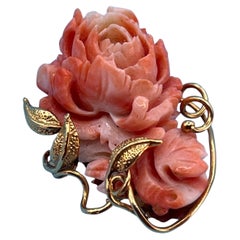
Mid-Century Italian Brooch 18 kt Gold 1960s
Located in Palermo, IT
Mid-Century Italian brooch 18 kt gold and natural coral 1960s
Purchased in 1966 in Torre Del Greco (Naples).
Intact and in excellent condition, pin with safety. Stamped 750 thousandt...
Category
Vintage 1960s Italian Collectible Jewelry
Materials
Gold
Italian Briar Pipe – "Sablé d’Or" by Lorenzo, 1960s
Located in Roma, IT
A finely crafted smoking pipe in briar wood, marked Sablé d’Or and Hand Made in Italy. The bowl shows a natural, rusticated finish in warm brown tones, with a slightly tapered cylind...
Category
Vintage 1960s European Tobacco Accessories
Materials
Wood

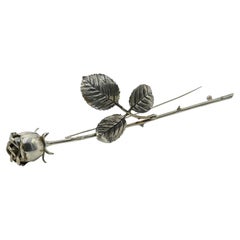
Brooch in the form of a Rose by G. Raspini, Italy 1960s
Located in Roma, IT
Brooch in the form of a Rose, with its original case.
Realized in Italy, Arezzo, by G. Raspini in 1960s.
Silver. L. 17.8 cm, 44 g.
Hallmarked with guarantee and maker's marks as we...
Category
Vintage 1960s Italian Collectible Jewelry
Materials
Sterling Silver
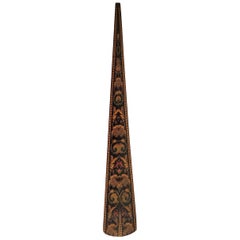
Rare 19th Century English Tunbridgeware Hair Pin or Slide
Located in Dallas, TX
PRESENTING an EXTREMELY UNIQUE and RARE 19C British Tunbridgeware Hair Pin/Bobbin or Slide.
This slide is unlike any of it’s kind we have seen before, it is a VERY RARE survivor.
From circa 1860 – 80 and made in Tunbridge Wells, England.
Made of walnut with gorgeous marquetry inlay on the entirety of the front with classic Tunbridgeware micro-mosaic all over the front. The rear is walnut.
The marquetry inlay appears to be various different woods, namely, maple, walnut and satinwood.
Would have been worn in a Lady’s hair bun with the micro-mosaic facing forward.
This would have belonged to a VERY ELEGANT LADY in the mid to late 19th Century.
Tunbridge ware is a form of decoratively inlaid woodwork, typically in the form of boxes, that is characteristic of Tonbridge and the spa town of Royal Tunbridge Wells in Kent in the 18th and 19th centuries. The decoration typically consists of a mosaic of many very small pieces of different coloured woods that form a pictorial vignette. Shaped rods and slivers of wood were first carefully glued together, then cut into many thin slices of identical pictorial veneer with a fine saw. Elaborately striped and feathered bandings for framing were pre-formed in a similar fashion.
There is a collection of Tunbridge ware in the Tunbridge Wells Museum and Art Gallery in Tunbridge Wells.
The famous makers of Tunbridge ware were in the Tunbridge Wells area of Kent; their most notable work was from circa 1830-1900.
Early makers of Tunbridge ware, in Tunbridge Wells in the mid-18th century, were the Burrows family, and Fenner and Co. In the 19th century, around 1830, James Burrows invented a technique of creating mosaics from wooden tesserae. Henry Hollamby, apprenticed to the Burrows family, set up on his own in 1842 and became an important manufacturer of Tunbridge ware, employing about 40 people.
Edmund Nye (1797–1863) and his father took over the Fenner company when William Fenner retired in 1840, after 30 years in partnership with him. Thomas Barton (1819–1903), previously apprenticed at the Wise factory, joined the Nyes in 1836, and worked as Nye’s designer; he took over the business in 1863 and continued there until his death.
In Tonbridge (near to Tunbridge Wells), George Wise (1703–1779) is known to have had a business in 1746. It continued with his son Thomas, and Thomas’s nephew George (1779–1869), who took over in 1806. In its early years the company made articles such as workboxes and tea caddies with prints of popular views; later items had pictures created from mosaics. Their workshop in Tonbridge, Wise’s Tunbridge Ware Manufactory, was next to the Big Bridge over the Medway; the building was demolished in 1886 to widen the approach to the bridge.
Tunbridge ware became popular with visitors to the spa town of Tunbridge Wells, who bought them as souvenirs and gifts. Articles included cribbage boards, paperweights, writing slopes, snuffboxes and glove boxes.
At the Great Exhibition of 1851, Tunbridge ware by Edmund Nye, Robert Russell and Henry Hollamby was shown; Edmund Nye received a commendation from the judges for his work. He exhibited a table depicting a mosaic of a ship at sea; 110,800 tesserae were used in making the picture.
The manufacturers of Tunbridge ware were cottage industries, and they were no more than nine in Tunbridge Wells and one in Tonbridge. The number declined in the 1880s; competent craftsmen were hard to find, and public tastes changed. After the death of Thomas Barton in 1903 the only surviving firm was Boyce, Brown and Kemp, which closed in 1927.
Marquetry was an old technique which was continued by Nye and Barton to create images such as birds or butterflies.
‘Green Oak’ as caused by the fungus Chlorociboria aeruginascens.
Stickware and half-square mosaic was invented by James Burrows in about 1830: a bunch of wooden sticks of different colours, each having triangular or diamond-shaped cross section, were tightly glued together; in the case of stickware, the resulting block was dried, then turned to form an article such as the base of a pincushion. For half-square mosaic, thin slices were taken from the composite block, and applied to a surface.
Tesselated mosaic, was a development by James Burrows of half-square mosaic; it was adopted by George Wise and Edmund Nye. Minute tesserae were used to form a wide variety of geometric and pictorial designs.
Many sorts of wood were used for the various colours; about 40 were in regular use. Only natural colors were used; green was provided by “green oak”, produced by the action of fungus on fallen oak. Designs for articles were often taken from designs of Berlin wool work.
Category
Antique Late 19th Century English High Victorian Collectible Jewelry
Materials
Satinwood, Walnut
Still Thinking About These?
All Recently ViewedMore Ways To Browse
Topaz Pin
Vintage Florenza
Florenza Vintage Jewelry
Kultaseppa Salovaara
Laura Ramsey
Lisa Eisner
Louis Vuitton Las Vegas
Man And Dolphin Dali
Mr John Jewelry
R Lalique Jewelry
Robert Larin
Rodeo Belt Buckle
Rolex Submariner Factory Diamonds
S Hawkins
Schiaparelli Watch
Seiko Quartz Gold Watch Vintage
Speidel Watch Band Vintage
St Benedict Medal