Want more images or videos?
Request additional images or videos from the seller
1 of 5
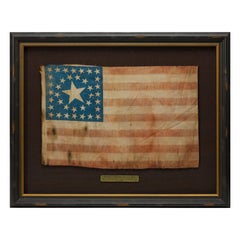
1876 Centennial George Washington Banner
Price:$3,500
$4,995List Price
About the Item
- Dimensions:Height: 35 in (88.9 cm)Width: 26 in (66.04 cm)Depth: 1.5 in (3.81 cm)
- Materials and Techniques:
- Place of Origin:
- Period:
- Date of Manufacture:1876
- Condition:Wear consistent with age and use. Minor fading. There is a water stain visible in the top left corner and bottom left portion, reaching the center but not impacting the central depiction. There is some fading, to be expected with age. Presented in an archival frame with UV acrylic.
- Seller Location:Colorado Springs, CO
- Reference Number:Seller: F4181stDibs: LU909723957812
About the Seller
4.9
Gold Seller
Premium sellers maintaining a 4.3+ rating and 24-hour response times
Established in 2010
1stDibs seller since 2011
473 sales on 1stDibs
Typical response time: 4 hours
Authenticity Guarantee
In the unlikely event there’s an issue with an item’s authenticity, contact us within 1 year for a full refund. DetailsMoney-Back Guarantee
If your item is not as described, is damaged in transit, or does not arrive, contact us within 7 days for a full refund. Details24-Hour Cancellation
You have a 24-hour grace period in which to reconsider your purchase, with no questions asked.Vetted Professional Sellers
Our world-class sellers must adhere to strict standards for service and quality, maintaining the integrity of our listings.Price-Match Guarantee
If you find that a seller listed the same item for a lower price elsewhere, we’ll match it.Trusted Global Delivery
Our best-in-class carrier network provides specialized shipping options worldwide, including custom delivery.You May Also Like
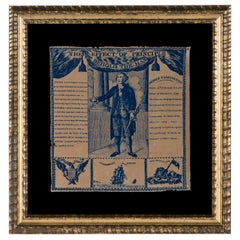
1806 Printed Linen Kerchief Glorifying George Washington, Germantown, Penn
Located in York County, PA
EXTRAORDINARILY EARLY (1806) PRINTED LINEN KERCHIEF GLORIFYING GEORGE WASHINGTON, PRINT WORKS, GERMANTOWN, PENNSYLVANIA
Printed in blue ink on coarse, white linen, this patriotic kerchief shows a standing portrait of George Washington, above which is a swag valance and the words “The Effect of Principle, Behold the Man”. The portrait is based on a mezzotint after Gilbert Stuart’s very famous painting of Washington in his later years, most often referred to as the Landsdowne portrait. Stuart painted three versions of it in oil on canvas, one of which was completed in 1796 for a wealthy merchant by the name of William Constable, who commissioned the work for Alexander Hamilton.
The kerchief is interesting because it is both American-made and documented. This is exceptionally unusual for any printed textile of the 19th century or prior and the earlier the time period the more unlikely an object is to be identified. This kerchief and a companion piece entitled “The Love of Truth Mark the Boy” (also glorifying Washington, through the fabled story of the cherry tree), were made circa 1806 by Germantown Print Works in Germantown, Pennsylvania.
To the left of Washington's image is a portion of his infamous farewell address to his troops at the end of the Revolutionary War. To the right is a short excerpt from his eulogy. Below these are three images. In the center is a square-rigged tall ship with “Commercial Union” above it, flanked by the American eagle on the left and the British lion on the right. It is reasonable to assume that the textile may have been produced in demonstration of the maker's desire, and/or that of others, to advance trade with England. Commercial printers were very influential in early America, as they possessed the means by which to disseminate information.
This kerchief and its companion piece are documented in Threads of History, Americana Recorded on Cloth, 1775 - the Present, by Herbert Ridgeway Collins (1979, Smithsonian Press), p. 63, items 38
39.* The two pieces pictured are in the collection of Cornell University, but the Collins text also cites an uncut pair to be present in the collection of the Western Reserve Historical Society, Cleveland, OH. The name "Germantown Print Works" is printed on the Western Reserve examples. Another example of the textile in question is documented in "Running for President, The Candidates and Their Images, 1789-1896" by Schlesinger, Israel, and Frendt, (1994, Simon
Schuster), p. 15.
I have seen three different color variations of this textile, including sepia, mulberry red, and blue. This particular example has a hand-sewn binding along the top, lower, and left edges.
Mounting: The textile was mounted and framed within our own conservation department, which is led by expert staff. We take great care in the mounting and preservation of flags and have framed thousands of examples.
The gilded molding has a rippled profile and dates to the period between 1825 and 1850.The background is 100% cotton twill, black in color. The glazing is U.V. protective plexiglass. Feel free to contact us for more details.
Condition: There is an all-over golden oxidation of the white fabric and there is very minor staining. There are tiny tack holes in each corner and there are minor nicks around the perimeter.
* Collins relates that Germantown Printworks was operated by the Hewsons. In doing so he cites one of Worthington Chauncey Ford's books on George Washington, but it isn't clear which one (there are many) and no page numbers are given. John Hewson was an Englishman who came to America and opened his printing business on the advice of Benjamin Franklin. He was one of the first “calico printers” and is the earliest documented to have advertised printed kerchiefs. His ads for bandanas appear as early as June 20th, 1774. He is suspected of having produced the very first American kerchief that pictured an American president, which is documented in Collins as item 1 on page 48. Linda Eaton, curator at Winterthur, in 2012, is currently doing in depth research on the three printers of fabrics that were operating in Germantown in early America. She discovered that the owner and/or operator of Germantown Print Works, while not currently known, was not John Hewson. This information is not yet published. She also noted that Winterthur possessed examples of the two George Washington textiles...
Category
Antique Early 1800s American Political and Patriotic Memorabilia
Materials
Cotton
Price Upon Request
H 19 in W 18 in D 2 in
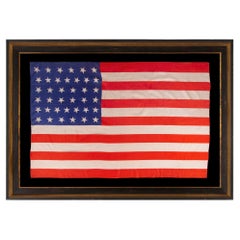
38 Star Antique American Flag, Colorado Statehood, circa 1876-1889
Located in York County, PA
38 star antique American parade flag with scattered star orientation, made of silk, with generous scale and vivid colors, Colorado Statehood, 1876-1889
38 star American national p...
Category
Antique Late 19th Century American Political and Patriotic Memorabilia
Materials
Silk
Price Upon Request
H 43 in W 60 in D 2.5 in
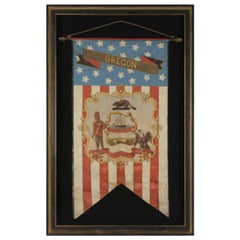
Hand-Painted Patriotic Banner with the Seal of the State of Oregon
Located in York County, PA
HAND-PAINTED PATRIOTIC BANNER WITH THE SEAL OF THE STATE OF OREGON AND GREAT FOLK QUALITIES, 1861-1876:
Swallowtail format, patriotic vertical banne...
Category
Antique Late 19th Century American Political and Patriotic Memorabilia
Materials
Canvas
Price Upon Request
H 78.75 in W 50.25 in D 4 in
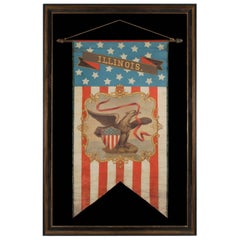
Hand-Painted Patriotic Banner With The Seal of the State of Illinois
Located in York County, PA
HAND-PAINTED PATRIOTIC BANNER WITH THE SEAL OF THE STATE OF ILLINOIS AND GREAT FOLK QUALITIES PROBABLY MADE FOR THE 1868 DEMOCRAT NATIONAL CONVENTION...
Category
Antique 1860s North American Political and Patriotic Memorabilia
Materials
Canvas
Price Upon Request
H 65 in W 34 in D 1 in
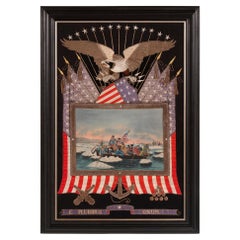
Elaborate Sailor Souvenir of Washington Crossing the Delaware, circa 1885-1912
Located in York County, PA
Elaborate sailor’s souvenir embroidery from the orient with a beautiful hand-painted image of Washington crossing the Delaware, surrounded by a large eagle, federal shield, crossed flags, a cannon, cannonballs, and anchor, circa 1885-1910:
Between roughly 1880 and 1915, American sailors visiting the orient could obtain beautiful needlework embroideries on shore, with patriotic American themes. These extraordinary works of art were acquired as mementos of a long voyage, often with the hope that they might be presented as gifts for loved ones and friends.
Using silk floss, elaborately embellished with both silver and gold metallic bullion thread...
Category
Antique Late 19th Century Asian Political and Patriotic Memorabilia
Materials
Silk
Price Upon Request
H 45 in W 31 in D 2.5 in
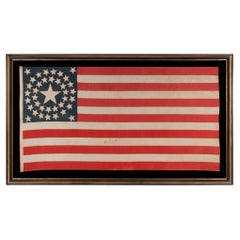
38 Star Antique Flag, Stars in Double Wreath Pattern, Colorado Statehood 1876-89
Located in York County, PA
38 STAR ANTIQUE AMERICAN FLAG WITH A DOUBLE-WREATH CONFIGURATION THAT FEATURES AN ENORMOUS CENTER STAR, REFLECTS THE PERIOD OF COLORADO STATEHOOD, 1876-1889:
38 star American national flag, made entirely of plain weave cotton. The stars are arranged in a medallion configuration. This features an enormous center star, surrounded by two wreaths of much smaller stars, with a flanking star in each corner of the blue canton. The sort of disparity here, present in the scale of the large star, versus those around it, is both exceptionally unusual and graphically dynamic.
Colorado became the 38th state on August 1st, 1876. This was the year of our nation’s centennial. Per the Third Flag Act of 1818, stars were not officially added until the 4th of July following a state's addition. For this reason, 37 remained the official star count for the American flag until part way through the following year. Flag-making was a competitive venture, however, and few flag-makers would have continued to produce 37 star flags when their competitors were making 38’s. Many flag-makers added a 38th star before Colorado entered the Union, in the early part of 1876, or possibly even prior. In fact, many makers of printed flags, called parade flags or hand-wavers, were actually producing flags in the 39 star count, in hopeful anticipation of the addition of two more Western Territories instead of one.
It is for these reasons that 38, 39, and 13 stars, to representing the original 13 colonies, are most often seen on flags displayed at the Centennial International Exhibition. Hosted in Philadelphia, this enormous event was our nation’s first World’s Fair, lasted for a duration of six months, and served as the nucleus of celebrations held to honor America’s 100-year anniversary of independence. The 38 star flag became official on July 4th, 1877 and was generally used until the 39th state was added in November of 1889.
This is probably a homemade flag, though sewn by a very skilled hand, or possibly, by two different individuals. The stripes are pieced and sewn entirely by hand, with remarkable care and precision. The canton is constructed of two lengths of blue fabric, that have been joined with treadle stitching. This was joined to the striped field by hand. The stars are double-appliquéd (applied to both sides) with treadle stitching. There is a treadle-sewn, cotton binding along the hoist, with five, hand-sewn grommets.
It is extremely unusual to encounter this combination of sewing methods. Soon after the sewing machine was mass-marketed, in the mid-1850’s, flag-makers both public and private made good use of treadle machines, to join stripes, when constructing American flags. During the Civil War (1861-65), most stripes were treadle-sewn. Stars were another matter. Until the advent of electric machines...
Category
Antique Late 19th Century American Political and Patriotic Memorabilia
Materials
Cotton
Price Upon Request
H 65 in W 115.25 in D 2.5 in
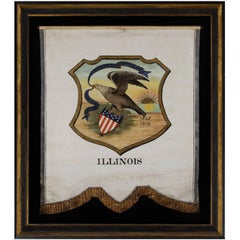
Hand-Painted 19th Century Banner with the 1867 Proposed Seal of Illinois
Located in York County, PA
HAND-PAINTED 19TH CENTURY BANNER WITH AN 1867 VERSION OF THE SEAL OF THE STATE OF ILLINOIS, PROPOSED IN THAT YEAR BY THE SECRETARY OF STATE, BUT IN A VARIATION NEVER FORMALLY ADOPTED
Banner with the Illinois State Seal, in a rare variation of the design, never adopted. In 1867 Illinois Secretary of State Sharon Tyndale proposed that the phrases in the state motto be reversed. In the wake of the Civil War, (which ended in 1865,) Tyndale suggested that the verbiage be changed from "State Sovereignty--National Union" to "National Union--State Sovereignty,” which made sense given the recent secession of the Southern States, which placed their own interests first. Illinois' own Abraham Lincoln had worked hard to preserve national interests, echoed here in the altering of the language. Though Tyndale’s suggestion was rejected, he was nonetheless charged with creating a new design, which he did and was soon adopted. This displayed the dates of "1818," when Illinois became a state, and "1868," when the seal was officially changed. Interestingly enough, Tyndale did manage to send a message in the new version by turning the word “sovereignty” upside-down , with the surmised explanation that this fit accordingly with the orientation / position of the streamer.
The banner is beautifully hand-painted on muslin and retains its original staff. The shape is beautifully scalloped at the bottom edge, which is painted to look as if there is an applied fringe. Most of the elements are congruent with the 1868 version, but there are various differences. Set within a shield-shaped medallion—usually circular—is the expected eagle in a side view, spread wing pose with beak uplifted. The eagle is supposed to be perched upon a rock with one talon, while gripping a Federal shield in the other. Here there is no rock and both talons grip the shield, which displays 13 stars. Note the date of "1867" and Tyndale's preferred order of the wording on the billowing ribbon in the eagle's beak. The foreground of the official design is all grass. Here there are olive branches—a peacetime reference appropriate for a country recovering from war—on a grassy area, set upon a sandy shore before Lake Michigan, with a rising sun on the horizon.
Mounting: The banner was mounted and framed within our own conservation department, which is led by masters degree trained staff. We take great care in the mounting and presentation of flags and have preserved thousands of examples; more than anyone worldwide.
The background is 100% cotton twill, black in color. The mount was placed in a black-painted, hand-gilded and distressed Italian molding. A shadowbox was created to accommodate the staff. The glazing is U.V. protective plexiglass. Feel free to contact us for more details.
Banner - 49" x 56.5"
Frame - 67.75" x 59.25"
About Jeff R. Bridgman Antiques, Inc.:
As an advisor to top museums and collectors alike, Jeff Bridgman is the world's leading expert and source for antique American flags and political textiles...
Category
Antique 1860s American Political and Patriotic Memorabilia
Materials
Cotton
Price Upon Request
H 67.75 in W 59.25 in D 3.5 in
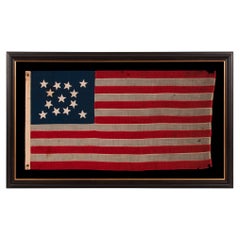
13 Star Antique American Flag , Hand-Sewn Stars in a Medallion, 1876 Centennial
Located in York County, PA
13 STAR ANTIQUE AMERICAN FLAG WITH A MEDALLION CONFIGURATION OF HAND-SEWN STARS AND A BEAUTIFUL, ELONGATED PROFILE, MADE IN THE ERA OF THE 1876 CENTENNIAL OF AMERICAN INDEPENDENCE, I...
Category
Antique 1870s Political and Patriotic Memorabilia
Materials
Wool
Price Upon Request
H 43 in W 72.25 in D 2.5 in
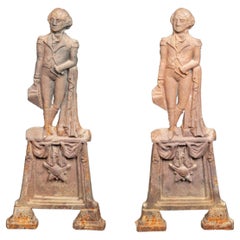
Pair of Cast Iron George Washington Figural Andirons
Located in New York, NY
Pair of cast iron George Washington Andirons:
Measures: 9" x 20" x 16"
Weighs: 30 LBS.
Category
Early 20th Century American American Classical Andirons
Materials
Iron
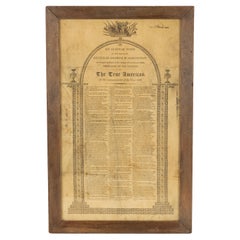
Antique Silk Broadside An Elegiac Poem Death of President George Washington 1800
Located in Portland, OR
An important & rare antique American political printed silk broadside, an elegy on the death of President George Washington, dated 1800.
A poem on the Death of President George Was...
Category
Antique 1790s Federal Political and Patriotic Memorabilia
Materials
Silk
$6,995
H 20.5 in W 13 in D 1 in
More From This Seller
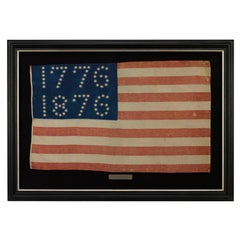
View AllCentennial Celebration "1776-1876" American Flag Banner
Located in Colorado Springs, CO
Presented is a rare Centennial patriotic flag banner, dating to 1876. The flag’s brilliant blue canton is spectacular, with 81 five-pointed, rayed stars, arranged to read “1776” and “1876.” The flag’s design is completed with thirteen alternating red and white stripes. The flag is a three-piece, treadle-sewn sewn construction, printed on a thin wool and cotton blend. Along the edge, there is a narrow, treadle-sewn sleeve made of cotton tape.
In the lead up to the nation’s Centennial in 1876, flag makers and individuals looked to the past for designs to produce as part of the country’s many celebrations. Popular interpretation of the stars and stripes undoubtedly reached its climax of variety and originality at the time of our Nation’s first Centennial. Since no design restrictions were placed on flagmaker’s imaginations and no strict distinctions were drawn between official and unofficial star counts, it is no surprise that, on the occasion of the Centennial, creativity in flag design was not the exception, but the rule.
The cantons from this period presented an array of geometric abstractions. Great star patterns, referred to as the “starry flower of Liberty” by Oliver Wendell Holmes, that were popular from 1818 and on, resurfaced in Centennial flags...
Category
Antique 1870s American Political and Patriotic Memorabilia
Materials
Wool, Cotton
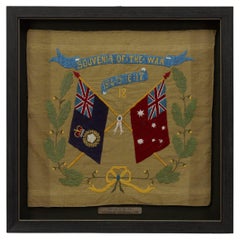
Souvenir of the War 1914-15-16-17-18 Banner
Located in Colorado Springs, CO
Presented is a stunning textile banner from the first World War, dating to 1918. The square tan cotton cloth is embroidered with two crossed flags, the ...
Category
Vintage 1910s Australian Political and Patriotic Memorabilia
Materials
Cotton
38-Star Antique American Flag with Unique Canton, circa 1876-1890
Located in Colorado Springs, CO
This is a striking 38-star American flag. The flag dates to 1876-1890, when Colorado (represented by the large star in the center of the flag’s canton) joined the Union as the 38th s...
Category
Antique Late 19th Century American Political and Patriotic Memorabilia
Materials
Muslin
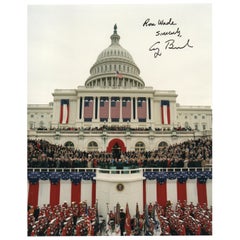
George H. W. Bush Signed and Inscribed 1989 Inaugural Photograph
Located in Colorado Springs, CO
Presented is a wonderful inscribed color photo of the inauguration of George H.W. Bush as the 41st President of the United States held on January 20, 1989. The inauguration marked the commencement of the four-year term of George H. W. Bush as President and Dan Quayle as Vice President. The photograph is signed and inscribed to Ron Wade, who once served as a White House page for President Nixon. Inscription reads, "To Ron Wade/ Sincerely /George Bush" Mr. Wade then scripted a note on the verso of the photo, stating "Signed as President, week of 6-1/-89".
The inauguration of George H. W. Bush as the 41st president of the United States was held at the West Front of the United States Capitol in Washington, D.C. This was the 51st inauguration. Chief Justice William Rehnquist administered the presidential oath of office to Bush and Justice Sandra Day O'Connor administered the vice presidential oath of office to Quayle. Bush was the first sitting vice president to be inaugurated as president (not due to his predecessor's death or resignation) since Martin Van Buren...
Category
Vintage 1980s American Historical Memorabilia
Materials
Paper
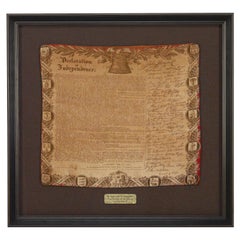
Declaration of Independence, Printed on Cotton, Circa 1876
Located in Colorado Springs, CO
Presented is a Centennial-era patriotic textile, celebrating the Declaration of Independence. At the center of the printed bandana design is artistic rendering of the Declaration of ...
Category
Antique 1870s American High Victorian Political and Patriotic Memorabilia
Materials
Cotton
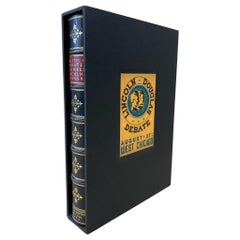
Political Debates Between Abraham Lincoln
Stephen A. Douglas, Limited Edition
Located in Colorado Springs, CO
Lincoln, Abraham and Stephen A. Douglas. Political Debates Between Hon. Abraham Lincoln and Hon. Stephen A. Douglas, In the Celebrated Campaign of 1858, in Illinois, Including the Preceding Speeches of Each, at Chicago, Springfield, Etc.; Also, the Two Great Speeches of Mr. Lincoln in Ohio, in 1859. Cleveland: The Burrows Brothers Company, 1894. Limited edition printing, No. 168 of 750. Presented in ¼ leather and cloth binding, with gilt titles and raised bands to spine, with a new archival cloth slipcase.
This is a special limited edition printing of the political debates of Lincoln and Stephen Douglas...
Category
Antique Late 19th Century American Victorian Political and Patriotic Mem...
Materials
Paper
Still Thinking About These?
All Recently ViewedMore Ways To Browse
Patriotic Banners
Signing Declaration Independence
George Washington Memorabilia
Buzz Aldrin
Dwight Eisenhower
Pennant Frame
Admiral Lord Nelson
Antique Metal Shoe
Antique Santa Claus
Antique Advertising Collectibles
Antique Military Memorabilia
National Furniture Co
National Register Antique
Queen Elizabeth Coronation
Alfa Romeo Vintage
Anders Aldrin
Gavel Used
Vintage Vending