Want more images or videos?
Request additional images or videos from the seller
1 of 7
21-Star American Flag, Civil War Era, Hand-Sewn Linen, circa 1860
Price:$26,000
$35,000List Price
About the Item
- Dimensions:Height: 52.5 in (133.35 cm)Width: 76 in (193.04 cm)Depth: 3.5 in (8.89 cm)
- Materials and Techniques:
- Place of Origin:
- Period:
- Date of Manufacture:1860
- Condition:Wear consistent with age and use.
- Seller Location:Colorado Springs, CO
- Reference Number:Seller: F3211stDibs: LU909715570711
About the Seller
4.9
Gold Seller
Premium sellers maintaining a 4.3+ rating and 24-hour response times
Established in 2010
1stDibs seller since 2011
471 sales on 1stDibs
Typical response time: 4 hours
Authenticity Guarantee
In the unlikely event there’s an issue with an item’s authenticity, contact us within 1 year for a full refund. DetailsMoney-Back Guarantee
If your item is not as described, is damaged in transit, or does not arrive, contact us within 7 days for a full refund. Details24-Hour Cancellation
You have a 24-hour grace period in which to reconsider your purchase, with no questions asked.Vetted Professional Sellers
Our world-class sellers must adhere to strict standards for service and quality, maintaining the integrity of our listings.Price-Match Guarantee
If you find that a seller listed the same item for a lower price elsewhere, we’ll match it.Trusted Global Delivery
Our best-in-class carrier network provides specialized shipping options worldwide, including custom delivery.You May Also Like
48 Star Crocheted Homemade American Flag, WWII Era, 1941-1945
Located in York County, PA
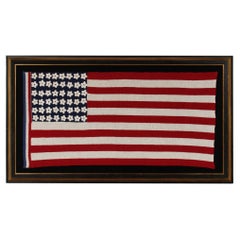
48 star, crocheted, antique american flag of the wwii era (1941-1945), a beautiful, homemade example, with a red, white, & blue hoist and flower-like stars:
Crocheted American flag of the WWII era (U.S. involvement 1941-1945), with some interesting and beautiful features. Made entirely of cotton, the flag’s most notable attribute is the red, white, and blue color of its hoist. This was carefully stitched to the canton and the striped field with white cotton floss or yarn. The 48 crocheted stars are appliquéd to a length of navy blue plain weave cotton. With pierced centers, note how these more closely resemble flowers than stars, tipped this way and that on their vertical axis. Large, with respect to the canton on which they are placed, note how these crowd their boundaries and overlap into the field.
The elongated format of the flag is also of interest and contributes to the bold presentation, as do the strong colors. Most crocheted flags are smaller than this one, or date to a much later period (namely the 1976...
Category
Mid-20th Century American Political and Patriotic Memorabilia
Materials
Cotton
Price Upon Request
H 43 in W 77.5 in D 2.5 in
Ohio State Parade Flag with a Civil War Veterans Overprint
Located in York County, PA
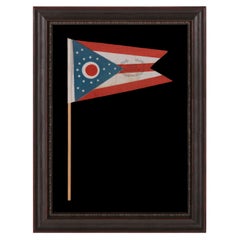
OHIO STATE FLAG WITH CIVIL WAR VETERANS' OVERPRINT FROM THE GRAND ARMY OF THE REPUBLIC POST IN COLUMBUS, MADE IN MOURNING OF THE 1925 PASSING OF NATIONAL G.A.R. COMMANDER IN CHIEF DANIEL M. HALL, WHO ALSO SERVED AS COMMANDER OF THE OHIO DEPARTMENT OF THE G.A.R., AS WELL AS THE LOCAL CHAPTER
Flag of the State of Ohio, printed on oilcloth-like cotton, affixed to its original wooden staff. Made for Civil War veteran's use, the flag bears a stamped overprint in the striped field that consists of an open wreath of laurel branches, inside which is the following text: “GAR [Grand Army of the Republic] Post, Dan Hall, Columbus, OH”.
Born on October 20th, 1842, Daniel M. Hall enlisted with the Union Army as a Private at the age of 18 on August 25th, 1861. On October 8th of that year he mustered into the Co. H of the 2nd Ohio Cavalry. Discharged for disability on June 28th, 1862, he reenlisted approximately 17 months later, on November 11th, 1863, and mustered into Co. F of the 12th Ohio Cavalry at Camp Cleveland. He was at some point promoted to the rank of Sergeant, and, on February 21st, 1864, to the rank of Corporal. He mustered out at Nashville on November 14th, 1865.
Hall mustered into the Hamlin Post of the Ohio G.A.R. on May 23rd, 1883. He would go on to serve not only as Commander of the Dept. of Ohio for the organization, but as National Commander of the entire Grand Army of the Republic.
The Grand Army of the Republic was the primary veterans association for Union Civil War soldiers. Founded in 1866, its members dressed up in Civil War uniforms, attended parades and reunions, and the organization was somewhat more fraternal in nature than today’s VFW or American Foreign Legion.
Flags overprinted for the purpose of advertising are a specialized form in American flag collecting. A flag with a basic G.A.R. overprint is the most common type. This might be accompanied by a post number and a date. More elaborate the overprints are more highly desired, such as this one, which is the only variation I know of that honors a particular person who was not the namesake of the chapter itself.
It is of interest to note that a sister variety of 48 star parade flag is known, printed on the same fabric, that bears the same overprint, accompanied by the words: “We Mourn Our Comrade." From the additional text on the 48 star variety, one can extrapolate that the flags were made to mourn the passing of this important leader of Civil War veterans on October 19th, 1925, just one day before his 83rd birthday.
The State Flag of Ohio was designed in 1901 by Cleveland architect John Eisenmann, who designed the Ohio building for the state's exhibition at the Pan American Exposition World's Fair in Buffalo, New York. It was officially adopted by the Ohio legislature on May 19th, 1902. It's elements are centered on a red disc, set against a circular white ground that forms a letter "O." This simultaneously represents a buckeye, the fruit of the state tree and an iconic Ohio symbol. The flag's 5 stripes are said to represent the state's waterways and roads, while the triangular shape of the union is said to illustrate hills and valleys. The presentation of 13 stars along the hoist end, arranged in a semi-circular medallion with two off-set stars above and below, reflects the original 13 colonies. The diamond of stars, towards the fly end. bring the overall count to 17 to reflect Ohio's admission. When the design was adopted by the state legislature, the position of these stars was changed slightly, moving them further around the circle to form a wreath.
Flag expert Whitney Smith, who coined the term Vexillology in the late 1950's (the accepted term for the study of flags), pointed out that the format of the flag itself was reminiscent of Civil War cavalry guidons, carried by Ohio regiments throughout the state. These were of swallowtail form, though with 13 stripes, all horizontal and 90 degrees to the hoist. Most often these had circular star patterns around an open center, which makes them even more similar to the Ohio flag...
Category
Vintage 1920s American Political and Patriotic Memorabilia
Materials
Cotton
1862 Civil War Playing Cards with Stars, Flag, Sheilds and Eagles
Located in York County, PA
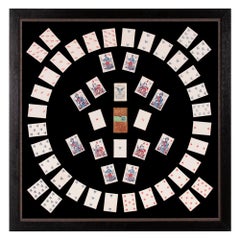
1862 Civil War playing cards with stars, flags, shields, & eagles, and face cards illustrating civil war officers and lady, Columbia, ca 1862, Benjamin Hitchcock, New York
1862 Civil War playing cards with suits represented by stars, flags, shields, & eagles, in lieu of the traditional French suits of hearts, diamonds, clubs, and spades. The face cards feature Union Army officers and Lady Columbia [a.k.a. Lady Liberty, Goddess of Liberty]. Entitled “Union Playing Cards,” two versions of this deck were produced in New York by Benjamin W. Hitchcock’s “American Card Company.” This is the earlier of the two. The other was released in 1863.
There are 52 cards in total with the ace of spades doubling as the title card, as was often the case during the 19th century. The telescoping box...
Category
Antique 1860s American Political and Patriotic Memorabilia
Materials
Paper
Price Upon Request
H 43.25 in W 43.25 in D 3 in
38 Star Antique American Flag, Colorado Statehood, circa 1876-1889
Located in York County, PA
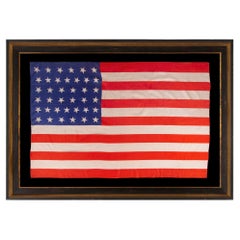
38 star antique American parade flag with scattered star orientation, made of silk, with generous scale and vivid colors, Colorado Statehood, 1876-1889
38 star American national p...
Category
Antique Late 19th Century American Political and Patriotic Memorabilia
Materials
Silk
Price Upon Request
H 43 in W 60 in D 2.5 in
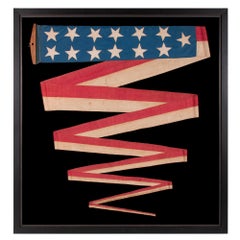
Hand-Sewn 13 Star Cornflower Blue 32 Foot Commission Pennant circa 1845-1865
Located in York County, PA
ENTIRELY HAND-SEWN, 32-FOOT, SHIP’S COMMISSION PENNANT OF THE 1845-1865 ERA, A HOMEMADE, COTTON EXAMPLE, WITH 13 STARS ON A CORNFLOWER BLUE CANTON, IN A BEAUTIFUL STATE OF PRESERVATION
Commission pennants are the distinguishing mark of a commissioned U.S. Navy ship. A ship becomes commissioned when the pennant is hoisted. Flown during both times of peace and war, the only time it is not flown is if a flag officer or civilian official is aboard and replaces it with their own flag. Flown at the topmast, this would be the first thing one would see coming over the horizon and identified the vessel as a warship.
Sometimes the owners of private ships mimicked the use of Navy signals. Some seafaring men would have served in the Navy and become privy to various practices in that capacity. Others flew them purely for stylistic reasons, either on a regular basis or while the boat was dressed for special occasion. Hudson River steamers regularly flew pennants of this nature, as evidenced by period photography as well as the paintings of artists such as John and James Bard...
Category
Antique Mid-19th Century American Political and Patriotic Memorabilia
Materials
Cotton
Price Upon Request
H 74.5 in W 70.5 in D 5 in
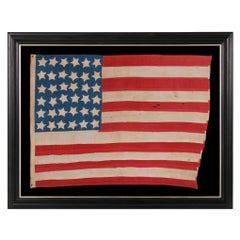
36 Star Antique American Flag, Cornflower blue Canton, circa 1864-1867, Nevada
Located in York County, PA
Antique American Flag With 36 Stars On A Cornflower Blue Canton, Civil War Era, 1864-1867, Reflects The Addition Of Nevada As The 36th State; A Great Folk Exaple With Haphazard Rows Of Starfish-like Stars:
36 star American national flag of the Civil War era with outstanding collector traits. Haphazard rows of fat, starfish-shaped stars fill most of the confines of a brilliant, cornflower blue canton. Note the crude piecing of the thirteen, red and white stripes, joined in an ill-planned manner that results in great variation in width, as well as general irregularity. The 4th red stripe actually falls slightly below the canton, and the height of each does not line up with the corresponding stripe on the reverse. This can clearly be seen at the fly end, which is is turned back and bound to repair obvious extended use in an outdoor environment. Clearly the maker lacked experience in seam work. Lining up the necessary components, so that they could be viewed on both sides, presented a challenge they may have not previously faced. This is also evident in the sewing of the stars, which do not line up on the obverse and reverse sides, as they typically would in a flag sewn by an experienced flag-maker. That said, this is just this kind of homemade charm that fuels interest in early American flags...
Category
Antique 1860s American Political and Patriotic Memorabilia
Materials
Cotton
Price Upon Request
H 50.5 in W 65 in D 2.5 in
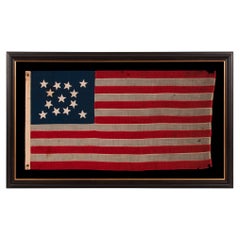
13 Star Antique American Flag , Hand-Sewn Stars in a Medallion, 1876 Centennial
Located in York County, PA
13 STAR ANTIQUE AMERICAN FLAG WITH A MEDALLION CONFIGURATION OF HAND-SEWN STARS AND A BEAUTIFUL, ELONGATED PROFILE, MADE IN THE ERA OF THE 1876 CENTENNIAL OF AMERICAN INDEPENDENCE, I...
Category
Antique 1870s Political and Patriotic Memorabilia
Materials
Wool
Price Upon Request
H 43 in W 72.25 in D 2.5 in
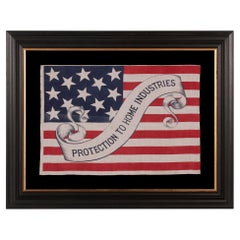
13 Star American Parade Flag with Rare Design, circa 1888 Ex Richard Pierce
Located in York County, PA
13 Star American parade flag in an extremely rare design, with “protection to home industries” slogan on a fanciful, scrolling streamer, made for the 1888 presidential campaign of Benjamin Harrison; formerly in the collection of Richard pierce.
1888 Benjamin Harrison campaign flag, printed on cotton, with 13 large stars in a 3-2-3-2-3 pattern, upon which a whimsical, scrolling streamer is superimposed that features the slogan: “Protection to Home Industries.”
There are numerous styles of both documented and undocumented, red, white, and blue bandanas and handkerchiefs, made for Harrison’s campaign in this year, as well as from the subsequent one, in 1892. Most bear variations of text to support the “Protection for American Industries” platform of the Republican Party. America was in the midst of the industrial age and there was a great deal of public interest, both in protecting growth and discouraging both imported goods and immigration. The constant stream of immigrants posed great challenges for a working families, competing for scarce jobs, in work environments that were already often far from ideal. In post-Civil War America, many of the working men were Civil War veterans.
Bandanas abound from Harrison’s Campaigns, but flags do not. This example, along with three others, were once part of an 1888 patriotic quilt that was disassembled by a dealer and sold piecemeal to collectors. I eventually acquired all four. Fifteen to twenty years ago, these were the only four known copies. A couple of others have since surfaced, but the total count known still stands closer to 5 than 10.
The use of 13 stars is seen in the flags of various candidates in the 19th century. Among these are Abraham Lincoln (1860 campaign), Henry Clay (1844 campaign), John Fremont (1856), and Benjamin Harrison’s grandfather, William Henry Harrison...
Category
Antique 1880s American Political and Patriotic Memorabilia
Materials
Cotton
Price Upon Request
H 28 in W 35.5 in D 2.5 in
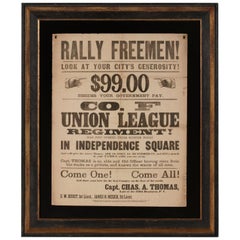
"Rally Freemen!..." Civil War Recruitment Broadside
Located in York County, PA
"RALLY FREEMEN! …COME ONE! COME ALL! AND SHOW YOUR LOVE FOR THE BEST COUNTRY ON THE FACE OF THE EARTH." A CIVIL WAR RECRUITMENT BROADSIDE FOR THE...
Category
Antique 1860s American Political and Patriotic Memorabilia
Materials
Paper
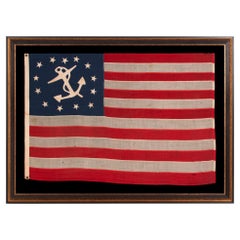
Outstanding 13 Star Hand-sewn American Private Yacht Flag, ca 1865-1885
Located in York County, PA
OUTSTANDING, 13 STAR, ANTIQUE AMERICAN PRIVATE YACHT ENSIGN WITH GREAT FOLK QUALITIES THAT INCLUDE AN UNUSUALLY WIDE ANCHOR AND A DECIDEDLY LOPSIDED RING OF 13 STARS; MADE DURING THE 2ND HALF OF THE 19TH CENTURY; ITS DEVICE HAND-SEWN AND SINGLE-APPLIQUÉD
Private yacht ensigns were approved American signals for maritime use that allowed pleasure boats to bypass customs. Though the legislation that approved them was adopted prior to 1850, almost all such flags that one will encounter were sewn by electric machine and made during the 20th century. The unusual gems among surviving examples are those that are earlier and include hand-sewn elements. Even more rare are a select few with atypical graphics. Barely any fall into both of these categories at once. Take note of the anchor on this particular flag, wide a long horizontal crossbar (stock) that contributes to uncommonly wide stance. Set within a ring of stars that is decidedly lopsided, the result is as bold as it is endearingly whimsical—two of the best qualities in American folk art, a category in which this particular example can be filed. While I have owned 13 star private yacht flags that have displayed star and canted anchor devices that were somewhat larger and/or bolder than typical, I cannot recall any that were so graphically intriguing as this one.
Brief History of Private Yacht Ensigns:
The medallion configuration, 13-star, 13-stripe flag, with a canted center anchor was entered into official use in 1848, following an act of Congress, that made it the official signal for U.S. pleasure sailing vessels. The need for such a flag arose with the popularity of boating as a pastime for well-to-do Americans, and as a competitive sport, in addition to its longstanding utilitarian role as a vehicle of trade. In early America, all boats were subject to customs searches at every port. Without modern income tax, the federal government derived its revenues mostly from tariffs, so an accounting of foreign goods on ships was a critical venture. As yachting for pleasure became more prevalent, however, more and more time was spent searching boats that had no such inventory, wasting time for both customs officials and wealthy ship owners.
John Cox Stevens, a former president of the Jockey Club and future founder of the Union League Club, became the New York Yacht Club’s Commodore upon its founding in 1845. In 1847 he approached the secretary of the treasury and suggested that something be done to streamline the customs process for non-trade vessels. In 1848, legislation passed Congress requiring registration of these boats, which could then fly the “American Yachting Signal” to bypass customs. This remained on the books until the 1980’s, when the 1848 legislation was revoked, but the use of flags in this design for decorative function continues to this day.
13 star flags have been flown throughout our nation’s history for a variety of purposes. In addition to their use on private yachts, they were hoisted at patriotic events, including Lafayette’s final visit in 1824-25, the celebration of the nation’s centennial in 1876, and the sesquicentennial in 1926. They were displayed during the Civil War, to reference past struggles for American liberty and victory over oppression, and were used by 19th century politicians while campaigning for the same reason. The U.S. Navy used the 13 star count on small boats until 1916, because it was easier to discern fewer stars at a distance on a small flag. Commercial flag-makers mirrored this practice and some private ships flew 13 star flags during the same period as the Navy.
Construction: The stars and anchor are made of cotton, hand-sewn, and single-appliquéd. This means that they were applied to one side of the canton, then the blue fabric was cut from behind each star, folded over, and under-hemmed, so that one star could be viewed on both sides of the flag. I always find single-appliquéd stars more interesting, not only because they are evidence of a more difficult level of seam-work and stitching, but also because they are more visually intriguing. The two visible rows of hand-stitching emphasize their hand-sewn construction. For these reasons, single-appliquéd stars often appeal to connoisseurs of early American textiles...
Category
Antique Mid-19th Century American Political and Patriotic Memorabilia
Materials
Wool
Price Upon Request
H 58.25 in W 78.5 in D 2.5 in
More From This Seller
View All13-Star Wool American Flag, with Zig-Zag Stars, Circa 1900
Located in Colorado Springs, CO
This is a beautiful 13-star American flag, each star sewn with zig-zag stitching. The wool flag was sewn at the turn of the century, circa 1900. The flag features 13 white stars rest...
Category
Antique Early 1900s American American Classical Political and Patriotic ...
Materials
Brass
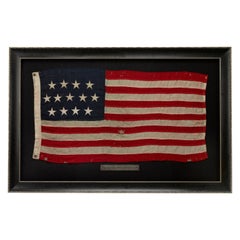
31-Star Printed American Flag, Celebrating California Statehood, Circa 1850
Located in Colorado Springs, CO
This is a rare 31-star medallion printed American flag, celebrating the addition of California to the Union. The flag is printed on silk and has a spectacular “Great Star” canton pat...
Category
Antique 1850s American Political and Patriotic Memorabilia
Materials
Silk
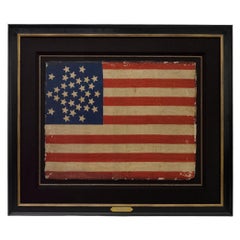
38-Star Antique American Flag with Unique Canton, circa 1876-1890
Located in Colorado Springs, CO
This is a striking 38-star American flag. The flag dates to 1876-1890, when Colorado (represented by the large star in the center of the flag’s canton) joined the Union as the 38th s...
Category
Antique Late 19th Century American Political and Patriotic Memorabilia
Materials
Muslin
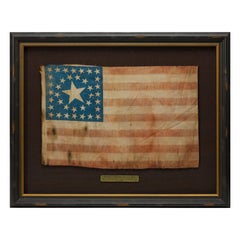
36-Star American Printed Parade Flag, Circa 1865-1867
Located in Colorado Springs, CO
This is an antique 36-star American flag, as striking as it is scarce. The flag has a glazed cotton construction, with a blue canton printed with 36 white stars. The stars are arrang...
Category
Antique 1860s American Political and Patriotic Memorabilia
Materials
Cotton
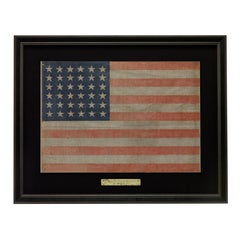
34-Star American Parade Flag, Commemorating Kansas Statehood, Circa 1861-1863
Located in Colorado Springs, CO
Offered is a spectacular 34-star American flag, produced during the Civil War. This flag features 34 printed white stars, on a blue wool blend canton. The stars are arranged in whims...
Category
Antique 1860s American American Classical Political and Patriotic Memora...
Materials
Brass
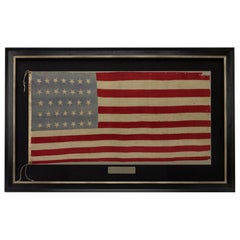
44-Star Silk American Flag, Celebrating Wyoming Statehood, Circa 1890-1896
Located in Colorado Springs, CO
Presented is a 44-star silk American flag, commemorating Wyoming statehood. The flag dates to 1890-1896. The flag has an “8-7-7-7-7-8” star configuration, with the stars whimsically ...
Category
Antique 1890s American Political and Patriotic Memorabilia
Materials
Silk
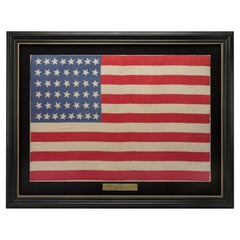
Still Thinking About These?
All Recently ViewedMore Ways To Browse
21 Star American Flag
Royal Memorabilia
Feather Tree
George Coronation
German Christmas Ornaments
Hand Crank
Neil Armstrong
Rare Christmas
Ulysses S Grant
Vintage Christmas Ornament
Mercury Glass Ornaments
Antique German Christmas
Mid Century Christmas Tree
German Antique Ornaments
German Glass Christmas Ornaments
Blown Glass Christmas
Masonic Furniture
Antique Coffe Grinder