Want more images or videos?
Request additional images or videos from the seller
1 of 5
Civil War Prisoner
s Charm
$3,280List Price
About the Item
- Dimensions:Height: 2.25 in (5.72 cm)Diameter: 14.5 in (36.83 cm)
- Style:Folk Art (In the Style Of)
- Materials and Techniques:Scrap Wood,Hand-Carved
- Place of Origin:
- Period:
- Date of Manufacture:1863
- Condition:Wear consistent with age and use.
- Seller Location:Chicago, IL
- Reference Number:Seller: CMT1421stDibs: LU820010653871
About the Seller
5.0
Platinum Seller
Premium sellers with a 4.7+ rating and 24-hour response times
Established in 1997
1stDibs seller since 2006
1,757 sales on 1stDibs
Typical response time: 2 hours
Authenticity Guarantee
In the unlikely event there’s an issue with an item’s authenticity, contact us within 1 year for a full refund. DetailsMoney-Back Guarantee
If your item is not as described, is damaged in transit, or does not arrive, contact us within 7 days for a full refund. Details24-Hour Cancellation
You have a 24-hour grace period in which to reconsider your purchase, with no questions asked.Vetted Professional Sellers
Our world-class sellers must adhere to strict standards for service and quality, maintaining the integrity of our listings.Price-Match Guarantee
If you find that a seller listed the same item for a lower price elsewhere, we’ll match it.Trusted Global Delivery
Our best-in-class carrier network provides specialized shipping options worldwide, including custom delivery.You May Also Like
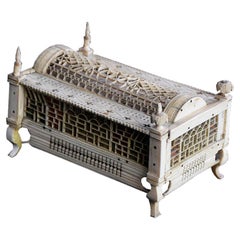
Napoleonic Prisoner of War Casket Dominoes Set
Located in London, GB
Napoleonic Prisoner of war casket Dominoes set
We share what we love, and we love this early 19th century Napoleonic prisoner of war cask...
Category
Antique 1820s French Folk Art Toys
Materials
Bone
Napoleonic Prisoner-of-War Guillotine
Located in New Orleans, LA
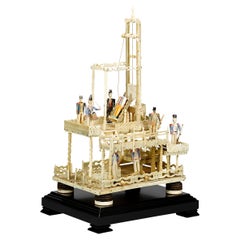
An incredible and extremely rare artifact of world history, this mutton bone model of a guillotine was created during the Napoleonic wars by a French prisoner of war. Many of the inmates at the prisoner of war camps were skilled artisans long before they were soldiers, and because of the long duration of the conflict and cost of care, their captors encouraged detainees to use their skills to create objects to be sold at civilian open markets. Because of the intricacy of these fascinating objets d'art, very few of these models have survived the test of time. This masterpiece is impeccably detailed with soldiers and cannons lining the platforms. Adding to the rarity of this piece is that it has moving parts, as only a scant few model carvings were ever created with such mechanical accuracy. The soldiers have movable arms, while the guillotine features a movable "blade" for added authenticity.
By many accounts, Napoleonic prisoners of war...
Category
Antique 19th Century French Models and Miniatures
Materials
Bone
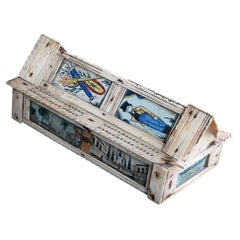
Napoleonic Prisoner of War Painted Casket Dominoes Set
Located in London, GB
Napoleonic Prisoner of war painted casket dominoes set
We share what we love, and we love this early 19th century Napoleonic prisoner of war hand painted ...
Category
Antique 19th Century French Folk Art Game Boards
Materials
Bone
Civil War Socket Bayonets
Located in Norton, MA
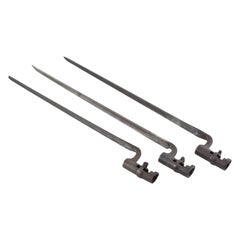
Three Socket Bayonets. One is a P-53 Civil War era marked "DEAKIN" and has a crown over 53, one is a "US" stamped dull tip, and the last is unmarked or stamped.
Category
Antique 19th Century American Arms, Armor and Weapons
Materials
Metal
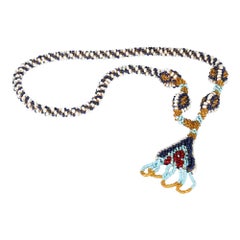
Turkish WWI Prisoner of War Glass Beadwork Amulet Necklace
Located in Bishop
s Stortford, Hertfordshire
An exceptionally good quality Turkish prisoner of war glass beadwork amulet necklace dating from the first world war 1914-1919. These pieces were made by Turkish prisoners of war, ca...
Category
Vintage 1910s Turkish Folk Art Collectible Jewelry
Materials
Glass
$315
Free Shipping
H 0.3 in W 9.26 in D 11.62 in
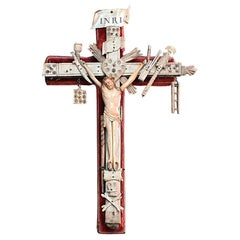
19th Century Napoleonic Prisoner of War Folk Art Corpus
Located in London, GB
19th century Napoleonic Prisoner of War Folk art Corpus
A rare and unusual example of a 19th Century hand crafted Napoleonic folk art prisoner of war corpus Christi. Later added ...
Category
Antique 19th Century Unknown Folk Art Religious Items
Materials
Bone
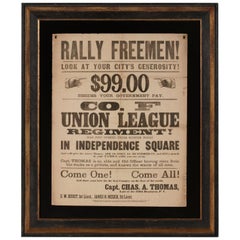
"Rally Freemen!..." Civil War Recruitment Broadside
Located in York County, PA
"RALLY FREEMEN! …COME ONE! COME ALL! AND SHOW YOUR LOVE FOR THE BEST COUNTRY ON THE FACE OF THE EARTH." A CIVIL WAR RECRUITMENT BROADSIDE FOR THE...
Category
Antique 1860s American Political and Patriotic Memorabilia
Materials
Paper
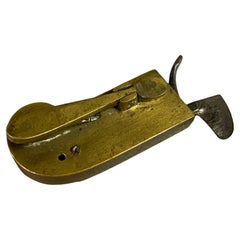
Civil War Era Brass Bodied Bloodletting Fleam
Located in New Windsor, NY
American Civil War Era brass bodied bloodletting fleam, phlebetome or scarificator. The fleam, which has many other spellings such as phleam, flew or fleame, is a very distinct surgi...
Category
Antique 1860s American High Victorian Scientific Instruments
Materials
Brass, Steel
American Hepplewhite Virginian Secretary Chest with Civil War Provenance
By George Hepplewhite
Located in Dallas, TX
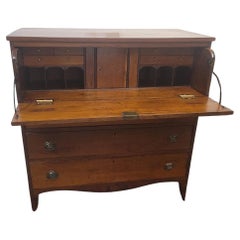
PRESENTING a FANTASTIC and HISTORIC Early 19C American Hepplewhite Virginian Secretary Chest with OUTSTANDING Provenance.
This Secretary Chest was made in Virginia in the Early 19th Century, circa 1810.
It is made of cherry, walnut and maple and is most definitely in the Hepplewhite Style of the period, with it’s original Hepplewhite brass drawer pulls.
IT IS A REALLY INTRIGUING AND HISTORIC PIECE, ESPECIALLY, WHEN VIEWED IN CONTEXT WITH IT”S AMAZING PROVENANCE!
This piece was originally owned by Major William Alexander Obenchain who ‘hailed’ from the State of Virginia.
He was an engineer and was in the Virginia Corps of Engineers during the Civil War and served on General Robert E. Lee’s staff. It was acquired by him before the Civil War and we believe that this piece was on campaign with him during the War. We know for a fact that he fought at the Richmond Campaign in 1864, as we have, in our Collection, his original Field Map for that Campaign which ended the War.
It has remained in family ownership ever since.
It has come directly from the Family Estate, together with other VERY IMPORTANT items belonging to Major Obenchain and other IMPORTANT items that belonged to his wife, Eliza Calvert Hall-Obenchain. ALL these items contained in the Collection, are listed/posted individually on our Website.
The top drawer is on retractable curved side hinge supports and pulls outwards and drops to reveal a secretary and writing area.
The Bureau/Secretary Gallery has 6 drawers and 6 cubbies, a central tabernacle door with another drawer and 2 cubbies and this is flanked by 2 secret pull out compartments.
The central tabernacle door has it’s original key and working lock.
Closed, it is almost ‘flush’ like the rest of the drawers, with some very minor bowing through age.
The 3 drawers underneath are graduated in size and it ends with a serpentine shaped base and sits on four hand carved legs with original metal casters, marked ‘Universal 3’.
It has it’s original brasses and hardware throughout, save the addition to 2 contemporary replacement brass hinges to the drop down desk front, as the original hinges were broken, could not be repaired and were not supporting the weight of the drop down leaf.
Some minor repairs but not noticeable.
Otherwise, the piece is in it’s entirely, ORIGINAL condition!
What makes this piece even MORE INTRIGUING and APPEALING HISTORICALLY, are the 2 ‘historic’ circular holes on the piece:-
(1) in the back of the piece as seen in the photos. This hole is not symmetrical or fully round and appears to serve no purpose to the piece whatsoever. Sometimes, pieces have holes for wiring for lighting, put in them over the years, but this one never had such lighting or, indeed, any such explanation for this hole, AND
(2) the rear hole is replicated, in the corner portion of the bottom drawer and someone (a very long time ago) has used a tin can top, to cover the hole in the back of the drawer. The tin can top is period to the Civil War Era and is embossed “Minimum Volume 1 Pint”.
Our conclusion, is that (whilst we are, by no means ballistic experts) that these holes were created by musket balls, fired during one of the Major’s campaigns in the Civil War. It is entirely conceivable that this piece, being strapped into a covered wagon for carriage, would have been on it’s side. We are of the opinion that both holes, were caused or created by a musket ball entered the chest trough the base and back. We also believe that ‘the Major’, used what he had at his disposal on the battlefield, namely, a tin can lid to repair the hole in the drawer.
SO THIS PIECE IS A VERY SPECIAL PIECE OF US HISTORY, INDEED!
NOT ONLY IS IT AN EARLY 19th CENTURY AMERICAN PIECE, WITH A CONNECTION TO THE STATE OF VIRGINIA, THE CIVIL WAR, HISTORIC & IMPORTANT FIGURES IN THAT WAR AND IMPECCABLE PROVENANCE AND HISTORY!
IT IS TRULY UNIQUE!
William Alexander Obenchain. Born April 27, 1841 at Buchanan, Botetourt Co., Virginia.
Parents: Thomas Jefferson Obenchain and Elizabeth Ann Sweetland.
Entered VMI on July 18, 1859 as a member of the VMI (Virginia Military Institute...
Category
Antique Early 19th Century American American Classical Historical Memora...
Materials
Brass
$16,000
H 44.25 in W 42.75 in D 20.25 in
Ohio State Parade Flag with a Civil War Veterans Overprint
Located in York County, PA
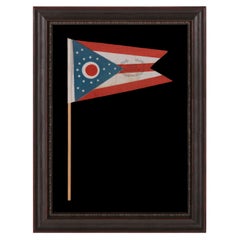
OHIO STATE FLAG WITH CIVIL WAR VETERANS' OVERPRINT FROM THE GRAND ARMY OF THE REPUBLIC POST IN COLUMBUS, MADE IN MOURNING OF THE 1925 PASSING OF NATIONAL G.A.R. COMMANDER IN CHIEF DANIEL M. HALL, WHO ALSO SERVED AS COMMANDER OF THE OHIO DEPARTMENT OF THE G.A.R., AS WELL AS THE LOCAL CHAPTER
Flag of the State of Ohio, printed on oilcloth-like cotton, affixed to its original wooden staff. Made for Civil War veteran's use, the flag bears a stamped overprint in the striped field that consists of an open wreath of laurel branches, inside which is the following text: “GAR [Grand Army of the Republic] Post, Dan Hall, Columbus, OH”.
Born on October 20th, 1842, Daniel M. Hall enlisted with the Union Army as a Private at the age of 18 on August 25th, 1861. On October 8th of that year he mustered into the Co. H of the 2nd Ohio Cavalry. Discharged for disability on June 28th, 1862, he reenlisted approximately 17 months later, on November 11th, 1863, and mustered into Co. F of the 12th Ohio Cavalry at Camp Cleveland. He was at some point promoted to the rank of Sergeant, and, on February 21st, 1864, to the rank of Corporal. He mustered out at Nashville on November 14th, 1865.
Hall mustered into the Hamlin Post of the Ohio G.A.R. on May 23rd, 1883. He would go on to serve not only as Commander of the Dept. of Ohio for the organization, but as National Commander of the entire Grand Army of the Republic.
The Grand Army of the Republic was the primary veterans association for Union Civil War soldiers. Founded in 1866, its members dressed up in Civil War uniforms, attended parades and reunions, and the organization was somewhat more fraternal in nature than today’s VFW or American Foreign Legion.
Flags overprinted for the purpose of advertising are a specialized form in American flag collecting. A flag with a basic G.A.R. overprint is the most common type. This might be accompanied by a post number and a date. More elaborate the overprints are more highly desired, such as this one, which is the only variation I know of that honors a particular person who was not the namesake of the chapter itself.
It is of interest to note that a sister variety of 48 star parade flag is known, printed on the same fabric, that bears the same overprint, accompanied by the words: “We Mourn Our Comrade." From the additional text on the 48 star variety, one can extrapolate that the flags were made to mourn the passing of this important leader of Civil War veterans on October 19th, 1925, just one day before his 83rd birthday.
The State Flag of Ohio was designed in 1901 by Cleveland architect John Eisenmann, who designed the Ohio building for the state's exhibition at the Pan American Exposition World's Fair in Buffalo, New York. It was officially adopted by the Ohio legislature on May 19th, 1902. It's elements are centered on a red disc, set against a circular white ground that forms a letter "O." This simultaneously represents a buckeye, the fruit of the state tree and an iconic Ohio symbol. The flag's 5 stripes are said to represent the state's waterways and roads, while the triangular shape of the union is said to illustrate hills and valleys. The presentation of 13 stars along the hoist end, arranged in a semi-circular medallion with two off-set stars above and below, reflects the original 13 colonies. The diamond of stars, towards the fly end. bring the overall count to 17 to reflect Ohio's admission. When the design was adopted by the state legislature, the position of these stars was changed slightly, moving them further around the circle to form a wreath.
Flag expert Whitney Smith, who coined the term Vexillology in the late 1950's (the accepted term for the study of flags), pointed out that the format of the flag itself was reminiscent of Civil War cavalry guidons, carried by Ohio regiments throughout the state. These were of swallowtail form, though with 13 stripes, all horizontal and 90 degrees to the hoist. Most often these had circular star patterns around an open center, which makes them even more similar to the Ohio flag...
Category
Vintage 1920s American Political and Patriotic Memorabilia
Materials
Cotton
More From This Seller
View AllChinese Petite Gilt String of Charms, c. 1900
Located in Chicago, IL
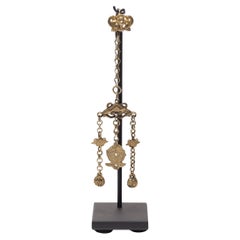
This petite Chinese jewelry chain dates to the early 20th century and is strung with an array of petite bells and good luck charms. Among the charms is a bat, a stone chime, two litt...
Category
Early 20th Century Chinese Qing Mounted Objects
Materials
Silver
Beaded Ndebele Ceremonial Doll
Located in Chicago, IL
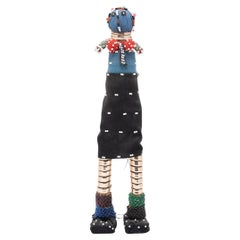
A rare imported commodity, glass beads have been a symbol of wealth and importance in south African cultures for centuries, and were exclusively distributed by the region's oba (king...
Category
Mid-20th Century South African Folk Art Figurative Sculptures
Materials
Fabric, Cotton, Wood
Beaded Ndebele Initiation Doll
Located in Chicago, IL
A rare imported commodity, glass beads have been a symbol of wealth and importance in south African cultures for centuries, and were exclusively distributed by the region's oba (king...
Category
Mid-20th Century South African Folk Art Figurative Sculptures
Materials
Fabric, Cotton, Wood
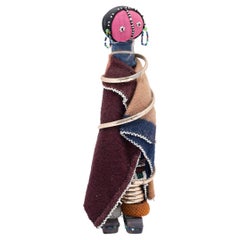
Beaded Ndebele Initiation Doll
Located in Chicago, IL
A rare imported commodity, glass beads have been a symbol of wealth and importance in south African cultures for centuries, and were exclusively distributed by the region's oba (king...
Category
Mid-20th Century South African Folk Art Figurative Sculptures
Materials
Fabric, Cotton, Wood
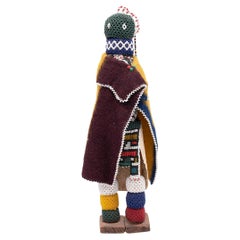
Beaded Ndebele Initiation Doll
Located in Chicago, IL
A rare imported commodity, glass beads have been a symbol of wealth and importance in south African cultures for centuries, and were exclusively distributed by the region's oba (king...
Category
Mid-20th Century South African Folk Art Figurative Sculptures
Materials
Fabric, Cotton, Wood
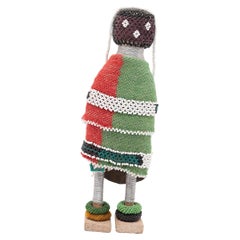
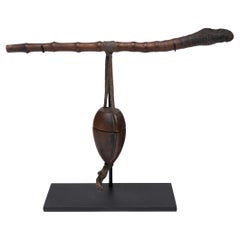
Chinese Bamboo Tobacco Pipe and Pouch, c. 1900
Located in Chicago, IL
This curious keepsake from the late 19th century is a provincial Chinese smoking pipe and its accompanying tobacco pouch. The small pipe honors the humble beauty of natural materials...
Category
Antique Late 19th Century Cambodian Qing Tobacco Accessories
Materials
Bamboo, Wood
Still Thinking About These?
All Recently ViewedMore Ways To Browse
Civil War Furniture
Storage Crate
Vintage Christmas Tree
Antique Badge
Vintage Black Memorabilia Collectibles
Antique Sign Collectibles
Christmas Ornament
George Washington Antique
Great Seal Of The United States
Neoclassical Cameo
Antique Autographs
American Revolution
Military Collectables
Royal Coat Of Arms
Revolutionary War Antique
Ancient Cameo
Antique Radios
Antique Telephones