1 of 6
Elizabeth Taylor 1970s Handwritten Love Letter to Richard Burton
$47,834.45List Price
About the Item
Authenticity Guarantee
In the unlikely event there’s an issue with an item’s authenticity, contact us within 1 year for a full refund. DetailsMoney-Back Guarantee
If your item is not as described, is damaged in transit, or does not arrive, contact us within 7 days for a full refund. Details24-Hour Cancellation
You have a 24-hour grace period in which to reconsider your purchase, with no questions asked.Vetted Professional Sellers
Our world-class sellers must adhere to strict standards for service and quality, maintaining the integrity of our listings.Price-Match Guarantee
If you find that a seller listed the same item for a lower price elsewhere, we’ll match it.Trusted Global Delivery
Our best-in-class carrier network provides specialized shipping options worldwide, including custom delivery.You May Also Like
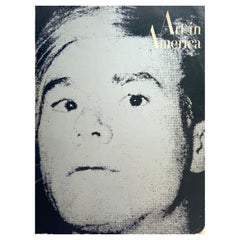
1970s Andy Warhol Art in America
By Andy Warhol
Located in Brooklyn, NY
Andy Warhol issue of Art in America magazine, featuring four articles on the artist ("Warhol: The Medium As Cultural Artifact," "A Catalogue Raisonn...
Category
Vintage 1960s Books
Materials
Paper
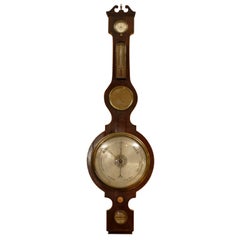
George III Banjo Mahogany Barometer by R. Taylor, Chepstow, England c. 1820
By R. Taylow
Located in Atlanta, GA
A Four-dial Barometer/Thermometer in Mahogany, dating from the George III period, and English in origin. Signed at the base "R. Taylor Chepstow". The barometer with swan neck pedim...
Category
Antique Early 19th Century English George III Decorative Art
Materials
Brass
$3,175
H 42.5 in W 12 in D 2 in
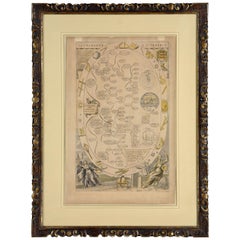
Cosmgraphy and Astrology, 1686 by Richard Blome from the First Edition
By Richard Blome
Located in BUNGAY, SUFFOLK
Cosmography & Astrology
Large oval engraved plate with inscriptions outlining the various parts of cosmography and astronomy; below, two emblematic figures with scientific instruments either side. Lettered with title, dedication, and various inscriptions. To his Excellency Roger Palmer, Earle of Castelmain and Baron of Limerick in Ireland, Embassador Extraordinary from his majesty King James II to his Holyness Pope Innocent 11th anno dom 1686. This plate is humbly DD by Richard Blome. On paper and retaining its original coloring.
Sheet width 26 ½ cm., 10 ½ in., height 41 ½ cm., 16 ½ in.,
In a part-gilded Sansovino frame...
Category
Antique 1680s English Charles II Decorative Art
Materials
Paper
$4,100
H 16.34 in W 10.44 in D 0.04 in
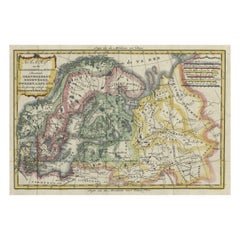
Uncommon Old Map of Lapland to Russia and Denmark to Kazan in the South, 1785
Located in Langweer, NL
Description: Antique map titled 'Kaart van het Noorderdeel van Europa, Bevattende Deenmarken, Noorwegen, Zweden, Lapland en het Grootste Gedeelte van Europeesch Rusland.'
This un...
Category
Antique 1780s Maps
Materials
Paper
$657
H 10.04 in W 14.73 in D 0 in
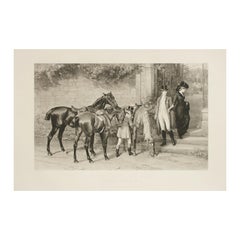
Antique Equestrian Print, Samuel Edmund Waller, Twixt Love and Duty, Photogravur
Located in Oxfordshire, GB
Equestrian print, S.E. Waller.
A fine photogravure after the original painting by Samuel Edmund Waller titled 'Twixt Love And Duty'. The 'romanti...
Category
Antique 1880s French Sporting Art Sports Equipment and Memorabilia
Materials
Paper
$792
H 17.13 in W 28.15 in D 0.04 in
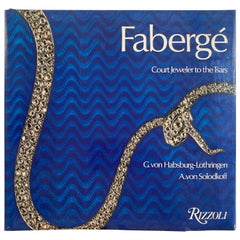
Fabergé Court Jeweler to the Tsars Hardcover Table Book
By Geza von Habsburg-Lothringen, Alexander von Solodkoff
Located in Moreno Valley, CA
Faberge: Court Jeweler to the Tsars Book by Solodkoff, Rizzoli 1984.
Fabergé: Court Jeweler to the Tsars
Fabergé, Court Jeweler to the Tsars by G. von Habsburg-Lothringen and A. von Solodkoff. New York: Rizzoli, 1979. First English edition hardcover with slip case. 171 pp. A book on the history of Carl Fabergé and his work. For more than 35 years, Peter Carl Fabergé (1846-1920) was purveyor of exquisite creations in jewels and precious metals to European royalty, most notably Russia and England, and to the wealthy of the world. He was a designer of unsurpassed ingenuity and delicacy. He turned out a profusion of jeweled flowers in rock-crystal pots, enameled cigarette cases, desk sets in multicolored gold, silver and platinum, gold sedan chairs and coronation coaches...
Category
20th Century American Modern Books
Materials
Paper
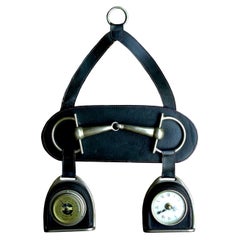
Gucci attributed to Rare Barometer and Clock Year 1960 Vintage Design
By Paolo Gucci
Located in Biella, IT
attributed to Gucci rare barometer and clock year 1960 vintage design. Measure h 17 inches x L12" x deep 3".
Category
Vintage 1950s Italian Mid-Century Modern Scientific Instruments
Materials
Metal, Brass
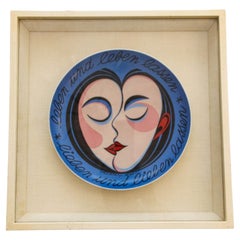
1970s VASARELY "Live and let live love and let love" Rosenthal Framed Plate
By Victor Vasarely, Rosenthal
Located in Moreno Valley, CA
1970s VICTOR VASARELY "Live and let live love and let love".
Rosenthal collectible framed German plate.
Victor Vasarely Rosenthal Studio Line Limited Edition Porcelain Plate.
By Vasarely born 1936.
"Leben und Leben lassen, Lieben und Lieben lassen"
"Live and let live - love and let love".
Limited edition, signed and numbered.
Plate is in good condition, size is 12".
Frame is not in good condition, white became yellowish shows wear.
Victor Vasarely, born as Győző Vásárhelyi on April 9, 1906, in Pécs, Hungary, was a Hungarian-French artist widely regarded as the "father of Op Art" (Optical Art). He is known for his pioneering work in geometric abstraction and the use of optical illusions to create visually captivating and dynamic artworks.
Vasarely's early career involved studying medicine in Budapest, but he later decided to pursue his passion for art and enrolled in the Műhely (Workshop) academy in Hungary. He initially experimented with various styles, including Impressionism and Post-Impressionism, but his interest in geometric abstraction grew stronger over time.
In the 1930s, Vasarely moved to Paris, where he continued to explore geometric patterns, lines, and shapes in his art. He believed that art should not merely imitate nature but should create its own language of forms and colors to engage the viewer's perception actively. This philosophy led to the development of Op Art, a movement that emerged in the 1960s and focused on creating optical illusions and visual effects through precise geometric patterns and colors.
Vasarely's artworks often featured meticulously arranged geometric shapes, giving the impression of movement and three-dimensionality. He employed various optical tricks, such as the juxtaposition of contrasting colors and the use of repetition, to create an illusion of depth and visual dynamism. His artworks can evoke a sense of visual vibration and often challenge the viewer's perception.
Throughout his career, Vasarely's influence extended beyond the art world. He believed in the democratization of art and wanted to make art accessible to a wider audience. He embraced mass production techniques, creating what he called "multiple originals" or "serigraphs" (a form of screen printing). These serigraphs allowed him to produce multiple copies of his artworks at affordable prices, making them more accessible to art enthusiasts.
Vasarely's artistic legacy continues to be celebrated around the world. His work has been exhibited in numerous galleries and museums, and he remains an influential figure in the fields of Op Art and abstract geometric art. He passed away on March 15, 1997, in Paris, leaving behind a vast body of work that continues to captivate audiences and inspire artists to this day.
About Rosenthal:
German porcelain manufactory Rosenthal was originally founded as a ceramics-painting studio by Philipp Rosenthal Sr. (1855-1937) in 1879 at Schloss Erkersreuth in Bavaria, near the Czech border. Its first highly popular product was an ashtray inscribed with the words “Resting place for lit cigars.” In 1890, the company moved to the neighboring hamlet of Selb and, a year later, began to manufacture its own porcelain, since white porcelain was, at that time, in short supply. Rosenthal’s first complete table service was called Empire; it was exhibited along with other lines at Paris’s Exposition Universelle in 1900.
With the dawn of the 20th century, Rosenthal began producing porcelain tableware and services formed and decorated in the latest styles, like the Jugendstil Botticelli (1903), the Art Nouveau Darmstadt (1905), and the all-white Maria (1916) lines. Successes with this au courant approach led the company to launch an art pottery division in 1910, dedicated to luxury tableware, vases, and other decorative objects. By the 1930s, figurines were another important Rosenthal product, most notably the Disney-licensed Mickey Mouse pieces introduced in 1931.
In 1934, Philipp Rosenthal was forced to leave his company and country when his Jewish ancestry came under persecution by the Nazi regime. Despite the loss of its founder, the Rosenthal company remained the premier supplier of high-quality porcelain tableware to the Third Reich. After the war, in 1950, Philip Rosenthal Jr. (1916-2001) joined his father's company as an advertising manager. By 1958, he had become its CEO, continuing his father’s vision to produce high-quality porcelain in line with progressive tastes. Through the rest of the 20th century, Rosenthal was the most commercially successful porcelain producer in Germany.
In the postwar era, Rosenthal’s most famous tableware lines have included 2000 by Raymond Loewy and Richard Latham (1954), Magic Flute by Bjørn Wiinblad (1959), Suomi by Timo Sarpaneva (1976), and Moon by Jasper Morrison (1997). The company has enjoyed many popular and critically acclaimed collaborations with designers and brands, like Salvador Dalì, Tapio Wirkkala, Walter Gropius, Andy Warhol, Ron Arad, Enzo Mari, Konstantin Grcic, and Versace.
Rosenthal's product lines have encompassed more than ceramics over the years. In 1972, the company began producing furniture, under the subsidiary Rosenthal Einrichtung, in Espelkamp, Germany. Standouts from this arm of Rosenthal include Gunter Ferdinand Ris and Herbert Selldorf’s futuristic Sunball Lounge Chair (1969), Verner Panton’s Relaxer Rocking Chair (1974), Burchard Vogtherr's Vario Pillo...
Category
Late 20th Century German Post-Modern Decorative Art
Materials
Porcelain
$349
H 15.5 in W 15.5 in D 2 in
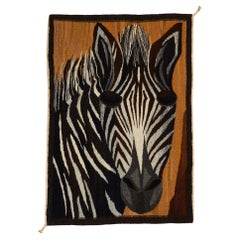
Tapestry ‘Zebra’ Attributed to Kerstin Bäckman, Sweden, 1970s
Located in Stockholm, SE
Tapestry ‘Zebra’ attributed to Kerstin Bäckman,
Sweden. 1970s.
Hand woven.
Signed.
H: 73 cm / 2' 4 3/4"
W: 52 cm / 1' 8 1/2".
Category
Mid-20th Century Swedish Mid-Century Modern Tapestries
Materials
Fabric
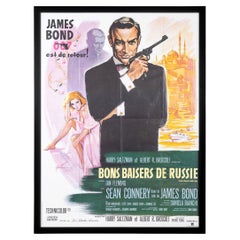
French James Bond 007
From Russia With Love
Poster, с.1970s
By Boris Grinsson
Located in Royal Tunbridge Wells, Kent
A very rare and original James Bond From Russia with Love / Bons Baisers de Russie (1963) Poster, French re-release c 1970s. This is o...
Category
20th Century French Decorative Art
Materials
Paper
Still Thinking About These?
All Recently ViewedMore Ways To Browse
Vintage Christmas Tree
Antique Badge
Vintage Black Memorabilia Collectibles
Antique Sign Collectibles
Christmas Ornament
George Washington Antique
Great Seal Of The United States
Neoclassical Cameo
Antique Autographs
American Revolution
Military Collectables
Royal Coat Of Arms
Revolutionary War Antique
Ancient Cameo
Antique Radios
Antique Telephones
Thomas Jefferson
Vintage Christmas Folk Art