Items Similar to A Gold And Enamel Mourning Ring For Lord Nelson By John Salter, England, 1806
Want more images or videos?
Request additional images or videos from the seller
1 of 21
A Gold And Enamel Mourning Ring For Lord Nelson By John Salter, England, 1806
$55,073.69
£39,995
€46,738.62
CA$75,338.88
A$82,115.53
CHF 43,413.76
MX$988,515.19
NOK 551,028.80
SEK 505,180.77
DKK 349,139.66
About the Item
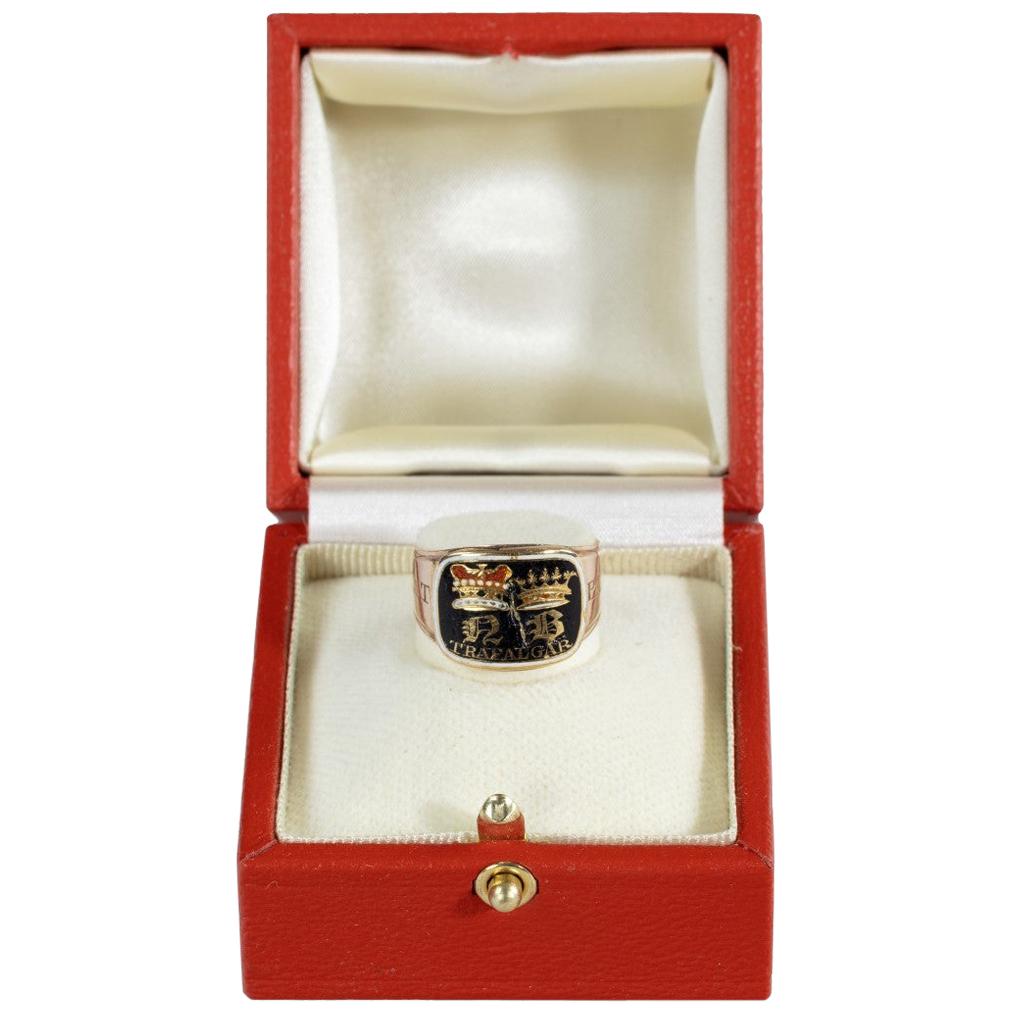
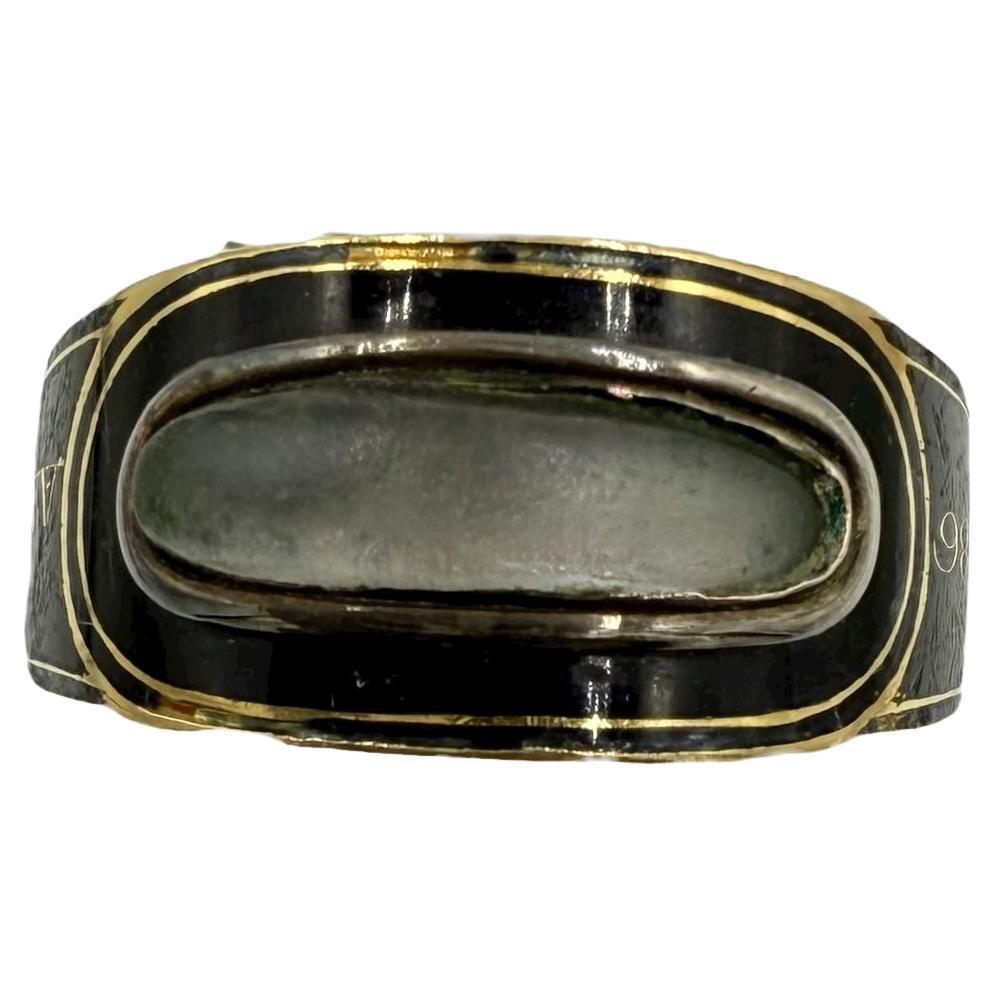
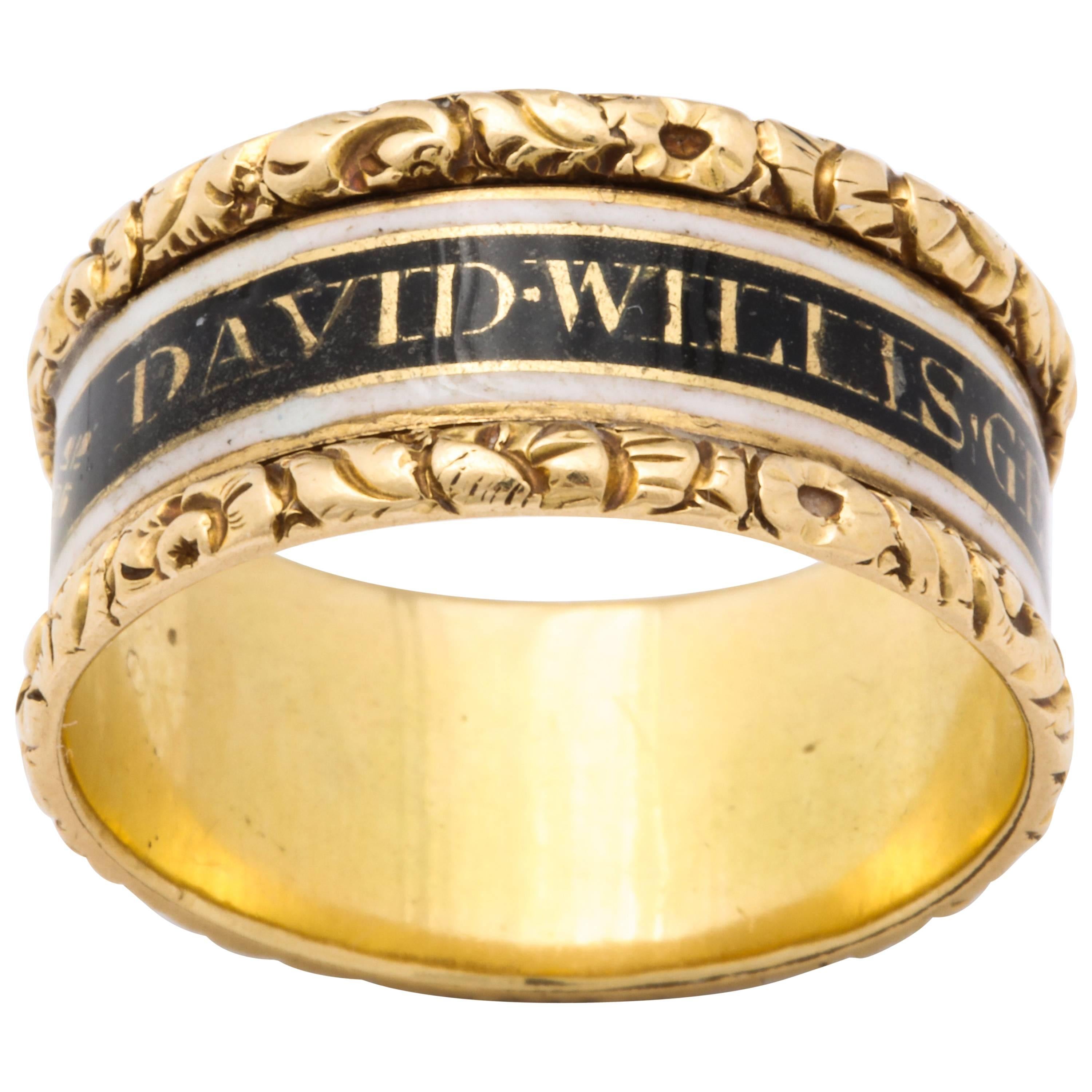
An extremely rare ring that commemorates the naval hero, Horatio Nelson, who died in 1805 at the Battle of Trafalgar, fighting against the Napoleonic forces. Dr William Nelson, the admiral's brother, ordered 58 mourning rings for family and friends and every admiral and post-captain who fought at the Battle of Trafalgar . The ring is inscribed on the bezel ‘Trafalgar’; outside the hoop with Nelson’s motto in Latin, ‘Let him who earned it bear the palm [of victory]’, adopted by Nelson from a poem ‘Ad Ventos’ written in 1727 by John Jortin (1698-1770). Inside is the inscription ‘Lost to his country 21 October 1805, aged 47’. The initials N and B stand for Nelson and Bronte.
Admiral Nelson was given the title of Duke of Bronte in 1799 by the King of Sicily and in 1801 became a Viscount. The two coronets above the initials refer to these titles. Tthe motto Palmam qui meruit ferat ("let him who has earned it, bear the palm") was added to his coat of arms in 1798 after the Battle of the Nile. Nelson was buried with full honours in St Paul's Cathedral. His cortege consisted of 32 admirals, over a hundred captains, and an escort of 10,000 soldiers.
This ring is an example of only fifty-eight that were made by Nelson's jeweller John Salter in 1806. Thirty-one were for Nelson's close family and friends, the rest for pall-bearers and other dignitaries (see The Nelson Dispatch, vol.3 pt.XII, oct.1990). Three similar examples of this ring are held extremely prestigious museums in the capital. One is in the Greenwich National Maritime Museum in London, another in The British Museum in London and another in the collection of the Victoria
Albert Museum, London, exhibited in the Jewellery Gallery, case 23, no. 8.
The ring has a particularly special provenance, arguably like no other mourning ring of Admiral Nelson’s. The ring belonged to the Reverend Alexander John Scott. The Reverend Alexander John Scott (1768-1840) was a British naval chaplain. He was appointed to the flagship H.M.S. Victory in 1803 where he served as private secretary to Lord Nelson. He was with Nelson when when he was shot on the quarter-deck of the Victory at the battle of Trafalgar on the 21st October 1805. Scott attended his dying chief in the cockpit of the flagship, receiving his last wishes. He refused to leave Nelson's body until it was brought back to England and placed in the coffin to lie in the Painted Hall Greenwich.
The ring, lock of hair and music book were passed down by the direct descendants of the Reverend Alexander John Scott's family and eventually gifted to the previous owners. The music book was a personal possession of the Reverend which gives watertight provenance of the person who owned the ring.
It is not clear exactly what Admiral Nelson’s last words really were although Scott documents Nelson’s last words to be “God and my country“. However, it is also recorded that a statement during his last hours was "Thank God I have done my duty.” Perhaps these two statements uttered in the last moments sound similar when mumbled by a feeble dying man. Nonetheless, it is noteworthy is that Scott remained by Admiral Nelson’s side as he died and his version is probably the most reliable.
The lock of hair is reputedly that of Lord Admiral Nelson. Without a DNA test there can be no conclusive proof of such. However, given that Reverend Alexander John Scott was with Nelson from the moment he was shot on the quarter-deck of H.M.S. Victory until the moment he was placed in his coffin, there is no reason to believe it is not a lock of Nelson’s hair.
It is difficult to overstate the significance and rarity of Nelson’s mourning rings. With only fifty-eight made, the vast majority of them were given to close family members and only a few were given to close friends. A close friend who receives a morning ring of Nelson’s must have had an important role in his life and it is easy to imagine how close Reverend Scott was to Admiral Nelson seeing as he acted as his private secretary. The fact that three similar examples are in arguably the three most important museums in the UK bears testament to its rarity.
Mourning rings were used from the early seventeenth century to the end of the nineteenth century. Testators left money in their wills to have rings with commemorative inscriptions made and distributed to their friends and families. Simple bands enamelled with the name and life dates of the deceased were frequently made, sometimes set with a gemstone or a bezel set with a rock crystal covering a symbol such as a coffin or initials in gold wire. In the later 18th century, rings followed neo-classical designs, their oval bezels often decorated with the same designs as funerary monuments such as urns, broken pillars and mourning figures. Hair from the deceased was incorporated into the designs or set in a compartment at the back of the ring to give each jewel a uniquely personal element. Black or white enamel were favoured though white enamel was often, though not universally used to commemorate children and unmarried adults.
CONDITION
The overall condition of the ring is excellent. At one point in its lifetime the back of the ring has been cut to fit a larger finger. Considering that Reverend Alexander John Scott was only 37 years old when Lord Nelson died and 72 years old when he passed away himself, it is reasonable to assume that the ring had been cut to fit his own finger. It can be restored but as the item is of historical significance rather than a dress ring in our opinion it is best left as is.
The lock of hair is encased by domed glass on both sides, one side of which has cracked. The binding of the music book is in very poor condition, the front cover has come away altogether from the spine.
SIZE
Ring
Height: 1.9 cm // 0.75 in
Width: 1.8 cm // 0.71 in
Depth: 1.5 cm // 0.59 in
Lock of Hair
Width: 3.4 cm // 1.34 in
Height: 4.2 cm // 1.65 in
Depth: 0.3 cm // 0.12 in
- Dimensions:Height: 0.75 in (1.9 cm)Width: 0.71 in (1.8 cm)Depth: 0.6 in (1.5 cm)
- Materials and Techniques:
- Place of Origin:
- Period:
- Date of Manufacture:1806
- Condition:Wear consistent with age and use. Minor losses. Minor fading. The overall condition of the ring is excellent. At one point in its lifetime the back of the ring has been cut to fit a larger finger. Considering that Reverend Alexander John Scott was only 37 years old when Lord Nelson died and 72 years old when he.
- Seller Location:Royal Tunbridge Wells, GB
- Reference Number:Seller: B10760a1stDibs: LU1348241340072
About the Seller
5.0
Platinum Seller
Premium sellers with a 4.7+ rating and 24-hour response times
Established in 2014
1stDibs seller since 2015
545 sales on 1stDibs
Typical response time: 3 hours
- ShippingRetrieving quote...Shipping from: Royal Tunbridge Wells, United Kingdom
- Return Policy
More From This Seller
View AllAntique 19th Century German Gold
Enamel Snuff Box, Freres Jordan, Hanau c.1800
Located in Royal Tunbridge Wells, Kent
Antique 19th Century German gold and enamel snuff box. This elongated rectangular snuff box, features cut corners and a lid adorned with intricate enamel work. The lid's central plaq...
Category
Antique 19th Century German Other Snuff Boxes and Tobacco Boxes
Materials
Gold, Enamel
18th Century French 18K Gold
Enamel Snuff Box, Joseph-Etienne Blerzy c.1780
Located in Royal Tunbridge Wells, Kent
Antique 18th Century Exceptional French 18k gold & enamel snuff box, a circular snuffbox crafted in solid gold, adorned with blue, green, and white enamels, further enhanced by gold ...
Category
Antique 18th Century French Other Snuff Boxes and Tobacco Boxes
Materials
Gold, Enamel
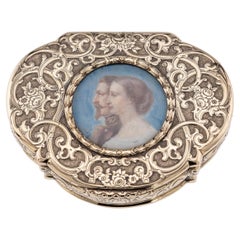
19th Century French 18K Gold Royal Presentation Snuff Box, c.1850
By Louis-François Tronquoy 1
Located in Royal Tunbridge Wells, Kent
Antique mid 19th century French 18k gold snuff box, of lobed design with chased scroll and foliate decoration, the hinged cover inset with a circula...
Category
Antique 19th Century French Snuff Boxes and Tobacco Boxes
Materials
Gold
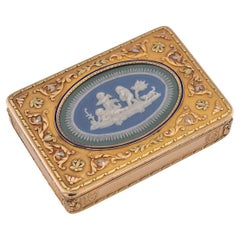
19th Century German Three-Colour 18K Gold
Jasperware Snuff Box, Hanau c.1820
Located in Royal Tunbridge Wells, Kent
Antique early 19th Century German three-coloured 18k gold snuff box, of rectangular form with gracefully rounded corners, this exquisite piece features a central oval jasperware plaq...
Category
20th Century German Other Snuff Boxes and Tobacco Boxes
Materials
Gold
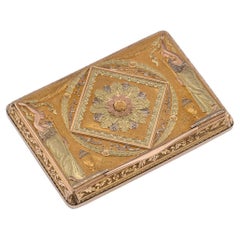
Antique 19th Century German Three-Colour 18K Gold Snuff Box, Hanau c.1820
Located in Royal Tunbridge Wells, Kent
Antique early 19th Century German three-coloured 18k gold snuff box, of rectangular shape with elegantly rounded corners, featuring a lid that is intricately adorned with a chased fl...
Category
Antique 19th Century German Other Snuff Boxes and Tobacco Boxes
Materials
Gold
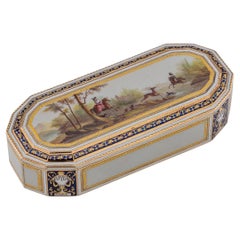
18th Century German 18K Gold
Enamel Snuff Box, Freres Jordan, Hanau c.1790
Located in Royal Tunbridge Wells, Kent
Antique 18th Century German 18k gold & hand painted enamel snuff box. of rectangular shape with angled corners, this exquisite snuff box features a meticulously designed lid. At its ...
Category
Antique 18th Century German Other Snuff Boxes and Tobacco Boxes
Materials
Gold, Enamel
You May Also Like
Georgian Gold and Enamel Urn Band Ring
Located in Stamford, CT
I love the proportion of this Gold and enamel Georgian urn ring. I previously sold a larger octagonal version and this proportion attracts me even ...
Category
Antique Early 1800s English George III Band Rings
Materials
10k Gold, Enamel
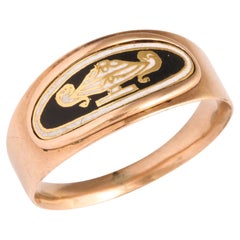
Antique 18K Gold Black White Enamel Mourning Band Ring, Early 19th Century
Located in Rotterdam, NL
This Georgian-era memorial band ring, crafted in 18-karat gold, dates to London, 1801 and beautifully captures the refined elegance of early 19th-century design. The ring showcases a...
Category
Antique Early 19th Century English Georgian Band Rings
Materials
Gold, 18k Gold, Enamel
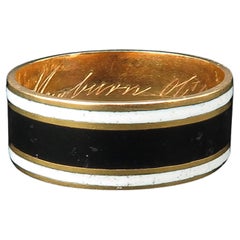
Enamel and Gold Nelson Memorial Ring, Made for His Aunt, Mrs Thomasine Goulty
Located in Lymington, Hampshire
The enamel and gold Nelson memorial ring made for his aunt, Mrs Thomasine Goulty (1733-1821), commemorating the death of Admiral Viscount Nelson at the...
Category
Antique Early 1800s English Collectible Jewelry
Materials
Gold, Enamel
Antique Gold Mourning Ring Enamel Inscription " Dear Father Died April 1885"
Located in Munich, Bavaria
This elegant and solid gold and enamel band ring has been handcrafted around 1880 out of 15 carat gold. It is of modernistic elegance with its two narrow enamelled lines. The ring be...
Category
Antique 1880s English Victorian Band Rings
Materials
Gold, Enamel
Georgian Mourning Ring In 18k Gold With Enamel Circa 1814
Located in Los Angeles, CA
Georgian Mourning Ring in 18k Yellow Gold with Enamel Circa 1814.
This Georgian Mourning Ring, made in 18k yellow gold and black enameling, is...
Category
Antique 1810s Georgian Band Rings
Materials
18k Gold, Enamel
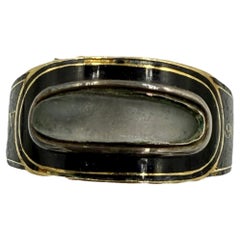
Antique Georgian Memorial Ring for a General
Located in Stamford, CT
Why do we offer this Georgian Memorial Ring? Because it honors a person who served to protect his country. We separate our strong principle agai...
Category
Antique 1810s British George III Band Rings
Materials
18k Gold
More Ways To Browse
Antique Nelson
Antique Mourning Ring
Gold Black Enamel Mourning Ring
Gold Enamel Coat Of Arms
Lord Nelson
Mourning Hair
Battle Of Trafalgar
Antique Hair Ring
The Battle Of Trafalgar
Lock Of Hair
Funerary Urn
Nelson Brothers
Hand Coffee Grinder
John Quincy Adams
Lotus Slippers
Rca Deco
Rca Victor Vintage
Rca Vintage Radios