Wool Historical Memorabilia
to
3
8
3
12
2
2
2
10
2
6
1
124,586
916
424
376
201
4
4
3
3
3
12
12
12
1
Material: Wool
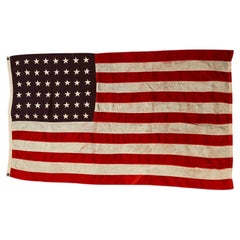
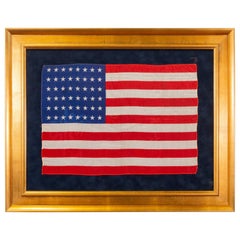
Antique 1912 Wool 48-Star American Flag, Rare Pre-Standard Collectible
Located in Doha, QA
This exceptional historic American flag, measuring 145 cm by 83 cm, is most likely made before 1912, based on its early craftsmanship and material characteristics. The unevenly arran...
Category
Early 20th Century American Wool Historical Memorabilia
Materials
Wool
Vintage Blue
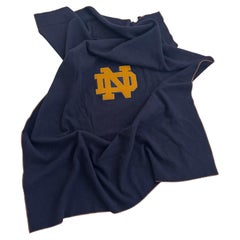
Gold Notre Dame University "Fighting Irish" Wool Stadium Blanket
Located in San Diego, CA
Super cool vintage blue and gold Notre Dame University "Fighting Irish" wool stadium blanket, circa 1970s. The blanket is 100% thick navy blue wool with a subtle gold edge trim and t...
Category
Mid-20th Century English Mid-Century Modern Wool Historical Memorabilia
Materials
Wool
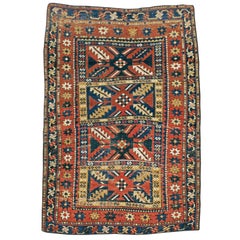
Distressed Caucasian Rug With A Tribal Design In Rust, Dark Blue, And Cream
Located in New York, NY
An antique Caucasian Kazak rug from the early 20th century. The warm madder red field is divided into four rectangular panels, each with a central motif radiating four serrated leave...
Category
Early 20th Century Caucasian Tribal Wool Historical Memorabilia
Materials
Wool

$1,120 Sale Price
20% Off
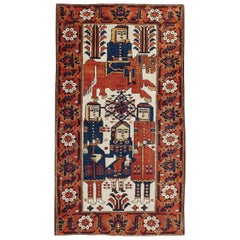
Vintage Persian Bakhtiari Rug
Located in New York, NY
A vintage Persian Bakhtiari pictorial rug from the mid-20th century.
Measures: 3' 10" x 6' 8"
Category
Mid-20th Century Persian Folk Art Wool Historical Memorabilia
Materials
Wool
$2,300 Sale Price
20% Off
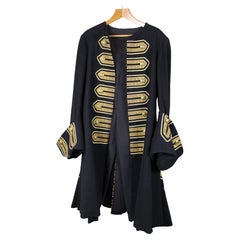
Decorative Vintage Ceremonial Wool Coat with Gold Braid Trim, 20th Century
Located in Worcester, GB
Decorative Vintage Ceremonial Wool Coat with Gold Braid Trim, 20th Century
A striking and well-made vintage ceremonial coat, inspired by 18th-century European military and regimenta...
Category
Mid-20th Century European Wool Historical Memorabilia
Materials
Wool
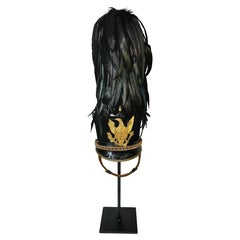
Full Dress La Salle Cadet
Tar Bucket
Dress Hat/Shako, and Stand
Located in West Palm Beach, FL
Full Dress La Salle Cadet ``Tar Bucket`` Dress Hat/Shako and Stand
USA, Late 19th Century/Early 20th Century
This nearly pristine 'Tar Bucket' Dress Hat/...
Category
20th Century American Wool Historical Memorabilia
Materials
Metal, Brass, Iron
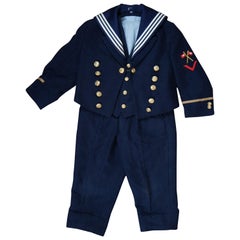
1930s German Wool Kaiserliche Marine Navy Suit Toddler Child Sailor Uniform
Located in Dayton, OH
German 1930s three piece toddler / child / doll sized uniform or sailor suit. Made of navy blue wool featuring a coat, vest and pants with white stripe and ...
Category
1930s Vintage Wool Historical Memorabilia
Materials
Wool
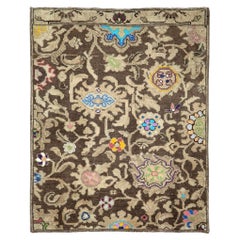
Vintage Persian Malayer Sampler Rug
Located in New York, NY
A vintage Persian Malayer Wagireh (sampler) rug from the mid-20th century with cotton highlights.
Measures: 2' 8" x 3' 4"
Category
Mid-20th Century Persian Folk Art Wool Historical Memorabilia
Materials
Wool, Cotton
$1,700 Sale Price
20% Off
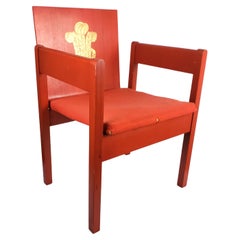
Mid-Century Investiture Chair Designed by Lord Snowden for Prince Charles 1969
By Remploy
Located in Hamilton, Ontario
This chair was designed by Lord Snowden in 1969 and produced by Remploy for the Investiture ceremony of Prince Charles, and done in the period Mid-Cetury Modern style. The chair is made of ash with a bentwood back and painted in a bright red with Prince of Wales styled feathers on the back in gilt. These chairs are known as 'investiture chairs...
Category
Mid-20th Century English Mid-Century Modern Wool Historical Memorabilia
Materials
Wool, Bentwood
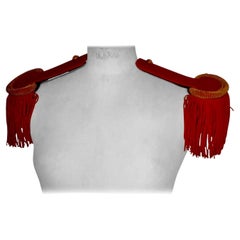
19th Century French First Officer’s Uniform Red Epaulettes
Located in Godshill, Isle of Wight
19th Century French First Officer’s Uniform Red Epaulettes
Good pair of French Officers Epaulettes made in Red Silk and lined in black velvet, the f...
Category
Late 19th Century Federal Antique Wool Historical Memorabilia
Materials
Wool
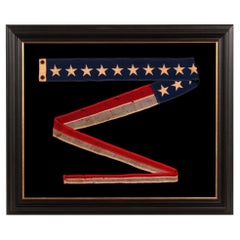
Commission Pennant with 13 Stars, like for Private Vessel, Ca 1892-1910
Located in York County, PA
Commission pennants are the distinguishing mark of a commissioned U.S. Navy ship. Flown at the topmast, the typical American format is a long blue field, usually with a single row of white stars, although sometimes with their total divided into two rows, followed by two long stripes, red-over-white. A ship became commissioned when this pennant was hoisted. Flown during both times of peace and war, the only time the pennant is not flown is if a flag officer or civilian official was aboard and replaced it with their own flag.
Sometimes the owners of private ships mimicked the use of Navy signals. Some seafaring men would have served in the Navy and become privy to various practices in that capacity. Others flew them purely for stylistic reasons, either on a regular basis or while the boat was dressed for special occasion. Hudson River steamers regularly flew pennants of this nature, as evidenced by period photography as well as the paintings of artists such as John and James Bard...
Category
Late 19th Century American Antique Wool Historical Memorabilia
Materials
Wool
Price Upon Request
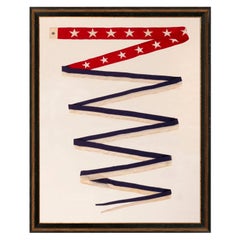
U.S War Department Commissioning Pennant with 13 Stars
Located in York County, PA
EXTREMELY RARE U.S. WAR DEPARTMENT COMMISSIONING PENNANT WITH 13 STARS, A REVERSAL OF THE U.S. NAVY COLOR SCHEME, TWENTY-FOUR FEET ON THE FLY, SP...
Category
20th Century American Wool Historical Memorabilia
Materials
Wool
Price Upon Request
Related Items
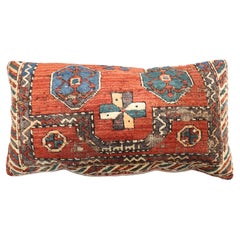
Tribal Persian Kurd Rug Pillow
Located in New York, NY
Largepillow made from an early 20th century Antique Persian Kurd Rug rug. Zipper closure and poly-fill provided.
Measures: 16'' x 30''.
Category
Early 20th Century Tribal Wool Historical Memorabilia
Materials
Wool
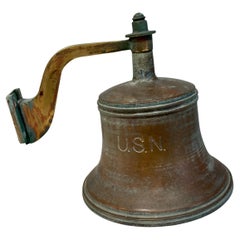
Antique Collectable USN Brass Bell
Located in Alhambra, CA
Antique WWII or earlier brass US Navy bell. Very heavy solid brass retired naval bell, engraved with "USN". Rings loud and clear (see video for an example). ...
Category
Mid-20th Century American Wool Historical Memorabilia
Materials
Brass
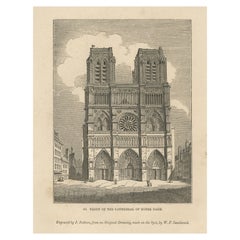
Antique Print of the Notre-Dame de Paris Cathedral in Paris, France, 1835
Located in Langweer, NL
Antique print titled 'Front of the Cathedral of Notre Dame'. Old print of the Notre-Dame de Paris Cathedral, France. This print originates from 'One Hundred and Fifty Wood Cuts selec...
Category
19th Century Antique Wool Historical Memorabilia
Materials
Paper
$179
H 13.39 in W 9.65 in D 0 in
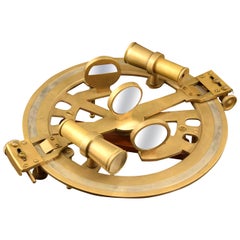
Circular Sextant, Decorative Piece, 20th Century
Located in Madrid, ES
The sextant is an instrument that allows to measure angles between two objects such as two points of a coast or a star, traditionally the sun of the earth and the horizon. Knowing th...
Category
Late 20th Century Spanish Other Wool Historical Memorabilia
Materials
Metal, Other
La Chinoise
Located in London, GB
Original Japanese film poster used in Japan when the film was first shown in 1967.
This film was directed by Jean-Luc Godard and starred Anne Wiazemsky, Juliet Berto, Jean-Pierre Le...
Category
1960s Japanese Vintage Wool Historical Memorabilia

Vintage 1912 Arizona and New Mexico Statehood Flag
Located in Coeur d
Alene, ID
25th Design Patriotic American silk flag with 48 stars. Arizona Statehood Feb 14, 1912; New Mexico Statehood Jan 6, 1912
Period: 1912
Origin: United States
Size: 12" x 17".
Family ...
Category
1910s American Vintage Wool Historical Memorabilia
Materials
Silk
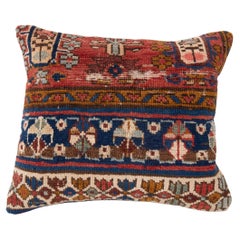
Pillow Cover Made from an Antique Caucasian Shirvan Rug Fragment
Located in Istanbul, TR
It does not come with an insert.
Linen in the back.
Zipper closure.
Dry clean is recommended.
Item above is made from an antique rug therefore not in brand new condition.
Category
Late 19th Century Caucasian Tribal Antique Wool Historical Memorabilia
Materials
Wool
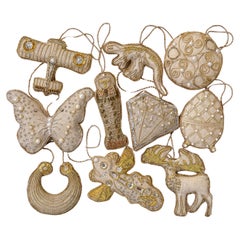
Museum Collection Luxury Christmas Tree Ornaments Set of 10 Vintage Irish Linen
Located in Belfast, Northern Ireland
Museum Collection Set of 10 Artisan Irish Linen Ornaments by Katie Larmour
This is a luxury box set of artisan made decorative ornaments created with authentic Irish Linen, exclusive to 1stdibs. They are special because they are limited editions from a beautiful mixture of vintage and deadstock fabric in small batches (some even one-of-a-kind) embellished with exquisite copper embroidery and dainty beading.
These novelty ornaments are a unique and quirky gift, or a treat to oneself. They are particularly suitable for the holiday season and the ultimate Christmas tree decorations. They are collectible and can be kept as heirlooms.
Katie Larmour is an acclaimed Northern Irish designer with a studio based in her hometown of Belfast. Known for heritage textiles, her signature use of Irish Linen and original designs have seen her brand make waves in Europe and beyond.
The fabric is 100% pure Irish Linen from a mixture of sustainable sources - vintage, local mill deadstock rolls from one of the last remaining linen mills still active in Ireland today, repurposed antique tablecloths...
Category
2010s Unknown Wool Historical Memorabilia
Materials
Linen
$259 / set
H 4.34 in Dm 2.76 in
Vintage Alligator Waiter Standing Full Body Mount Taxidermy Ashtray Stand
Located in Philadelphia, PA
Vintage Alligator Waiter Standing Full Body Mount Taxidermy Ashtray Stand. Circa Early 20th Century. Measurements (Overall): 25" H x 15" W x 19" D
Category
Early 20th Century Unknown Rustic Wool Historical Memorabilia
Materials
Wood

$1,800
H 25 in W 15 in D 19 in
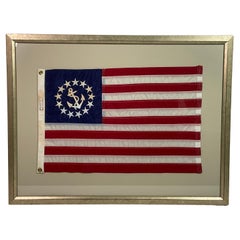
American Nautical Yacht Ensign Flag
Located in Norwell, MA
Framed American yacht ensign flag. Nautical flag with a blue panel that has an embroidered fouled anchor and thirteen stars, and red and white stripes with a canvas hoist and brass g...
Category
1960s North American Vintage Wool Historical Memorabilia
Materials
Cotton
Rare 48 Star Flag Quilt
Located in Los Angeles, CA
This is an amazing 48 hand sewn stars flag quilt has fine quilting and piece work comes from a private folk art collection.This is a great example of Americana.Great addition to any ...
Category
1930s American Adirondack Vintage Wool Historical Memorabilia
Materials
Cotton

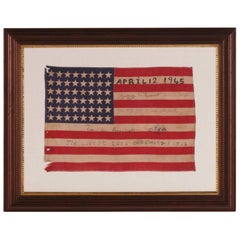
Antique American Flag w/ Hand-Written Inscriptions Mourning the Death of FDR
Located in York County, PA
48 STARS ON ANTIQUE AMERICAN FLAG WITH HAND-WRITTEN INSCRIPTIONS AND AN EMBROIDERED DATE OF APRIL 12TH, 1945, MOURNING THE DEATH OF PRESIDENT FRANKLIN DELANO ROOSEVELT:
American national parade flag with 48 stars, printed on cotton, embellished with hand-written inscriptions and an embroidered date to commemorate the death of FDR on April 12th, 1945.
“On this day in 1945, President Franklin D. Roosevelt died of a massive cerebral hemorrhage at his Warm Springs, Georgia, retreat at the age of 63. Roosevelt’s death in the final months of World War II was met with shock and grief throughout the Western world. Many Americans had no inkling of his decline in health. [He] had been president for more than 12 years, longer than any other person. He led the country through some of its greatest domestic and foreign crises to the impending defeat of Nazi Germany and within sight of Japan’s surrender...
Category
1940s American Vintage Wool Historical Memorabilia
Materials
Cotton
$4,500
H 19.5 in W 25.5 in D 2.5 in
Previously Available Items
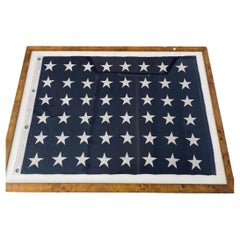
United States Navy 48 Star Union Jack, circa 1912
Located in Nantucket, MA
Antique United States Navy 48 Star Union Jack, circa 1912, a scarce early, World War I era US Navy Jack with 48 embroidered stars on a cobalt field, flown on the bow of Navy, Coast G...
Category
1910s American Other Vintage Wool Historical Memorabilia
Materials
Wool
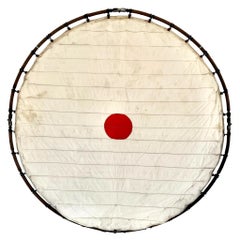
Fireman
s Life Saving Machine, 1907 USA
Located in Los Angeles, CA
Although it may resemble a trampoline, this is an extremely rare fire safety net designed to catch those leaping from burning buildings. The net was patented in 1887 by Thomas F. Bro...
Category
Early 1900s American Antique Wool Historical Memorabilia
Materials
Metal
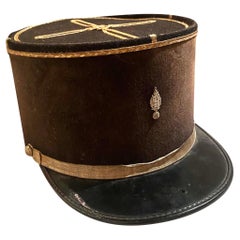
Vintage French Fireman Officers Kepi Hat
Located in Sheridan, CO
This is a vintage French Kepi/Hat was acquired on a buying trip to France in 2019. In black felt with black plastic peak, gold braid. Made by Balsan Paris,...
Category
1970s French Charles X Vintage Wool Historical Memorabilia
Materials
Leather, Wool, Felt, Plastic
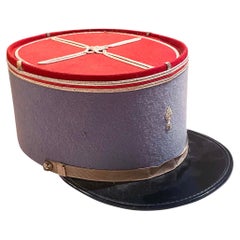
Vintage French Military Academy Officers Kepi Hat
Located in Sheridan, CO
This rare Vintage French Military Academy Officers hat was acquired on a buying trip to France in 2019.
The French Army Saint Cyr Officer Kepi is an...
Category
1970s French Charles X Vintage Wool Historical Memorabilia
Materials
Leather, Wool, Felt, Polyester
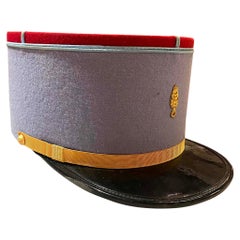
Vintage French Military Academy Officers Kepi Hat
Located in Sheridan, CO
This rare Vintage French Military Academy Officers hat was acquired on a buying trip to France in 2019. Gold braid runs around the top of the Hat with...
Category
1970s French Charles X Vintage Wool Historical Memorabilia
Materials
Leather, Wool, Felt, Polyester
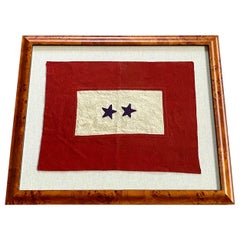
Antique Historic American Double Blue Star Flag, circa 1917
Located in Nantucket, MA
Antique historic American double blue star flag, circa 1917, a World War I flag honoring two family members in service. The flag is hand crafted of wo...
Category
1910s American Other Vintage Wool Historical Memorabilia
Materials
Wool
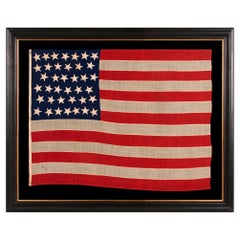
38 Star Antique American hand sewn Flag, Colorado Statehood, circa 1876-1889
Located in York County, PA
Entirely hand sewn, 38 Star, antique American flag of the Indian wars period, with a Squarish profile and a canton that is taller than it is wide, similar to U.S. infantry and artillery battle flags, and with an especially graphic presentationof stars; made in the era when colorado was the most recent state to join the union, 1876-1889
38 star antique American flag, with an array of interesting and visually impressive features. Entirely hand sewn, note how the flag’s dimensions appear near-to-square, when compared to most of its counterparts. Also note how the canton is slightly taller than it is wide. These traits mimic the visual aspects of infantry and artillery battle flags of the 18th- early 20th centuries, that were basically square in shape, with cantons that were far more narrow than what one would expect. U.S. Army regulations of 1861 (opening year of the Civil War), for example, specified that both regimental and national colors be 6 x 6.5 feet. This shape maximized the surface area of the textile when carried on foot. Favorable for ground use, it allowed the flag to be as large as possible, in order to maximize its visibility as a Signal, yet at the same time not drag on the ground.
At approximately 3.5 x 4.5 feet, this particular flag has a similar appearance, yet is significantly smaller. Entirely hand sewn, it measures approximately 3/5 of the scale of a regulation, infantry battle flag. Note how the stars, while roughly arranged in rows of 7-6-6-6-6-7, are spun in all directions on their vertical axis, and how their placement within each row is grossly inconsistent. Two of the most notable occurrences of variation can be seen at the beginning of the third row, where enough space was left to easily add another star (not possible elsewhere), and in the final row of 7, where the 4th and 5th stars from the hoist, practically touch.
The flag has terrific presentation as a result of the above features, stronger and more unusual than most examples of the time.
The stars of the flag are made of cotton and are double-appliquéd, meaning that they are applied to both sides of the blue canton. The canton and stripes of the flag are made of wool bunting. There is a narrow binding along the hoist, made of either linen or hemp, with three, tiny, hand sewn, whip-stitched grommets. Remnants of hemp rope are present in the top and center grommets.
Colorado became the 38th state on August 1st, 1876. This was the year of our nation’s 100-year anniversary of independence. Per the Third Flag Act of 1818, stars were not officially added until the 4th of July following a state's addition. For this reason, 37 was the official star count for the American flag in 1876. Flag-making was a competitive venture, however, and few flag-makers would have been continuing to produce 37 star...
Category
Late 19th Century American Antique Wool Historical Memorabilia
Materials
Wool
H 54.5 in W 67 in D 2.5 in
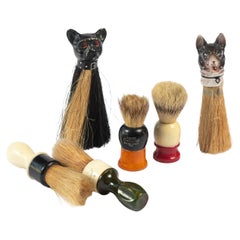
Collection of Six Unique Vintage Shaving Brushes
Located in San Francisco, CA
Collection of 6 unique vintage shaving brushes, two with dog handles, 6" tall and 2" round, two with celluloid handles are 5.5" tall and 2" round...
Category
Mid-20th Century American Art Deco Wool Historical Memorabilia
Materials
Goat Hair, Bakelite, Wood
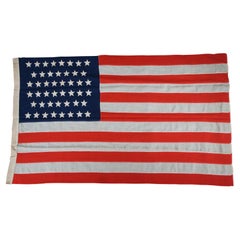
Antique 46 Star WMH Horstmann Company United States of America Flag 83"
By Horstmann
Located in Dayton, OH
Antique forty six star large wool American flag by Horstmann Company, circa 1908-1912.
Horstmann firm was founded by William H. Horstmann (1785-1850), who had immigrated to Philadelphia from Germany. Horstmann bought out a local swordmaker in 1828 and thereafter entered the military goods field. The firm benefitted from the Civil War, becoming the largest military goods supplier in the nation by 1864.
WILLIAM H. HORSTMANN & SONS, Manufacturers of Dress Trimmings and Military Goods. 5th & Cherry Streets, Philadelphia, PA.
This house was founded, in 1815, by William H. Horstmann, a native of Cassel, in Germany. He had learned the trade of silk-weaving in France, and, emigrating to the United States in the above-mentioned year, established himself in Philadelphia as a manufacturer of fringe, laces and trimmings of various kinds. He married the daughter of Frederick Hoeckly, a German settler in Philadelphia, and also a manufacturer of fringe, coach-lace and tassels. He devised several improvements in this trade, especially by introducing varieties in the styles and patterns of this class of goods, there being at that time only two patterns used in the trade, which were known as the Jefferson pattern and the Monroe pattern.
In 1824, he introduced into this country from Germany the use of plaiting or braiding machines, and about the same time he was the first to introduce into this country the use of the Jacquard loom, for weaving patterns in textile fabrics. His location was in the first instance at No. 50 North Third street, but within a short time he removed to a store next to the Harp and Crown tavern, afterwards known as the City hotel, and continued his business within a short distance of this point for many years.
In 1828, he commenced the manufacture of military trimmings as a special department, and this branch has grown to most important proportions, Horstmann's military goods being in demand throughout time country. The firm have also executed large Government contracts in this line for the War and Navy Departments. In 1831, he established a branch house in New York city, and about the same time erected a factory at the corner of Germantown road and Columbia avenue. The factory was continued here until time erection of the extensive building at Fifth and Cherry streets, where the works, salesrooms and offices of time firm now are. This massive structure is six stories high, and extends 140 feet on Fifth street and 200 on Cherry street, and reaches back to Race street. The separate departments into which the business is divided are thirty in number. More than 1000 distinct looms and machines are in use in the building, many of them very costly and some invented and used exclusively by this firm, the motive power being supplied by a steam engine of fifty horse power. The area covered by the works is about 11,000 square feet. Time number of hands employed is very large, about 500. When the erection of a vast factory at this point was first proposed, a strong opposition was made by time holders of the neighboring property. The ancient German Lutheran Church and burying ground, since removed, stood opposite the site, and a bill was introduced into the Legislature to forbid the use of a steam engine within 100 yards of any place of worship. The interests which such a bill would have affected injuriously, especially those of several newspapers, roused a strong opposition to it, and it failed to become a law. In 1845, William H. Horstmann, the founder of the house, retired from the business, and his two sons, William and Sigmund, assumed the management and it was under their direction that the new building, above described, was erected.
The goods produced by this house are of almost endless extent and variety. They include goods woven from all the various textile fibres—cotton, wool, silk, etc.—in every style, color and pattern, and are used for an infinite number of purposes. Narrow woven goods are time staple production, made up into material for dresses for both sexes, for use in daily life, and for regalia for ""societies;"" for the costumes of the stage, the upholstering of houses and of carriages, the uniforms of soldiers, together with equipments for the same, and for funeral purposes. The raw material used in the manufacture is to a great extent very costly, and their store rooms often hold as much as $200,000 worth of goods in an unworked state. There are two rooms devoted to power looms in the factory, one for coach lace and one for other styles of weaving, in which about 250 of these machines are constantly running. The braiding machines in the coach lace room are very noteworthy. The cord to be covered with braid is drawn through an opening in time middle of a flat, circular, metallic plate, about 15 inches across. Up to a point on this cord, about a foot above the plate, the threads of the braiding material converge, like the ribs of a tent-roof, and there weave in and out and out and in, as the coating of braid grows, and time covered cord rises and is wound away above. The weaving is accomplished by the motion of the spools below that carry the different threads of the braid. These spools stand in uprights, which are carried round and amongst each other in curved slots in the above-mentioned broad metallic plate. All but two of these spools run in and out among each other, with a swift, easy and intricate motion, mind so rapid that time eye can hardly follow it, while one or two special spools run steadily round and round among time twisting spools with the most extreme swiftness. Many other machines, displaying equally ingenious mechanism, are used in the factory. The various details of equipment manufactured and supplied by this house are also important, both for their number and the superior quality of the manufacture.
The one article of swords may be taken as an instance. This trade grew naturally and immediately out of the established army and navy goods department of the works, it being necessary that the sword itself should be furnished together with the sword-belt and other trappings all complete. Every part of the sword and trappings, with the exception of the blade, is made on the premises. The blades are almost all imported from the ancient German sword-blade emporium of Solingen, where, it is said, swords have been made ever since the year 1147, when Count Adolphus of Berg brought home from the East and established there the business of forging Damascus blades. There is in this department a stock of some thousands of blades, of many different patterns and sizes, ready to be set and finished. Any style or sword can be had from this warehouse, from the plainest kind up to a presentation sword...
Category
1910s American Classical Vintage Wool Historical Memorabilia
Materials
Wool
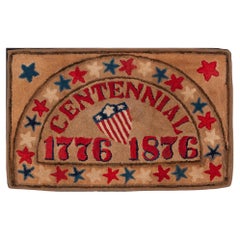
1876 Centennial Hooked Rug with Stars and Shiled
Located in York County, PA
WOOL HOOKED RUG, MADE FOR THE 1876 CENTENNIAL OF AMERICAN INDEPENDENCE, WITH STARS AND A PATRIOTIC SHIELD
Wool hooked rug with a wonderful, patriotic theme, made for the 100th ann...
Category
Late 19th Century American Antique Wool Historical Memorabilia
Materials
Wool
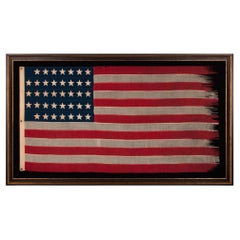
38 Star American Flag, Stars in Notched Pattern, ca 1876-1889
Located in York County, PA
38 HAND-SEWN STARS IN A "NOTCHED" PATTERN, ON AN ANTIQUE AMERICAN FLAG WITH BEAUTIFUL WEAR FROM HAVING BEEN EXTENSIVELY FLOWN, MADE AT THE TIME WHEN COLORADO WAS THE MOST RECENT STATE TO JOIN THE UNION, 1876-1889
38 star Antique American flag, made during the period when Colorado was the most recent state to join the Union. The stars are arranged in what is known as a "notched" pattern, in which two spaces were left open along the hoist end, in the first and last rows, in anticipation that two more Western Territories would soon join the Union. The latter 19th century was a time of when much of the land in and about the Continental Divide was formalized into states, and there was continual speculation about which ones would be accepted next, and with what boundaries.
The stars of the flag are made of cotton and are double-appliquéd (applied to both sides) with a lineal, treadle stitch. The canton and stripes of the flag are made of wool bunting that has been pieced with treadle stitching. The canton was constructed from five separate lengths of fabric, which is an unusual feature, though hardly unknown. To each of these a row of stars was sewn. This manner of construction is sometimes encountered and tends to be an early trait, at least when it occurs in flags of this scale and smaller. When encountered, it also seems to have been preferred in flags meant for maritime use. While the feature does not by any means guarantee this fact, it is a reasonable, educated guess, based upon my examination of many other examples. A flag with a 5-piece canton, such as this, would have been less likelihood to stretch, with increased structural integrity. The alternative is that this was simply an example made when there were at least five pieces of leftover fabric, of a reasonable size to made individual rows, and that what it actually demonstrates is the careful conservation of scarce resources. There is a sailcloth canvas binding along the hoist, with 3 brass grommets, evenly spaced.
Perhaps the best feature of the flag is the evidence it displays of having been extensively flown, with the fly end whipped out from wind exposure. While many flags display damage from a combination of having been flown, exposure to the elements, various mishaps, and improper storage, very few exhibit wear such as this, which is both endearingly and visually attractive. This one shows its age beautifully, whipped out along the fly end, with losses that convey an element of movement, that most flags don’t capture in the state in which they survive.
Colorado became the 38th state on August 1st, 1876. This was the year of our nation’s 100-year anniversary of independence. Per the Third Flag Act of 1818, stars were not officially added until the 4th of July following a state's addition. For this reason, 37 was the official star count for the American flag in 1876. Flag-making was a competitive venture, however, and few flag-makers would have been continuing to produce 37 star flags, when their competitors were making 38’s. It is for this reason that 38 and 13 stars (to represent the original 13 colonies...
Category
Late 19th Century American Antique Wool Historical Memorabilia
Materials
Wool
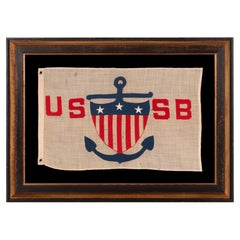
United State Shipping Board Flag, ca 1917-1934
Located in York County, PA
United States shipping board flag, an extremely scarce and beautiful, nautical design, made sometime between WWI (U.S. Involvement 1917-18) and 1934
Flag of the United States Ship...
Category
Early 20th Century American Wool Historical Memorabilia
Materials
Wool
Still Thinking About These?
All Recently ViewedMore Ways To Browse
Vintage Glass Ball Ornaments
Voting Box
Ww2 Binoculars
1960s Christmas Ornament
Antique Iron Plow
Antique Police Memorabilia
Antique Stamp Machines
Antique Voting Box
Audrey Hepburn Personal Collection
Audrey Hepburn Personal
Cast Iron Fire Box
Charles And Diana
Cipher Machine
Collectible Vintage Oil Cans
Gamewell Alarm
George Bush Signed
Gutta Percha Case
Jewish National Fund