Items Similar to Royal Silver Calcutta Races Trophy

Want more images or videos?
Request additional images or videos from the seller
1 of 8
Royal Silver Calcutta Races Trophy
$58,000
£44,197.08
€50,971.43
CA$82,377.34
A$88,509.87
CHF 47,485.37
MX$1,042,748.24
About the Item
This stunning piece of horseracing history was presented to the winner of the 1933-1934 Calcutta Races on behalf of King George V. The Calcutta Races was the premier horseracing event in Asia of the period, and its prestige is reflected in this trophy, crafted by the silversmithing firm Goldsmiths and Silversmiths Company of London. It is crafted in a distinctive and elegant “pilgrim’s jug” shape, resembling the flasks early travelers tied to their horses’ harnesses on long pilgrimages to holy sites. The vessel is exquisitely decorated with gadrooned borders, classical masks and the engraved coat of arms of George V. This distinguished prize stands as an emblem of the pinnacle of equine sportsmanship as well as a brilliant example of English silver.
This trophy was presented to the winning horse’s owner Mr. Edward Esmond, a very well-known name in the horseracing world of his day. His horses won races across the globe, including the French Derby, the Grand Prix de Paris, the Prix de Diane and the Calcutta Races. Organized by the Royal Calcutta Turf Club, a horse racing organization founded in 1847 in Calcutta, British India, the Calcutta Races was the most prestigious race in Asia and among the most important social events of the season, with the King himself often in attendance.
The inscription reads, "Calcutta Races 1933-1934 / The King-Emperor's Cup Presented by The King-Emperor / Won by Mr. Edward Esmond's 'Sans Ame'"
Hallmarks for Goldsmiths and Silversmiths Company, London, 1928
Measures: 11 1/4" wide x 4 1/2" deep x 20 1/4" high.
- Dimensions:Height: 20.25 in (51.44 cm)Width: 11.25 in (28.58 cm)Depth: 4.5 in (11.43 cm)
- Materials and Techniques:
- Place of Origin:
- Period:
- Date of Manufacture:1928
- Condition:
- Seller Location:New Orleans, LA
- Reference Number:Seller: 31-57071stDibs: LU891130252022
About the Seller
5.0
Recognized Seller
These prestigious sellers are industry leaders and represent the highest echelon for item quality and design.
Established in 1912
1stDibs seller since 2010
115 sales on 1stDibs
Typical response time: 5 hours
- ShippingRetrieving quote...Shipping from: New Orleans, LA
- Return Policy
More From This Seller
View AllAqueduct Wood Memorial Trophy Won by Personality
Located in New Orleans, LA
A rare and exceptional trophy, won by the thoroughbred personality at the 1970 Wood Memorial Stakes race held at the Aqueduct Racetrack. Beautifully craf...
Category
20th Century American Other Sports Equipment and Memorabilia
Materials
Silver
Queen Mary Homage Vase
By T. Goode
Co.
Located in New Orleans, LA
This remarkable limited edition etched glass vase pays homage to Queen Mary of Teck, queen consort of Great Britain from 1910-1937. She reigned with her husband, King George V, through a period of great change for the country and served as a dedicated advisor to George through his ill health, the First World War and the political changes that arose as a result. Her intellect, calm demeanor and dedication to her husband and country made her popular with the public, and after her death, the ocean liners RMS Queen Mary and RMS Queen Mary 2...
Category
20th Century English Other Vases
Materials
Glass
$5,450
Meiji Period Japanese Silver Censer
Located in New Orleans, LA
This stunning Meiji period silver censer is a work of exquisite detail. Crafted by renowned silversmith Masatoshi of Tokyo, the censer, or incense burner...
Category
20th Century Japanese Meiji Metalwork
Materials
Silver
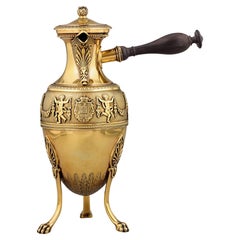
Personal Coffee Pot of Eugène de Beauharnais, Napoleon
s Heir
By Martin Guillaume Biennais
Located in New Orleans, LA
Personal coffee pot of Eugène de Beauharnais
Martin-Guillaume Biennais
Circa 1797–1809
This exceptionally rare silver coffee pot was made for Eugène de Beauharnais, Napoleon Bonapar...
Category
Antique Early 19th Century French Serving Pieces
Materials
Silver
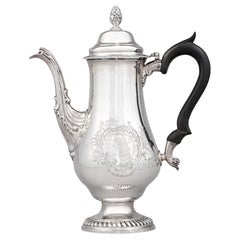
Paul Revere Coffee Pot
By Paul Revere
Located in New Orleans, LA
Sterling Silver Coffee Pot
Paul Revere
Circa 1775
This phenomenal and incredibly rare silver coffee pot by the legendary patriot Paul Revere is one of only six armorial coffee pots crafted before the Revolutionary War, and one of only three still in private hands. The other two are housed in the collections of the Worcester Art Museum and the Museum of Fine Arts, Boston, making this coffee pot an extraordinary treasure. In terms of maker, quality and provenance, this coffee pot is the most significant American silver object available today.
The coffee pot bears the hallmarks of Revere's exquisite craftsmanship at every turn. Revere was not only the preeminent silversmith in America—he was the only silversmith in the colonies capable of crafting a finished product from the silver ingot to a finished engraved treasure, all by himself. Perfectly balanced and adorned with such fine Rococo detailing as a fluted scroll spout rising from a shell and a flower spray cartouche, this coffee pot epitomizes Revere's unmatched talent.
The pot also notably features Revere’s stamped maker’s mark and the original scratch weight of 40.1 troy ounces on the bottom of the pot. The average silver object made by the famed American would have weighed approximately five troy ounces, and his grand serving spoons averaged approximately two ounces each—making this coffee pot one of Revere's most magnificent and monumental masterpieces.
Within the central cartouche, the monogram "MSS" appears, belonging to the prominent Dr. Micajah Sawyer (1737-1815). A distinguished Harvard graduate, Sawyer was well-known as the "celebrated physician of Newburyport." Such an extraordinary object would have been a precious family heirloom, and this coffee pot remained in the Sawyer family until 1980, when it was sold to another American private collection, where it has remained until now. It was also prominently displayed at the Virginia Museum of Fine Arts for more than 30 years, from the 1980s until 2014.
Born in 1734 to a Huguenot silversmith, Paul Revere's patriotism and his contribution to the American decorative arts are of inestimable value. He was immortalized in Henry Wadsworth Longfellow's poem, The Midnight Ride of Paul Revere, which tells of how he heroically rode through the countryside warning of the approaching British troops at the beginning of the American Revolution. This legendary event, along with his extraordinary work as a silversmith, has ensured a timeless legacy for Revere.
In 1768, on the eve of the American Revolution, Revere crafted the “Sons of Liberty Bowl,” now housed at the Museum of Fine Arts in Boston. Both before and after serving his country during the Revolution, Revere was at the forefront of American silver, producing elegant bowls, sauceboats and creamers. By far, his most important works are coffee pots, of which only 15 are listed in his records books, making this coffee pot the ultimate piece of Revere's legacy.
Maker's mark "Revere" stamped near the top of the handle
12 1/4" high x 10" wide x 5" deep
42 ounces
Provenance:
Micajah and Sibyl Sawyer, Newburyport
Descended in the family until sold
Sotheby Parke Bernet, New York, April 30—May 3, 1980, lot 184
Private Collection, United States
M.S. Rau, New Orleans
Literature:
Patricia E. Kane, Colonial Massachusetts...
Category
Antique 18th Century American Sterling Silver
Materials
Sterling Silver
$1,285,000
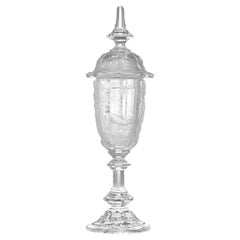
Bohemian Crystal Goblet
Located in New Orleans, LA
A striking example of Czech artistry, this Bohemian glass goblet exhibits carefully carved scenes of stags within wooded landscapes that evoke th...
Category
Antique 19th Century Czech Bohemian Glass
Materials
Crystal
$11,500
You May Also Like
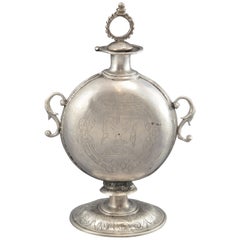
Silver Chrism Vessel or Chrismarium, No Original Lid, 16th Century
Located in Madrid, ES
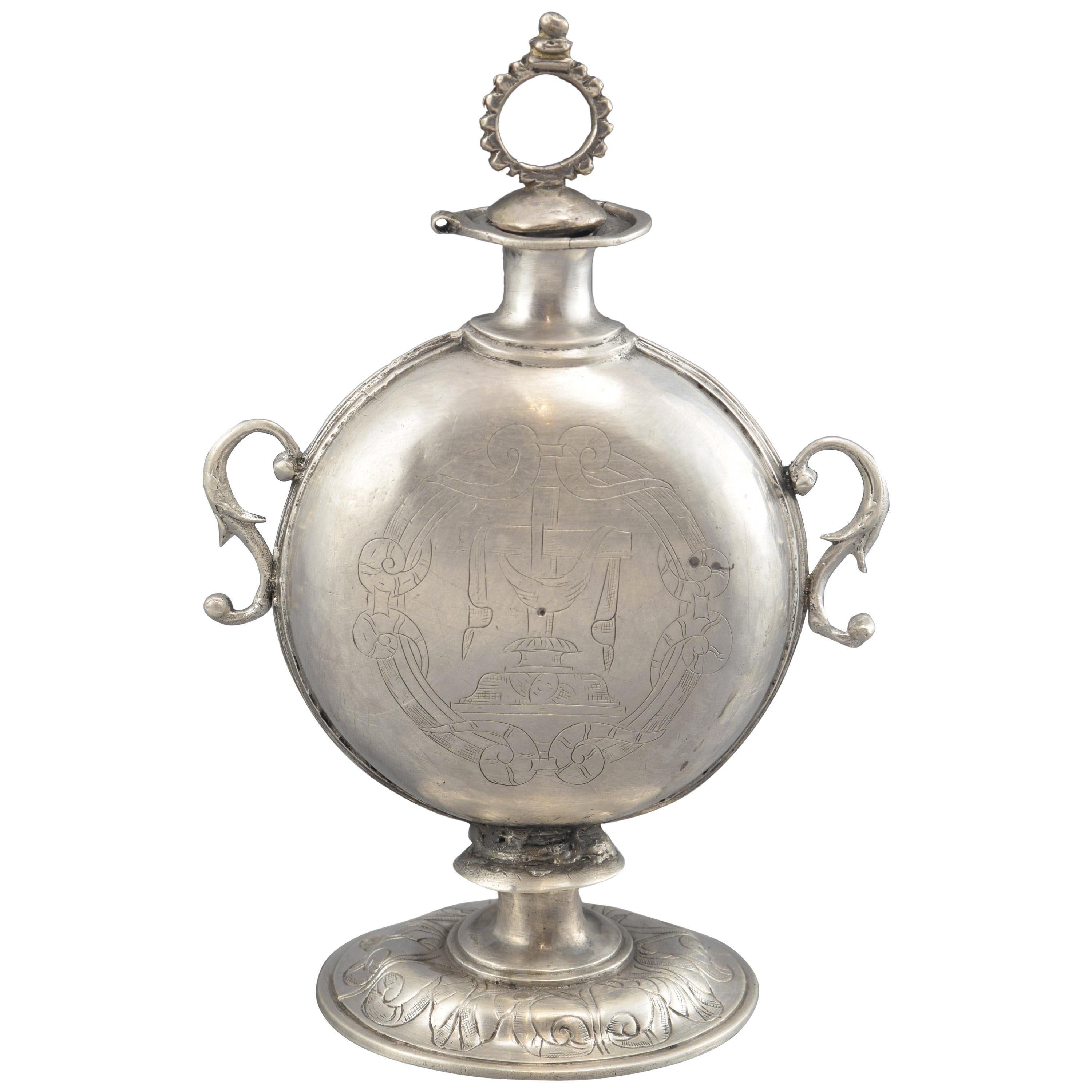
Crismera Silver in its color. 16th century. Cover not original.
Silver chrome in color with a circular foot decorated with an engraved composition of vegetable elements and a flat circular body with two "ese" handles with vegetal motifs and a small neck at the top covered with a lid topped by a ring (which it is not the original of the piece). The body has engraved, on the one hand, a cross on a pedestal with a shroud hung from it, all within an engraved frame; On the other hand, with a frame similar to that mentioned, appear the letters "ihs" (cristogram of ancient origin, already used in the Early Christian, which gave rise to varied etymologies and was adopted as a seal by San Ignacio...
Category
Antique 16th Century European Renaissance Religious Items
Materials
Silver
Early 20th Century Silver-Plated Decanter, Napoleon III Style.
Located in Saint-Ouen, FR
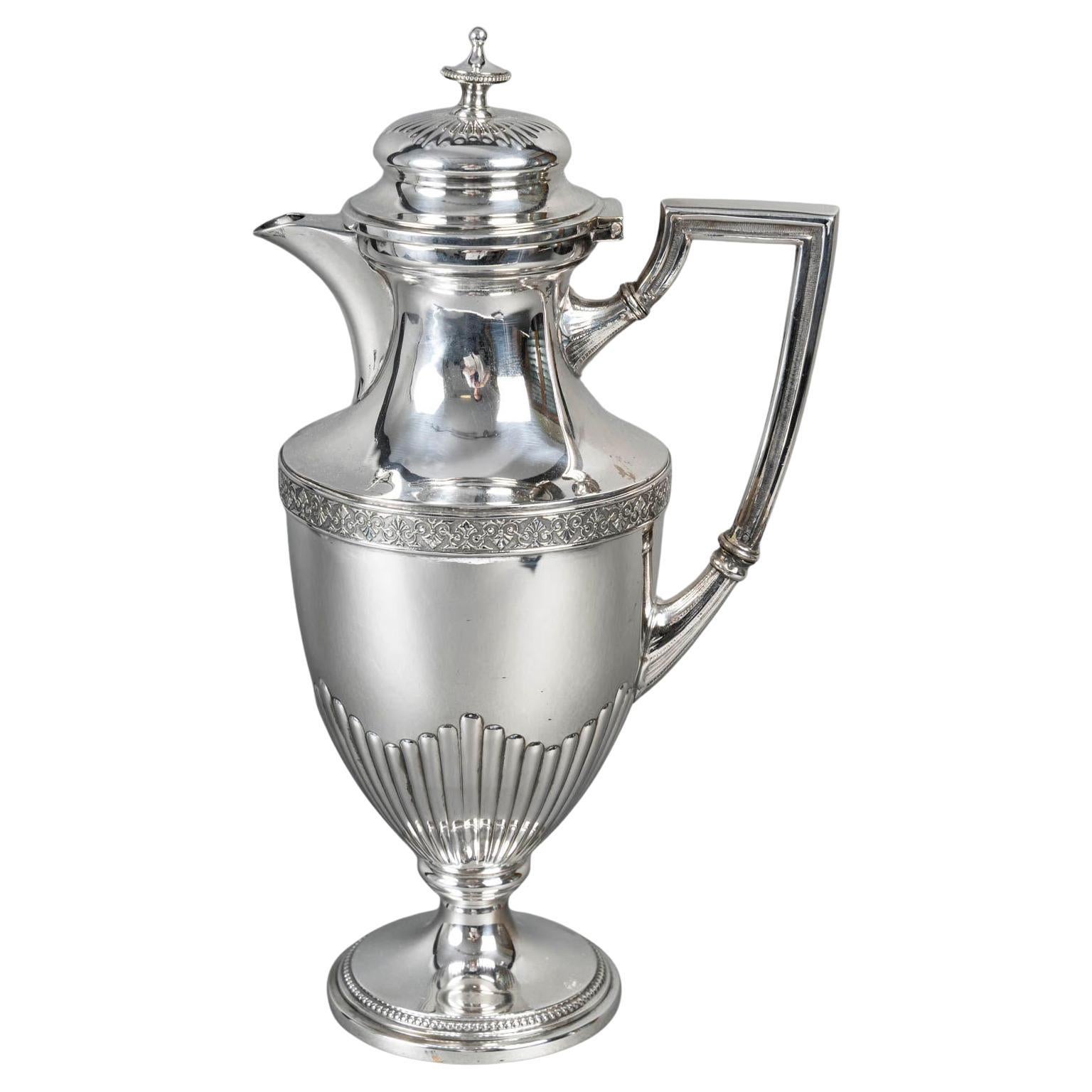
Early 20th century silver-plated decanter, Napoleon III style.
Early 20th century silver-plated metal decanter, Napoleon III style.
H: 32cm, W: 19cm, D: 13cm
Category
20th Century French Napoleon III Jars
Materials
Silver Plate
Silver wine bottle
Located in Porto, PT
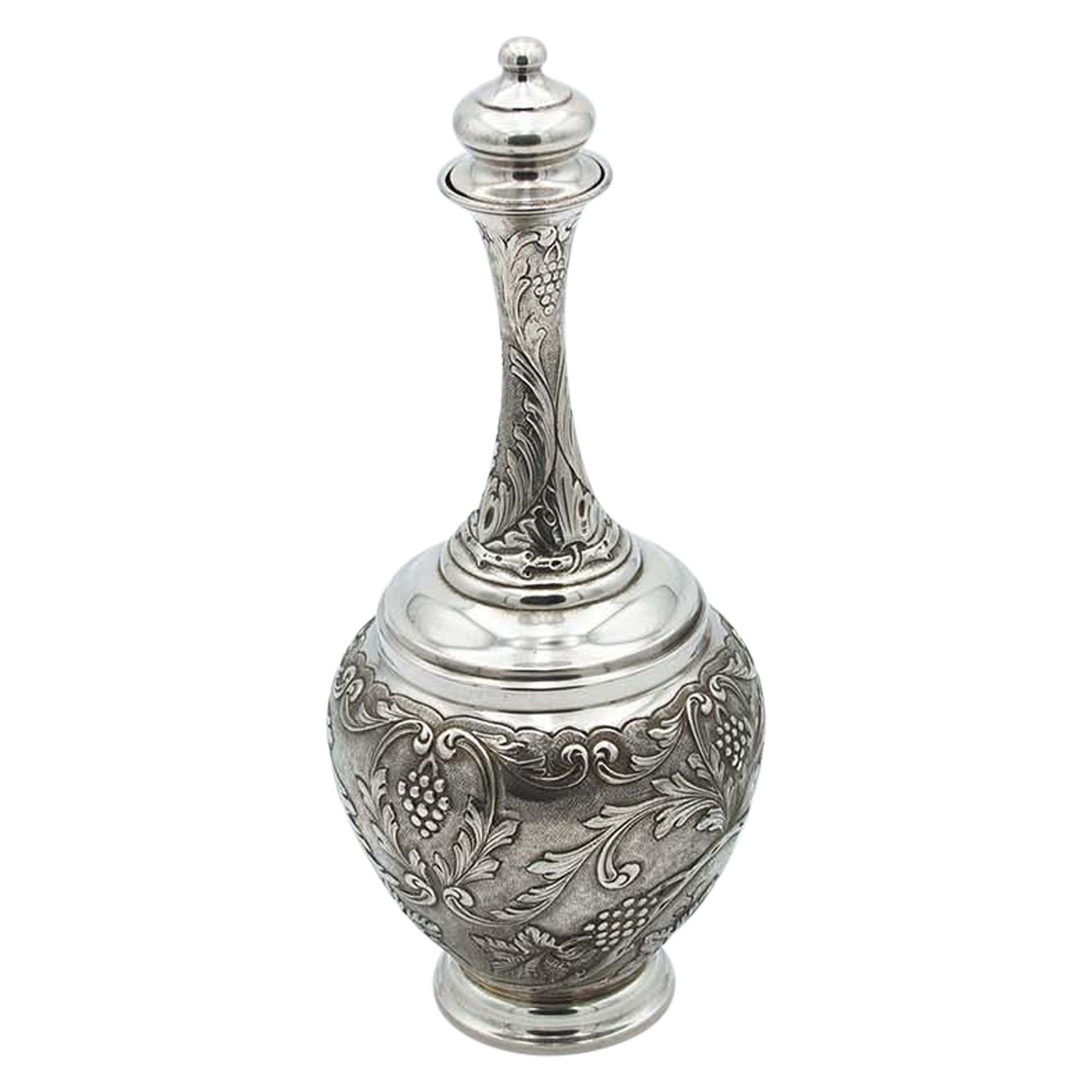
Description: Silver wine bottle with reliefs of grapes and vines with removable lid. Metal: Silver. Origin: Portuguese. Mark: standing eagle. Weight: 464.93 grams. Dimensions: 13.5cm...
Category
20th Century European Bottles
Materials
Silver

Antique Victorian Silver Plated Sugar Caster William Batt
Sons 1860, 19th C
Located in London, GB
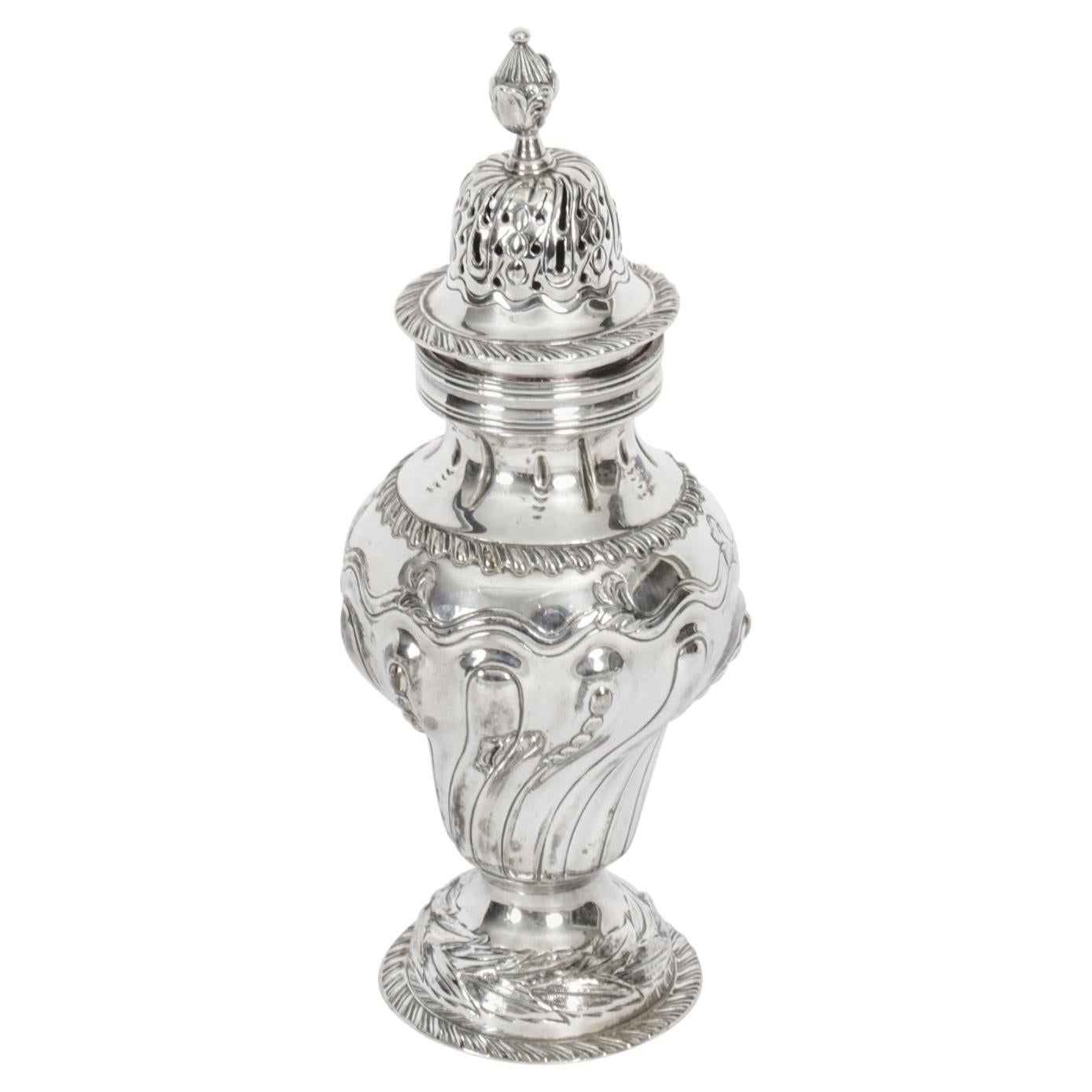
A large beautiful Victorian silver plated sugar caster made by William Batt & Sons Ltd, circa 1860 in date.
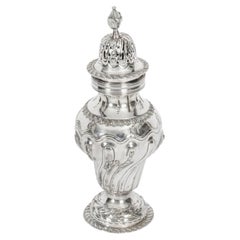
It features typical baluster form and is embossed with lavish decorati...
Category
Antique 1860s English Victorian Sheffield and Silverplate
Materials
Silver Plate
Silver perfume bottle with round base and cord application around the edge
Located in Porto, PT
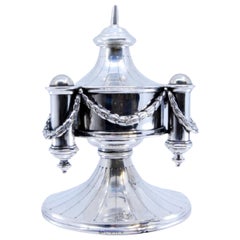
Description: Silver perfume bottle with round base and cord application around the edge. Metal: Silver. Origin: English. Brand: London. Weight: 593.61 grams. Dimensions: 16x12cm. Con...
Category
20th Century European Bottles
Materials
Silver
$2,375 Sale Price
50% Off
Free Shipping
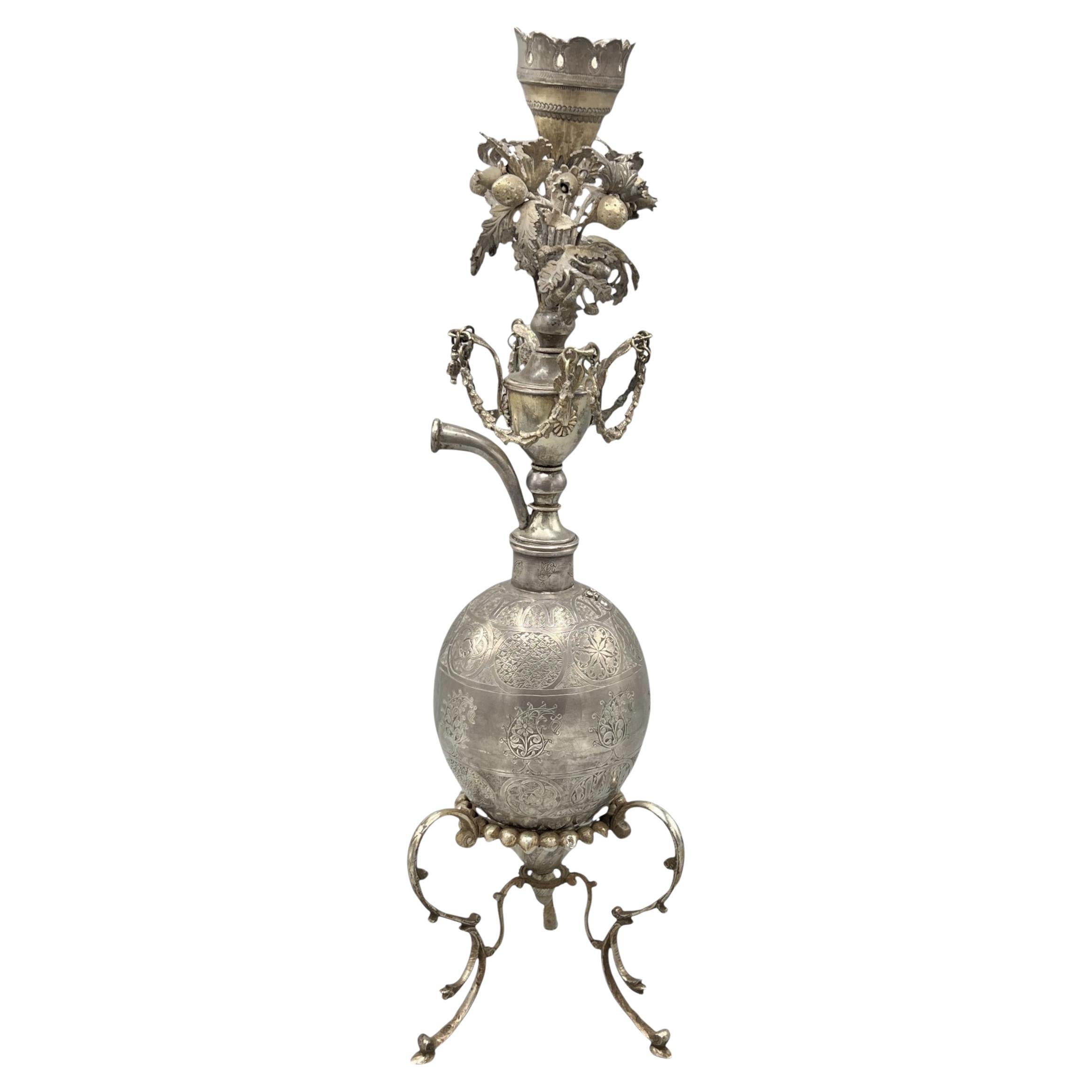
19th Century Ottoman / Turkish Silver Huqqa / Hookah
Located in New York, NY
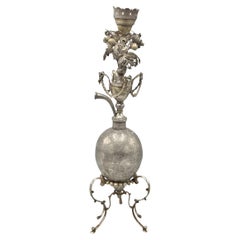
Antique (19th century) huqqa (hookah) finely crafted from silver, of ovoid form resting on three-legged stand with floral designs around the neck and embossed designs throughout. 20...
Category
Antique Late 19th Century Turkish Tobacco Accessories
Materials
Silver
More Ways To Browse
Goldsmith And Silversmith
British India
Derby Vintage
King George V
English Silver Trophy
Horse Tie
French Derby
Trench Ww1
Victorian Advertising
Antique Chaps
Brass Shell Casing
Georg Jensen Christmas Ornament
Georg Jensen Christmas
Fire Memorabilia
Royal Coronation
Vending Machine
18th Century Coins
1953 Coronation