Items Similar to Balsamarium shaped as a Bust of a Black Boy - Roman, 1st – 2nd Century AD
Want more images or videos?
Request additional images or videos from the seller
1 of 5
Balsamarium shaped as a Bust of a Black Boy - Roman, 1st – 2nd Century AD
$14,958.03
£11,172.09
€12,500
CA$20,607.42
A$22,458.46
CHF 11,892.73
MX$269,749.81
NOK 150,564.53
SEK 138,429.28
DKK 95,228.37
About the Item
Balsamarium shaped as a Bust of a Black Boy
Bronze, silver inlaid eyes and lips, Roman, 1st – 2nd Century AD
Provenance:
Private London Collection formed 1965-1975
H 10 cm (4 inch)
This exquisite Roman bronze balsamarium, dating from the 1st or 2nd century AD, is shaped in the form of a bust depicting a young black African boy. His youthful face has been meticulously executed to the finest detail. Beneath his abundant elaborately crafted curly hair, his wide eyes, once adorned with precious inlaid materials, expressively gaze at the onlooker. The boy sports a bare chest beset at the bottom by a frame of acanthus leaves. At the top of the balsamarium is a circular orifice, allowing fragrant contents to be poured into it and which used to be covered by a lid attached to its rim. To the right of this opening is a large loop to which a chain could be attached.
Representations of black people were not uncommon in Roman art and their popularity is evidenced by the fact that such images have been found all over the Roman Empire, in places stretching as far north as Germania. The exotic images of blacks were used for balsamaria in the shape of busts, balances, terracotta vases, lamps and statuettes depicting fighters or jugglers. They have traditionally been considered as products of the so-called school of Alexandria or at least have taken inspiration from the popular art of Greco-Roman Egypt. However, it is now accepted that there also must have been numerous other locations outside of the Alexandrian realm that produced artefacts depicting black people, but since the subject has altogether been poorly studied the exact places of origin usually remain unknown.
Balsamaria were luxury products, that, as the name suggests, were mainly used for holding balsam, the resinous, sap-like product of many different plants, perfumes as well as the oil used by athletes to clean their skin. Balsamaria often depict women's, satyr's heads or animals, or wineskins.
Anthropomorphic balsamaria became widely popular during the 2nd and 3rd centuries AD and it was especially during this period that the number of those depicting exotic sitters grew exponentially. Balsamaria of Ethiopians, Nubians, and Indians were extremely sought-after, especially in those regions of the Roman Empire where contacts with such ethnic groups was limited.
Cosmetics were as important to the ancient Romans as they are in the present time, used by men and women alike, and kept in exquisite vessels specifically made for holding them. As balsamaria were predominantly intended to hold cosmetic odorous substances, it comes as no surprise that a considerable number of them depicted black people. In fact, Africans were the slaves of choice at the thermae, where they usually served as unctores, servants who massaged and anointed the visitors of the thermae with fragrant oils before or after bathing.
Often balsamariums were deemed so important that they were buried together with their owners and some, like one of a woman's head at the British Museum (1868,0601.3) were made exclusively to be placed into tombs with offerings rather than to be used by the living.
The vessels were especially popular in Etruria and were discovered on sites dating to the Hellenistic era (cf. the Norbert Schimmel collection). Other vessels have been found on later sites up to the 4th century AD, thus they need to be studied separately to be dated.
- Dimensions:Height: 3.94 in (10 cm)Width: 2.37 in (6 cm)Depth: 0.99 in (2.5 cm)
- Style:Classical Roman (Of the Period)
- Materials and Techniques:
- Place of Origin:
- Period:15th Century and Earlier
- Date of Manufacture:Roman, 1st – 2nd Century AD
- Condition:Wear consistent with age and use.
- Seller Location:Bruxelles, BE
- Reference Number:1stDibs: LU6666236556712
About the Seller
5.0
Vetted Professional Seller
Every seller passes strict standards for authenticity and reliability
1stDibs seller since 2022
15 sales on 1stDibs
Typical response time: 1 hour
- ShippingRetrieving quote...Shipping from: Bruxelles, Belgium
- Return Policy
More From This Seller
View AllRenaissance Marble Portrait - Northern Italy, 17th century
Located in Bruxelles, BE
Renaissance Marble Portrait
Northern Italy, 17th century, inspired by antiquity
Marble
36 x 13 cm (including the marble pedestal)
This Renaissance portrait head of a young man, sl...
Category
Antique 17th Century Italian Renaissance Figurative Sculptures
Materials
Marble
$9,573 Sale Price
20% Off
Child Jesus - Umbria, first half of the 16th century
Located in Bruxelles, BE
Child Jesus
Polychrome and gilded wood
Umbria, first half of the 16th century
H 40 cm
Entirely naked, the Child is standing, leaning on his left leg, his right leg forward; he keep...
Category
Antique 16th Century Italian Renaissance Religious Items
Materials
Wood
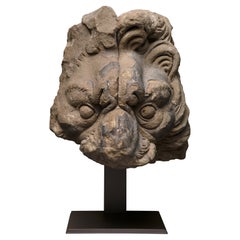
Roman Lion
s Protome - Gallo-Roman, 2nd century AD/3rd century
Located in Bruxelles, BE
Roman Lion's Protome
Sandstone
Gallo-Roman, 2nd century AD - 3rd century
Provenance : Private Collection Prof. Giesen (Konstanz on Bodensee), pré 1945
Most likely from the Chateau a...
Category
Antique 15th Century and Earlier German Classical Roman Animal Sculptures
Materials
Sandstone
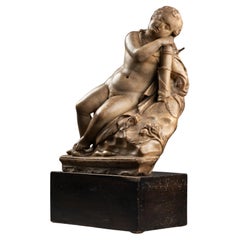
Sleeping Eros - Rome, 16th century
Located in Bruxelles, BE
Sleeping Eros
Rome, 16th century
Carrara marble, on a wooden base
of an ancient collection
31 × 44 x 17 cm
Carved from a fine block of Carrara marble, this sculpture depicts Eros ...
Category
Antique 16th Century Italian Renaissance Figurative Sculptures
Materials
Carrara Marble
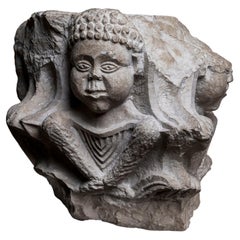
Rare Romanesque Capital Depicting Four Africans, Apulia, 13th Century
Located in Bruxelles, BE
Large stone capital carved on each side in strong relief. The basket is covered with two crowns of vertical acanthus leaves which sprout from the astragal and fill the space between ...
Category
Antique 15th Century and Earlier Italian Medieval Architectural Elements
Materials
Stone
$22,018 Sale Price
20% Off
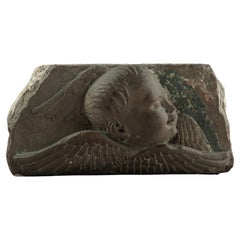
Renaissance Winged Cherub Relief
- Florence, 15th century
Located in Bruxelles, BE
Renaissance Winged Cherub Relief
Florence, Second Half of the 15th Century
Stone with traces of polychromy
Provenance: Important private collection, Northern Italy
This exceptional...
Category
Antique 15th Century and Earlier Italian Renaissance Figurative Sculptures
Materials
Stone
You May Also Like
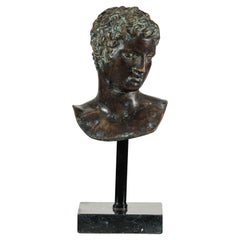
Classical Greek Style Bronze Bust of a Young Man on Marble Base
Located in Yonkers, NY
This bronze bust of a young man evokes the timeless elegance of classical sculpture. Modeled with softly detailed curls and a contemplative expression, the head is presented on a bla...
Category
Late 20th Century Classical Greek Busts
Materials
Marble, Bronze
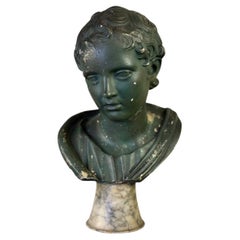
Young Boy, Green Patina Plaster Bust, About 1900
Located in Honnelles, WHT
Young Boy, Green Patina Plaster Bust, About 1900
Category
Mid-20th Century Italian Classical Greek Garniture
Materials
Plaster
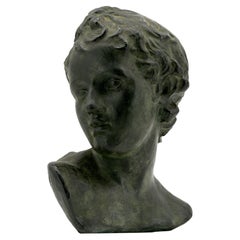
AMPHORA Terracotta Young Boy Bust Sculpture
Located in Saint-Amans-des-Cots, FR
Terracotta Bust of a Young Roman Ephebe, Signed “Amphora” — Neoclassical Style.
This striking terracotta bust of a young Roman ephebe, signed “Amphora,” is a refined example of neoc...
Category
20th Century Neoclassical Busts
Materials
Terracotta
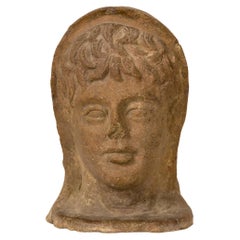
Etruscan Sculpture Head, 4th Century B.C., Italy
Located in Girona, Spain
DESCRIPTION: Etruscan sculpture head made with terracotta, the art represents a young man from the 4th century. It's a very decorative piece and the stat...
Category
Antique 15th Century and Earlier Italian Classical Greek Busts
Materials
Terracotta
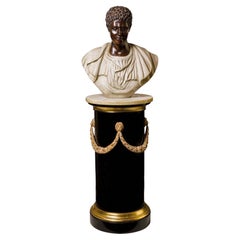
Italian Greco-Roman Style Carved Marble
Patinated Bronze Bust of a Young Male
Located in Los Angeles, CA
An Italian Early 20th Century Carved Marble and Patinated Bronze Bust of a Greco-Roman Young Male. The brown patinated bronze head with a straight stare and curly hair, fitted in a c...
Category
20th Century Italian Greco Roman Busts
Materials
Carrara Marble, Bronze
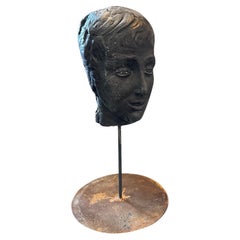
A Late 19th century Hand Crafted Clay Sicilian Head of a Young Man
Located in Catania, Sicilia
A black painted clay head handcrafted in Sicily in the late 19th century, the head it's in original condition and shows signs of aging, which contribute to their charm and authentici...
Category
Antique Late 19th Century Sicilian Neoclassical Revival Figurative Sculp...
Materials
Iron
More Ways To Browse
Black Boy
Antique Silver Miniatures
Antique Miniature Silver Furniture
Antique Massager
Roman Bust 2nd Century
Roman Bust 1st Century
Model Sailing Ships
Tv Tower Models
Antique Miniature Shoes Collectibles
Brendel Botanical
Chris Craft Vintage
Retro Rubber Gloves
Shoe Last
Wooden Artist Mannequin
19th Century Artist Model
Botanical Model Brendel
Brendel Model
Ferrari Model