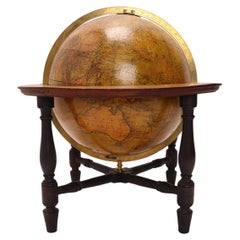
Items Similar to Pocket Globe, Lane, London 1815
Video Loading
Want more images or videos?
Request additional images or videos from the seller
1 of 19
Pocket Globe, Lane, London 1815
$10,764.54
£7,993.27
€9,000
CA$14,788.86
A$16,078.48
CHF 8,524.83
MX$192,740.17
NOK 108,346.17
SEK 99,259.83
DKK 68,608.87
About the Item
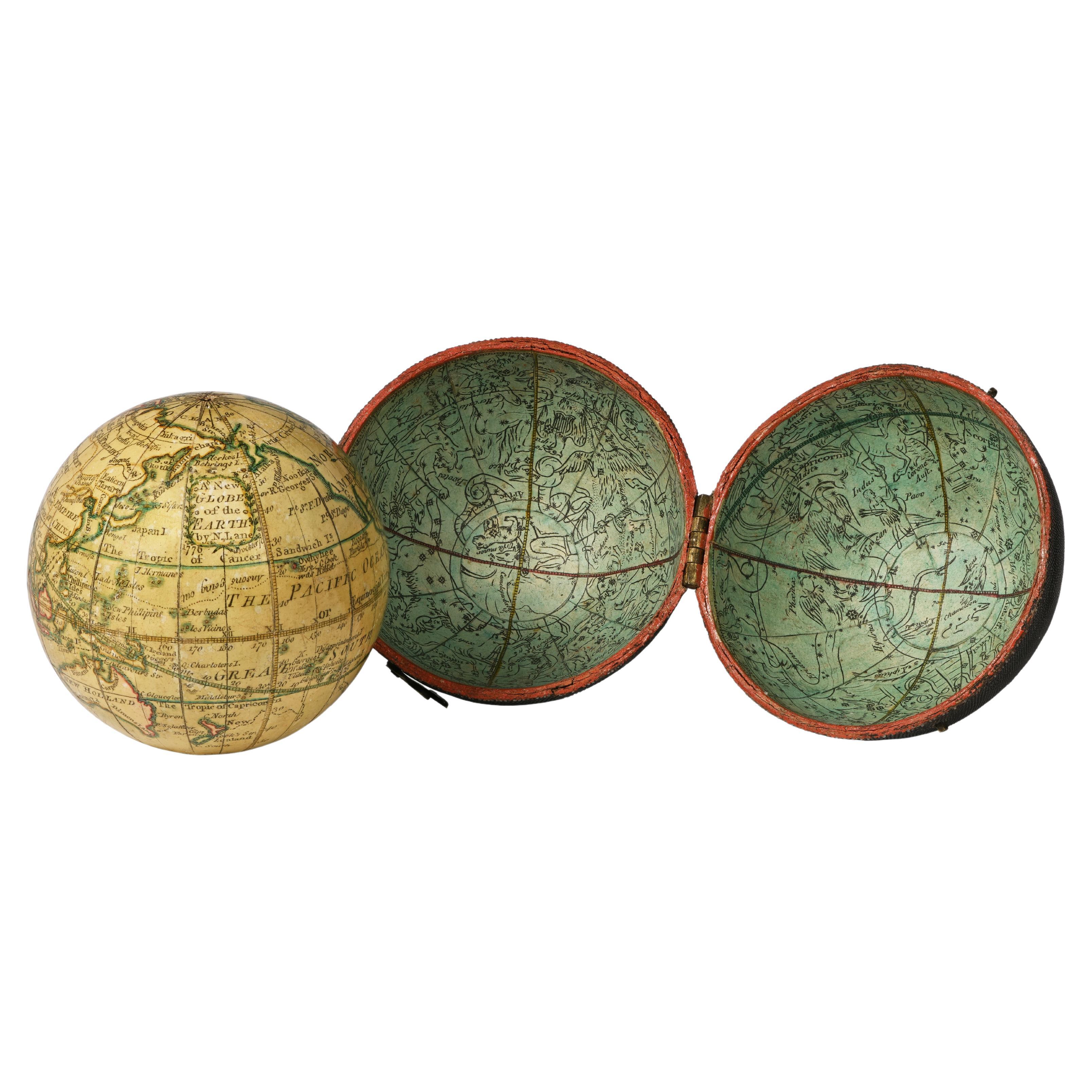
Pocket Globe
Lane
London, 1815
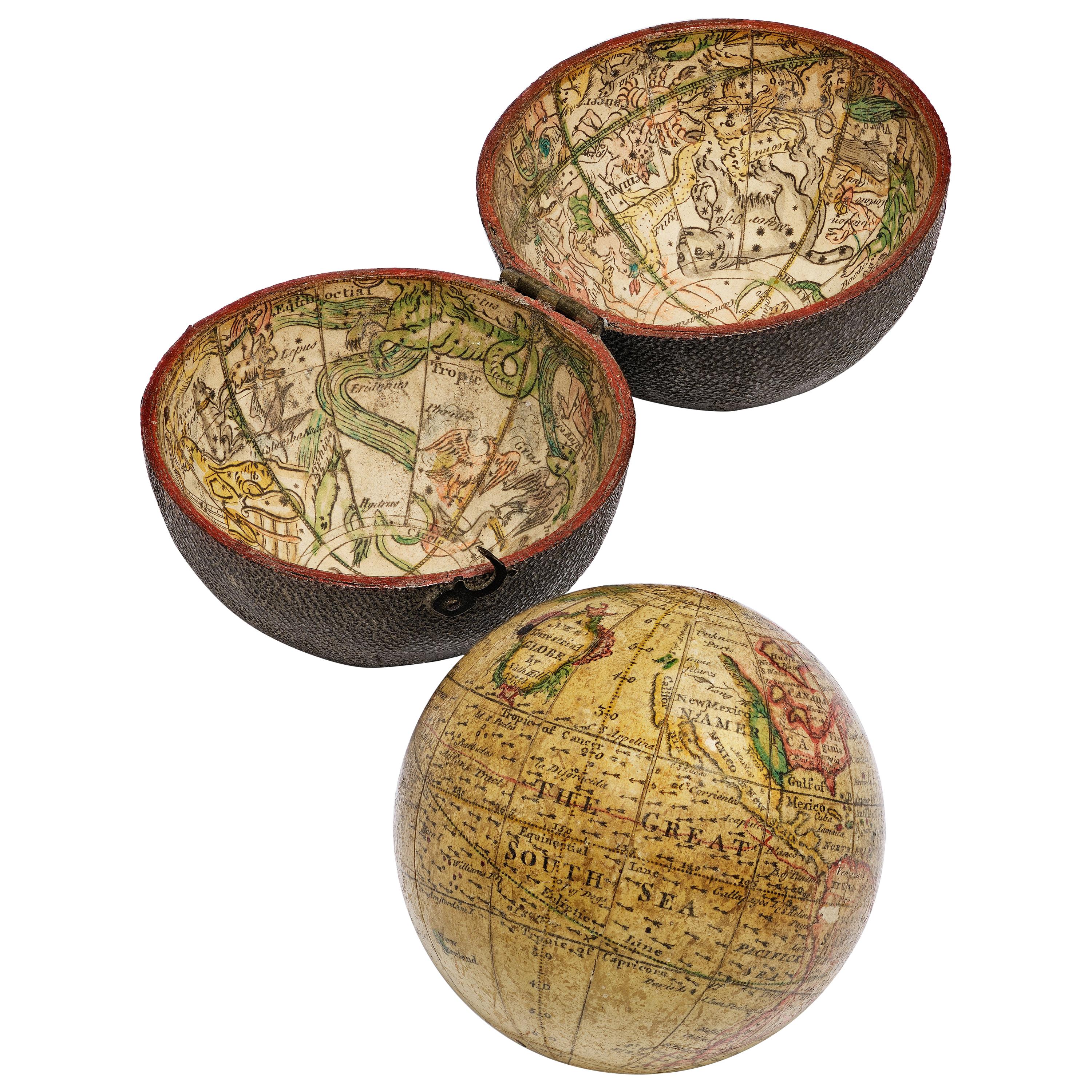
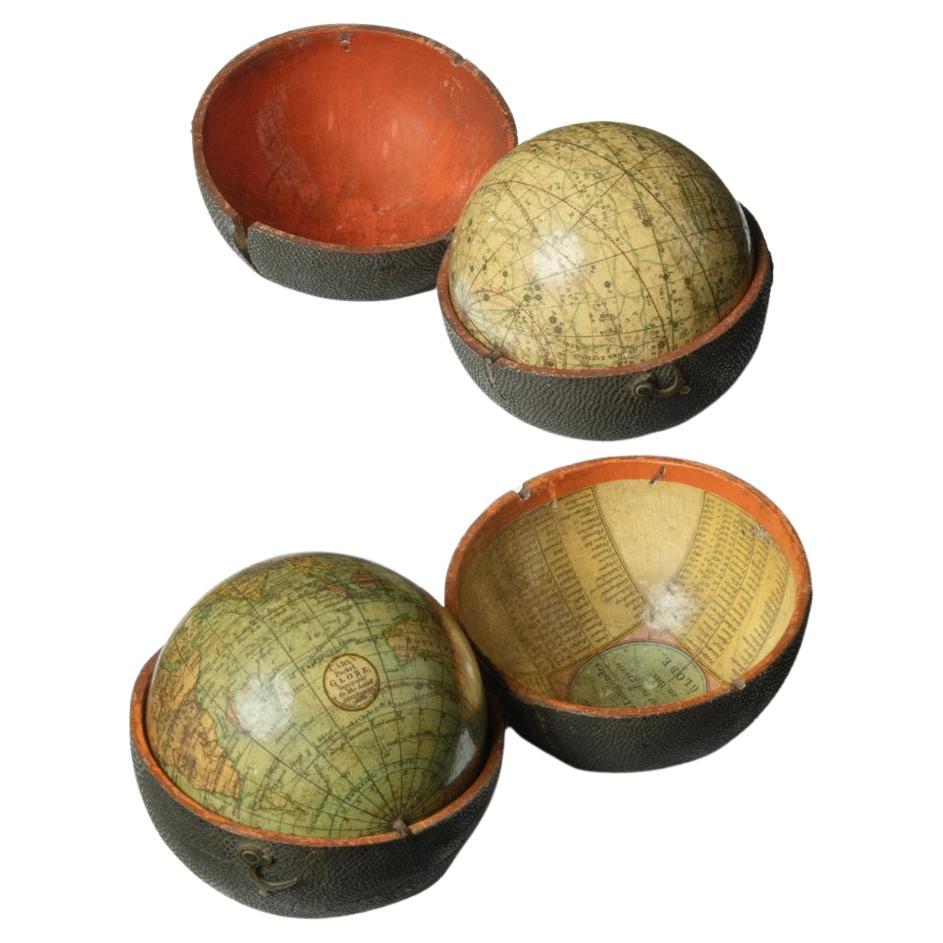
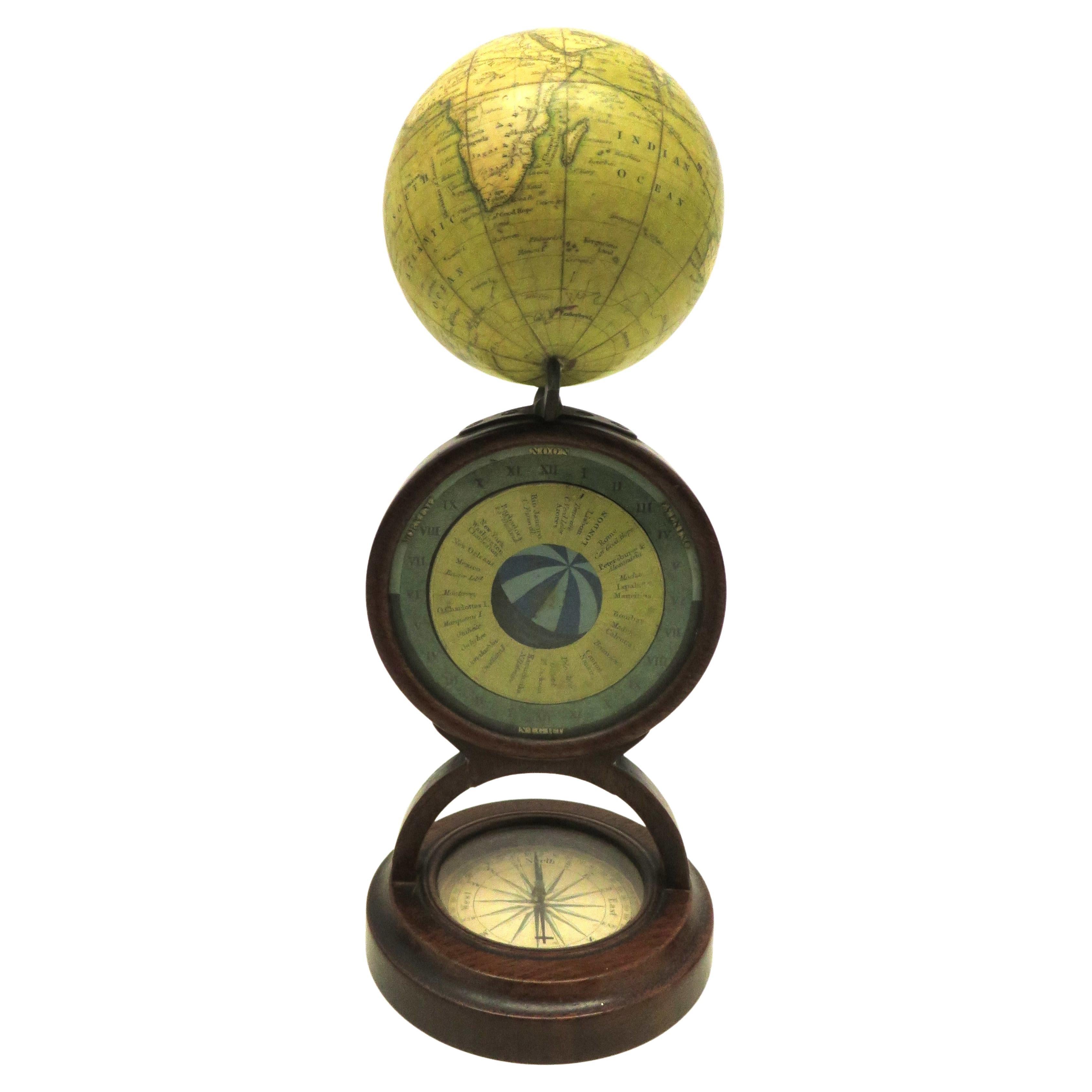
The globe is contained in its original black leather case.
The sphere measures 2.76 in (7 cm) whereas the case measures 3.15 in (8 cm).
State of conservation: almost excellent. The slightly deformed case has a few minor abrasions and some internal signs of use.
The globe is made up of twelve printed paper gores aligned and glued to the sphere. Two pins are inserted on the poles.
In the North Pacific Ocean, above the Tropic of Cancer, the globe bears a cartouche with the inscription:
LANE's
pocket
GLOBE
LONDON
1815
On the terrestrial globe, a large part of Africa is empty, and the Great Lakes Tanganyika and Victoria (which Europeans would begin to explore after 1858) are not marked. Australia bears the old name of New Holland (the new name would be introduced after 1824); Tasmania is already reported as an island (Matthew Flinders circumnavigated it in 1798).
Some of the routes of the voyages of Anson and Cook are traced on the map. The pocket globe was likely created after the death of Captain Cook on February 14, 1779, as his place of death, Kealakekua Bay in the Hawaiian Islands, is marked on the map.
South of New Zealand is marked the antipode point of London.
In the South China Sea and the Indian Ocean, the directions of the monsoons are indicated. The Great Wall of China is also depicted on the map.
The pocket globe was published in 1815 (as inscribed in the cartouche) using the plates-with some updated details-of earlier publishers.
The reconstruction of the story is due to Elly Dekker (Dekker, E., Globes at Greenwich, Oxford 1999, pp. 128-129).
Around 1757 James Ferguson began publishing his own pocket globe, of which few surviving copies are known, in at least six different editions. In that same year Ferguson sold his production workshop to Benjamin Martin. The sale almost certainly did not include the engraved plates used to print his pocket globe, because no specimens published by Martin are known. A few decades later these plates came into the possession of Dudley Adams who published the same globe, updating it and replacing Ferguson's name with his own.
Adams went bankrupt in 1817 and the plates were purchased by Lane's workshop, which again updated the maps and replaced Adams' cartouche with the one we find on our specimen. The fact that our pocket globe is dated 1815 probably proves that Adams had already entered into financial difficulty two or three years before he went bankrupt and thus decided to sell some of the engraved plates from his business.
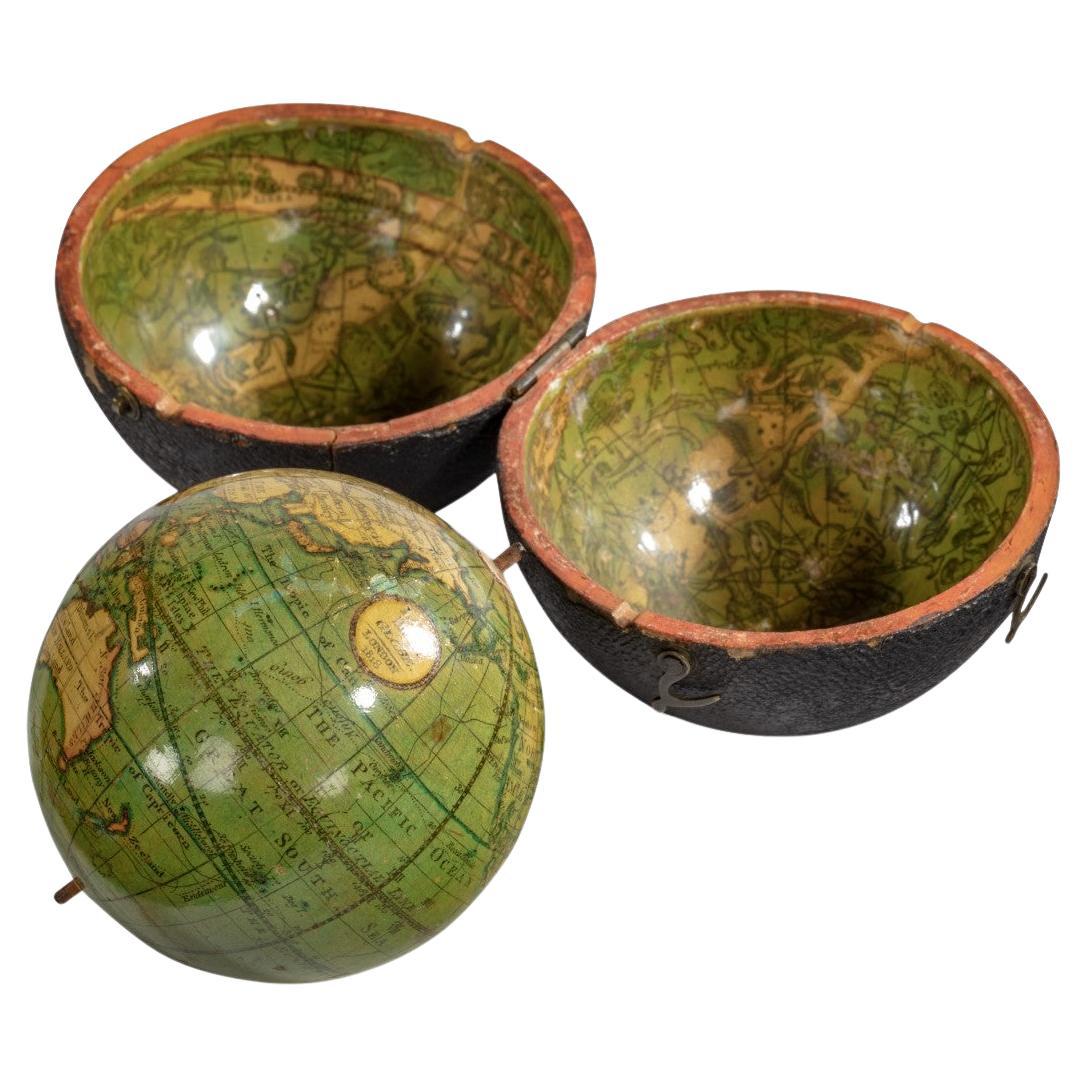
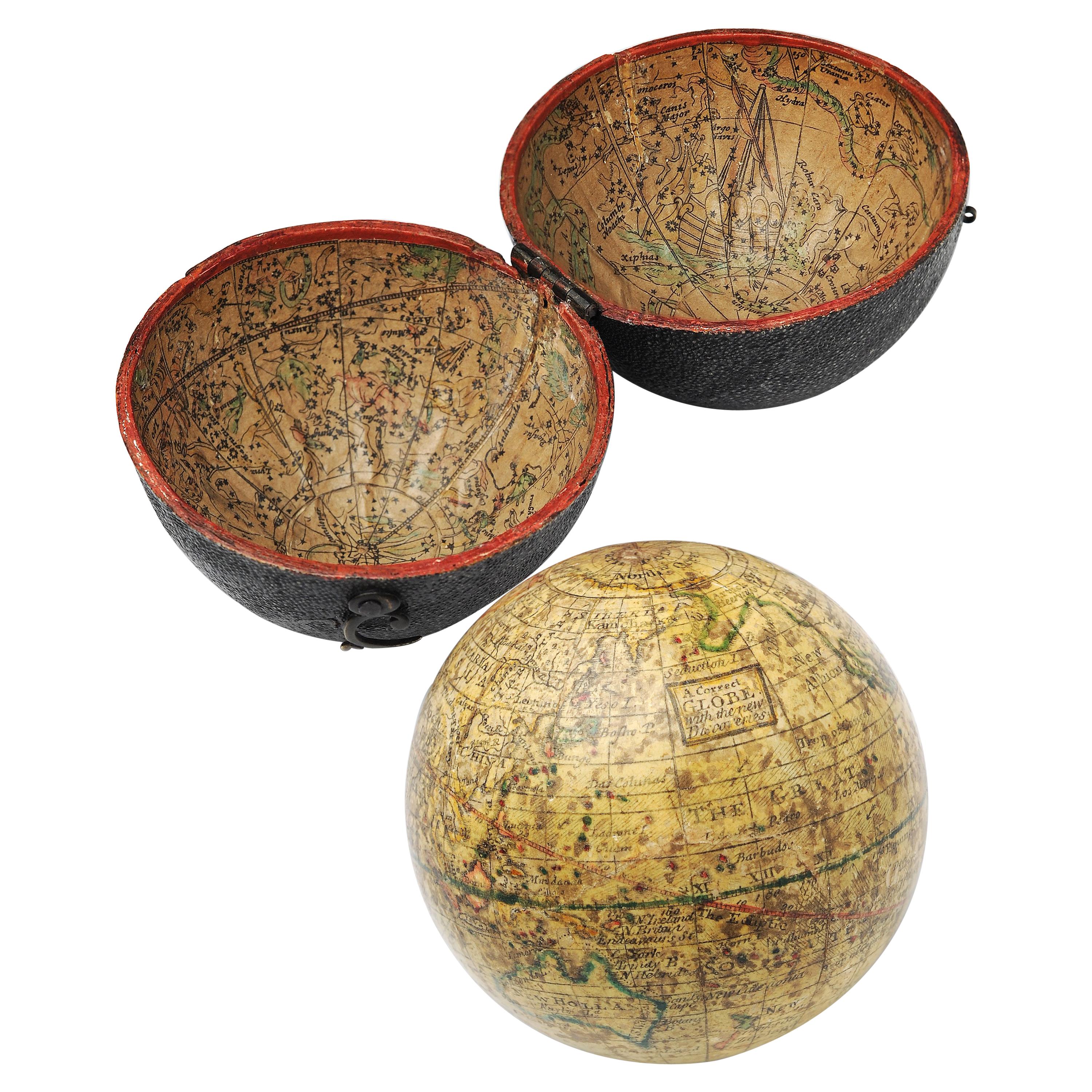
The case consists of two hinged half-spheres covered with black leather; three hooks ensure closure.
Inside the two hemispheres is the celestial vault, on which stars and constellations are indicated in Latin. Many of these are represented by the corresponding mythological figures.
The current state of the research does not allow for the reconstruction of the entire history of the Lane family. They were manufacturers of globes - especially pocket-sized ones - and the founder of the company in the 1770s was almost certainly Nicholas (perhaps a relative of John I, John II or James, all of whom were active in manufacturing scientific instruments for other entrepreneurs, starting from 1733); his son Thomas continued the business until at least the early decades of the nineteenth century. Then it is not clear which family members took over the management of the company. The sources have so far provided the names (George, John), but not the kinship relationships between them; the only certain fact is that the production of Lane-branded globes continued until about the middle of the 19th century.
Bibliography:
P., Van der Krogt, Old Globes in the Netherlands, Utrecht 1984, pp. 180-182;
G., Clifton, Directory of British Scientific Instrument Makers 1550-1851, London 1995, s. v.;
E., Dekker, Globes at Greenwich, Oxford 1999, pp. 393-394.
- Creator:Lane s (Manufacturer)
- Dimensions:Height: 3.15 in (8 cm)Diameter: 3.15 in (8 cm)
- Style:Other (Of the Period)
- Materials and Techniques:
- Place of Origin:
- Period:
- Date of Manufacture:1815
- Condition:Wear consistent with age and use. Almost excellent. The slightly deformed case has a few minor abrasions and some internal signs of use.
- Seller Location:Milano, IT
- Reference Number:1stDibs: LU4352246792032
About the Seller
4.3
Vetted Professional Seller
Every seller passes strict standards for authenticity and reliability
Established in 1860
1stDibs seller since 2018
23 sales on 1stDibs
Typical response time: 3 hours
Associations
International Confederation of Art and Antique Dealers
Associations
- ShippingRetrieving quote...Shipping from: Milano, Italy
- Return Policy
More From This Seller
View AllPocket Globe, Nicholas Lane, London, post 1779
By Nicholas Lane
Located in Milano, IT
Pocket Globe
Nicholas Lane
London, post 1779
The globe is contained in its original case, which is covered in leather.
The sphere measures 2.75 in (6.9 cm) whereas the case measure...
Category
Antique 1780s English Other Models and Miniatures
Materials
Leather, Wood, Paper
English Pocket Globe, London, Circa 1775-1798
By Herman Moll
Located in Milano, IT
Pocket globe
London, between 1775 and 1798
Re-edition of the globe of Hermann Moll (1678-1732) dated 1719
The globe is contained in its original case, which itself is covered in shark skin.
There are slight gaps in the original paint on the sphere. The case no longer closes.
The sphere measures 2.7 in (7 cm) in diameter whereas the case measures 2.9 in (7.4 cm) in diameter.
lb 0.22 (kg 0.1)
The globe is made up of twelve printed paper gores aligned and glued to the sphere.
In the North Pacific Ocean there is a cartouche with the inscription:
A Correct
Globe
with the new
Discoveries.
The celestial globe is depicted on the inside of the box and is divided into two hemispheres with the cartouche:
A correct globe
with ye new cons
relations of Dr.
Halley & c.
It shows the ecliptic divided into the days of the zodiacal calendar and the constellations represented as animals and mythological figures.
On the globe are delineated the equinoctial line, divided by degrees and hours, the ecliptic and the meridian (passing west of Greenwich). The continents are shaded and outlined in pink, green and yellow. It shows: the Cook routes; a wind rose in the Southern Indian Ocean; Antarctica without land; Africa with Negroland (Hermann Moll is considered the first geographer to name the West African region in his 1727 map. (Encyclopaedia Britannica, ed. 1902, under "States of Central Africa"); Tartary in Central Asia; the Mogul kingdom in northern India; in North America only New England, Virginia, Carolina, Florida, Mississippi are identified; California is already a peninsula; the northwest coast of America is "unknown parts" (Alaska is not described and it is only partially delineated, it was to become part of the United States in 1867); Mexico is named "Spain"; Central South America "Amazone America". Australia (which was to be so named after 1829) is called New Holland. The route of Admiral Anson is traced (1740) and the trade winds are indicated by arrows. (See Van der Krogt, P., Old Globes in the Netherlands, Utrecht 1984, p. 146 and Van der Krogt, P. - Dekker, E., Globes from the Western World, London 1993, pp. 115.)
Elly Dekker, comparing Moll’s 1719 globe and his re-edition (of which the one described above is a sample), identifies the differences between them: the two editions are quite similar to each other, but in the "anonymous" globe, compared to the previous globe of 1719, California looks like a proper peninsula - the reports of the Spanish explorers of the region had given rise to uncertainty over whether it was connected to the mainland or not. The geographical nature of California was confirmed after the explorations of Juan Bautista de Anza (1774-1776). The routes of Dampier's journey were partially erased and the route of Captain James Cook's first voyage was superimposed on them, and the geography of Australasia was adapted accordingly, including the denomination of the Cook Strait. See Dekker, Elly, Globes at Greenwich, 1999.
An important ante quem element is represented by Tasmania: it is not separated from Australia by the Bass Strait...
Category
Antique Late 18th Century English George III Globes
Materials
Shagreen, Paper
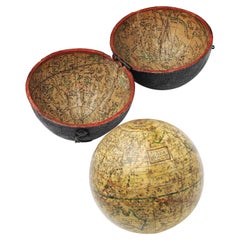
Pocket Globe by Nathaniel Hill, London 1754
Located in Milano, IT
Nathaniel Hill
Pocket globe
London, 1754
The globe is contained in its original case, which itself is covered in shark skin.
There are slight gaps in the original paint on the sphere. The case no longer closes.
The sphere measures 2.6 in (6.8 cm) in diameter whereas the case measures 2.9 in (7.4 cm) in diameter.
lb 0.24 (kg 0.11)
The globe is made up of twelve printed paper gores aligned and glued to the sphere.
In the North Pacific Ocean there is a scroll with the inscription:
A
New
terrestrial
Globe
by
Nath. Hill,
1754.
The celestial globe is depicted on the inside of the box.
On the terrestrial globe much of central and southern Africa is empty. North America bears only the name of some British colonies. It shows California as a peninsula and the northwest coast of America as "unknown parts" (Alaska is not described and is only partially delineated; it would become part of the United States in 1867). The route of Admiral Anson is traced (1740) and the trade winds are indicated by arrows. Australia, still named New Holland (the new name would be introduced in 1829), is part of the west coast. (See Van der Krogt, P., Old Globes in the Netherlands, Utrecht 1984, p. 146 and Van der Krogt, P. - Dekker, E., Globes from the Western World, London 1993, p. 115.)
Nathaniel Hill (London, news from 1746 to 1768) had impeccable professional credentials: he had done his apprenticeship with Richard Cushee, who at the time was carrying out surveying work for John Senex's Surrey map...
Category
Antique 1750s English George II Globes
Materials
Shagreen, Paper
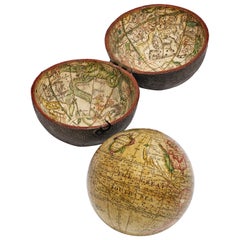
Miniature Terrestrial Globe Newton
Son London, Post 1833, Ante 1858
By Newton and Son
Located in Milano, IT
Miniature Terrestrial Globe
Newton
Son
London, post 1833, ante 1858
Paper, papier-mâché, bronze and wood
It measures: sphere diameter 2.95 in (7.6 cm); diameter of the wooden base 6.02 in (15.3 cm); height 8.36 in (21.24 cm).
Weight: 2,067 lb.
State of conservation: the globe still bears its original paint, but has various small gaps, abrasions and stains on the surface.
The globe is hinged with two pins at the meridian circle, which is in turn inserted perpendicular to the horizon circle; this is supported by four semi-arches connected at the bottom by a small goblet-shaped foot, resting on a wooden bell-shaped base.
Apart from the wooden base, the entire support structure is made of bronze; on the foot there are the scale reproductions of a compass, a telescope and an open book.
The sphere is made of papier-mâché and is covered with twelve printed paper gores.
In the North Pacific Ocean the globe bears a cartouche with the inscription (about 30% of the writing is illegible, but the missing parts can be easily integrated based on the rest):
NEWTON’S
New
Improved
TERRESTRIAL
Globe
Published by Newton
Son
66 Chancery Lane
LONDON
On the globe, much of central Africa is empty and the great lakes Tanganyika and Victoria are not marked (Europeans would begin to explore the area after 1858). Canada is called "British Territory" and Alaska "Russian Territory" (it would become part of the United States in 1867). Australia already bears its modern name (until 1829 it had been called New Holland) and its coasts are completely designed; Tasmania is listed as an island (Matthew Flinders circumnavigated it in 1798). The routes of Cook's various voyages are plotted; both the route followed by Biscoe in 1831 and the "Land of Enderby" which he discovered on the coast of Antarctica, south of Africa, are marked.
Bibliography
P. Van der Krogt, Old Globes...
Category
Antique 1840s English Early Victorian Maps
Materials
Bronze
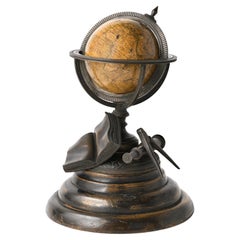
18-inch Globe, Cary
s, London, 1840
By Cary’s
Located in Milano, IT
John and William Cary
Updated by George and John Cary
Terrestrial Globe
London, 1840
lb 22 (kg 10)
Slight surface abrasions due to use. A small crack on the horizon circle.
The globe rests in its original Dutch style stand with four supporting turned wood columns.
It measures 26 in in height x 23.6 in in diameter with the diameter of the sphere measuring 18 in; 66 cm in height x 60 cm in diameter with the diameter of the sphere measuring 45.72 cm.
The 18 inch...
Category
Antique 1840s English Early Victorian Globes
Materials
Paper, Wood
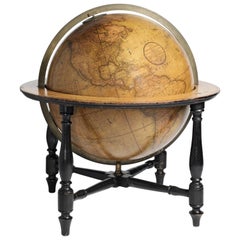
Celestial Table Globe, Charles-François Delamarche, Paris, 1791
By Charles Francois Delamarche
Located in Milano, IT
Celestial table globe
Charles-François Delamarche
Paris, 1791
It measures: 17.13 in in height, Ø max 27.7 in; the sphere Ø 7.09 in
(h 43.5 cm x Ø max 27.7 cm; the sphere Ø 18 cm).
W...
Category
Antique 1790s French Other Scientific Instruments
Materials
Metal
You May Also Like
Regency Lane’s Pocket Globe, Dated 1818
By Lane
s
Located in Lymington, Hampshire
A 3 ½ inch Regency Lane’s pocket globe, dated 1818, the terrestrial globe with the seas in light green and the land masses outlined in darker green, contained within a hinged black shagreen case, the concave interior of the case applied with the engraved celestial charts...
Category
Antique 1810s English Regency Globes
Materials
Wood
Pair of George III 3 inch pocket globes by J
W Cary, one dated 1791
Located in Lymington, Hampshire
The terrestrial globe is applied with 12 engraved and hand-coloured gores and signed in a circular cartouche ‘Cary’s Pocket Globe, Agreeable to the Latest Discoveries. Pubd. by J. & ...
Category
Antique 1790s English Globes
Materials
Shagreen
An English POCKET GLOBE with dial for time zones
By Newton and Son
Located in ZWIJNDRECHT, NL
NEWTON & SON (fl.1840-61)
AN ENGLISH POCKET GLOBE WITH A DIAL FOR TIME ZONES, CIRCA 1835
A previously unrecorded stand for an early-19th-century English globe.
A 3-inch (7.6cm.) di...
Category
Antique 1830s British Other Globes
Materials
Mahogany
Early 20th Century American Library Globe
Located in Norwell, MA
Fine library globe with makers logo from Atlas School Supply Co., Chicago. Hardwood base with rich finish and nice detail. Celestial globe with equ...
Category
Vintage 1920s North American Maps
Materials
Wood
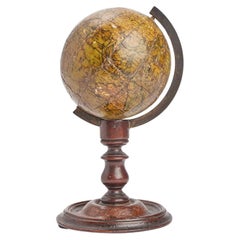
A little terrestral globe by Newton, London 1820.
Located in Milan, IT
Over a round foot that rise with a central element with moved profile is connected the brass half meridian, which holds at the ends the metal axe of the little globe. The base is mad...
Category
Antique Early 19th Century English Globes
Materials
Metal, Brass
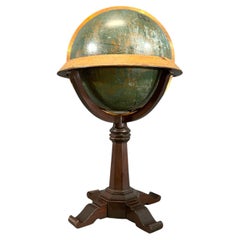
Rare 12 inches terrestrial globe signed Cary, London United Kingdom 1800.
Located in Milan, IT
Large 12" terrestrial globe made by the famous Cary brothers, made with a wooden frame, refined plaster polished to perfection, and colored paper gores. The globe is supported by a f...
Category
Antique Early 19th Century English Scientific Instruments
Materials
Brass