Meiji Models and Miniatures

MEIJI STYLE

From 1868 to 1912, Emperor Mutsuhito oversaw an era of transformation in Japan. Formerly a country of feudalism and isolation, Japan entered an age of modernization influenced by newly established trade and exchange with the West. The Meiji period, or period of “enlightened rule,” also saw the global impact of the East Asian country’s culture. Japanese Meiji furniture was exhibited at expositions from Paris to San Francisco and created for export.

Prior to the Meiji era, furniture was mostly made by commission for the ruling class; now there were new domestic and international markets. European styles like Japonisme appropriated Japanese design while craftsmen in places like Wales and England employed japanning, a varnishing technique that approximated the appearance of lacquer for the surfaces of furnishings.

Meiji furniture made for Japanese homes and buildings constructed in Western styles resulted in taller tables, chairs, cabinets with large drawers and other features. The government invested in areas such as transportation and communication, and because people could freely choose occupations after the restrictions of feudalism, industries of various types were energized by expressive new ideas during those years. Art schools were formed and, for the first time, design was an area of study in the country, leading to the evolution of professional design as a career by the 1890s.

The work of Japanese designers was transmitted widely through lavishly illustrated pattern books that included designs for screens and lacquerware for the home. While screens today may be of use as decorative accents or partitions to ensure privacy in one’s space, Japanese screens were adorned with paintings and were featured in performing arts such as concerts, tea ceremonies and more. The color illustrations that characterize Meiji woodblock prints, a genre of Japanese art that grew out of 17th-century developments in printing and book publishing, depicted the sweeping changes that the era brought to East Asia.

Although it was a time of societal and cultural shifts, a bolstered interest in art and design elevated Japanese craft traditions. From colorful porcelain table lamps with silk shades and hardwood tables decorated with dark lacquer to cabinets featuring iron hardware and inlaid with mother-of-pearl, Meiji furniture showcased Japan’s artistic heritage to the world.

Find a collection of antique Japanese Meiji period case pieces and storage cabinets, decorative objects, wall decorations and more furniture on 1stDibs.

to
1
1
2
164
160
83
58
47
45
24
18
15
15
15
14
13
10
9
7
6
6
2
1
1
1
1
1
2
2
2
2
2
2
Style: Meiji
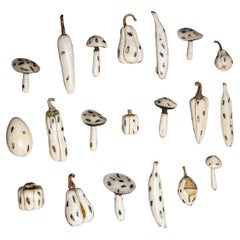
Collection of 23 Shibayama Objects, Japan, Meiji Period, late 19th Century
Located in Greding, DE
Naturalistically crafted objects in the form of mushrooms and fruits, mostly signed. Executed in ivory using the Shibayama-zaiku technique, incorporating coral, mother-of-pearl, gems...
Category

Late 19th Century Japanese Antique Meiji Models and Miniatures

Materials

Coral, Multi-gemstone, Metal

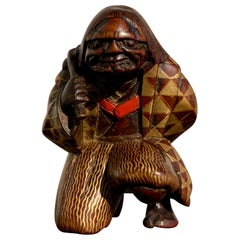
Carved Boxwood and Lacquer Netsuke of a Noh Dancer, Meiji Period, Japan
Located in Austin, TX
A fine lacquer decorated carved boxwood netsuke of a Noh dancer in a Hannya role, unsigned, Meiji period, late 19th century, Japan. The boxwood netsuke finely carved as a kneeling Noh dancer dressed in striking geometric patterned robes. The actor holds an opened war fan behind their back in one hand, a Shinto wand slung over the shoulder in the other. The war fan, tessen, decorated in red lacquer with a golden rising sun at the center. Tessen were sturdy fans used by samurai as protective devices, and sometimes as weapons. The wand, called an onusa, is a traditional Shinto ritual implement comprised of folded paper streamers, shide, attached to a wooden wand, often used in purification rituals. Here, the shide are crafted from silver maki-e, with the handle of the natural boxwood. The actor wears a fierce and unearthly hannya mask...
Category

1890s Japanese Antique Meiji Models and Miniatures

Materials

Boxwood, Lacquer

Related Items
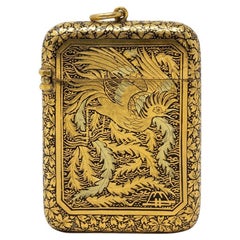
Japanese Antique Meiji Period Vesta Case by Fujii Yoshitoyo
Located in Newark, England
DEPICTING A MYTHICAL HO-O PHOENIX From our Japanese collection, we are delighted to offer this Japanese Vesta Case by Fujii Yoshitoyo. The Vesta Case extensively decorated with gol...
Category

Early 20th Century Japanese Meiji Models and Miniatures

Materials

Gold Plate, Brass

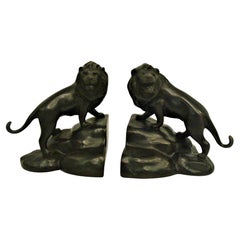
19th Century Pair of Japanese Bronze Lions Bookends, Meiji Period
Located in Buenos Aires, Olivos
This superb and rare pair of Japanese Meiji period bronze bookends are cast in solid bronze and depict a pair of Lions, with their heads raised. These finely sculpted pieces are beau...
Category

Late 19th Century Japanese Antique Meiji Models and Miniatures

Materials

Bronze

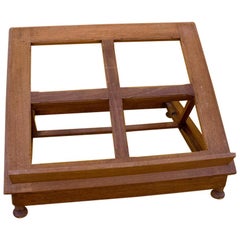
19th Century Lectern Louis-Philippe Period
Located in Beuzevillette, FR
This Louis-Philippe period table lectern in cherrywood resting on four turned legs, has three positions for three different reading angles. France, circa 1840.
Category

1840s French Antique Meiji Models and Miniatures

Materials

Cherry

19th Century Lectern Louis-Philippe Period
$651 Sale Price
20% Off
H 10.24 in W 15.36 in D 13 in
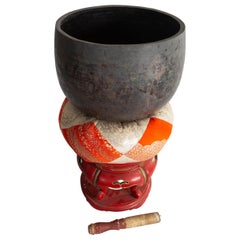
Japanese 19th Century Temple Gong
Located in Hudson, NY
Japanese 19th century temple gong. Temple gongs were originally used to beckon the gods. Comes with bronze bell, silk pillow, red lacquer stand and s...
Category

19th Century Japanese Antique Meiji Models and Miniatures

Materials

Bronze

Japanese 19th Century Temple Gong
$3,800
H 28.5 in Dm 18 in
Fine Example of Aviary Taxidermy, Late 19th Century
Located in London, GB
The group consisting of twenty six exotic species of bird, displaying vivad plumage, enclosed in its original glazed mahogany case. Additional information: Dimension: Height 86 cm, ...
Category

Late 19th Century Antique Meiji Models and Miniatures
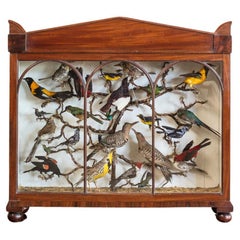
Fine Example of Aviary Taxidermy, Late 19th Century
$6,547
H 33.86 in W 37.01 in D 9.26 in
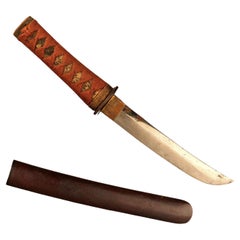
19th Century Edo-Meiji Period Samurai Tantō Knife/Short Blade Sword and Scabbard
Located in North Miami, FL
19th century Edo-Meiji period samurai Tantō knife/short blade sword and scabbard By: unknown Material: iron, metal, paint, steel, leather, wood, lacquer, metal Technique: forged, ha...
Category

19th Century Japanese Antique Meiji Models and Miniatures

Materials

Metal, Copper, Steel, Iron

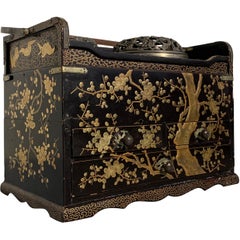
Japanese Lacquer Smoking Box, Tabako Bon, Edo Period, 19th Century
Located in Austin, TX
A very fine Japanese maki-e lacquer decorated tabako bon, or smoking box, late Edo Period, mid-19th century, Japan. The elegant smoking box of black lacquer decorated with a wonderful gold lacquer takamaki-e design of a gnarled and elegantly twisted plum tree with branches in full bloom. A border of golden cranes in flight to the top. The smoking box, called a tabako bon, is comprised of an open section at the top with inset with two cylindrical metal canisters...
Category

Mid-19th Century Japanese Antique Meiji Models and Miniatures

Materials

Lacquer

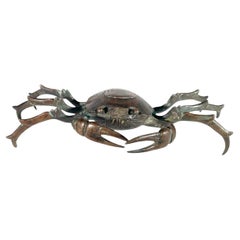
Large Japanese Meiji Period Bronze Crab (B) Okimono
Located in Chapel Hill, NC
Large Japanese naturalistically modeled bronze okimono in the form of a crab. One of 5 designated by the (B) in the title.
Category

Late 19th Century Japanese Antique Meiji Models and Miniatures

Materials

Bronze

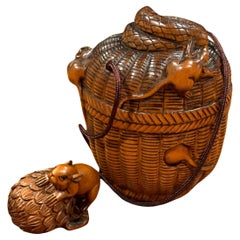
Japanese Boxwood Inro Netsuke of Rats and Snakes in Basket
Located in San Diego, CA
A really nice vintage Japanese boxwood inro and netsuke of rats and snakes on a round basket, circa early 1940s. The piece is well carved with wonderful detail and in very good vint...
Category

Early 20th Century Japanese Meiji Models and Miniatures

Materials

Boxwood

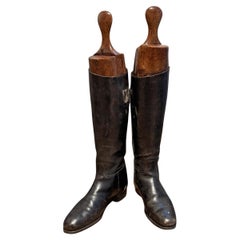
Pair of Late 19th Century English Riding Boots
Located in Chicago, IL
This striking pair of late 19th-century English black leather riding boots is a handsome relic of the sporting life. Crafted with exceptional care, the boots retain their original fo...
Category

Late 19th Century English Antique Meiji Models and Miniatures

Materials

Leather, Wood

Pair of Late 19th Century English Riding Boots
$1,800 / set
H 24.5 in W 11.5 in D 3.5 in
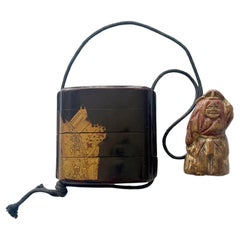
Japanese Lacquer Inro with Gold Maki-e and Carved Wood Netsuke Meiji Period
Located in Atlanta, GA
A Japanese four-case inro with a stringed carved wood netsuke circa 19th century. The inro has a near square form with rounded corners, The surface is decorated with gold hiramaki-e ...
Category

19th Century Japanese Antique Meiji Models and Miniatures

Materials

Wood, Lacquer

Collection of Three Antique Scottish Carpet Rug Balls, Late 19th Century
Located in Haddonfield, NJ
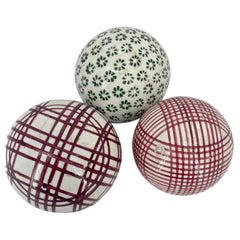
Set of three scottish stoneware carpet rug balls. Carpet balls in reds and green. A storied game dating back Centuries, Carpet Ball is similar to Bocci Ba...
Category

Late 19th Century Scottish Antique Meiji Models and Miniatures

Materials

Stoneware

Previously Available Items
Japanese Silver Karabitsu Bonbonniere Box, Taisho Period, Japan
Located in Austin, TX
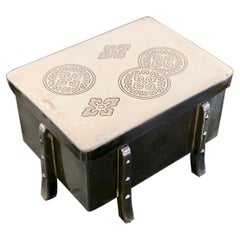
A fine Japanese silver bonbonniere box in the shape of a karabitsu, Meiji Period, circa 1900, Japan. The small bonbonniere crafted of silver in the form of a karabitsu, a storage ...
Category

1920s Japanese Vintage Meiji Models and Miniatures

Materials

Silver, Sterling Silver

Boxwood and Lacquer Netsuke of Hotei by Shunsho, Meiji period, circa 1900, Japan
Located in Austin, TX
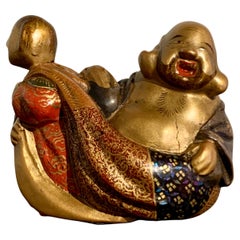
A charming and finely decorated carved and lacquered boxwood netsuke of Hotei by Shunsho (probably Shunsho XI, Masaoki), Meiji period, circa 1900, Japan. This delightful and colorful netsuke features the beloved figure Hotei, one of the Seven Lucky Gods. The god of fortune and happiness is seated upon his treasure bag, and being dragged by a smiling child. Carved from boxwood and decorated in bright lacquers of gold, silver, red, black and green. Hotei's chest and ample stomach mostly exposed, his skin covered in gold lacquer. Large elephantine ears frame his bearded face. His red-lipped mouth open in an uproarious laugh. Hotei's treasure bag formed as a patchwork of various brocades in gold, red, and black lacquer. The black lacquer further decorated in the lac burgaute...
Category

Early 1900s Japanese Antique Meiji Models and Miniatures

Materials

Boxwood, Lacquer

Early 20th Century Japanese Bamboo Basket Netsuke
Located in Chicago, IL
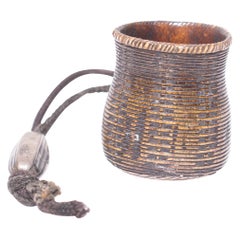
In 17th century Japan, kimono-clad men compensated for the garment’s lack of pockets by wearing small pouches secured by button-like fasteners known as netsuke. Although these tiny, ...
Category

Early 20th Century Japanese Meiji Models and Miniatures

Materials

Horn

Meiji models and miniatures for sale on 1stDibs.

Find a broad range of unique Meiji models and miniatures for sale on 1stDibs. Many of these items were first offered in the Early 20th Century, but contemporary artisans have continued to produce works inspired by this style. If you’re looking to add vintage models and miniatures created in this style to your space, the works available on 1stDibs include asian art and furniture, more furniture and collectibles and other home furnishings, frequently crafted with boxwood, hardwood and other materials. If you’re shopping for used Meiji models and miniatures made in a specific country, there are Asia, East Asia, and Japan pieces for sale on 1stDibs. It’s true that these talented designers have at times inspired knockoffs, but our experienced specialists have partnered with only top vetted sellers to offer authentic pieces that come with a buyer protection guarantee. Prices for models and miniatures differ depending upon multiple factors, including designer, materials, construction methods, condition and provenance. On 1stDibs, the price for these items starts at $1,500 and tops out at $2,200 while the average work can sell for $1,850.

Still Thinking About These?

All Recently Viewed