1 of 11
Chicago World
s Fair Skyscraper Radio with Bluetooth Speaker
Price:$1,850
$2,500List Price
About the Item
- Dimensions:Height: 17 in (43.18 cm)Width: 18 in (45.72 cm)Depth: 14 in (35.56 cm)
- Style:Art Deco (Of the Period)
- Materials and Techniques:
- Place of Origin:
- Period:
- Date of Manufacture:1933
- Condition:Minor losses.
- Seller Location:Oakland, CA
- Reference Number:Seller: 26581stDibs: LU871414778191
Authenticity Guarantee
In the unlikely event there’s an issue with an item’s authenticity, contact us within 1 year for a full refund. DetailsMoney-Back Guarantee
If your item is not as described, is damaged in transit, or does not arrive, contact us within 7 days for a full refund. Details24-Hour Cancellation
You have a 24-hour grace period in which to reconsider your purchase, with no questions asked.Vetted Professional Sellers
Our world-class sellers must adhere to strict standards for service and quality, maintaining the integrity of our listings.Price-Match Guarantee
If you find that a seller listed the same item for a lower price elsewhere, we’ll match it.Trusted Global Delivery
Our best-in-class carrier network provides specialized shipping options worldwide, including custom delivery.You May Also Like
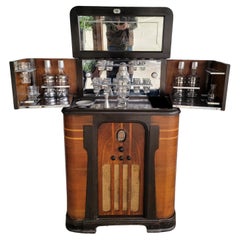
Philco Radio Bar
By Radiobar Corp. and Philco
Located in Fulton, CA
Art Deco Philco Radiobar dry bar and Am radio. Circa. late 1930's. Original, unrestored condition. Original finish and original radio chassis. Partial ...
Category
Vintage 1930s American Art Deco Dry Bars
Materials
Chrome
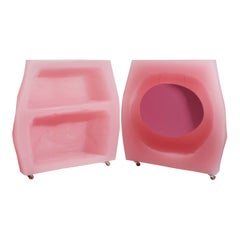
The Holy Mountain bar cabinet with sound speaker by Objects of Common Interest
By Objects of Common Interest
Located in Milano, Lombardia
The Holy Mountain emerges as an enigmatic monolith, its faceted pink resin surface evoking the raw geometry of an otherworldly rock formation. At first glance, it appears as a singul...
Category
2010s Greek Dry Bars
Materials
Resin
$42,470
H 35.44 in W 39.38 in D 27.56 in
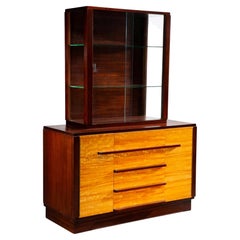
Art Deco Signed Wolfgang Hoffmann for Romweber World
s Fair Display Cabinet
By Wolfgang Hoffmann, Romweber Furniture Co.
Located in Forney, TX
A rare and important Art Deco period Century of Progress Display Cabinet designed by Wolfgang Hoffmann (Austrian, 1900-1969) for Romweber Company, Batesville, Indiana, United States of America. circa 1933-1936
Created for the 1933 Chicago World's Fair, one piece design, having a rectangular showcase top with glass panel sides and a pair of sliding glass doors, over solid wood chest fitted with four drawers affixed with horizontal pulls, flanked by cabinet doors, opening to shelved interior. Rosewood, mahogany, richly figured blonde - golden birch or primavera, and glass.
Signed, original label to drawer interior, featuring 1933 World's Fair mark impressed.
**Please note, at the time of writing this, a matching sideboard - buffet (shown in last photo) is currently available separately**
Provenance / Acquisition:
Property from the important and iconic collection of Mr. James I. Rafftesaeth Jr., Dallas, Texas
Acquired from highly reputable auction house, Heritage Auctions, Dallas, Texas. 2022 Design Signature Auction catalog #8091
History:
Wolfgang Hoffmann was born in Vienna, Austria in 1900. He is the son of famous architect, pedagogue and Wiener Werkstatte cofounder, Joseph Hoffmann (1870-1956). Early on, following his father’s s interests, he was trained in the decorative arts and design. Wolfgang Hoffmann once reminisced, “I spent eight years at the Realschule, then three years went to a special architectural school, where I perfected my technical knowledge of architecture and general construction. From this school, I was graduated to the Kunstgewerbeschule [Studying under Oskar Strnad and Josef Frank in Vienna]. After finishing this school, I had one and a half years of practical in a well known architect’s office. Thereafter I worked in my Father’s office for two years”.
Hoffmann met his future wife, Polish immigrant Pola (1902-1984) when they were both studying at the Kunstgewerbeschule. Joseph Urban (1872-1933) was needing an assistant for his architectural business in New York and contacted his friend and colleague, Joseph Hoffmann in Vienna. Hoffmann recommended his son Wolfgang. Urban hired him and sent a first class passage ticket to Vienna for Wolfgang to travel to New York. Wolfgang married Pola and traded his ticket for two tickets to America in steerage, arriving in New York City in December of 1925.
Leaving the Urban office after nine months, Wolfgang and Pola formed an independent design practice with offices on Madison Avenue in Manhattan with the purpose of creating contemporary interiors and industrial designs. Early work included theaters, stores, and apartments mostly in New York City.
During the late 1920’s and early 1930’s the Hoffmanns designed custom furniture for private clients. Some of these examples were shown in the February 1929 issue of House and Garden. Curiously, the examples’ design was attributed to Urban and the production to Pola Hoffmann, Inc.
Established in the fall of 1928, the American Designers’ Gallery was “devoted exclusively to showing objects and interiors for practical use… by fourteen American architects and designers”. Its members included the Hoffmans and Urban as well as ceramist Henry Varnum Poor (1888-1971), architect Raymond Hood (1881-1934), artist designer Winold Reiss (1886-1953), graphic designer Lucien Bernhard (1896-1981), decorator Donald Deskey (1894-1989), and architect Ely Jacques Kahn (1884-1972).
The Hoffmanns’ work was included in the American Designers’ Gallery’s two showcase events, its 1928 and 1929 exhibitions. Their dining alcove at the 1929 event featured a bench with a dinette table and two chairs in American walnut designed by Wolfgang and a rug by Pola.
Lucien Bernhard, fellow Austrian immigrant who settled in New York a year before the Hoffmanns, operated the gallery and decorating service Contempora with Munich resident Bruno Paul (1874-1968). The Hoffmanns, occasionally participating with Contempora, designed a number of outstanding interiors, including the constructivist living room of 1930 for Mrs. O.R. Sommerich at 40 East 66th street. In 1934, Donald Deskey commissioned Wolfgang to design birchwood furnishings for the eclectic apartment at 625 Park Avenue belonging to Helena Rubinstein.
In 1931, Wolfgang exhibited his work at the Pennsylvania Art Museum and the Museum of Modern Art in New York City. The same year, with Kem Weber (1889-1963) he organized the second and final exhibition of AUDAC- “Modern Industrial and Decorative Arts”- at the Brooklyn Museum. At this event, the Hoffmanns showed the dining room previously included in the American Designer’s Gallery’s 1929 exhibition in the Chase Bank Building lobby at 145 West 57th Street in Manhattan.
In 1932 Wolfgang was asked to assist Urban in developing the color scheme for the 1933-34 Chicago World’s Fair “A Century of Progress”. He was also commissioned to design the interior and furniture for the fair’s lumber industries house. There he executed its living and dining rooms furnished by Kroehler Manufacturing Company of Chicago; the boys’ room by Shower Brothers...
Category
Early 20th Century American Art Deco Vitrines
Materials
Glass, Mahogany, Rosewood
$9,500
H 66.75 in W 47.5 in D 19.5 in
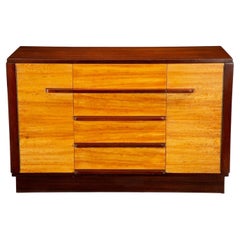
Art Deco Wolfgang Hoffmann Romweber World
s Fair Century of Progress Sideboard
By Romweber Furniture Co., Wolfgang Hoffmann
Located in Forney, TX
A rare and important American Art Deco Century of Progress Sideboard by iconic designer Wolfgang Hoffmann (Austrian, 1900-1969) for Romweber Company, Batesville, Indiana. circa 1933-1936
Created for the 1933 Chicago World's Fair, fine quality craftsmanship and construction, having a rectangular exotic rosewood veneered top over conforming solid wood case fitted with four drawers affixed with horizontal pulls, the top drawer opening to reveal felt lined divided interior for silverware, flanked by cabinet doors opening to shelved interior, subtle geometric lines add interest. Rosewood, mahogany, richly figured blonde - golden birch or primavera.
Signed, top drawer interior, featuring 1933 World's Fair mark impressed.
**Please note, at the time of writing this, a matching display case - vitrine cabinet (shown in last photo) is currently available separately**
Provenance / Acquisition:
Property from the important and iconic Collection of Mr. James I. Rafftesaeth Jr., Dallas, Texas
Acquired from highly reputable auction house, Heritage Auctions, Dallas, Texas. 2022 Design Signature Auction catalog #8091
History:
Wolfgang Hoffmann was born in Vienna, Austria in 1900. He is the son of famous architect, pedagogue and Wiener Werkstatte cofounder, Joseph Hoffmann (1870-1956). Early on, following his father’s s interests, he was trained in the decorative arts and design. Wolfgang Hoffmann once reminisced, “I spent eight years at the Realschule, then three years went to a special architectural school, where I perfected my technical knowledge of architecture and general construction. From this school, I was graduated to the Kunstgewerbeschule [Studying under Oskar Strnad and Josef Frank in Vienna]. After finishing this school, I had one and a half years of practical in a well known architect’s office. Thereafter I worked in my Father’s office for two years”.
Hoffmann met his future wife, Polish immigrant Pola (1902-1984) when they were both studying at the Kunstgewerbeschule. Joseph Urban (1872-1933) was needing an assistant for his architectural business in New York and contacted his friend and colleague, Joseph Hoffmann in Vienna. Hoffmann recommended his son Wolfgang. Urban hired him and sent a first class passage ticket to Vienna for Wolfgang to travel to New York. Wolfgang married Pola and traded his ticket for two tickets to America in steerage, arriving in New York City in December of 1925.
Leaving the Urban office after nine months, Wolfgang and Pola formed an independent design practice with offices on Madison Avenue in Manhattan with the purpose of creating contemporary interiors and industrial designs. Early work included theaters, stores, and apartments mostly in New York City.
During the late 1920’s and early 1930’s the Hoffmanns designed custom furniture for private clients. Some of these examples were shown in the February 1929 issue of House and Garden. Curiously, the examples’ design was attributed to Urban and the production to Pola Hoffmann, Inc.
Established in the fall of 1928, the American Designers’ Gallery was “devoted exclusively to showing objects and interiors for practical use… by fourteen American architects and designers”. Its members included the Hoffmans and Urban as well as ceramist Henry Varnum Poor (1888-1971), architect Raymond Hood (1881-1934), artist designer Winold Reiss (1886-1953), graphic designer Lucien Bernhard (1896-1981), decorator Donald Deskey (1894-1989), and architect Ely Jacques Kahn (1884-1972).
The Hoffmanns’ work was included in the American Designers’ Gallery’s two showcase events, its 1928 and 1929 exhibitions. Their dining alcove at the 1929 event featured a bench with a dinette table and two chairs in American walnut designed by Wolfgang and a rug by Pola.
Lucien Bernhard, fellow Austrian immigrant who settled in New York a year before the Hoffmanns, operated the gallery and decorating service Contempora with Munich resident Bruno Paul (1874-1968). The Hoffmanns, occasionally participating with Contempora, designed a number of outstanding interiors, including the constructivist living room of 1930 for Mrs. O.R. Sommerich at 40 East 66th street. In 1934, Donald Deskey commissioned Wolfgang to design birchwood furnishings for the eclectic apartment at 625 Park Avenue belonging to Helena Rubinstein.
In 1931, Wolfgang exhibited his work at the Pennsylvania Art Museum and the Museum of Modern Art in New York City. The same year, with Kem Weber (1889-1963) he organized the second and final exhibition of AUDAC- “Modern Industrial and Decorative Arts”- at the Brooklyn Museum. At this event, the Hoffmanns showed the dining room previously included in the American Designer’s Gallery’s 1929 exhibition in the Chase Bank Building lobby at 145 West 57th Street in Manhattan.
In 1932 Wolfgang was asked to assist Urban in developing the color scheme for the 1933-34 Chicago World’s Fair “A Century of Progress”. He was also commissioned to design the interior and furniture for the fair’s lumber industries house. There he executed its living and dining rooms furnished by Kroehler Manufacturing Company of Chicago; the boys’ room by Shower Brothers...
Category
Early 20th Century American Art Deco Sideboards
Materials
Birch, Mahogany, Rosewood
$9,500
H 30 in W 49 in D 20 in
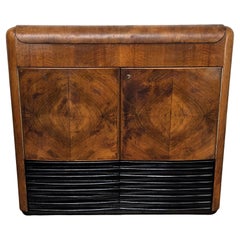
50s Art Deco Italian Radio Vynil Disc Walnut Burl Mirror Mosaic Dry Bar Cabinet
By Ico
Luisa Parisi, Guglielmo Ulrich, Paolo Buffa, Gio Ponti, Vittorio Dassi
Located in Carimate, Como
Very elegant Italian Art Deco Mid-Century Modern dry bar cabinet, in beautiful veneer walnut briar burl wood. On the top part we find the radio and the vynil record player while on t...
Category
Mid-20th Century Italian Art Deco Dry Bars
Materials
Brass
$2,471 Sale Price
20% Off
H 35.83 in W 39.38 in D 17.72 in
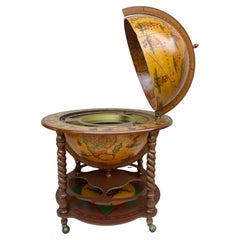
Vintage Italian World Globe Dry Bar, 1960s
Located in Miami, FL
This vintage 1960s Italian dry bar is perfect for adding a touch of classic European flair to your home. The globe design is made of wood, giving it an authentic and timeless look. T...
Category
Mid-20th Century Spanish Mid-Century Modern Dry Bars
Materials
Wood
1970
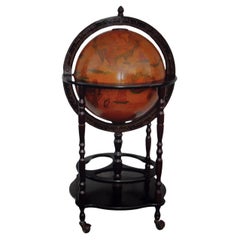
s Mid Century Modern World Globe Dry Bar
Located in Opa Locka, FL
1970's Mid Century Modern World Globe Dry Bar. Top of globe opens to reveal interior storage. Beautifully carved wood base. Please look at pictures ...
Category
Vintage 1970s American Mid-Century Modern Dry Bars
Materials
Wood
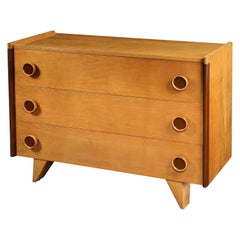
Gilbert Rohde Dresser 4041 Kroehler New York World
s Fair 1940 Two-Tone 44" long
Located in BUNGAY, SUFFOLK
Designer : Gilbert Rohde
Model ; Dresser 4041 Honeymoon Furniture for Young America,
Maker : Kroehler
Exhibited : 'America at Home' at the New York World's Fair 1940.
Created by Gilbert Rohde, 1940's foremost furniture designer, expressly to demonstrate modern living displayed in the 'America at Home' building at the New York World's Fair 1940.
Honeymoon furniture by Kroehler is outstanding in contemporary furniture design.
Notice its space saving compactness, its sturdiness, its freedom from dirt catching corners.
Honeymoon furniture offers comfort, convenience and economy never before possible in the small home or apartment
The use of two different coloured woods to create a two-tone effect is very striking and complements the simple form. This unusual chest of drawers is a signature piece that injects character into any interior.
The raised sides sit proud of the top elevating the chest creating an elegant tray effect. The front is fitted with three drawers with original wooden knobs in contrasting dark brown laurel. The sides have a projecting section of contrasting dark brown laurel at the front which defines the form. Inverted triangular feet. "Kroehler Made" metal tag. Designer unknown.
Kroehler
In 1902, Peter E. Kroehler bought the Naper ville Lounge Co., a maker of wooden lounge chairs and upholstered furniture. Kroehler built a new factory in Naperville in 1913 after the original facility was destroyed by a tornado. Soon thereafter, he renamed the company Kroehler Manufacturing Co. This enterprise soon operated across the country and employed several hundred men and women in the Chicago area. By the middle of the 1940s, with over $20 million in annual sales, Kroehler was the second-largest furniture maker in the United States. During the 1960s, when the company employed close to 8,000 people around the country, annual revenues passed $100 million. The company struggled during the 1970s, closing its historic Naperville factory in 1978 and ending its operations in the area. In 1981 Kroehler was acquired by the ATR Group of Northbrook, which put the company up for sale. By the early 2000s, furniture was still manufactured under the Kroehler name by two unrelated companies, one in North Carolina and the other in Ontario, Canada.
Gilbert Rhode : American, 1894 - 1944
Gilbert Rohde (1894-1944) is best known for helping to create the modern design at Herman Miller Inc. Gilbert Rohde furniture design was focused on mass production and bringing modern products to the greatest number of consumers. He is also credited with designing the first examples of biomorphic furniture in America-which would ultimately shape mid century modernism.
US industrial designer, born in New York. He became familiar with cabinetmaking in his father's shop. He studied at the Art Students League and Grand Central School of Art in New York. Early work was as a drama and music critic, cartooninst, reporter, and furniture illustrator. He traveled to France and Germany in 1927 and was inspired by modernism.
He opened his own office in New York in 1927, designing furniture and showrooms, and consulting with manufacturers like General Electric and Hudson Motor Car Company.
In 1931 HeywoodWakefield Company introduced a compact armless leatherette side chair with bentwood rear legs designed by Rohde, which sold 250,000 over the next eight years. Rohde also developed a later version for the Herman Miller Furniture Company, which was sold dis-assembled and made by what Rohde called an "automobile type of assembly."
By 1929 he had established a relationship with D.J. Depree, president of the Herman Miller Furniture Company in Zeeland, MI and prepared some designs for him. Dupree appointed him director of design there in 1932 as part of his decision to shift the company’s orientation from traditional to modern design. His first modern design for the company, a No. 2185 Group bedroom suite was shown at the Chicago Century of Progress.
Also in 1932, Rohde exhibited his furniture designs in a "Design for Machine" exhibit in Philadelphia, along with designs of Russel Wright. The Herman Miller Clock...
Category
Vintage 1950s North American Mid-Century Modern Commodes and Chests of D...
Materials
Birdseye Maple
$5,438
H 32.49 in W 43.9 in D 18.9 in
Art Deco Style Cabinet in Oak with Bronze
By Loyzaga
Located in Mexico, Ciudad de México
Cabinet made in mahogany and oak woods. The legs and handles are done in bronze, with its dark wood finish, creating the most elegant combination.
It ´s named the Collector ´s Cabine...
Category
2010s Mexican Art Deco Cabinets
Materials
Bronze
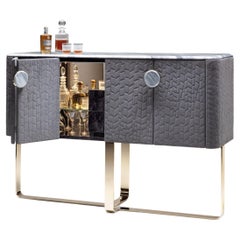
Giorgio Collection Bar Upholstered with Marble Top
By Giorgio Collection
Located in New York, NY
Bar for living room in quilted grey nubuk color nr 6. 2 double sliding doors with 2 big handles in combination of beveled marble and light gold chrome stainless steel. Top in beveled...
Category
2010s Italian Art Deco Dry Bars
Materials
Marble, Gold Plate, Stainless Steel
Still Thinking About These?
All Recently ViewedMore Ways To Browse
Vintage Wood Speakers
Art Deco Radio Bar
Chicago Cabinet
Vintage World Radio
Art Deco Wood Radio
Vintage Record Player Cabinet With Radio
Skyscraper Clock
Art Deco Speakers
Speaker Fabric Vintage
Bluetooth Radio
Worlds Fair Clock
Antique and Vintage Pianos
Antique Instrument Box
Antique Brass Musical Instruments Brass
Collectable Vintage Radios
Vintage Audio
Antique Bells Collectibles
Radio Bar