Porcelain Musical Instruments
to
5
5
1
2
3
1
1
27,413
358
331
121
62
4
2
1
1
5
5
5
2
1
Material: Porcelain
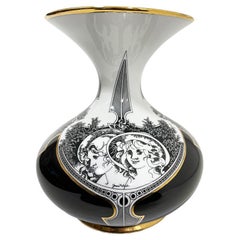
László Jurcsák for Hollohaza Large Porcelain Vase
Located in Delft, NL
László Jurcsák for hollohaza large porcelain vase, Hungary 1982-1992
A Hungarian porcelain vase of 24 cm high. White porcelain with black pain...
Category
20th Century Hungarian Porcelain Musical Instruments
Materials
Porcelain
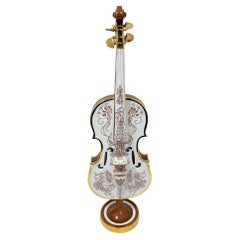
Endre László Szász for Hollohaza Porcelain Violin
By Endre Szasz
Located in Delft, NL
Endre László Szász for hollohaza porcelain violin, Hungary 1979-1980.
A Hungarian porcelain violin on a round stand with a brown painted scene o...
Category
20th Century Hungarian Porcelain Musical Instruments
Materials
Porcelain
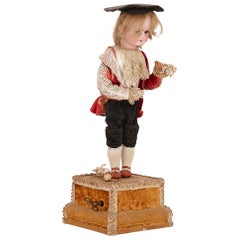
Unusual Continental Bisque Porcelain Automaton Figure
Located in London, GB
Unusual bisque porcelain automaton figure
Continental, circa 1900
Measures: Height 57cm, width 21cm, depth 21cm
This unusual doll takes the form ...
Category
Early 1900s European Antique Porcelain Musical Instruments
Materials
Porcelain, Fabric
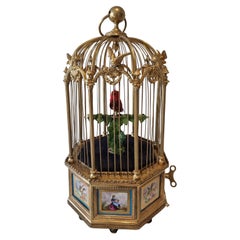
A stunning Hexagonal shaped, gilt bronze and Sevres Singing Cage by Bontems
Located in London, GB
A stunning and very fine Hexagonal gilt bronze and Sevres plaque single singing bird-in-cage, by Bontems,
Going-barrel movement,
When wound with the key and start/stop lever actuated, the large and perfectly perched red thrush begins to sing his chorus, moving naturalistic beak, tailfeather and head from side-to-side to continuous birdsong.
One of the most sought after and most looked forward to models ever made by Bontems, this example is offered in pristine original condition. Hexagonal shaped, which is one of the rarer models you'll be lucky to come across, with 8 seperate porcelain plaques depicting lovers alternating with song birds within tooled gilt and bleu céleste borders
Gilt bronze singing bird cages, usually with stained glass, or fine porcelain panel inserts, were made in limited numbers during the 19th century to commission orders. The first maker to offer a bird cage to this design was Jacquet Droz in about 1798 with his large singing bird in cage, fusee-driven with a clock to the underside so when hung up, its use was three-dimensional.
Bontems created this with the past in mind and was no doubt the only maker...
Category
1880s Antique Porcelain Musical Instruments
Materials
Bronze
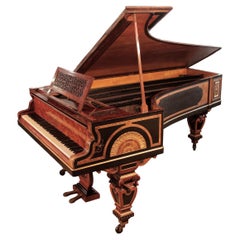
Erard Grand Piano Egyptian Revival Neoclassical Style by William Lomax Walnut
Located in Leeds, GB
An 1861, Erard grand piano with an ornate burr walnut, black and gilt cabinet. Piano casework features Egyptian Revival and Neoclassical elements. Th...
Category
Mid-19th Century English Neoclassical Antique Porcelain Musical Instruments
Materials
Ivory, Porcelain, Giltwood, Walnut
Related Items
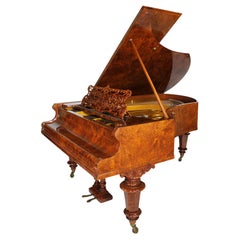
A German 19th Century Louis XVI Style Burr Walnut Bechstein Concert Grand Piano
By Bechstein Piano Company
Located in Los Angeles, CA
A Very Fine German 19th Century Louis XVI Style Burr Walnut Bechstein Concert Grand Piano, Serial No. 5655. The beautifully crafted Grand piano, raised on three tapered barrel shaped legs, with an intricately carved ornate music desk and original keys. Circa: 1872.
Length: 80 inches (203.2 cm)
Width: 59 inches: (149.9 cm)
Height (top closed): 38 5/8 inches (98.1 cm)
C. Bechstein Pianofortefabrik
C. Bechstein Pianofortefabrik AG (also known as Bechstein) is a German manufacturer of pianos, established in 1853 by Carl Bechstein.
Before Bechstein
Young Carl Bechstein studied and worked in France and England as a piano craftsman, before he became an independent piano maker. His first pianos were made for other companies.
C. Bechstein
C. Bechstein piano factory was founded on 1 October 1853 by Carl Bechstein in Berlin, Germany.
Carl Bechstein set out to manufacture a piano able to withstand the great demands imposed on the instrument by the virtuosi of the time, such as Franz Liszt. In 1857, Hans von Bülow (Liszt's son-in-law) gave the first public performance on a Bechstein grand piano by performing Liszt's Piano Sonata in B minor in Berlin
By 1870, with endorsements from Franz Liszt and Hans von Bülow, Bechstein pianos had become a staple in many concert halls and private mansions. By that time three piano makers, all of which were founded in 1853, became established as the industry leaders across the world: Bechstein, Blüthner and Steinway & Sons.
In 1881 Bechstein began supplying pianos to Queen Victoria. A gilded art-case piano was delivered to Buckingham Palace, followed by several more Bechstein pianos to Windsor Castle and other royal residences. By January 1886 they were among the piano manufacturers holding a Royal Warrant as a supplier to the Queen. Several British embassies across the world acquired Bechstein pianos.
In 1885, Bechstein opened a branch in London, that eventually grew to become the largest showroom and dealership in Europe. By 1890 showrooms had been opened in Paris, Vienna, and Saint Petersburg. On 31 May 1901, Bechstein Hall, built at a cost of £100,000, was opened next to the company's London showroom at 36-40 Wigmore Street. Between 1901 and 1914, C. Bechstein was the largest piano dealership in London. At that time, Bechstein was patronized by the tsars of Russia, the royal families of Spain, Belgium, the Netherlands, Italy, Sweden, Norway, Austria and Denmark, and other royalty and aristocracy. The list of royal clients of Bechstein may be found on the soundboard of vintage Bechstein pianos made before the Second World War. The list is part of the original Bechstein trademark logo; it can be seen under the strings in the center of a piano's soundboard.
The signature of Carl Bechstein
The years from the 1870s through 1914 brought Bechstein their most dramatic increase in sales. In 1880 a second Bechstein factory was opened in Berlin, and the third factory was opened in 1897 in Berlin-Kreuzberg. Production reached 3,700 pianos annually in 1900, and 4,600 in 1910, making Bechstein the largest German manufacturer of high-end pianos. At that time, about three quarters of production went to international markets, especially Britain and the Commonwealth, and Russia.
Carl Bechstein died in 1900, and the Bechstein company continued to operate under the management of his sons.
Between 1900 and 1914 C. Bechstein was one of the leading piano makers in the world, employing 1,200 craftsmen and workers by 1913 and making five thousand pianos per year.
First World War
C. Bechstein suffered huge property losses in London, Paris, and St. Petersburg during World War I. The largest loss was in London. Although the company's position in the United Kingdom was initially unaffected, with the company still listed as holding a Royal Warrant in January 1915, Warrants to both King George V, and his wife Queen Mary were cancelled on 13 April 1915. Bechstein was not the only musical concern to be affected by growing anti-German sentiment: there were earlier attempts, led by William Boosey, to boycott German music altogether. In 1915, despite being a Baronet and Privy Counsellor, Sir Edgar Speyer, who was then funding the Proms, was forced to leave the country. Following the passing of the Trading with the Enemy Amendment Act 1916 the British arm of the company was wound-up on 5 June 1916, all Bechstein property, including the concert hall and showrooms full of pianos, were seized as "enemy property" and closed. In 1916 the hall was sold as alien property at auction to Debenhams for £56,500. It was renamed Wigmore Hall, and then re-opened under the new name in 1917. All 137 Bechstein pianos at the Bechstein showrooms were confiscated too, and became property of the new owner of the Hall. After a dispute with his brother, Edwin Bechstein left the company and was paid off.
Eventually the Bechstein factory resumed full-scale production during the 1920s. At that time, technical innovations and inventions of new materials and tools, as well as improvements in piano design and construction, had allowed Bechstein to become one of the leading piano makers again.
The most successful models were the updated "A"-185 and "B"-208 grand pianos. The upright pianos became more popular after the war, and C. Bechstein were successful with its upright pianos Model-8 and Model-9, both of which have been considered the finest upright pianos.
As the company was changed into a joint-stock company 1923, Edwin Bechstein and his wife Helene, bought themselves back into the company as shareholders.
In 1930 the company collaborated with German electrical goods manufacturer Siemens under Nobel laureate Walther Nernst to produce one of the first electric pianos...
Category
19th Century German Louis XVI Antique Porcelain Musical Instruments
Materials
Bronze

$34,850 Sale Price
53% Off
H 38.63 in W 80 in D 59 in
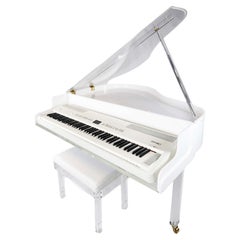
Custom-made Lucite Acrylic Baby Grand Piano and Bench by Iconic Design Gallery
Located in Miami, FL
Custom-made Lucite Acrylic Baby Grand Piano and Bench by Iconic Design Gallery
Offered for sale is a new custom-made baby grand piano in Lucite and acrylic with a matching bench. The piano is crafted with thick Lucite legs on casters and a hinged top that opens to a height of 65" high. The sides ares substantial and can be created in additional colors. The keyboard used for the digital piano...
Category
21st Century and Contemporary American Modern Porcelain Musical Instruments
Materials
Brass
$15,000 / set
H 65 in W 57 in D 48 in
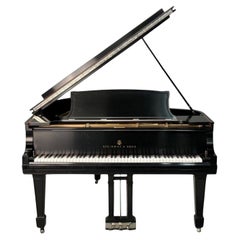
Steinway
Sons, Baby Grand Model O Piano, Fully Refurbished, 1911
Located in Manhasset, NY
Steinway & Sons, Baby Grand Model L Piano, Refurbished Satin Ebony, 1911, 88 Keys, Serial Number 146562
This exceptional 1911 Steinway piano, Model 146561, has undergone a complete ...
Category
20th Century American Modern Porcelain Musical Instruments
Materials
Lacquer
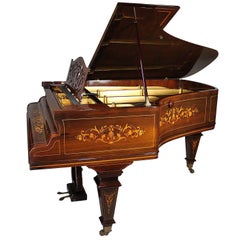
19th Century Louis XIV Style Marquetry Baby Grand Piano by Collard
Collard
By Collard
Collard
Located in Los Angeles, CA
A very fine Anglo-French 19th century rosewood, palisander, amboyna and satinwood marquetry (inlaid) art-case baby grand piano, the works by "Collard & Collard". The intricately deco...
Category
Late 19th Century English Neoclassical Revival Antique Porcelain Musical Instruments
Materials
Bronze
$75,600 Sale Price
20% Off
H 40.25 in W 72 in D 55.5 in
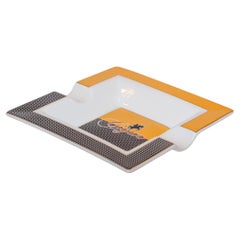
Large Vintage Porcelain Cigar Ashtray 1980
s
Located in Moreno Valley, CA
Large vintage square ceramic porcelain cigar ashtray.
Large collectible cigar ashtray in yellow and black and white check with gilt borders that break at cigar rests at either side.
Gold lettering in the center reads “Cigar”. and there is a knight on horse...
Category
Late 20th Century Post-Modern Porcelain Musical Instruments
Materials
Porcelain
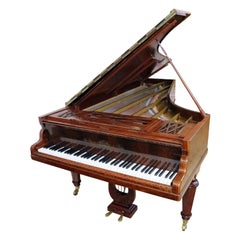
Erard Parallel-Strung Grand Piano, Paris, 1845
Located in Littleton, CO
This Erard parallel-strung grand piano, crafted in Paris in 1845 (serial number: 18725), has been extraordinarily well-tended, restored and maintained, enduring today as not only a spectacular example of the pinnacle of 19th Century piano design - characterized by its innovative construction and exceptional sonoral qualities - but also as a premium instrument by the most advanced modern standards, concert-ready for world-class, discriminating performers and their audiences.
Erard was a renowned piano manufacturer established by Sébastien Erard, and for much of the 19th Century, the company produced some of the most exquisite and innovative European pianos of the era.
The sound produced by this parallel-strung grand piano is characterized by a clarity and transparency that distinguishes it from its contemporaries. The parallel arrangement of strings contributes to a more direct transfer of sound energy, resulting in a balanced and articulate tone across the instrument's registers.
This piano's tone is beloved for its sweetness in the treble range and a robust quality in the bass, while also allowing for an especially nuanced and expressive interpretation of the musical repertoire of its era.
The ebony and ivory keyboard is a testament to the meticulous attention Erard paid to the tactile experience of playing. Each key is precision-weighted, providing a responsive touch that allows the pianist to articulate a wide range of dynamics and expressiveness.
An interior faux tableau latches to the outer case lid in an open position for maximum concert volume, and rests in a lowered position to maintain a softer, more muted experience.
The year 1845 places this Erard instrument in the heart of the Romantic era, a period marked by a surge in musical creativity and emotional expression. Composer/performers like Chopin and Liszt were drawn to Erard grand...
Category
Mid-19th Century French Romantic Antique Porcelain Musical Instruments
Materials
Wood
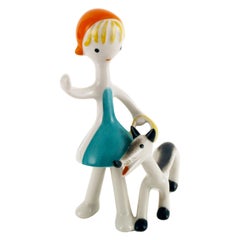
Age Art Deco Porcelain Figurine from Hungarian Porcelain Hollóháza
Located in Vigonza, Padua
Age Art Deco porcelain figurine from Hungarian porcelain Hollóháza
About Holloaza
Hollohaza porcelain is one of the oldest porcelain manufactory ...
Category
Mid-20th Century Hungarian Art Deco Porcelain Musical Instruments
Materials
Porcelain
$1,693
H 5.91 in W 4.34 in D 2.76 in
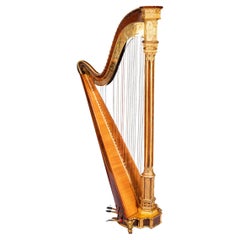
Early 19th Century Parcel Gilt Gothic Revival Harp By Sebastian Erard
Located in Dublin, IE
A very fine and elegant Regency Satinwood and parcel-gilt double action Harp from the workshop of the famous harp and piano maker Sebastian Erard (1752-1831), decorated in the Grecia...
Category
Early 19th Century English Gothic Revival Antique Porcelain Musical Instruments
Materials
Brass
$15,422
H 66.93 in W 31.5 in D 20.08 in
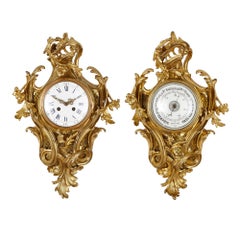
French Rococo Style Gilt Bronze Clock and Barometer by Charpentier
Located in London, GB
Designed in the French Rococo style, this clock and barometer set have been beautifully ornamented with scrolling foliate gilt bronze forms. The two are diamond shaped, with symmetri...
Category
Late 19th Century French Rococo Antique Porcelain Musical Instruments
Materials
Enamel, Ormolu, Bronze
$16,719 / set
H 20.48 in W 12.6 in D 5.52 in
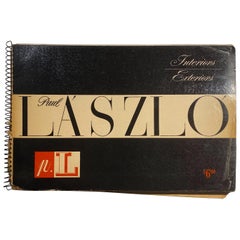
Paul Laszlo Catalog from 1947
By Paul Laszlo
Located in New York, NY
Scarce, self-published, 102-page catalog with laminated boards showcasing Paul Laszlo's work in and around Beverly Hills between 1937-1947. The Hungarian born and Vienna-educated Las...
Category
1940s American Mid-Century Modern Vintage Porcelain Musical Instruments
Materials
Wire
Vintage Karl Griesbaum Automatronic Singing Bird Cage, Made in Germany
Located in Norwood, NJ
Vintage automatronic wind-up singing bird cage crafted by Karl Griesbaum in Germany. Automation makes the caged bird sing, flutter its tail and move its beak and head about. The cage...
Category
Early 20th Century German Victorian Porcelain Musical Instruments
Materials
Brass

Liberace Autographed Vintage Schoenhut Toy Grand Piano
By Schoenhut
Located in Hamilton, Ontario
Made by the renowned American toy manufacturer in approximately 1920, this wooden toy baby grand piano has been autographed in two places by the legendary Liberace. The piano shows o...
Category
Early 20th Century American Victorian Porcelain Musical Instruments
Materials
Brass

Previously Available Items
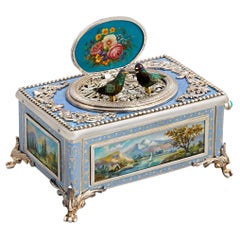
Silver Double Singing Bird Box
Located in New Orleans, LA
One of the rarest examples of a mechanical bird box ever seen, this extraordinary box features not one, but two brilliantly colored love birds. When the lid is opened, the delightful pair begin to sing their sweet, melodious tune, with their bodies, wings and beaks in full motion. While the presence of two singing birds makes this an exceptional rarity, it is distinguished in all other respects as well. The sterling silver casing is handsomely set with panels of powder blue enamel and hand-painted porcelain miniatures decorated with serene seascapes. The complex mechanism has the amazing ability to successfully engage two independently moving birds within a casing typically designed for a single bird. The one-of-a-kind objet d'art was inspired by the mechanical complexity of 19th-century Swiss automata, and it represents the pinnacle of the art form.
Mechanical singing bird boxes...
Category
19th Century American Antique Porcelain Musical Instruments
Materials
Silver, Sterling Silver, Enamel
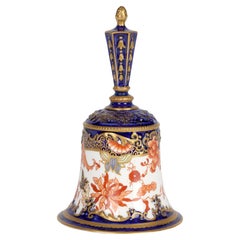
Royal Crown Derby Rare Antique Imari Pattern Porcelain Bell
Located in Bishop
s Stortford, Hertfordshire
A very rare antique porcelain imari pattern bell by Royal Crown Derby and dating from 1904. The bell has a traditional bell shaped body with molded and finely decorated patterning in...
Category
Early 1900s English Art Nouveau Antique Porcelain Musical Instruments
Materials
Porcelain
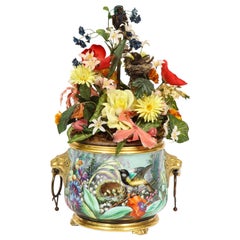
Blaise Bontems, an Extremely Fine
Rare Automaton Double Singing Bird Music Box
By Bontems
Located in Queens, NY
Blaise Bontems, an extremely fine and rare automaton double singing bird music box, in the form of a Porcelain Jardinière, 1870-1880, Paris.
...
Category
19th Century French Antique Porcelain Musical Instruments
Materials
Porcelain
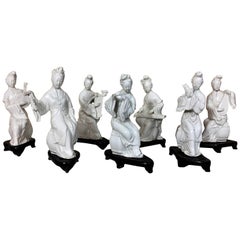
"Blanc de Chine" Porcelaine Statuettes Traditional Instruments Players
Located in Beuzevillette, FR
Really nice set of seven characters in porcelain "Blanc de Chine", representing women playing traditional chineses instruments: Pipa, Guzheng, Liuqin, Konghou, Dizi, Sheng, Cliquette...
Category
19th Century Chinese Chinoiserie Antique Porcelain Musical Instruments
Materials
Porcelain
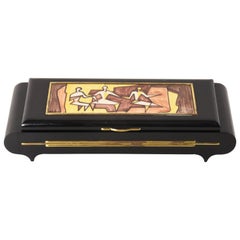
Pier Giovanni Urbino, Decorated Ceramic Jewelry Box, Carillon, Italy, 1960s
Located in Roma, IT
Pier Giovanni Urbino Sardella, vintage ceramic decorated jewelry box
Italian, 1960s for Ceramica, black lacquered wood case with inset hand painted porcelain plaques featuring fox h...
Category
1960s Italian Mid-Century Modern Vintage Porcelain Musical Instruments
Materials
Brass
H 2.37 in W 11.42 in D 4.14 in