Satinwood Musical Instruments
to
1
5
4
9
1
1
1
4
5
5
1
2,014
352
331
125
61
9
4
3
1
1
9
9
9
1
1
Material: Satinwood
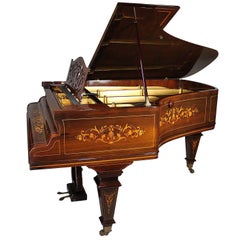
19th Century Louis XIV Style Marquetry Baby Grand Piano by Collard
Collard
By Collard
Collard
Located in Los Angeles, CA
A very fine Anglo-French 19th century rosewood, palisander, amboyna and satinwood marquetry (inlaid) art-case baby grand piano, the works by "Collard & Collard". The intricately deco...
Category
Late 19th Century English Neoclassical Revival Antique Satinwood Musical Instruments
Materials
Bronze

$75,600 Sale Price
20% Off
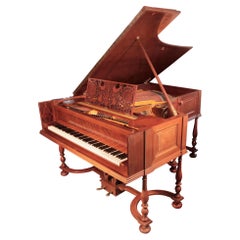
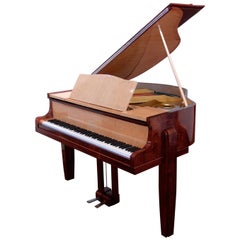
Harpsichord Style Schiedmayer Grand Piano Mahogany Baluster Legs Barn Door Cheek
Located in Leeds, GB
A 1912, Schiedmayer model 15 grand piano with a harpsichord style mahogany cabinet. The square tailed, mahogany cabinet features beveled square panels. The square, high piano cheeks ...
Category
Early 20th Century German Satinwood Musical Instruments
Materials
Brass
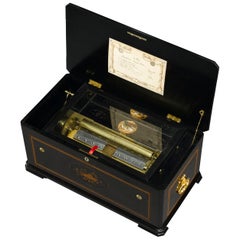
Mandolin Singing Bird Automaton Music Box
Located in New Orleans, LA
This exceptional singing bird cylinder music box is a wonder of Austrian mechanical ingenuity. Not only does it play a selection of classical airs with remarkable tone and clarity, but its lush sound is accompanied by a colorful, singing bird automaton...
Category
19th Century Austrian Other Antique Satinwood Musical Instruments
Materials
Satinwood
Important Ormolu-Mounted Amaranth, Kingwood and Satine Parquetry Grand Piano
By Henry Dasson
Located in New York, NY
Attributed to Henry Dasson (d. 1896)
Origin: French
Date: circa 1885-q890
Dimension: (H) 35 1/4 in x (W) 54 in x (W) 78 in.
Provenance: Acquired by Dr. J. T Nieto-Gomez from fi...
Category
Mid-19th Century French Louis XVI Antique Satinwood Musical Instruments
Materials
Bronze
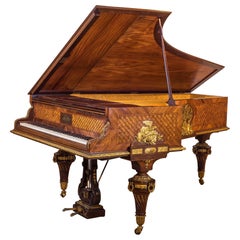
Wonderful Turn of the Century Gilt Bronze Mounted Six-Leg Grand Erard Piano
Located in Long Island City, NY
A wonderful turn of the century gilt bronze mounted Louis XVI style six-leg Grand Erard piano
Beautiful satinwood veneer, bronze mounts, standing on six legs centered by a stretcher.
The movement stamped with Erard serial number 93712 and patent stamps, the interior of the case further stamped F. TURBEC/A LEMOINE, and M. BECKER.
Erard is the oldest and most prestigious French piano manufacturer. The firm was founded by Sebastian Erard...
Category
Early 1900s French Belle Époque Antique Satinwood Musical Instruments
Materials
Bronze, Ormolu
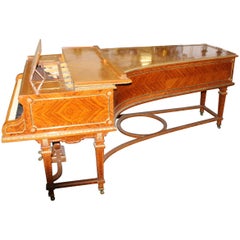
Pleyel Upright Piano Satinwood Neoclassical Inlay Fluted, Columnar Legs
Located in Leeds, GB
An 1893, Pleyel upright piano with a satinwood cabinet.
Entire cabinet features intricate, Neocalssical style inlay. The front panels feature a symmetri...
Category
1890s French Neoclassical Antique Satinwood Musical Instruments
Materials
Brass
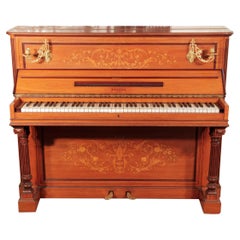
Adams Style Bluthner Grand Piano Quarter Cut Satinwood Inlaid Swags and Bows
Located in Leeds, GB
Adams style, 1911, Bluthner grand piano with a french polished, quarter cut, satinwood case with boxwood stringing inlay and crossbanding accents. The satinwood veneer of the cabinet...
Category
Early 20th Century German Adam Style Satinwood Musical Instruments
Materials
Brass
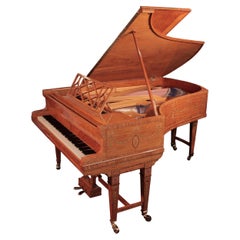
Antique Steinway
Sons Gold Bronze
Satinwood Baby Piano Circa 1910
Located in New Orleans, LA
This piano was made in the Hamburg Steinway & Sons factory and decorated in France. It is a beautiful instrument. As with most pianos, special shipping will be needed.
Category
Early 20th Century German Satinwood Musical Instruments
Materials
Ormolu
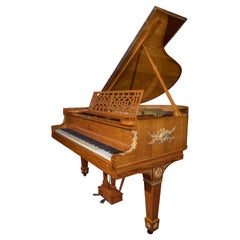
Secessionist, Bechstein Model VI Grand Piano with an Inlaid, Mahogany Case
Located in Leeds, GB
Secessionist 1902, Bechstein Model VI grand piano with an inlaid, mahogany case and statement copper hinges. Cabinet inspired by Arts and Crafts and Art Nouveau periods. The polished...
Category
Early 20th Century German Arts and Crafts Satinwood Musical Instruments
Materials
Copper
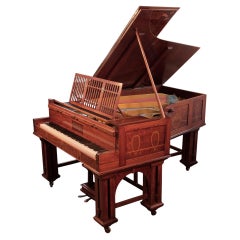
Related Items
Antique Jewelry Box Art Deco Period
Located in New York, NY
A beautiful antique Art Deco period jewelry box, styled by Jacques Kreisler, circa early-20th Century, New York, New York. Box is an aubergine ...
Category
Early 20th Century Art Deco Satinwood Musical Instruments
Materials
Metal
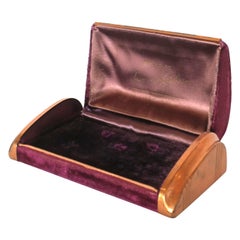
Thorens Swiss AD 30 Upright Music Box with Ten Discs, circa 1970
Located in Evergreen, CO
Manufactured by the renowned Thorens Company of Switzerland in the mid-20th century, this delightful music box is comprised of a quality fruitwood case with a glass door that allows ...
Category
1970s Swiss Vintage Satinwood Musical Instruments
Materials
Fruitwood
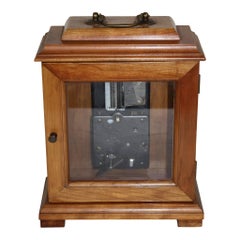
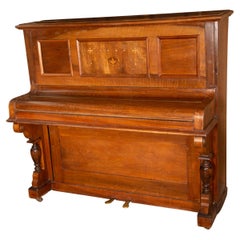
Upright piano. Towards the beginning of the 20th century.
Located in Madrid, ES
Upright piano. Towards the beginning of the 20th century.
Upright or wall piano with a wooden body with marquetry elements on the central panel of the uppe...
Category
20th Century European Other Satinwood Musical Instruments
Materials
Other
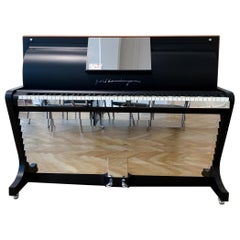
PH Upright Piano, Cognac Color Leather with Chrome, Modern, Sculptural
Located in Copenhagen, DK
- All prices are listed ex works.
- 5 year guarantee.
- We regularly crate, ship and install PH Pianos worldwide with full insurance.
For those who want a traditional acoustic upright piano with one of the most iconic design silhouettes, the PH Upright Piano...
Category
2010s Danish Bauhaus Satinwood Musical Instruments
Materials
Chrome
$60,520
H 43.31 in W 55.91 in D 21.26 in
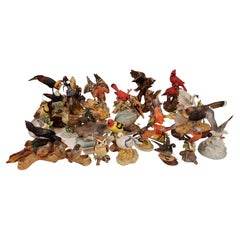
Birds a Collection of 25 Bird Figures and Music Boxes
Located in New York, NY
A lifetime collection of birds. A set of 25 some made of porcelain some carved from wood or resin. Of the 25 of them 5 are music boxes.
I actually think it's quite charming.
Siz...
Category
Late 20th Century Satinwood Musical Instruments
Materials
Porcelain, Resin, Wood
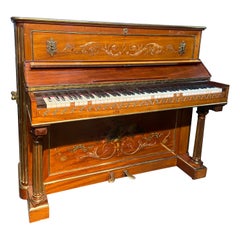
19th Century Pleyel French Upright Piano Hand Painted Decoration and Fluted Legs
By Pleyel
Located in Sofia, BG
This rare upright piano was made by Pleyel in France in September 1871 according to the Pleyel Archives found at Musée de la Musique.
The natural wood cabinet is beautifully decorated with hand painted floral garlands. The piano sides are square and it has fluted, columnar legs resting on original castors. The instrument...
Category
Late 19th Century French Antique Satinwood Musical Instruments
Materials
Brass
$10,387 Sale Price
55% Off
H 44.89 in W 54.34 in D 20.87 in
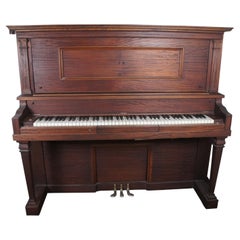
Antique 1915 Mahogany Chicago Cable Company Carolina Inner Player Upright Piano
Located in Dayton, OH
Antique Victorian player piano by The Cable Company of Chicago which features a Carolina Inner-player. Circa 1915.
Includes: I Love Paris and Oh Lady Be Good by Max Kortlander, He...
Category
1910s American Edwardian Vintage Satinwood Musical Instruments
Materials
Mahogany
$2,450 Sale Price
30% Off
H 55 in W 63 in D 30 in
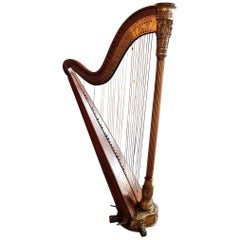
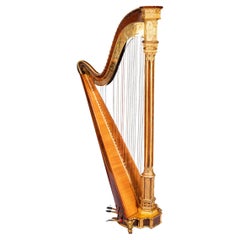
Early 19th Century Parcel Gilt Gothic Revival Harp By Sebastian Erard
Located in Dublin, IE
A very fine and elegant Regency Satinwood and parcel-gilt double action Harp from the workshop of the famous harp and piano maker Sebastian Erard (1752-1831), decorated in the Grecia...
Category
Early 19th Century English Gothic Revival Antique Satinwood Musical Instruments
Materials
Brass
$15,249
H 66.93 in W 31.5 in D 20.08 in
Liberace Autographed Vintage Schoenhut Toy Grand Piano
By Schoenhut
Located in Hamilton, Ontario
Made by the renowned American toy manufacturer in approximately 1920, this wooden toy baby grand piano has been autographed in two places by the legendary Liberace. The piano shows o...
Category
Early 20th Century American Victorian Satinwood Musical Instruments
Materials
Brass

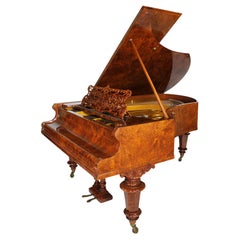
A German 19th Century Louis XVI Style Burr Walnut Bechstein Concert Grand Piano
By Bechstein Piano Company
Located in Los Angeles, CA
A Very Fine German 19th Century Louis XVI Style Burr Walnut Bechstein Concert Grand Piano, Serial No. 5655. The beautifully crafted Grand piano, raised on three tapered barrel shaped legs, with an intricately carved ornate music desk and original keys. Circa: 1872.
Length: 80 inches (203.2 cm)
Width: 59 inches: (149.9 cm)
Height (top closed): 38 5/8 inches (98.1 cm)
C. Bechstein Pianofortefabrik
C. Bechstein Pianofortefabrik AG (also known as Bechstein) is a German manufacturer of pianos, established in 1853 by Carl Bechstein.
Before Bechstein
Young Carl Bechstein studied and worked in France and England as a piano craftsman, before he became an independent piano maker. His first pianos were made for other companies.
C. Bechstein
C. Bechstein piano factory was founded on 1 October 1853 by Carl Bechstein in Berlin, Germany.
Carl Bechstein set out to manufacture a piano able to withstand the great demands imposed on the instrument by the virtuosi of the time, such as Franz Liszt. In 1857, Hans von Bülow (Liszt's son-in-law) gave the first public performance on a Bechstein grand piano by performing Liszt's Piano Sonata in B minor in Berlin
By 1870, with endorsements from Franz Liszt and Hans von Bülow, Bechstein pianos had become a staple in many concert halls and private mansions. By that time three piano makers, all of which were founded in 1853, became established as the industry leaders across the world: Bechstein, Blüthner and Steinway & Sons.
In 1881 Bechstein began supplying pianos to Queen Victoria. A gilded art-case piano was delivered to Buckingham Palace, followed by several more Bechstein pianos to Windsor Castle and other royal residences. By January 1886 they were among the piano manufacturers holding a Royal Warrant as a supplier to the Queen. Several British embassies across the world acquired Bechstein pianos.
In 1885, Bechstein opened a branch in London, that eventually grew to become the largest showroom and dealership in Europe. By 1890 showrooms had been opened in Paris, Vienna, and Saint Petersburg. On 31 May 1901, Bechstein Hall, built at a cost of £100,000, was opened next to the company's London showroom at 36-40 Wigmore Street. Between 1901 and 1914, C. Bechstein was the largest piano dealership in London. At that time, Bechstein was patronized by the tsars of Russia, the royal families of Spain, Belgium, the Netherlands, Italy, Sweden, Norway, Austria and Denmark, and other royalty and aristocracy. The list of royal clients of Bechstein may be found on the soundboard of vintage Bechstein pianos made before the Second World War. The list is part of the original Bechstein trademark logo; it can be seen under the strings in the center of a piano's soundboard.
The signature of Carl Bechstein
The years from the 1870s through 1914 brought Bechstein their most dramatic increase in sales. In 1880 a second Bechstein factory was opened in Berlin, and the third factory was opened in 1897 in Berlin-Kreuzberg. Production reached 3,700 pianos annually in 1900, and 4,600 in 1910, making Bechstein the largest German manufacturer of high-end pianos. At that time, about three quarters of production went to international markets, especially Britain and the Commonwealth, and Russia.
Carl Bechstein died in 1900, and the Bechstein company continued to operate under the management of his sons.
Between 1900 and 1914 C. Bechstein was one of the leading piano makers in the world, employing 1,200 craftsmen and workers by 1913 and making five thousand pianos per year.
First World War
C. Bechstein suffered huge property losses in London, Paris, and St. Petersburg during World War I. The largest loss was in London. Although the company's position in the United Kingdom was initially unaffected, with the company still listed as holding a Royal Warrant in January 1915, Warrants to both King George V, and his wife Queen Mary were cancelled on 13 April 1915. Bechstein was not the only musical concern to be affected by growing anti-German sentiment: there were earlier attempts, led by William Boosey, to boycott German music altogether. In 1915, despite being a Baronet and Privy Counsellor, Sir Edgar Speyer, who was then funding the Proms, was forced to leave the country. Following the passing of the Trading with the Enemy Amendment Act 1916 the British arm of the company was wound-up on 5 June 1916, all Bechstein property, including the concert hall and showrooms full of pianos, were seized as "enemy property" and closed. In 1916 the hall was sold as alien property at auction to Debenhams for £56,500. It was renamed Wigmore Hall, and then re-opened under the new name in 1917. All 137 Bechstein pianos at the Bechstein showrooms were confiscated too, and became property of the new owner of the Hall. After a dispute with his brother, Edwin Bechstein left the company and was paid off.
Eventually the Bechstein factory resumed full-scale production during the 1920s. At that time, technical innovations and inventions of new materials and tools, as well as improvements in piano design and construction, had allowed Bechstein to become one of the leading piano makers again.
The most successful models were the updated "A"-185 and "B"-208 grand pianos. The upright pianos became more popular after the war, and C. Bechstein were successful with its upright pianos Model-8 and Model-9, both of which have been considered the finest upright pianos.
As the company was changed into a joint-stock company 1923, Edwin Bechstein and his wife Helene, bought themselves back into the company as shareholders.
In 1930 the company collaborated with German electrical goods manufacturer Siemens under Nobel laureate Walther Nernst to produce one of the first electric pianos...
Category
19th Century German Louis XVI Antique Satinwood Musical Instruments
Materials
Bronze
$34,850 Sale Price
53% Off
H 38.63 in W 80 in D 59 in
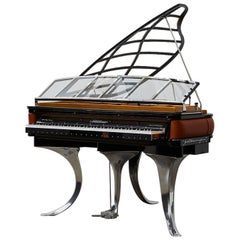
PH Grand Piano PH150 Excellence, cognac leather with chrome, Modern, Sculptural
Located in Copenhagen, DK
- All prices are listed ex works.
- 5 year guarantee.
- We regularly crate, ship and install PH Pianos worldwide with full insurance. Please contact us for individual shipping quote and for any questions.
The PH Grand Piano...
Category
2010s Danish Bauhaus Satinwood Musical Instruments
Materials
Aluminum, Chrome
$151,170
H 43.31 in W 60.24 in D 59.06 in
Pierre-Paul Montagnac Modernist Piano
Located in Philadelphia, PA
French Modernist Art Deco piano and bench by Pierre-Paul Montagnac, a variant of the model used in one of the luxe apartments, the Caen, on the great French oceanliner Normandie in 1935. Created in rosewood and sycamore, and carefully and correctly restored, including the fine Erard (#127208) instrument. 56” wide x 60” deep. Documented in numerous sources, including the July 1935 issue of Art et Decoration.
Pierre-Paul Montagnac
(1883-1961)
Born in Saint-Denis, France on 9 May 1883, Pierre-Paul Montagnac was equally talented as a fine artist and a decorative artist. He was educated in both disciplines, studying with Eugene Carriére as well as at the Académie de la Grande Chaumiére, both in Paris.
His inaugural exhibition was at the 1912 Salons – and at the 1920 Salon d’Automne he received a traveling scholarship. In 1918 he began working in the firm of André Mare and from 1922 collaborated with Maurice Dufrene at La Maîtrise, the famous design studio of Galeries Lafayette. From 1921 he exhibited at the Salons of la Société des Artistes Décorateurs, Salon des Architectes Modernes,
and internationally, in Barcelona and Leipzig. He designed suites on the grand French oceanliners, l’Atlantique, Normandie and Pasteur.
At the 1925 Paris International Exposition his work was in a standout class. At the 1937 Exhibition he organized the pavillion of the Artistes Decorateurs and personally won a Grand Prix. For the New York Exhibition in 1938, he was a member of the international jury, organized the group of Decorators, and, as architect, organized the exhibitions of jewelry and perfumes.
He became a member of the Society of Modern Architects and executed important and numerous architecture and decorating projects including the luxury apartments on the great French oceanliners l’Atlantique, Pasteur, and Normandie.
Vice President and then President of the Societe des Artistes Decorateurs from 1930-1938, he was also President of the Salon d’Automne and Vice President of the Committee of the Exhibition of Arts and Embellishments of Life; member of the steering committee of C.T.I. and Artistic Property, member of the Board of Directors of the Central Union of Decorative Arts. He was also an Officer of the Legion of Honor and received the Cross of War.
MONTAGNAC was the son of an engineer and he had a taste for geometry
and science that predisposed him to the rigors of architectural laws.
Multi-talented, he worked independently as a painter – who had
paintings acquired by the French government – while also working in
the related fields of architecture and decoration. His work included
homes, apartments, galleries, luxury shops, banks and the aforesaid
oceanliners.
As a designer/decorater, Montagnac had the taste for quality, luxurious
furniture, using precious woods, bronze extensions, ivory inlays, mother-of-pearl,
metal and coral. He advocated for a resolutely modern style and, free of all
pastiches, focused on beautiful cabinetry, the challenges of furniture design,
particularly from 1940 to 1945, captured all his attention.
The tireless activity of Montagnac, whose varied works are represented in
official museums and residences, was also recognized from a professional
and social point of view. He was a remarkable organizer, devoted to the
cause of art, to the defense of the trade and his colleagues. It was Montagnac
who, in 1939, with Anatole de Monzie, took the initiative to found the
ENTRAIDE to Artists (which provides support to talented young French artists).
MOBILIER ET DECORATION, September/October 1953
ERARD
An illustrious piano manufacturer, Sebastien Erard began building superior harpsichords in Paris in the mid-1700s, produced pianos for the French Court, and received a multitude of patents, many of which are still in use in piano manufacturing. Erard pianos were marketed as the finest pianos in the world and were owned by Queen Victoria, Franz Liszt, Chopin, Verdi, Ravel, and Felix Mendelssohn among many others. They continued to enjoy international success well into the 20th century. They were known for their unique sound quality, similar to the American square grand piano...
Category
1930s French Art Deco Vintage Satinwood Musical Instruments
Materials
Rosewood, Sycamore
Previously Available Items
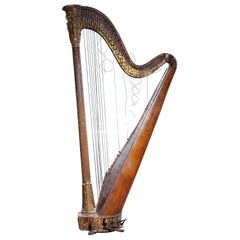
Early 19th Century Regency Satin
Gilt Wood Harp Country House
Located in Lowestoft, GB
A wonderfully decorative early 19th century harp, decorated with gesso applied grecian figures and motifs.
The harp has had a hard life, with elderly repairs, knocks and plenty of ...
Category
Early 19th Century British Regency Antique Satinwood Musical Instruments
Materials
Satinwood
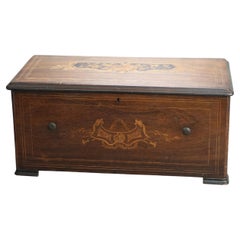
Antique Swiss Inlaid Rosewood Music Box with Bells
Satinwood Marquetry C1890
Located in Big Flats, NY
Antique Swiss Inlaid Rosewood Music Box with Bells & Satinwood Marquetry C1890
Measures - 21 7/8" x 22 1/8" x 10 3/4"
Category
Late 19th Century Antique Satinwood Musical Instruments
Materials
Rosewood, Satinwood
H 22 in W 22.25 in D 10.75 in
Antique Swiss Large Case Inlay Marquetry
Ebonized Music Box with Bells
Drums
Located in Big Flats, NY
Antique Swiss Large Case Inlay Marquetry & Ebonized Music Box with Bells & Drums C1880
Measures - 10"h x 27"w x 7"d
Category
Late 19th Century European Antique Satinwood Musical Instruments
Materials
Mahogany, Satinwood
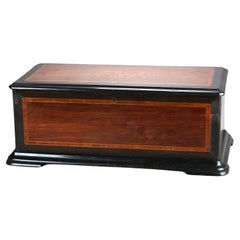
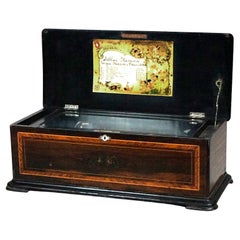
Antique Oversized Swiss Eight-Tune Rosewood
Satinwood Inlay Music Box c1890
Located in Big Flats, NY
A large Swiss eight-tune music box offers rosewood case having satinwood inlaid banding and marquetry reserve, JL Wood, c1890
Measures- 10.5''H x 23.75''W x 11.75''D.
Category
Late 19th Century Swiss Antique Satinwood Musical Instruments
Materials
Rosewood, Satinwood
H 11.75 in W 23.75 in L 11.75 in
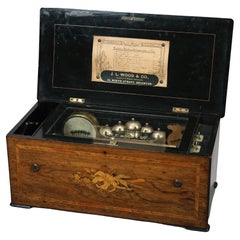
Large Antique Swiss Ten-Tune Rosewood
Satinwood Inlay Music Box Band, C1890
Located in Big Flats, NY
An oversized antique Swiss music box band offers a instruments to include bells, drum and castanet with cylinder player encased in rosewood box...
Category
Early 19th Century Antique Satinwood Musical Instruments
Materials
Rosewood, Satinwood
H 9.5 in W 27.5 in D 12.75 in
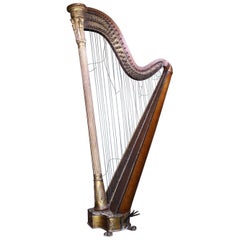
William iv, Jackson Late Egan Irish Satin
Gilt Wood Harp
Located in Lowestoft, GB
A decorative Irish gilt and satin wood harp in country house condition, produced around 1837/1839.
The Harp is in very much untouched condition, elderly word worn is apparent. The...
Category
Early 19th Century Irish William IV Antique Satinwood Musical Instruments
Materials
Satinwood
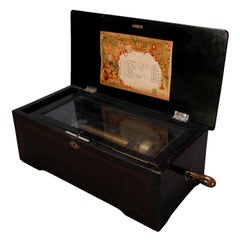
Antique Inlaid Swiss 8-Tune Cylinder Music Box, circa 1880
Located in Big Flats, NY
An antique Swiss 8-tune cylinder music box offers satinwood inlaid and banded case with top having heart, anchor, cross and flowers, original program having Classical scene with cher...
Category
19th Century Swiss Antique Satinwood Musical Instruments
Materials
Satinwood
Antique Swiss 8-Tune Cylinder Music Box, Floral Marquetry and Mahogany Case
Located in Big Flats, NY
An antique Swiss 8-tune cylinder music box offers mahogany case with floral satinwood inlay mahogany top opening to reveal original tune card surmounting glass covered works, circa 1...
Category
19th Century Swiss Antique Satinwood Musical Instruments
Materials
Brass
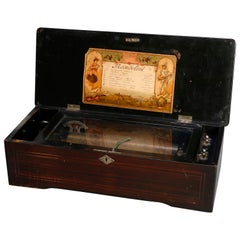
H 5.75 in W 20.25 in D 8.25 in
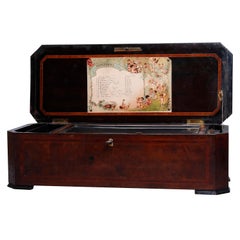
Antique Swiss 12-Tune Cylinder Music Box, Banded Floral Inlaid Burl Case
Located in Big Flats, NY
An antique Swiss 12-tune cylinder music box offers banded burl clip-corner and footed case with floral satinwood marquetry top opening to reveal original tune card surmounting glass ...
Category
19th Century Swiss Antique Satinwood Musical Instruments
Materials
Brass
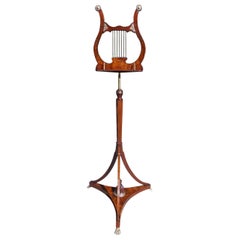
English Mahogany Bronze Mounted and Inlaid Lyre Music Stand on Paw Feet. C. 1800
Located in Charleston, SC
English mahogany bronze mounted lyre music stand with intertwined floral and musical satinwood inlays, adjustable music rest and telescopic brass cylinder, ...
Category
Early 1800s English George III Antique Satinwood Musical Instruments
Materials
Brass
H 60 in W 14 in D 23 in
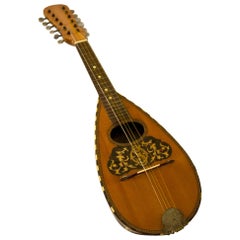
Antique Victorian Bowl-Back Mandolin
Located in Savannah, GA
Bowl-back mandolin. Anonymous maker and unknown age in the 19th century style. Contains mother of pearl inlays, metal nuts (possibly pewter). The head stock has been altered to accom...
Category
1890s American Late Victorian Antique Satinwood Musical Instruments
Materials
Metal
Mid 19th Century T. Dodd
Sons London Harp
Located in Dallas, TX
Presenting a gorgeous Mid-19th century harp by Thomas Dodd & Sons of 3 Berners Street, London from circa 1840-1850.
Stunning neoclassical gilt mounts and inlay to head and base. Made of satinwood with gilt stringing.
Solid brass to the stringing plate.
Fully marked an engraved for the maker on the brass plate : “T. Dodd & Sons, Patent Harp, 3 Berners Street, London, No. 530.”
Also marked on the front as “ Sold by J. George Morley...
Category
Mid-19th Century English Neoclassical Revival Antique Satinwood Musical Instruments
Materials
Satinwood, Giltwood