Items Similar to Miniature Portrait of the Prince of Wales, Later Edward VII
Want more images or videos?
Request additional images or videos from the seller
1 of 6
Miniature Portrait of the Prince of Wales, Later Edward VII
$14,038.62
£10,275
€12,068.01
CA$19,503.88
A$20,979.21
CHF 11,211.90
MX$247,285.09
NOK 141,355.77
SEK 129,226
DKK 90,168.45
About the Item
A Very Fine and Important Miniature Portrait of the Prince of Wales, Later Edward VII, as Captain of the Royal Yacht Britannia Painted in 1896 by Robert Henderson for the Royal Warrant Holders Dickinson and Foster
This fine miniature depicts the future King Edward VII whilst still Prince of Wales in 1896 in the uniform he wore whilst captaining the Royal Yacht Britannia including his peaked cap and, in his tie, his tie pin with the burgee for the Royal Yacht Squadron of which he was a proud member. The miniature is signed “R H” and dated 1896 and contained in a 14ct gold bezel with suspension ring, suggesting perhaps that it was mounted in America where 14ct was the usual standard of gold whereas in England it would have been much more likely to have been 15ct or 18ct at this time. This suggests that it may have been given to an American friend of the Prince, perhaps the owner of one of the American yachts against which the Britannia raced in the 1896 season. A label on the back of the miniature states that it was ‘painted by R. Henderson, Dickenson (sic)
Foster, 114 New Bond St.’.
Dickinson and Foster and Robert Henderson
The article Robert Henderson (1826–1904) and the Family Order of King Edward VII, published in the The British Art Journal, Winter 2014/15, Vol. 15, No. 2 (Winter 2014/15), pp. 93-102, by James Greville is an invaluable source of information about the firm of Dickinson and Foster and their relationship with Robert Henderson. Founded in London in the 1820s, the firm of Dickinson was established as a print publisher but also having the capability to produce frames and dealing in second hand and antique paintings as well. In 1851 the firm was given the first of many endorsements by the royal family, being awarded a Royal Warrant by Prince Albert due to his interest in a set of lithographs of the Great Exhibition that the firm published that year. Queen Victoria commissioned the firm to produce a very large scale miniature portrait of herself for presentation to the American George Peabody in 1866. The request caused the firm some difficulty but the result was to everyone’s satisfaction when delivered in 1867. The success of this piece led the firm to experiment with early photographic technology that allowed them to blow up photographic images and then combine them with traditional painting techniques to produce portrait miniatures for a larger market. This was commercially successful but something of an artistic failure despite the calibre of some of the artists involved. As a result when the firm was sold by the Dickinson family to Joshua James Foster in 1876, one of his first decisions as head of the firm was to concentrate on more traditional portrait techniques and to search for an artist of requisite skill. The firm advertised itself as ‘miniature painters and publishers to the Queen’ and Foster was keen to develop this reputation. Our research in the newspaper archives uncovered an interesting advert from 1896 reproduced here.
This demonstrates what a large part of the firm’s business now depended on the production of miniatures of one form or another and by this stage the firm had found an artist who was able to supply them with work of the highest quality befitting a firm with a Bond Street address and an elite clientele. That artist was Robert Henderson, a Scot born in Dumfries in 1826 who had lived in London since as a young man he had moved to the English capital to train as a wood carver. From 1854, and somewhat as a result of the interesting social circles in which he moved due to his wife’s position as a successful actress, Henderson started working full time as an artist. Although he began by painting in oils, Henderson’s first love was the portrait miniature and luckily the art form began to see a steady increase in interest and just the same time as his career began to take off. He is recorded has having produced some work for Dickinson pre-Foster’s take over but it was in the 1880s when he really began to make a real name for himself in this field and he was by then contracted exclusively to Dickinson and Foster. This arrangement lasted the rest of his life and benefited both parties greatly.
The Prince of Wales had by this time come in to contact with the firm and, to quote from Greville’s article,
‘There were also royal visits by the Prince and Princess of Wales to exhibitions held in the company’s gallery and in 1895 Edward agreed to sit for a composite picture, The Royal Yacht Squadron at Cowes. He was evidently intrigued by its production for he visited Dickinson
Foster twice to be photographed and once to review progress’
It would have been natural for the Prince to have chosen the firm to memorialise him for presentation to a friend or fellow yachtsmen in his Britannia uniform.
The Prince also used the firm to produce portrait miniatures of him in more conventional regal garb for use on his Family Order, a decoration featuring a portrait of the now King that was commissioned in 1902 and presented to the King’s closest female relatives. 11 of these orders are known to have been made with three retained in the Royal Collection to this day, two of them linked below. All of the portraits were painted by Henderson.
During the 1896 season, Britannia raced 58 times, winning 14 of those races and achieving other prizes on another 10 occasions. One of the most famous yachts she faced that year was the Meteor II, designed by Scottish builder George Lennox Watson in Glasgow. It is likely that the owner of one of the yachts with whom the Prince of Wales came in to contact in 1896 was the lucky recipient of this exceptional painting.
ROBERT HENDERSON (UK, 1826–1904)
Miniature oil on ivory in 14K gold case of King Edward VII (1841–1910) in uniform as Captain of HMY “Britannia”, a gaff-rigged cutter yacht built in 1898 (note burgee tie pin, initialed “RH” over his right shoulder), dated 1896 and inscribed on backing paper:
“Painted by R. Henderson, Dickenson
Foster, 114 New Bond S., London W, 1898”.
Under convex glass lens, with moire satin back.
4 1/2 inches x 3 1/4 inches including suspension loop.
- Creator:Robert Henderson (Artist)
- Dimensions:Height: 4.5 in (11.43 cm)Width: 3.25 in (8.26 cm)Depth: 1.5 in (3.81 cm)
- Materials and Techniques:
- Place of Origin:
- Period:
- Date of Manufacture:1896
- Condition:Wear consistent with age and use. Good.
- Seller Location:Lymington, GB
- Reference Number:1stDibs: LU973048244202
About the Seller
5.0
Recognized Seller
These prestigious sellers are industry leaders and represent the highest echelon for item quality and design.
Gold Seller
Premium sellers maintaining a 4.3+ rating and 24-hour response times
Established in 1982
1stDibs seller since 2013
141 sales on 1stDibs
Typical response time: 1 hour
Associations
LAPADA - The Association of Arts
Antiques Dealers
- ShippingRetrieving quote...Shipping from: Lymington, United Kingdom
- Return Policy
More From This Seller
View AllA framed plaster portrait plaque of the Glasgow Reformist MP James Oswald, signe
Located in Lymington, Hampshire
A framed plaster portrait plaque of the Glasgow Reformist MP James Oswald, signed and dated Carlo Marochetti, 1842, of circular form, shown facing to the right within a black border and the original glazed giltwood frame.
Another version of this plaque is in the collection of Glasgow Museums and can be seen on the Art UK website
James Oswald (1779-1853) was a successful Glasgow merchant who later inherited various landed estates due to the early death of his cousin. Oswald was one of the first members of the Glasgow Bank when it was established in 1809. He traded largely in cotton and other raw textiles and in his spare time he commanded the Glasgow branch of the volunteer mounted Yeomanry. It was his political career however that captured the hearts of many of his countrymen and led to his eventually being immortalised in sculptural form.
The Liberal Party MP for Glasgow from 1832-1837, Oswald was a staunch opponent of Sir Robert Peel...
Category
Antique 1840s Decorative Art
Materials
Plaster
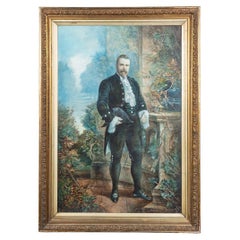
A large portrait of Provost Samuel Leckie by William A. Donnelly 1901
Located in Lymington, Hampshire
A large portrait of Provost Samuel Leckie as he was presented to Queen Victoria in 1897, William A. Donnelly, 1901, gouache and watercolour showing a large bearded man in court dress...
Category
Early 20th Century English Paintings
Materials
Paint
Charles Dixon R.A. for King George V, Royal Yacht Britannia
Located in Lymington, Hampshire
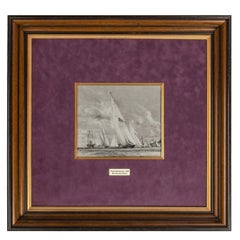
This ‘en grisaille’ watercolour on paper is Charles Dixon’s preparatory sketch for a proposed but apparently uncompleted painting of the royal racing yacht Britannia...
Category
Vintage 1930s English Nautical Objects
Materials
Paper
Major R Sloane-Stanley by George Hillyard Swinstead, 1916
Located in Lymington, Hampshire
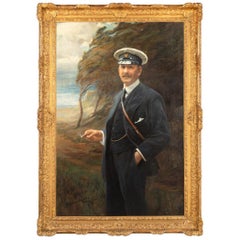
This three-quarter length oil on canvas portrait shows Major Sloane-Stanley in a landscape by the sea. He is smoking a cigar and wearing a Royal Yacht Squadron cap. Signed lower left ‘G Hillyard Swinstead 1916’ the reverse inscribed in pencil ‘Major R Sloane-Stanley, Hants Yeomanry 1916’ . English.
Capt. thence Lt Col Ronald F A Sloane-Stanley of the Hampshire Regiment (1867 – 1948) served as Deputy Lord Lieutenant of Hampshire. As a close friend of Edward VII, he reputedly procured two billiard tables from Osborne House (East Cowes, Isle of Wight) for Lee- on-the-Solent Yacht Club, of which he was the founding Commodore in 1907. He was also a member of the Royal Yacht Squadron from 1907 until his death, owning seven yachts during that period. He served on the Yachting Committee between 1935 and 1946.
Despite Sloane-Stanley's long history of involvement with yachting, there is one yacht with which his family is associated that overshadows all of his other great achievements in the sport. The Formosa, built for his father Francis Sloane-Stanley in 1877, was acclaimed as a masterpiece of maritime design before she was even launched. In a rhapsodic article published on the 22nd of February 1879, The Field newspaper describes her as “the most beautiful cutter yacht ever built”.
In addition to her fine attributes as a racing vessel, the article also mentions the luxurious way that she was decorated inside, personally supervised and designed by Mrs Sloane-Stanley-our sitter's mother.
The Formosa, pictured above, became so famous that shortly after this article was written Francis Sloane-Stanley sold her to his friend the Prince of Wales (later Edward VII). There are several images of the Formosa in the Royal Collection, all dating from 1880. The Prince raced her on multiple occasions and her victories included the Queen's Cup on the 3rd of August 1880. By 1881, however, the Prince had sold her to a “Mr Bischoffsheim” as reported in the as reported in the Portsmouth Evening News on the 23rd of July of that year.
Although Ronald Sloane-Stanley would have been 12 at the time the Formosa was raced by his father it is highly likely that seeing this beautiful cutter, and the success that it brought to his family, would have inspired Ronald's own yachting career.
Additionally, as the same article in The Field makes clear, the Sloane-Stanley family were related in some way to Thomas Assheton-Smith, a founder member of the Yacht Club (later the Royal Yacht Squadron). The family is therefore a highly renowned one in yachting circles and we were lucky enough to be able to offer a silver gilt trophy won by Assheton Smith at the Regatta in 1828 in one of our previous catalogues. This portrait is a very exciting piece of yachting memorabilia as well as a superb work of art in its own right.
The Artist
George Hillyard Swinstead...
Category
Vintage 1910s English Paintings
Materials
Paint
Gold, Enamel and Cameo Commemorative Pendant by William Tassie, 1805
Located in Lymington, Hampshire
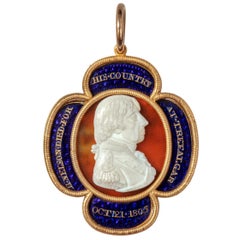
The enamelling on this quatrefoil gold pendant is attributed to Ray & Montague: ‘hiltmakers, goldworkers and enamellers’. The obverse is mounted with a vitreous paste profile portrait cameo of Admiral Viscount Nelson within four navy blue enamel panels with the gilt inscription: ‘H·Nelson·Died·for His·Country at·Trafalgar Oct:21·1805’ all within ropework borders. The reverse is mounted with an oval polychrome enamel plaque representing a blue Royal Navy ensign flying triumphant above the flags of France and Spain superimposed with an anchor and laurel wreath against a red background within four navy blue enamel panels with the gilt inscription: Glory to the Souls of the Brave, a line from The Battle of the Baltic written in 1801 by Scottish poet Thomas Campbell (1777-1844) to commemorate Nelson’s victory at the Battle of Copenhagen. Cameo with incised signature Tassie F. 1805
English, 1805
John Ray and James Montague succeeded to the celebrated enamelling and goldsmithing firm of James Morisset (1738-1815) in 1800. Like Morisset, they
specialised in presentation swords...
Category
Antique Early 1800s English Collectible Jewelry
Materials
Gold, Enamel
Portrait Mezzotint of Admiral Viscount Duncan
By John Raphael Smith
Located in Lymington, Hampshire
This fine impression of the celebrated print engraved by mezzotint engraver John Raphael Smith after a painting by Henry Danloux shows the subject on the deck of a ship in the heat of the Battle Camperdown. It is framed in an ornate giltwood frame with a paper label on the reverse showing a coat of arms flanked by the inscription ‘Admiral Lord Viscount Duncan when Victorious off Camperdown, is by permission most humbly dedicated to the Hon. Miss Jane Duncan by her most obedient Servant H.P.Danloux London. Published by H. P. Danloux No 11 Charles Street, Middlesex Hospital...
Category
Antique Early 1800s English Prints
Materials
Giltwood, Paper
You May Also Like
Antique Miniature Portrait of a Man Tempera Painting
Located in Malmö, SE
European Tempera hand-painting of a Man, not signed. Gilt Bronze Frame with original Glass cover. The frame is sealed. To be hanged.
Sized: frame 8.2 cm x 5.6 cm x 6 mm deep / paint...
Category
Antique 1880s European Arts and Crafts Decorative Art
Materials
Gold, Bronze
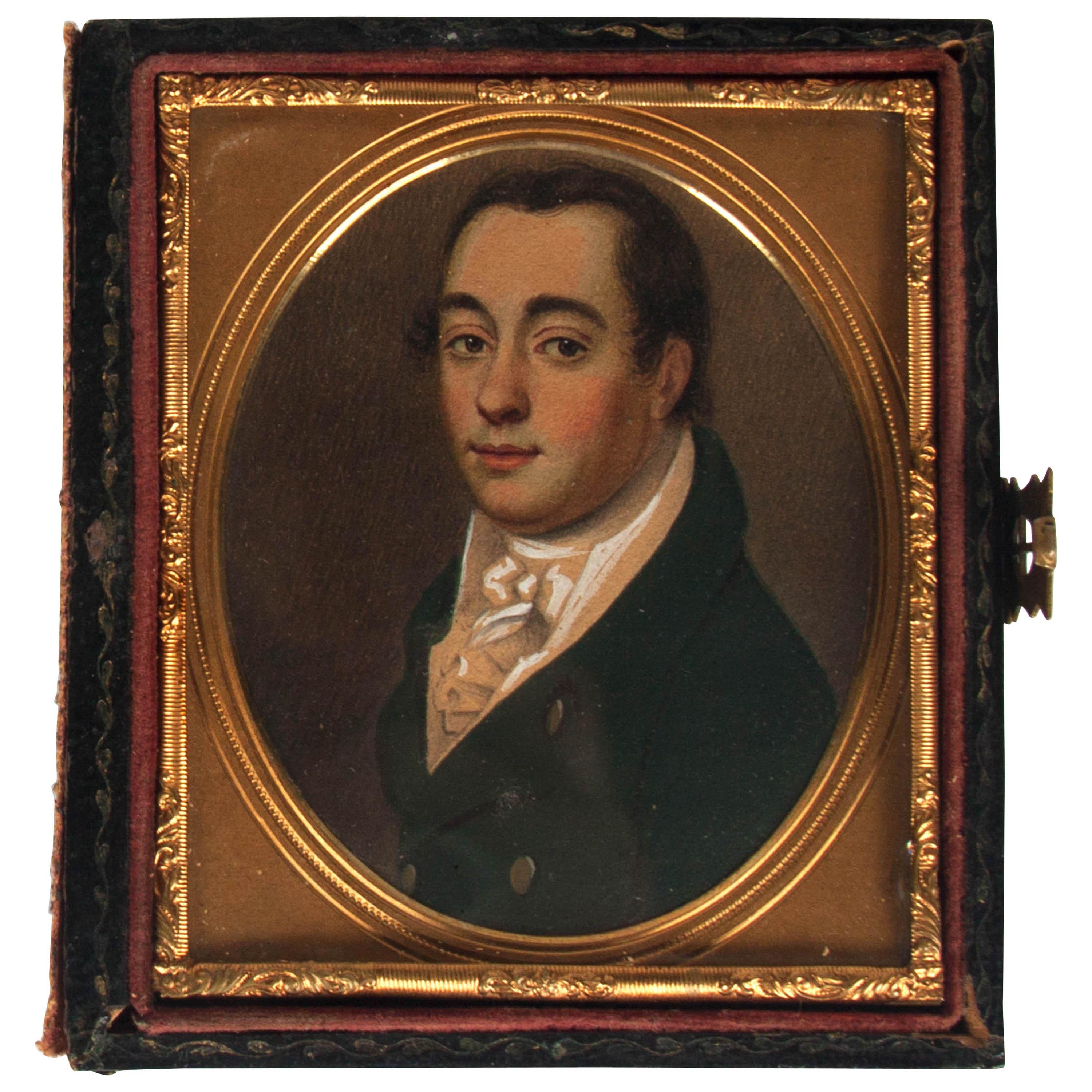
Antique Miniature Portrait Of A Young Man – Circa 1830–1845
Located in Bilzen, BE
A superb hand-painted miniature portrait of a refined young gentleman, dated early 19th century (circa 1830–1845), presented in its original oval gilt-brass frame with protective dom...
Category
Antique 1830s French Louis Philippe Historical Memorabilia
Materials
Other
Antique Miniature Portrait with an 18-Karat Yellow Gold Frame
Fitted Case
Located in Hamilton, Ontario
This well executed miniature portrait was made in England in approximately 1900 in the period Edwardian style and comes with its original fitted leather case. The painting is unsigne...
Category
Antique Late 19th Century English Edwardian Models and Miniatures
Materials
Gold
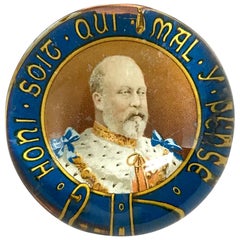
Edward VII Glass Paperweight
Located in New York, NY
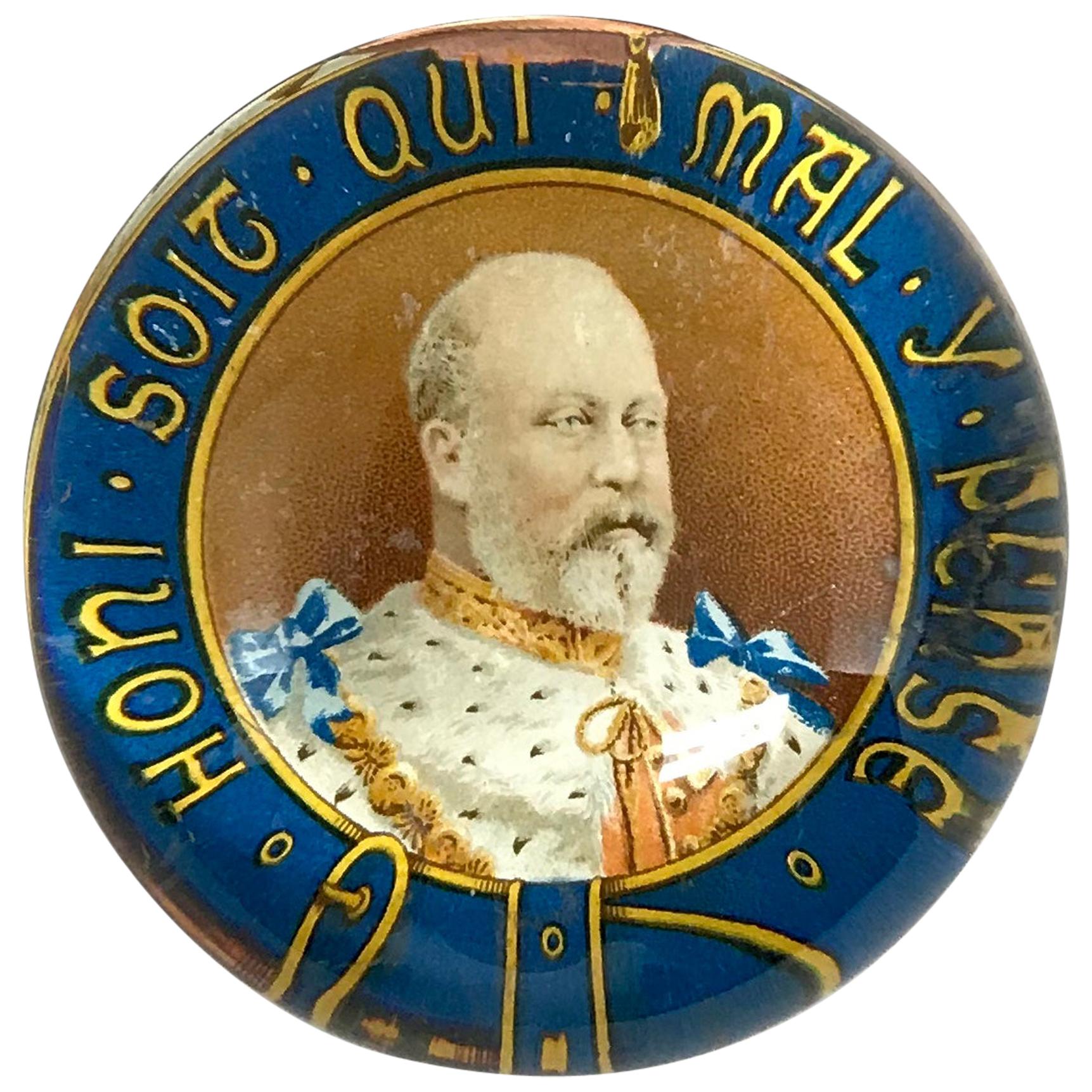
Edward VII glass paperweight. "Honi soit mal quiy mal y pense" commemorative souvenir paperweight of Edward VII in his coronation robes, England, circa 1902...
Category
Early 20th Century English Paperweights
Materials
Glass
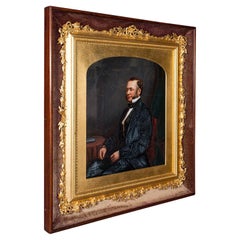
Antique Gentleman
s Portrait, English School, Framed, Painting, Art, Edwardian
Located in Hele, Devon, GB
This is an antique gentleman's portrait. An English, painted print in glazed giltwood frame in the English School manner, dating to the Edwardian period, circa 1910.
Superb frame, ...
Category
Early 20th Century British Edwardian Prints
Materials
Paper
19th Century English Painted Miniature Portrait Signed by Chester Dennery
Located in Esbeek, NL
First half of the 19th century painted portrait, depicting Newark Hudson.
Signed by Chester Dennery, England.
Bronze gilded frame.
Category
Antique Early 19th Century English Models and Miniatures
Materials
Paint