Items Similar to Presentation silver to the Master Shipwright of Captain Cook’s Endeavour
Want more images or videos?
Request additional images or videos from the seller
1 of 10
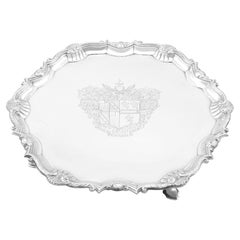
Presentation silver to the Master Shipwright of Captain Cook’s Endeavour
$25,813.03
£18,750
€21,968.54
CA$35,596.01
A$37,686.89
CHF 20,395.08
MX$450,427.62
NOK 254,221.99
SEK 232,476.99
DKK 164,076.76
About the Item
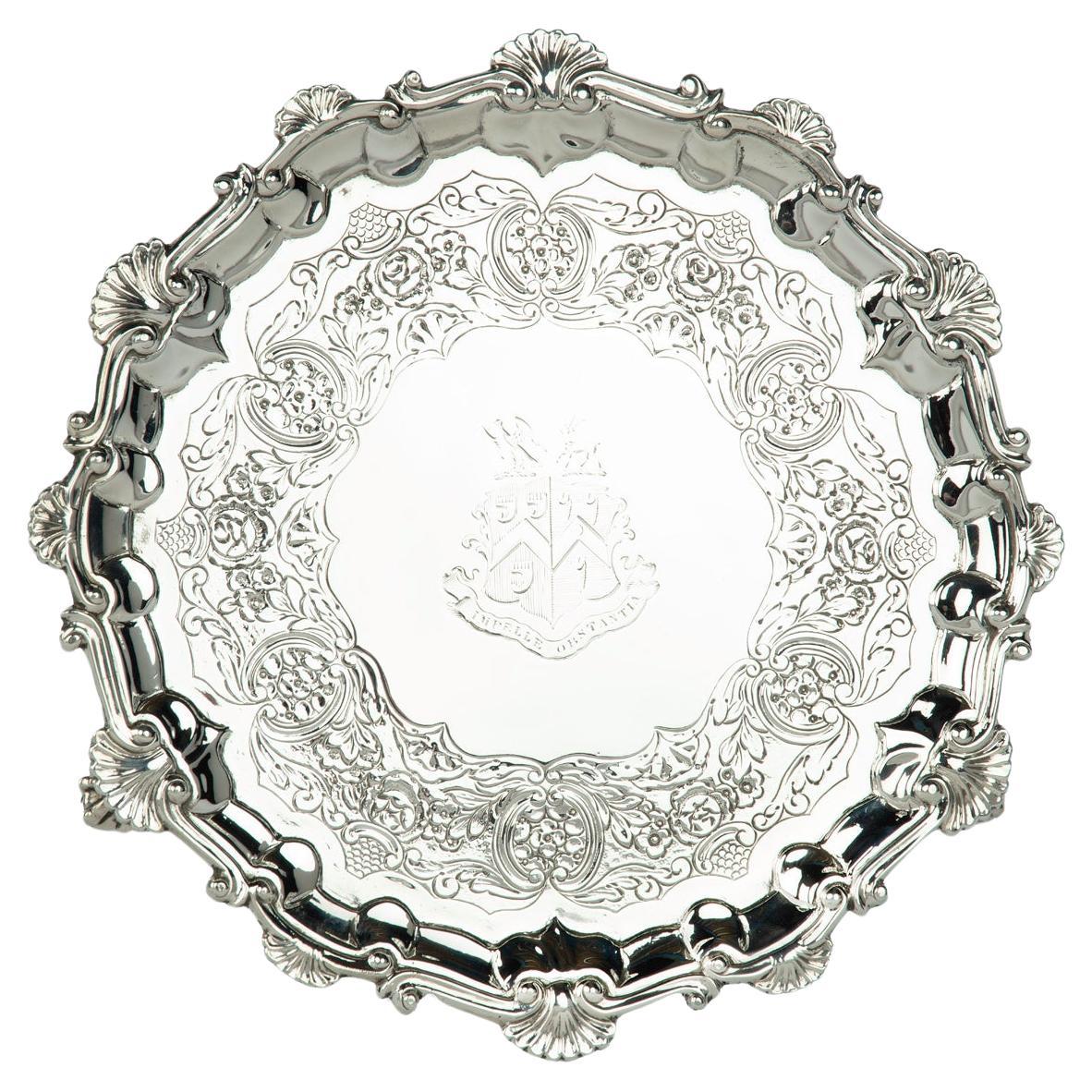
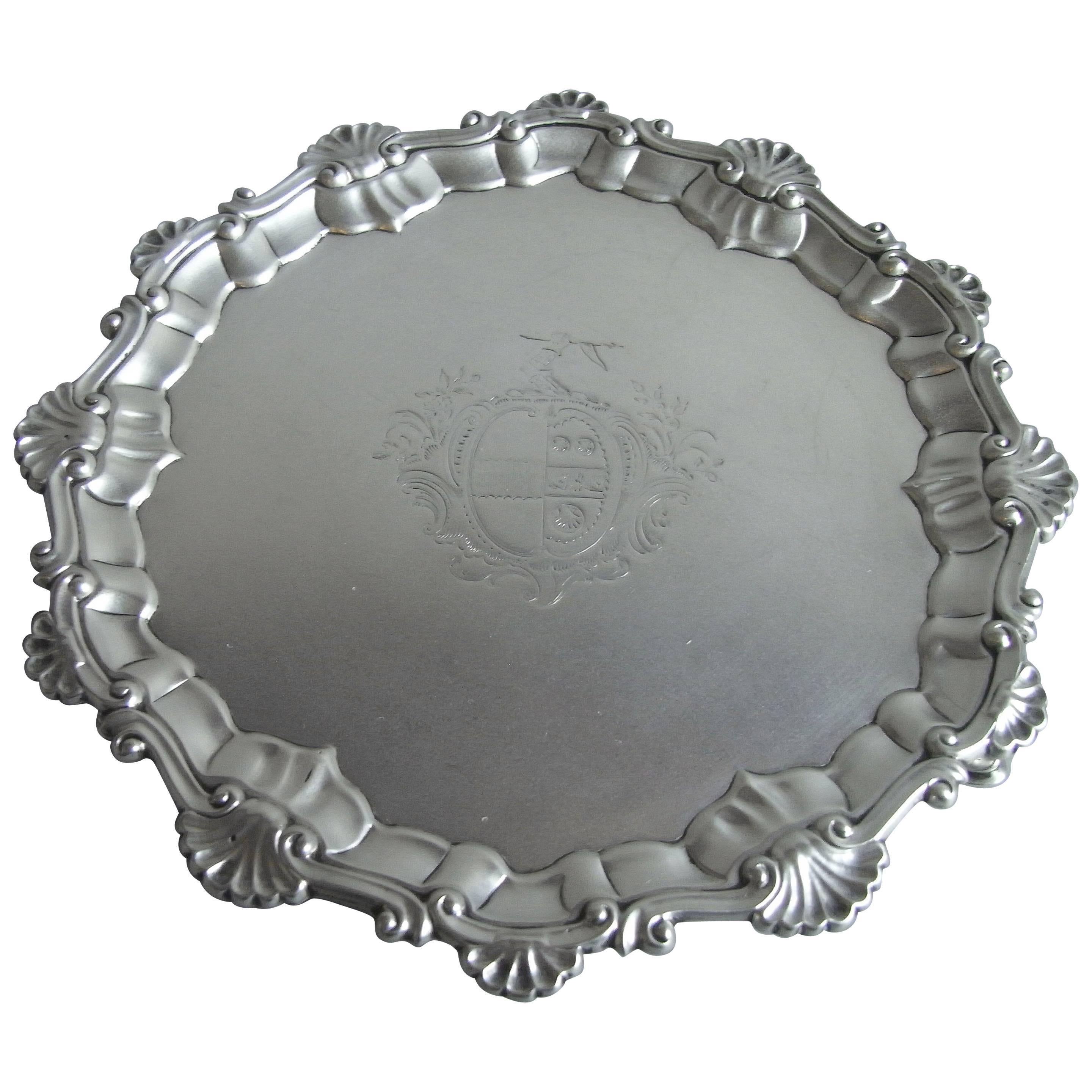
A George III shaped circular silver salver, plain within a shell and scrolling wave border and outer gadrooned edge, engraved with the royal coat of arms, crest and motto (period 1714-1800) of King George III and, on the reverse with a presentation inscription: For the Launching of His Majestys sloop ‘Otter’ 14 Gunns 305 Tonns 26 October 1767
His Majestys ship ‘Egmont’ 74 Gunns 1643 Tonns 29 August 1768 by Mr Adam Hayes Master Shipwright of his Majestys yard at Deptford; further monogrammed A*H P A*M. Hallmarked for Benjamin Cartwright, London, 1769
Adam Hayes (1710-1785) began his career as ship’s carpenter in Centurion during Commodore Anson’s famous voyage around the world in 1740-44 when he saw action and shared in the capture of the Spanish treasure galleon Nuestra Señora de Covadonga. In 1746, under Anson’s patronage, Hayes was appointed master shipwright at Gibraltar before working under the eminent naval architect Thomas Slade – designer of HMS Victory – at Plymouth, Sheerness, Woolwich and Chatham. Appointed master shipwright to Deptford in 1755, Hayes specialised in building 74-gun third-rate warships such as Magnificent, Albion, Superb, Dragon and in 1768, as detailed on this small salver, HMS Egmont which saw action at the 1797 Battle of Cape St Vincent. Launched a year earlier at a cost of £6,500, Otter was a Slade designed 14-gun sloop of war which, during service in North America, was wrecked off Florida in 1778.
Hayes, however, is best known for selecting and re-fitting the merchant collier Earl of Pembroke as a Royal Navy bark for a scientific mission to the Pacific Ocean under the command of Captain James Cook. No doubt Hayes’s seafaring experience with Anson selected him for this high-profile task. At a cost of £2,200, he sheathed and caulked Pembroke’s leaky hull, installing an additional internal deck to provide living quarters for Cook and the scientific members of the Royal Society assigned to the voyage. Hayes’s original plan for the converted ship is at the National Maritime Museum, Greenwich (ZAZ6587). Commissioned into the Royal Navy as Endeavour, the ship left Deptford on 30 July 1768, just a few weeks before the launch of Egmont. On 29 April 1770, Endeavour became the first European vessel to make landfall on the east coast of Australia.
- Dimensions:Height: 1.5 in (3.81 cm)Diameter: 10.25 in (26.04 cm)
- Style:George III (Of the Period)
- Materials and Techniques:
- Place of Origin:
- Period:1760-1769
- Date of Manufacture:1769
- Condition:Wear consistent with age and use.
- Seller Location:Lymington, GB
- Reference Number:1stDibs: LU973035087502
About the Seller
5.0
Recognized Seller
These prestigious sellers are industry leaders and represent the highest echelon for item quality and design.
Gold Seller
Premium sellers maintaining a 4.3+ rating and 24-hour response times
Established in 1982
1stDibs seller since 2013
141 sales on 1stDibs
Typical response time: 1 hour
Associations
LAPADA - The Association of Arts
Antiques Dealers
- ShippingRetrieving quote...Shipping from: Lymington, United Kingdom
- Return Policy
More From This Seller
View AllA George IV crested silver tray commemorating the marriage Colonel Thomas Arthur
Located in Lymington, Hampshire
A George IV crested silver tray commemorating the marriage of Lieutenant Colonel Thomas Arthur, 3rd Dragoon Guards, of circular form, raised upon three ...
Category
Antique Early 19th Century English George IV Platters and Serveware
Materials
Silver
The large and interesting silver gilt trophy of Captain George
Located in Lymington, Hampshire
The large and interesting silver gilt trophy of Captain George Welstead, purchased with prize money from the East India Company, 1805, in the form of a footed cup with a separate cov...
Category
Antique 18th Century English Nautical Objects
Materials
Silver
A Victorian silver armorial tray presented to Brig. General Sir Bertram Portal
By Charles Boyton
Located in Lymington, Hampshire
A Victorian silver armorial tray presented to Brig. General Sir Bertram Portal, 17th Lancers, of rounded form with a bracketed, gadrooned rim with eight scallop shells, raised on th...
Category
Antique Late 19th Century English Victorian Tableware
Materials
Silver
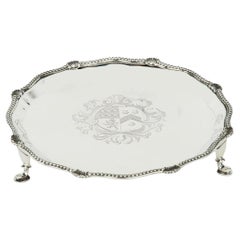
George III Lloyds Patriotic Fund Silver and Silver Gilt Vase and Cover by Samuel
Located in Lymington, Hampshire
George III Lloyds patriotic fund silver and silver gilt vase and cover by Samuel Hennell, of Adam design, the lift-off cover with knop finial above an...
Category
Antique Early 1800s English Nautical Objects
Materials
Silver
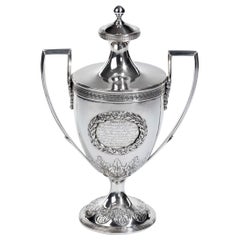
A Mudhook Yacht Club racing prize
Located in Lymington, Hampshire
A Mudhook Yacht Club racing prize, in the form of an oval silver box with a slightly concave hinged lid and gilt interior, inscribed ‘Mudhook Yacht Club 10th July 1914 for yachts of ...
Category
Early 20th Century English Sterling Silver
Materials
Silver
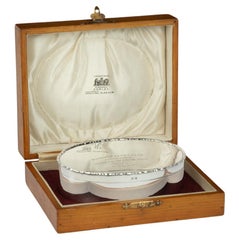
Valentine Munden’s Prize Money Silver Salver, London, 1792
Located in Lymington, Hampshire
This small oval George III silver salver is raised on four scroll feet with a plain field and curvetto within a triple reed border. The reverse is engraved ‘June 18th 1803 Valentine Munden’s Prize Money when on board the Exeter East Indiaman for the Capture of the French Frigate La Medée.’ Maker’s mark of John Crouch & Thomas Hannam, London 1792.
The naval action took place on the 4th of August 1800 off the coast of Brazil. On that morning, the Royal Navy escort, Belliqueux sighted a squadron of French frigates and, giving chase, captured the largest ship La Concorde whilst the East Indiamen, Exeter and Bombay Castle pursued and took the surrender of La Medée. The Coutts and Neptune were unsuccessful in capturing a third frigate La Franchaise, but the action stands out as the only occasion during the Napoleonic Wars when a merchant vessel captured a French ship of war...
Category
Antique 1790s English Sterling Silver
Materials
Silver
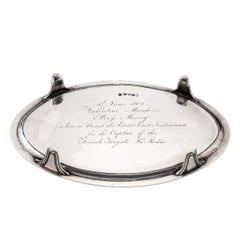
You May Also Like
George III period sterling silver salver by Ebeneezer Coker London 1771
By Ebenezer Coker
Located in London, London
Hallmarked in London in 1771 by Ebenezer Coker, this handsome, Antique, George III period, Sterling Silver Salver, stands on 4 flared feet, and features a shaped gadroon border, and ...
Category
Antique 1770s English George III Platters and Serveware
Materials
Sterling Silver
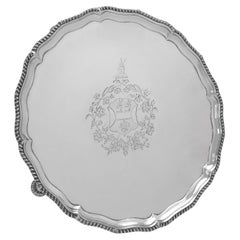
George III Antique Sterling Silver Salver by Hannam
Crouch, London, 1772
By Hannam
Crouch
Located in London, London
Hallmarked in London in 1772 by Hannam & Crouch, this exceptional, George III, antique sterling silver salver, features a shaped gadroon border, an engraved crest to the centre, and ...
Category
Antique 1770s English George III Sterling Silver
Materials
Sterling Silver

Good George II Salver Made in London in 1754 by Thomas Robinson
Located in London, GB
The Salver stands on three hoof feet and displays a raised shaped border decorated with scrolls and Rococo shell details. The centre of the Salver is engraved with a contemporary Arm...
Category
Antique 1750s English More Dining and Entertaining
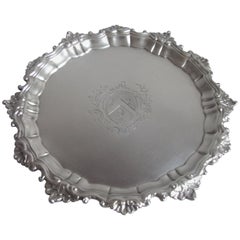
18th Century Silver Salver by Paul de Lamerie
By Paul de Lamerie
Located in London, GB
18th century silver salver by Paul de Lamerie
English, 1744
Height 3cm, diameter 27cm
Hailing from the workshop of the eminent Dutch-born English sil...
Category
Antique 18th Century English Rococo Sterling Silver
Materials
Silver
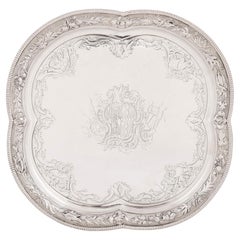
Early George III Salver Made in London in 1761 by Ebenezer Coker
Located in London, GB
The Salver stands on three foot feet and displays a raised stepped border decorated with scrolls and Rococo raying shells in sizes. The centre of this example is engraved with a cont...
Category
Antique 1760s English More Dining and Entertaining
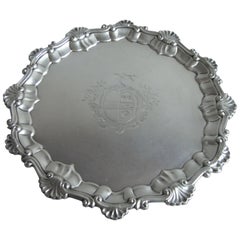
Antique Georgian Sterling Silver Salver (1736)
By Isaac Cookson
Located in Jesmond, Newcastle Upon Tyne
An exceptional, fine and impressive antique George II Newcastle sterling silver salver; an addition to our Georgian dining collection.
This exceptional, fine and impressive antique ...
Category
Antique 1730s English George II Sterling Silver
Materials
Sterling Silver
More Ways To Browse
Antique Cook
Captain Cook
Presentation Silver
Antique Silver Salvers
St George And The Dragon
George Silver Salver
Spanish Galleon
Nuestra Senora
King George Iii Coat Of Arms
George III Silver Collectibles
George Cook
James Hayes
Antique Brass Gimbal
Antique Glass Floats
Antique Wood Pulleys
Boat Oars
Yacht Burgee
Antique Aquarium