Want more images or videos?
Request additional images or videos from the seller
1 of 5
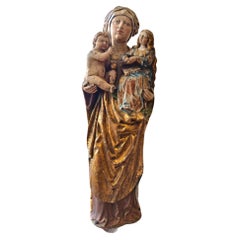
15th century Bronze Florentine Pax of the Seated Madonna and Child
$995List Price
About the Item
- Dimensions:Height: 6.7 in (17.02 cm)Width: 5.11 in (12.98 cm)Depth: 1 in (2.54 cm)
- Style:Renaissance (Of the Period)
- Materials and Techniques:Bronze,Cast
- Place of Origin:
- Period:
- Date of Manufacture:Unknown
- Condition:Wear consistent with age and use.
- Seller Location:Leesburg, VA
- Reference Number:1stDibs: LU8166235783082
About the Seller
4.7
Vetted Professional Seller
Every seller passes strict standards for authenticity and reliability
Established in 2013
1stDibs seller since 2023
47 sales on 1stDibs
Typical response time: 12 hours
Authenticity Guarantee
In the unlikely event there’s an issue with an item’s authenticity, contact us within 1 year for a full refund. DetailsMoney-Back Guarantee
If your item is not as described, is damaged in transit, or does not arrive, contact us within 7 days for a full refund. Details24-Hour Cancellation
You have a 24-hour grace period in which to reconsider your purchase, with no questions asked.Vetted Professional Sellers
Our world-class sellers must adhere to strict standards for service and quality, maintaining the integrity of our listings.Price-Match Guarantee
If you find that a seller listed the same item for a lower price elsewhere, we’ll match it.Trusted Global Delivery
Our best-in-class carrier network provides specialized shipping options worldwide, including custom delivery.You May Also Like
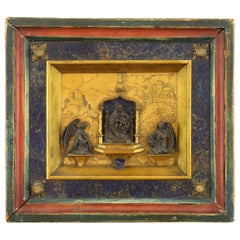
"Madonna with Child and Angels". Italy, 15th-16th Centuries
Located in Madrid, ES
Bronze in its color and gold, lapis lazuli, rock crystal, enamel.
In the centre of the work is presented, enthroned, the figure of Mary, with a mantel (fireplace) on her shoulders and hair and holding on her knees the child, who appears addressing one of the angels. The virgin is also sheltered by an ogee arch supported on turned columns, and raised visually by steps. This composition achieves a very striking contrast: the dark bronze figure, in contrast to the lapis lazuli background and the part of the arch and the outside of it, in gilded bronze. Under the steps there is a heraldic enamel shield with a key on an azure background. The angels, kneeling, are flanking this figure, and, appearing in dark bronze, visually share the "category" of religious figures with Mary, while their (lower) position gives more status to both the Mother and Jesus. The rest of the composition is completed with a delicate landscape: constructions and walls on mountains, clouds in the sky, plants, stones, etc. To the outside, another lapis lazuli frame is placed decorated in the corners with appliques, giving way to carved and polychrome wood. The lapis lazuli is a semiprecious stone already known in the seventh millennium BC., found in deposits from the Caucasus to Mauritania. From the end of the middle ages, it increased its export to Europe, its use being more frequent since then both to use it as a pigment in paintings after grinding it (giving rise to the finest and most expensive of the blues, and of the colors in many occasions), as for backgrounds of paintings, incrustations in works of art, jewelry and, a little later, in the well-known "hard stone works". The figure of Mary still shows an influence of Gothic models, although more European than Italian, along with elements that could already show a closeness to the Renaissance: although the nakedness of Jesus is already shown in Gothic works (Madonna with Angels by Fra Angelico ), the creation of space by playing with the cloth in front of Christ can be appreciated in more advanced paintings (Virgin with Child by Domenico Ghirlandaio, National Gallery of London); the presence of a powerful throne can be seen frequently in Italian Madonnas of the Quattrocento (and before), but not quite as presented here. As for the landscape, it is necessary to compare it, for example, with that of the fresco of the Condotiero Guidoriccio de Fogliano (Simone Martini, finished in 1328). This is a work of great technical and aesthetic quality, not to mention the materials chosen for its creation, comparable only to outstanding examples from around the world, such as those preserved in the Palazzo Madama in Torino (Italy), where the coral It also has an important role. It is essential to mention, also, works such as the plate of hard stones (lapis lazuli between them) with a relief of Mary with the Child in...
Category
Antique 16th Century Italian Renaissance Religious Items
Materials
Lapis Lazuli, Bronze, Enamel, Other
Bronze Pax or Pax Board, 16th Century
Located in Madrid, ES
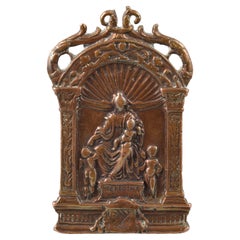
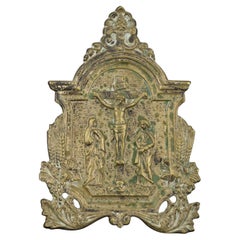
Peacekeeper. Bronze. Century XVI.
Bronze purse with a handle on the back in the shape of an esse in the same material and a decoration in light relief on the front that shows, unde...
Category
Antique 16th Century Spanish Renaissance Religious Items
Materials
Bronze
Bronze Pax or Pax Board, 16th Century
Located in Madrid, ES
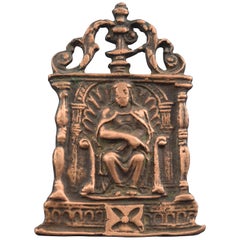
Paper holder bronze, 16th century.
Bronze paper holder with flat handle on the back that features a light relief decoration on the front. Under an auction of openwork elements of cle...
Category
Antique 16th Century Spanish Renaissance Religious Items
Materials
Bronze
Bronze Pax or Pax Board, 16th Century
Located in Madrid, ES
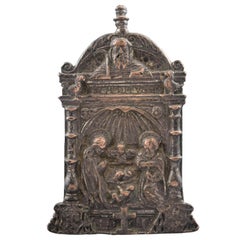
Paper holder bronze, 16th century.
Bronze paper holder with a flat curved handle on the back that features a relief decoration organized in the front through an architectural composition with a classical influence usual in the Renaissance. Under the columns on the sides there are two heraldic shields (without bonnet, laces with tassels on three levels) with a Latin cross in the middle zone; the center shows a birth of Christ under a winged dome with heads of winged angels in the corners; at the top and under a semi-circular arch, the bust of Saint Dominic...
Category
Antique 16th Century Spanish Renaissance Religious Items
Materials
Bronze
Pax or Pax Board, Bronze, Spain, 16th Century
Located in Madrid, ES
Paper holder bronze, 16th century.
Portapaz made of bronze with an "asymmetric" handle on the back, which presents a decoration in light relief framed in an architectural compositio...
Category
Antique 16th Century European Renaissance Religious Items
Materials
Bronze
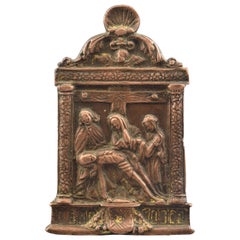
Bronze pax. 18th century
Located in Madrid, ES
BRONZE PAX.
The plaque that forms this element, formerly used in mass to give the osculus of peace with decorum, has been decorated with varied reliefs: in the lower part, vegetal sc...
Category
Antique 18th Century Spanish Rococo Religious Items
Materials
Bronze
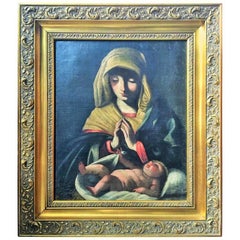
Madonna and Child, Classical 19th Century Painting
Located in Miami, FL
Madonna and child, Classical 19th century painting.
This lovely oil painting was purchased in Spain.
The artist is unknown.
The painting still maintains its original finish and ha...
Category
Antique Late 19th Century Italian Renaissance Religious Items
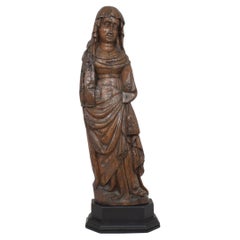
Large Flemish Medieval Gothic 15th / 16th Century Carved Oak Madonna
Located in Buisson, FR
Amazing period piece.
A Gothic / medieval Carved oak Madonna
Southern Netherlands/ Flemish
Circa 1450-1550
Weathered, small losses and old repairs
H:101cm W:35cm D:15cm
Measurement...
Category
Antique 16th Century Dutch Gothic Religious Items
Materials
Oak
$5,646 Sale Price
51% Off
H 39.77 in W 13.78 in D 5.91 in
15th Century Gothic Virgin
Located in Madrid, ES
15th century Gothic Virgin
Gothic Virgin of the 15th century Virgin in carved and polychrome wood of the 15th century. In its original state, muse...
Category
Antique 15th Century and Earlier Figurative Sculptures
Materials
Wood
Silver Pax O Portapaz, Spain, 16th Century
Located in Madrid, ES
Portapaz. Silver in its color and gilded. Century XVI.
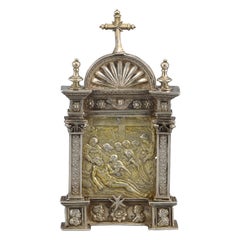
Portapaz made of silver that has a handle (decorated with delicate plant motifs similar to those of the pilasters) and a female and a male bust at the bottom, as well as other architectural elements on the back, and, on the front, an architectural composition classicist basement (with busts flanking a flower and a cross), two pilasters (vegetal decoration and capital recalling the composite order) with entablature (flowers flanking an angel's head; moldings), and a semicircular arch finish with elements veined in relief under cross and flanked by two architectural motifs in the upper part. This composition frames and enhances a gilt silver relief where you can see the Lament or Cry over the Body of Christ, with the Virgin holding the head of Jesus, Saint John at her side, the Magdalene and other characters, a cross following the group and a landscape background with houses and plant elements. This architectural structure mentioned is similar to the one present in other 16th century portapaces, such as that of the Magdalena de Dos Hermanas parish (Hernando de Ballesteros el Mozo, around 1575); or that of the Galaroza parish (same author and date); or that of the portapaz of San Miguel de Jerez de los Caballeros (in some details); etc. As for the relief, it is possible to clearly see a strong Italian influence, and the similarity between it and important pieces such as the Portapaz known as “de Cisneros by Juan de Burgos (1493-1497; MuseoCatedralicio de Alcalá de Henares), as well as in paintings and reliefs. Also noteworthy are both the male and female busts in the lower area and the Maltese cross (or Saint John's) that appears in this area. This symbol was used since the 12th century as an insignia by the Knights Hospitallers of the Order of Saint John of Jerusalem, also known as the Order of Malta...
Category
Antique 16th Century Spanish Renaissance Religious Items
Materials
Silver
More From This Seller
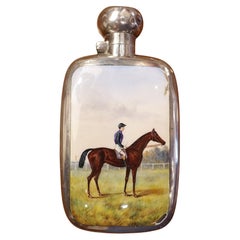
View AllEarly 20th century English Enamel Equestrian Silver Flask
Located in Leesburg, VA
Early 20th century English Enamel Equestrian Silver Flask
Unidentified Maker
England; early 20th century
Silver, enamel
Approximate size: 6 (h) x 3 (w) x 1.25 (d) in.
Crafted in E...
Category
Early 20th Century English Edwardian Historical Memorabilia
Materials
Silver, Enamel
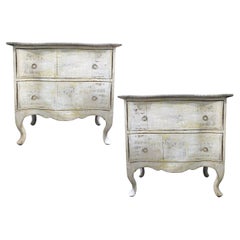
Pair of Antique 18th century Florentine Italian Bedside Commodes
Located in Leesburg, VA
Anonymous
18th century; Florence, Italy
Probably Italian stone pine, iron
Approximate size: 35 (h) x 34 (w) x 17 (d) inches (each)
This pair of Italian two-drawer bedside dressers ...
Category
Antique 18th Century Italian Gustavian Dressers
Materials
Iron
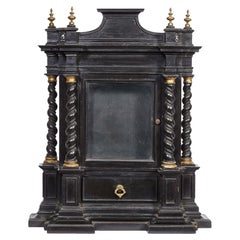
An early 18th century Florentine Ebonized Wood Aedicule Case
Located in Leesburg, VA
An early 18th century Florentine ebonized wood aedicule case with gilt metal embellishments
Ambit of Leonard van der Vinne
Possibly first decade of the 18th century; Florence, Italy
Approximate size: 83.5 (h) x 69 (w) x 23 (d) cm
The cabinet’s centralized glass door is flanked by thick spiraling Solomonic columns surmounting a lower drawer. To the rear of the cabinet, the motif repeats in an eloquent display of perspectival treatment. The overall work is supported by a tiered base, elegantly conceived, and the cabinet is topped by a handsome pediment flanked by square plinths crested by gilt metal finials and an openwork frieze.
The cabinet’s tempered and moderate form suggests an origin probably during the first decade or quarter of the 18th century. Although utilitarian in concept, the reserved and sublime expressiveness of this cabinet is managed with a quality and care respective of the influence of Florentine ebony cabinetry work conceived in the Galleria dei lavori or Grand Ducal Workshops of the 18th century Medici dynasty. In particular, its base mouldings echo a remarkable Night Clock...
Category
Antique Early 18th Century Italian Baroque Vitrines
Materials
Brass
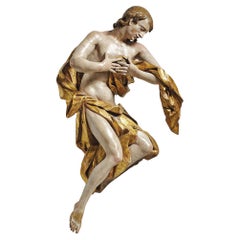
18th century Polychrome and Giltwood Angel from the ambit of Franz Ignaz Gunther
Located in Leesburg, VA
A large polychrome and gilt limewood sculpture of an Angel in the Manner of Franz Ignaz Gunther, ca. 1770, Munich (Bavaria)
Approximate size: 107 c...
Category
Antique Mid-18th Century German Rococo Wall-mounted Sculptures
Materials
Wood
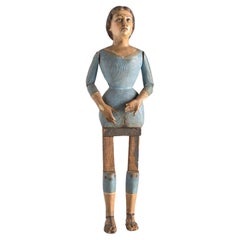
19th Century Articulated Wooden Figure of the Virgin Mary
Located in Leesburg, VA
19th century articulated wooden figure of the Virgin Mary
Anonymous
Spain; 19th century
Polychrome wood, inset glass eyes
Approximate size: 37 x 11 x 7 cm
An antique ‘Virgin...
Category
Antique 19th Century Primitive Figurative Sculptures
Materials
Glass, Wood, Paint
$1,496 Sale Price
52% Off
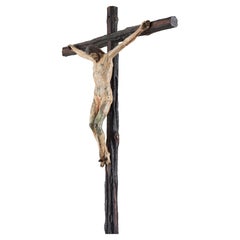
Rare and important painted bronze Crucifix after a model by Michelangelo
By Michelangelo Buonarroti
Located in Leesburg, VA
A rare and very fine bronze corpus of Christ after a model by Michelangelo, cast ca. 1597-1600 by Juan Bautista Franconio and painted in 1600 by Francisco Pacheco in Seville, Spain.
The present corpus reproduces a model attributed to Michelangelo. The best known example, lesser in quality, is one on display at the Metropolitan Museum of Art (MET).
The association of this corpus with Michelangelo was first brought to light by Manuel Gomez-Moreno (1930-33) who studied the wider circulated casts identified throughout Spain. The attribution to Michelangelo was subsequently followed by John Goldsmith-Phillips (1937) of the MET and again by Michelangelo expert, Charles de Tolnay (1960).
While Michelangelo is best known for his monumental works, there are four documented crucifixes he made. The best known example is the large-scale wooden crucifix for the Church of Santa Maria del Santo Spirito in Florence, made in 1492 as a gift for the Prior, Giovanni di Lap Bicchiellini, for allowing him to study the anatomy of corpses at the hospital there. In 1562, Michelangelo wrote two letters to his nephew, Lionardo, indicating his intention to carve a wooden crucifix for him. In 1563 a letter between Lionardo and the Italian sculptor Tiberio Calcagni, mentions this same crucifix (a sketch of a corpus on the verso of a sheet depicting Michelangelo’s designs for St. Peter’s Basillica [Palais des Beaux-Arts in Lille] may reproduce this). That Michelangelo was working on small corpora in the last years of his life is further evidenced by the small (26.5 cm) unfinished wooden crucifix located at the Casa Buonarroti, considered his last known sculptural undertaking. Michelangelo’s contemporary biographer, Giorgio Vasari additionally cites that Michelangelo, in his later years, made a small crucifix for his friend, Menighella, as a gift.
Surviving sketches also indicate Michelangelo’s study of this subject throughout his career, most notably during the end of his life but also during the 1530s-40s as he deepened his spiritual roots. The occasional cameo of crucified Christ’s throughout his sketched oeuvre have made it challenging for scholars to link such sketches to any documented commissions of importance. All the while, in consideration that such objects were made as gifts, it is unlikely they should be linked with commissions.
Nonetheless, a number of theories concerning Michelangelo’s sketches of Christ crucified have been proposed and some may regard the origin of the present sculpture. It has been suggested that the corpus could have its impetus with Michelangelo’s work on the Medici Chapel, whose exclusive design was given to the master. It is sensible smaller details, like an altar cross, could have fallen under his responsibility (see for example British Museum, Inv. 1859,0625.552). Others have noted the possibility of an unrealized large marble Crucifixion group which never came to fruition but whose marble blocks had been measured according to a sheet at the Casa Buonarroti.
A unique suggestion is that Michelangelo could have made the crucifix for Vittoria Colonna, of whom he was exceedingly fond and with whom he exchanged gifts along with mutual spiritual proclivities. In particular, Vittoria had an interest in the life of St. Bridget, whose vision of Christ closely resembles our sculpture, most notably with Christ’s proper-left leg and foot crossed over his right, an iconography that is incredibly scarce for crucifixes. The suggestion could add sense to Benedetto Varchi’s comment that Michelangelo made a sculpted “nude Christ…he gave to the most divine Marchesa of Pescara (Vittoria Colonna).”
Of that same period, two sketches can be visually linked to our sculpture. Tolnay relates it to a sketch of a Crucified Christ at the Teylers Museum (Inv. A034) of which Paul Joannides comments on its quality as suggestive of preparations for a sculptural work. Joannides also calls attention to a related drawing attributed to Raffaello da Montelupo copying what is believed to be a lost sketch by Michelangelo. Its relationship with our sculpture is apparent. Montelupo, a pupil of Michelangelo’s, returned to Rome to serve him in 1541, assisting with the continued work on the tomb of Pope Julius II, suggesting again an origin for the corpus ca. 1540.
The earliest firm date that can be given to the present corpus is 1574 where it appears as a rather crudely conceived Crucifixion panel, flanked by two mourners in low-relief and integrally cast for use as the bronze tabernacle door to a ciborium now located at the Church of San Lorenzo in Padula. Etched in wax residue on the back of the door is the date, 27 January 1574, indicating the corpus would have at least been available as a model by late 1573.
The Padula tabernacle was completed by Michelangelo’s assistant, Jacopo del Duca and likely has its origins with Michelangelo’s uncompleted tabernacle for the Basilica of St. Mary of the Angels in Rome.
The impetus for the Padula tabernacle’s Crucifixion panel begins with a series of late Crucifixion sketches by Michelangelo, depicting a scene of Christ crucified and flanked by two mourners (see British Museum Inv. 1895.0915.510; Ashmolean Museum Inv. 1846.89, KP II 343 recto; Windsor Castle RCIN 912761 recto; and Louvre Inv. 700). A faintly traced block possibly intended for sculpting the sketch of the crucified Christ on its recto was discovered by Tolnay on a version of the composition at Windsor Castle. The Windsor sketch and those related to it appear to have served as preparatory designs for what was probably intended to become the Basilica of St. Mary’s tabernacle door. Vasari documents that the project was to be designed by Michelangelo and cast by his assistant, Jacopo del Duca. Michelangelo died before the commission was complete, though on 15 March 1565, Jacopo writes to Michelangelo’s nephew stating, “I have started making the bronze tabernacle, depending on the model of his that was in Rome, already almost half complete.” Various circumstances interrupted the completion of the tabernacle, though its concept is later revitalized by Jacopo during preparations to sell a tabernacle, after Michelangelo’s designs, to Spain for Madrid’s El Escorial almost a decade later. The El Escorial tabernacle likewise encountered problems and was aborted but Jacopo successfully sold it shortly thereafter to the Carthusians of Padula.
An etched date, 30 May 1572, along the base of the Padula tabernacle indicates its framework was already cast by then. A 1573 summary of the tabernacle also describes the original format for the door and relief panels, intended to be square in dimension. However, a last minute decision to heighten them was abruptly made during Jacopo’s negotiations to sell the tabernacle to King Phillip II of Spain. Shortly thereafter the commission was aborted. Philippe Malgouyres notes that the Padula tabernacle’s final state is a mixed product of the original design intended for Spain’s El Escorial, recycling various parts that had already been cast and adding new quickly finished elements for its sale to Padula, explaining its unusually discordant quality, particularly as concerns the crudeness of the door and relief panels which were clearly made later (by January 1574).
Apart from his own admission in letters to Spain, it is apparent, however, that Jacopo relied upon his deceased master’s designs while hastily realizing the Padula panels. If Michelangelo had already earlier conceived a crucifix model, and Jacopo had access to that model, its logical he could have hastily employed it for incorporation on the door panel to the tabernacle. It is worth noting some modifications he made to the model, extending Christ’s arms further up in order to fit them into the scale of the panel and further lowering his chin to his chest in order to instill physiognomic congruence. A crude panel of the Deposition also follows after Michelangelo’s late sketches and is likewise known by examples thought to be modifications by Jacopo based upon Michelangelo’s initial sculptural conception (see Malgouyres: La Deposition du Christ de Jacopo del Duca, chef-d’oeuvre posthume de Michel-Ange).
Jacopo’s appropriation of an original model by Michelangelo for more than one relief on the Padula tabernacle adds further indication that the crucifix was not an object unique to Jacopo’s hand, as few scholars have posited, but rather belongs to Michelangelo’s original...
Category
Antique 16th Century Renaissance Figurative Sculptures
Materials
Bronze
Still Thinking About These?
All Recently ViewedMore Ways To Browse
Shell Niche
Vintage Germany Nativity
Corner Pew
Yaacov Heller
Antique Santos Crown
Bible Leaf
Brutalist Mezuzah
Carved Oak Antique Kneeling Bench
Catholic Chalice
Ceramic Holy Water Font
Church Candle Snuffer
Church Confessional
Dan Givon
Geneva Bible
Reed And Barton Cross
Santos Cage Doll
Bronze Jesus Plaque
Tibetan Skull