Want more images or videos?
Request additional images or videos from the seller
1 of 7
16th Century Italian Brass Hanukkah Lamp Menorah
$14,950List Price
About the Item
- Dimensions:Height: 6.3 in (16 cm)Width: 5.12 in (13 cm)Depth: 1.97 in (5 cm)
- Style:Renaissance (Of the Period)
- Materials and Techniques:Brass,Cast
- Place of Origin:
- Period:Early 17th Century
- Date of Manufacture:circa 1620
- Condition:Wear consistent with age and use.
- Seller Location:New York, NY
- Reference Number:1stDibs: LU5281219431462
About the Seller
5.0
Recognized Seller
These prestigious sellers are industry leaders and represent the highest echelon for item quality and design.
Established in 2006
1stDibs seller since 2020
153 sales on 1stDibs
Typical response time: 18 hours
Authenticity Guarantee
In the unlikely event there’s an issue with an item’s authenticity, contact us within 1 year for a full refund. DetailsMoney-Back Guarantee
If your item is not as described, is damaged in transit, or does not arrive, contact us within 7 days for a full refund. Details24-Hour Cancellation
You have a 24-hour grace period in which to reconsider your purchase, with no questions asked.Vetted Professional Sellers
Our world-class sellers must adhere to strict standards for service and quality, maintaining the integrity of our listings.Price-Match Guarantee
If you find that a seller listed the same item for a lower price elsewhere, we’ll match it.Trusted Global Delivery
Our best-in-class carrier network provides specialized shipping options worldwide, including custom delivery.You May Also Like
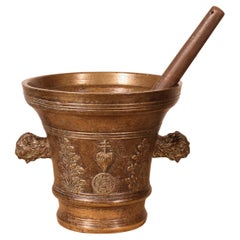
Bronze Mortar - Italy - 16th Century
Located in Brussels, Brussels
Superb Italian Renaissance bronze mortar with his pestle - 16th century
Very beautiful model with AN in its center surmounted by a cross below .
The mortar is decorated with several...
Category
Antique 16th Century Italian Renaissance Scientific Instruments
Materials
Bronze
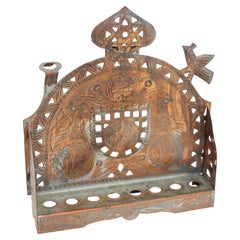
Moroccan Copper Hanukkah Lamp Judaica Menorah
By Berber Tribes of Morocco
Located in Moreno Valley, CA
Moroccan copper Hanukkah metal lamp menorah.
Judaica Menorah or Hanukkah Lamp in Brass with Openwork Pattern.
Judaica Menorah or Hanukkah lamp in coppe...
Category
Mid-20th Century Moroccan Arts and Crafts Religious Items
Materials
Metal, Copper
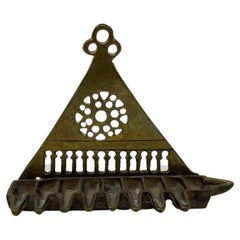
Vintage Triangular Hanukkah Menorah
Located in San Diego, CA
Beautiful vintage Hannukah Menorah. This vintage piece is a replica of a menorah from the 14th century southern Europe. Made in Israel, this piece is ...
Category
Vintage 1970s Israeli Baroque Metalwork
Materials
Brass
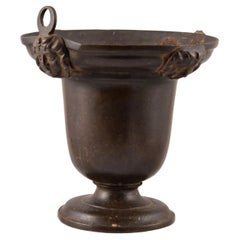
Bronze Situla, 16th Century
Located in Madrid, ES
Acetre. Bronze. Century XVI.
Bronze piece that has a circular foot, and a circular body, with an outwardly hollowed mouth at the top, and a decoration in relief in this last area o...
Category
Antique 16th Century European Renaissance Religious Items
Materials
Bronze
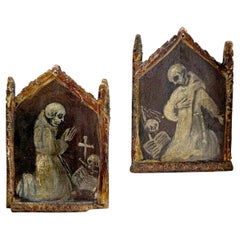
Memento Mori 16th Century Italian
Located in Hastings, GB
A truly exceptional pair of Memento Mori 'remember you must die' painted on board, these date to the 16th century and were originally housed in an North Italian Monastery, this incre...
Category
Antique 16th Century Italian Gothic Religious Items
Materials
Pine
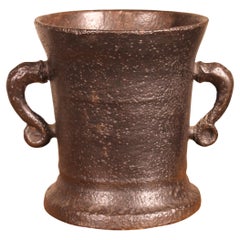
16th Century Cast Iron Mortar
Located in Brussels, Brussels
16th century cast iron mortar with two very beautiful handles
Beautiful original object with a great patina and in very good condition.
Category
Antique 16th Century French Renaissance Scientific Instruments
Materials
Iron
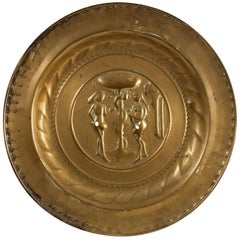
Gilt Brass Alms Collecting Dish, Nuremberg, Germany, 16th Century
Located in Madrid, ES
Alms collection dish made of gilded brass decorated with a series of moldings and details both on the edge and towards the center. In this area there is a figurative motif in light r...
Category
Antique 16th Century German Renaissance Religious Items
Materials
Brass
$1,245
H 14.97 in W 14.97 in D 1.97 in
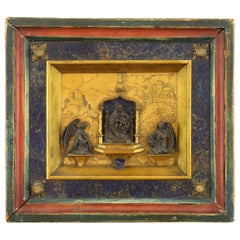
"Madonna with Child and Angels". Italy, 15th-16th Centuries
Located in Madrid, ES
Bronze in its color and gold, lapis lazuli, rock crystal, enamel.
In the centre of the work is presented, enthroned, the figure of Mary, with a mantel (fireplace) on her shoulders and hair and holding on her knees the child, who appears addressing one of the angels. The virgin is also sheltered by an ogee arch supported on turned columns, and raised visually by steps. This composition achieves a very striking contrast: the dark bronze figure, in contrast to the lapis lazuli background and the part of the arch and the outside of it, in gilded bronze. Under the steps there is a heraldic enamel shield with a key on an azure background. The angels, kneeling, are flanking this figure, and, appearing in dark bronze, visually share the "category" of religious figures with Mary, while their (lower) position gives more status to both the Mother and Jesus. The rest of the composition is completed with a delicate landscape: constructions and walls on mountains, clouds in the sky, plants, stones, etc. To the outside, another lapis lazuli frame is placed decorated in the corners with appliques, giving way to carved and polychrome wood. The lapis lazuli is a semiprecious stone already known in the seventh millennium BC., found in deposits from the Caucasus to Mauritania. From the end of the middle ages, it increased its export to Europe, its use being more frequent since then both to use it as a pigment in paintings after grinding it (giving rise to the finest and most expensive of the blues, and of the colors in many occasions), as for backgrounds of paintings, incrustations in works of art, jewelry and, a little later, in the well-known "hard stone works". The figure of Mary still shows an influence of Gothic models, although more European than Italian, along with elements that could already show a closeness to the Renaissance: although the nakedness of Jesus is already shown in Gothic works (Madonna with Angels by Fra Angelico ), the creation of space by playing with the cloth in front of Christ can be appreciated in more advanced paintings (Virgin with Child by Domenico Ghirlandaio, National Gallery of London); the presence of a powerful throne can be seen frequently in Italian Madonnas of the Quattrocento (and before), but not quite as presented here. As for the landscape, it is necessary to compare it, for example, with that of the fresco of the Condotiero Guidoriccio de Fogliano (Simone Martini, finished in 1328). This is a work of great technical and aesthetic quality, not to mention the materials chosen for its creation, comparable only to outstanding examples from around the world, such as those preserved in the Palazzo Madama in Torino (Italy), where the coral It also has an important role. It is essential to mention, also, works such as the plate of hard stones (lapis lazuli between them) with a relief of Mary with the Child in...
Category
Antique 16th Century Italian Renaissance Religious Items
Materials
Lapis Lazuli, Bronze, Enamel, Other
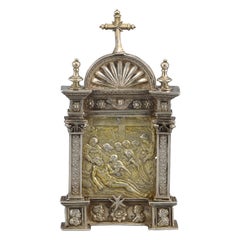
Silver Pax O Portapaz, Spain, 16th Century
Located in Madrid, ES
Portapaz. Silver in its color and gilded. Century XVI.
Portapaz made of silver that has a handle (decorated with delicate plant motifs similar to those of the pilasters) and a female and a male bust at the bottom, as well as other architectural elements on the back, and, on the front, an architectural composition classicist basement (with busts flanking a flower and a cross), two pilasters (vegetal decoration and capital recalling the composite order) with entablature (flowers flanking an angel's head; moldings), and a semicircular arch finish with elements veined in relief under cross and flanked by two architectural motifs in the upper part. This composition frames and enhances a gilt silver relief where you can see the Lament or Cry over the Body of Christ, with the Virgin holding the head of Jesus, Saint John at her side, the Magdalene and other characters, a cross following the group and a landscape background with houses and plant elements. This architectural structure mentioned is similar to the one present in other 16th century portapaces, such as that of the Magdalena de Dos Hermanas parish (Hernando de Ballesteros el Mozo, around 1575); or that of the Galaroza parish (same author and date); or that of the portapaz of San Miguel de Jerez de los Caballeros (in some details); etc. As for the relief, it is possible to clearly see a strong Italian influence, and the similarity between it and important pieces such as the Portapaz known as “de Cisneros by Juan de Burgos (1493-1497; MuseoCatedralicio de Alcalá de Henares), as well as in paintings and reliefs. Also noteworthy are both the male and female busts in the lower area and the Maltese cross (or Saint John's) that appears in this area. This symbol was used since the 12th century as an insignia by the Knights Hospitallers of the Order of Saint John of Jerusalem, also known as the Order of Malta...
Category
Antique 16th Century Spanish Renaissance Religious Items
Materials
Silver
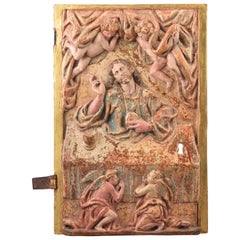
Tabernacle Door, Wood, Metal, 16th Century
Located in Madrid, ES
This type of elements are basic in churches, chapels, etc. since they contain the Sacred Forms, reason why it is logical the abundance, with a series of typologies more habitual and traditional or old than others. There are also iconographies more common than others, a certain thematic preference according to the date or school to which the work belongs, etc., always related to the Sacrifice of Christ, Salvation, Transubstantiation, Eucharist, etc. for being a key element for Christianity (especially the Catholic) what they will always contain.
The present work shows a chalice with Sacred Form in what would originally be the interior of the door (very usual iconography) and a somewhat more striking relief to the exterior. Inside that it is a Eucharistic Christ or Eucharistic Savior, the way of presenting it is more usual of the scenes of the Last Supper, being not so frequent to find it alone like this. Compare for example with works such as the door of the tabernacle attributed to Alonso Cano...
Category
Antique 16th Century Spanish Renaissance Religious Items
Materials
Metal
More From This Seller
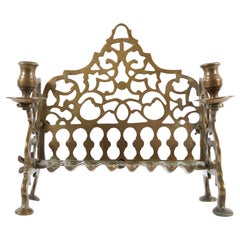
View All18th Century Galician Brass Hanukkah Lamp Menorah
Located in New York, NY
Cast brass Hanukkah Lamp, Galicia, 18th century.
The backplate is cast and pierced featuring dense scrollwork. The side panels fitted with two servant lights, fronted by a row of eight oil fonts. Scholars theorize that these Polish Chanukah Lamps that bear two servant lights (as opposed to the singular servant light normally found on a Chanukah Lamp), served a purpose, having been used on one of the days that Chanukah fell on the Sabbath, as Sabbath Candlesticks.
This lamp was made by the technique known as "sand casting". This process begins with a wooden mold that was carved out to create negative space, which in turn is used to make the inverse form or shape to be used for the casting of metal. The mold is pressed into fine sand mixed with clay, then removed, and molten brass poured into the impression. When a mold wears out, a casting from that mold is often used as the mold for the next generation. Those later lamps...
Category
Antique Mid-18th Century Polish Religious Items
Materials
Brass
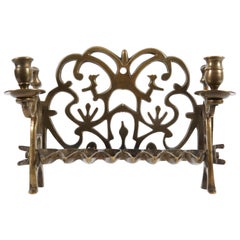
18th Century Polish Brass Hanukkah Lamp Menorah
Located in New York, NY
The backplate is cast and featuring two birds in the center surrounded by open scrollwork. The side panels fitted with two servant lights, fronted by a row of eight oil fonts. Schola...
Category
Antique 18th Century Polish Religious Items
Materials
Brass
18th Century Dutch Brass Hanukkah Lamp Menorah
Located in New York, NY
Brass Hanukkah Lamp Menorah, The Netherlands, circa 1730.
The backplate is pierced and embossed with floral motifs around the vessel in the center...
Category
Antique Mid-18th Century Religious Items
Materials
Brass
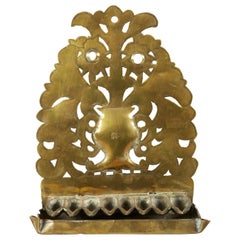
19th Century Greek Brass Hanukkah Lamp Menorah
Located in New York, NY
Brass Hanukkah Lamp, Salonika, Greece, 19th century.
Openwork backplate with scrolled branches; three stylized flowers support central triangular c...
Category
Antique Mid-19th Century Greek Religious Items
Materials
Brass
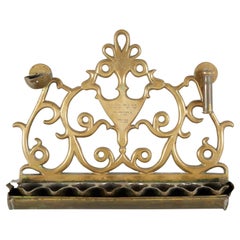
Mid-20th Century Israeli Brass Hanukkah Lamp Menorah
Located in New York, NY
Cast enameled brass Hanukkah Lamp Menorah, Israel, circa 1950.
In a form of nine Maccabees holding the candles, the Servant light (Shamash) with ...
Category
Mid-20th Century Israeli Religious Items
Materials
Brass
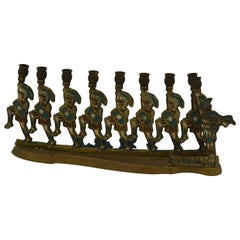
Mid-18th Century Dutch Brass Hanukkah Lamp Menorah
Located in New York, NY
Handmade silver plated brass Hanukkah Lamp, the Netherlands, circa 1750.
On four legs in bench form. Fronted with covered oil container, each oil section with hand wrought wick holder. Backplate hammered with reflective panel.
Every item in Menorah Galleries...
Category
Antique Mid-18th Century Dutch Religious Items
Materials
Brass
Still Thinking About These?
All Recently ViewedMore Ways To Browse
Spanish Colonial Reliquary
Antique Italian Rosary
Antique Miniature Bibles
Bible Stand Altar
Catholic Font
Champleve Crucifix
Dominican Cross
Ethiopian Coptic Cross
Ethiopian Processional Cross
Gorham Sterling Silver Snowflake
Henderson Chair Company
Holy English Bible
Large Processional Cross
Limoges Mary
Neon Crucifix
Omer Counter
Reliquary Arm
Sold Items Furniture