Items Similar to Adoration of the Shepherds. Carved and polychromed wood. Colonial school, 18th
Want more images or videos?
Request additional images or videos from the seller
1 of 9
Adoration of the Shepherds. Carved and polychromed wood. Colonial school, 18th
$10,061.83
£7,523.98
€8,400
CA$13,862.69
A$15,119.21
CHF 8,009.14
MX$181,257.82
NOK 102,000.79
SEK 93,272.15
DKK 64,011.35
About the Item
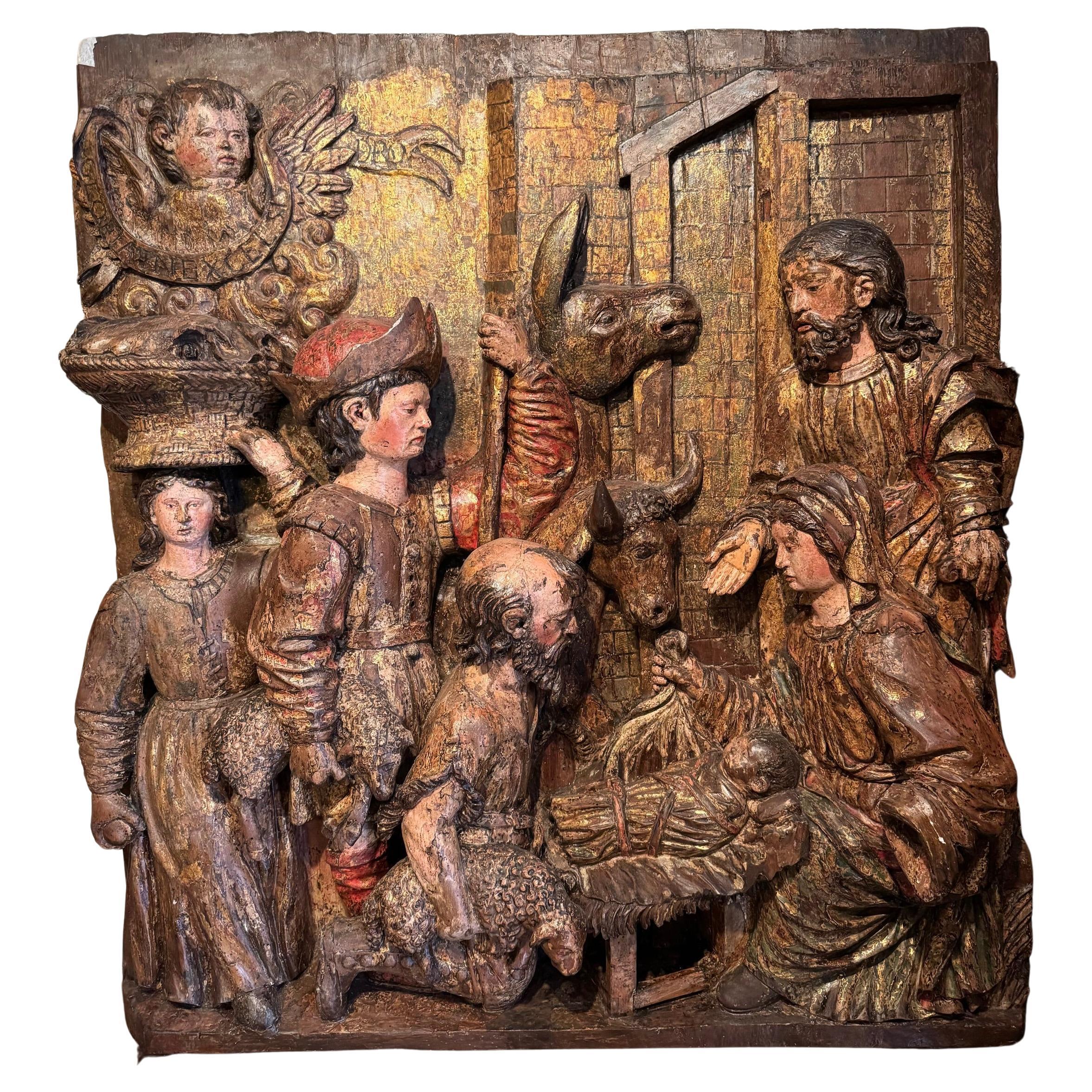
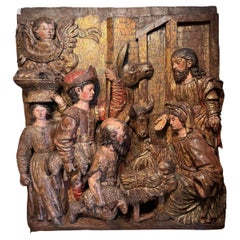
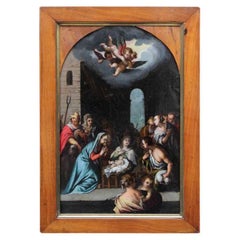
Adoration of the Shepherds. Carved and polychromed wood. Colonial school (possibly Viceroyalty of Peru), 18th century.
Fragment of a carved, polychrome, and gilded wooden altarpiece depicting a figurative scene within a rectangular space crowned by a semicircular arch. In the upper section, angels emerge from clouds holding a scroll on which some of the original text is still visible; below, a red roof partially covers vertical structures with a classical influence. In the lower section, four shepherds are depicted with a donkey and an ox. The Christ Child is positioned in the center (note that the halo resembles a cradle, or vice versa), with the Virgin Mary and Saint John at his side, their hands clasped in prayer. Iconographically, it is clear that this is the Adoration of the Shepherds. In sculpture, the school of the Viceroyalty of Peru is considered to have emerged with the establishment of the viceroyalty in 1542 (and to have disappeared in the 19th century). As was typical, in its early stages it owed much to the influence of Spanish art (especially the Sevillian school), eventually acquiring a strong identity of its own thanks to the work of indigenous masters, religious orders, and others. The main artistic centers were often Lima (the viceroyalty's capital), Quito, and Cusco (from the second half of the 17th century onward, this area would become known primarily for its dressed religious images). ·
Size: 63x7x140 cm
WEIGHT and packaging are ORIENTATIVE, MAY VARY.
International Buyers – Please Note: for those articles that need Export Permits (those older than 100 years), the obtaining of the Permit will be processed without additional expenses (if you choose the seller sends it to you), but the period for the obtention of it may vary from 10 to 35 days.
- Dimensions:Height: 55.12 in (140 cm)Width: 24.81 in (63 cm)Depth: 2.76 in (7 cm)
- Style:Other (Of the Period)
- Materials and Techniques:
- Period:
- Date of Manufacture:18th century
- Condition:Wear consistent with age and use. Minor losses. Minor fading.
- Seller Location:Madrid, ES
- Reference Number:Seller: ZF14831stDibs: LU2951347389862
About the Seller
4.9
Vetted Professional Seller
Every seller passes strict standards for authenticity and reliability
Established in 1985
1stDibs seller since 2017
357 sales on 1stDibs
Typical response time: Several days
- ShippingRetrieving quote...Shipping from: MADRID, Spain
- Return Policy
More From This Seller
View All"Madonna with Child and Angels". Italy, 15th-16th Centuries
Located in Madrid, ES
Bronze in its color and gold, lapis lazuli, rock crystal, enamel.
In the centre of the work is presented, enthroned, the figure of Mary, with a mantel (fireplace) on her shoulders and hair and holding on her knees the child, who appears addressing one of the angels. The virgin is also sheltered by an ogee arch supported on turned columns, and raised visually by steps. This composition achieves a very striking contrast: the dark bronze figure, in contrast to the lapis lazuli background and the part of the arch and the outside of it, in gilded bronze. Under the steps there is a heraldic enamel shield with a key on an azure background. The angels, kneeling, are flanking this figure, and, appearing in dark bronze, visually share the "category" of religious figures with Mary, while their (lower) position gives more status to both the Mother and Jesus. The rest of the composition is completed with a delicate landscape: constructions and walls on mountains, clouds in the sky, plants, stones, etc. To the outside, another lapis lazuli frame is placed decorated in the corners with appliques, giving way to carved and polychrome wood. The lapis lazuli is a semiprecious stone already known in the seventh millennium BC., found in deposits from the Caucasus to Mauritania. From the end of the middle ages, it increased its export to Europe, its use being more frequent since then both to use it as a pigment in paintings after grinding it (giving rise to the finest and most expensive of the blues, and of the colors in many occasions), as for backgrounds of paintings, incrustations in works of art, jewelry and, a little later, in the well-known "hard stone works". The figure of Mary still shows an influence of Gothic models, although more European than Italian, along with elements that could already show a closeness to the Renaissance: although the nakedness of Jesus is already shown in Gothic works (Madonna with Angels by Fra Angelico ), the creation of space by playing with the cloth in front of Christ can be appreciated in more advanced paintings (Virgin with Child by Domenico Ghirlandaio, National Gallery of London); the presence of a powerful throne can be seen frequently in Italian Madonnas of the Quattrocento (and before), but not quite as presented here. As for the landscape, it is necessary to compare it, for example, with that of the fresco of the Condotiero Guidoriccio de Fogliano (Simone Martini, finished in 1328). This is a work of great technical and aesthetic quality, not to mention the materials chosen for its creation, comparable only to outstanding examples from around the world, such as those preserved in the Palazzo Madama in Torino (Italy), where the coral It also has an important role. It is essential to mention, also, works such as the plate of hard stones (lapis lazuli between them) with a relief of Mary with the Child in...
Category
Antique 16th Century Italian Renaissance Religious Items
Materials
Lapis Lazuli, Bronze, Enamel, Other
Virgin and Child Jesus. Carved and polychrome wood. Spanish School, 14th century
Located in Madrid, ES
Virgin and Child Jesus. Carved and polychrome wood. Spanish School, 14th century.
A polychrome wooden carving with gold highlights depicting the Virgin Mary seated on a low throne, ...
Category
Antique 15th Century and Earlier European Gothic Religious Items
Materials
Other
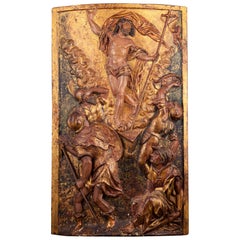
“Ressurrection”, Polychromed Wood, Spanish School, 16th Century
Located in Madrid, ES
The relief was probably a door of the Sagrario. The piece follows a customary decoration in the tabernacles of the Renaissance and the Baroque. Compare, for example, with the sevente...
Category
Antique 16th Century Spanish Renaissance Religious Items
Materials
Other
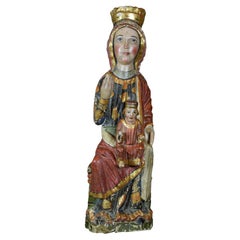
Virgin with Child. Carved and polychrome wood. Spanish school, 13th century.
Located in Madrid, ES
Virgin with Child. Carved and polychrome wood. Spanish school, 13th century.
It has faults.
Polychrome wood carving that shows the Virgin sitting on a throne, with her right hand r...
Category
Antique 15th Century and Earlier Spanish Gothic Religious Items
Materials
Other
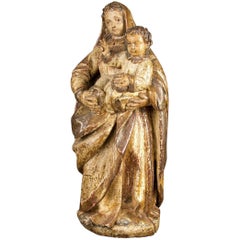
"Virgin with Child Jesus". Spain, End of the 17th-Early 18th Century
Located in Madrid, ES
Spanish Baroque sculpture is one of the most authentic and personal examples of our art, because its conception and its form of expression arose from the people and from the deepest ...
Category
Antique Late 17th Century Spanish Baroque Religious Items
Materials
Wood
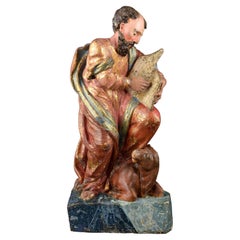
"Saint Luke the Evangelist", Polychromed Wood, 16th Century
Located in Madrid, ES
Saint Luke is often represented as a man of mature and bearded age, accompanied by the animal of the Tetramorphs with which he is related (Revelation 4: 67)...
Category
Antique 16th Century Spanish Renaissance Religious Items
Materials
Wood
You May Also Like
Adoration of the shepherds - Large high-relief, Northern Italy Circa 1500
Located in PARIS, FR
Large high relief in carved and gilt wood, with many traces of polychromy, representing the Adoration of the Shepherds.
The evangelist Luke first mentions that the scene takes place at night. A sudden light, which frightens the shepherds, signals the arrival of an angel who announces "great joy". He gives them a sign: they will find "a newborn baby wrapped...
Category
Antique 16th Century Italian Renaissance Figurative Sculptures
Materials
Wood
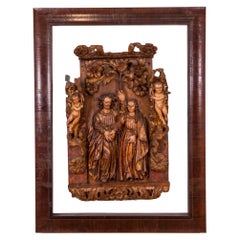
The Betrothal and Love of Mary and Joseph, 1500-1600s, Carved Wood Polychromed
Located in North Miami, FL
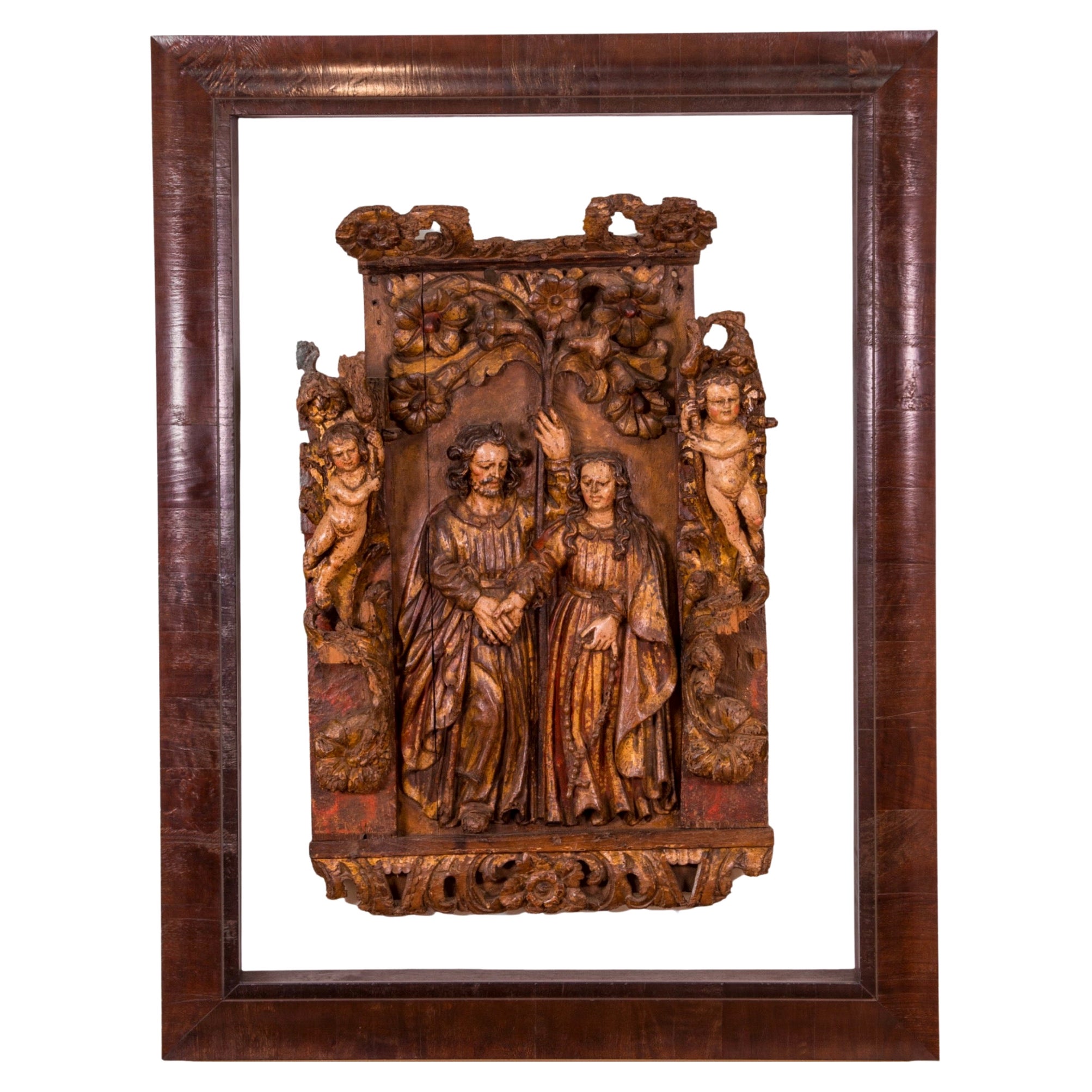
Early 16th Century Spanish carved-wood and polychromed panel of The Betrothal and Love of Joseph and Mary mounted on a Lucite panel and framed with a walnut wood hand-finished frame.
Category
Antique 16th Century Spanish Renaissance Wall-mounted Sculptures
Materials
Gold Leaf
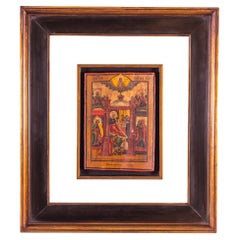
Nativity of the Mother of God, 17th Century
Located in North Miami, FL
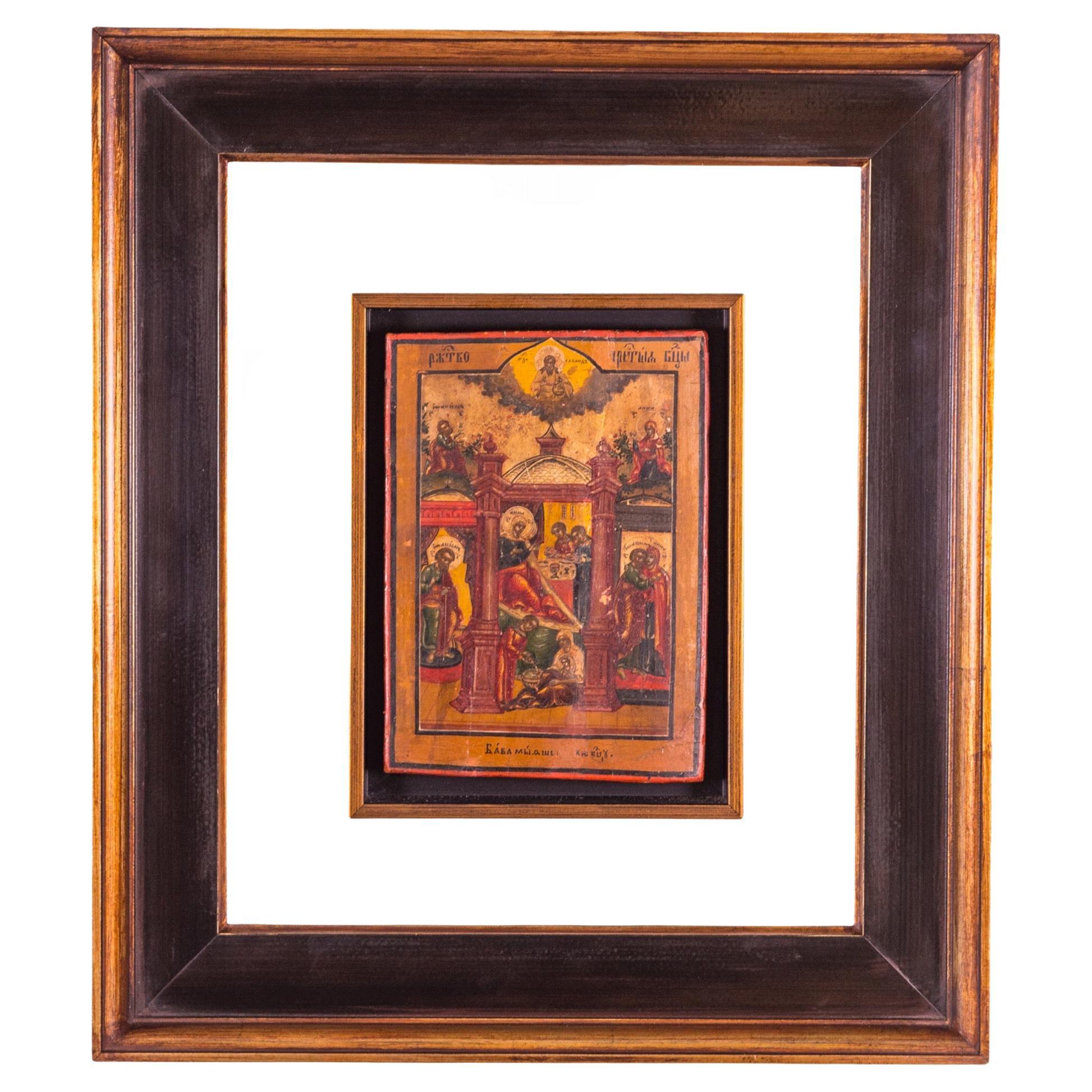
Late 17th Century Russian Orthodox Icon of the Nativity of the Mother of God painted over gold leaf and gesso laid on a wooden board. It has been framed with a gold gilded museum mou...
Category
Antique 17th Century Russian Baroque Wall-mounted Sculptures
Materials
Gold Leaf
$7,600 Sale Price
20% Off
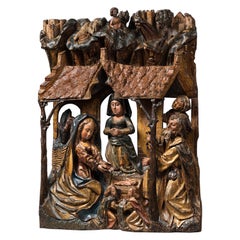
Late 15th Century Polychrome Wood Carving Depicting the Nativity
Located in Saint-Ouen, FR
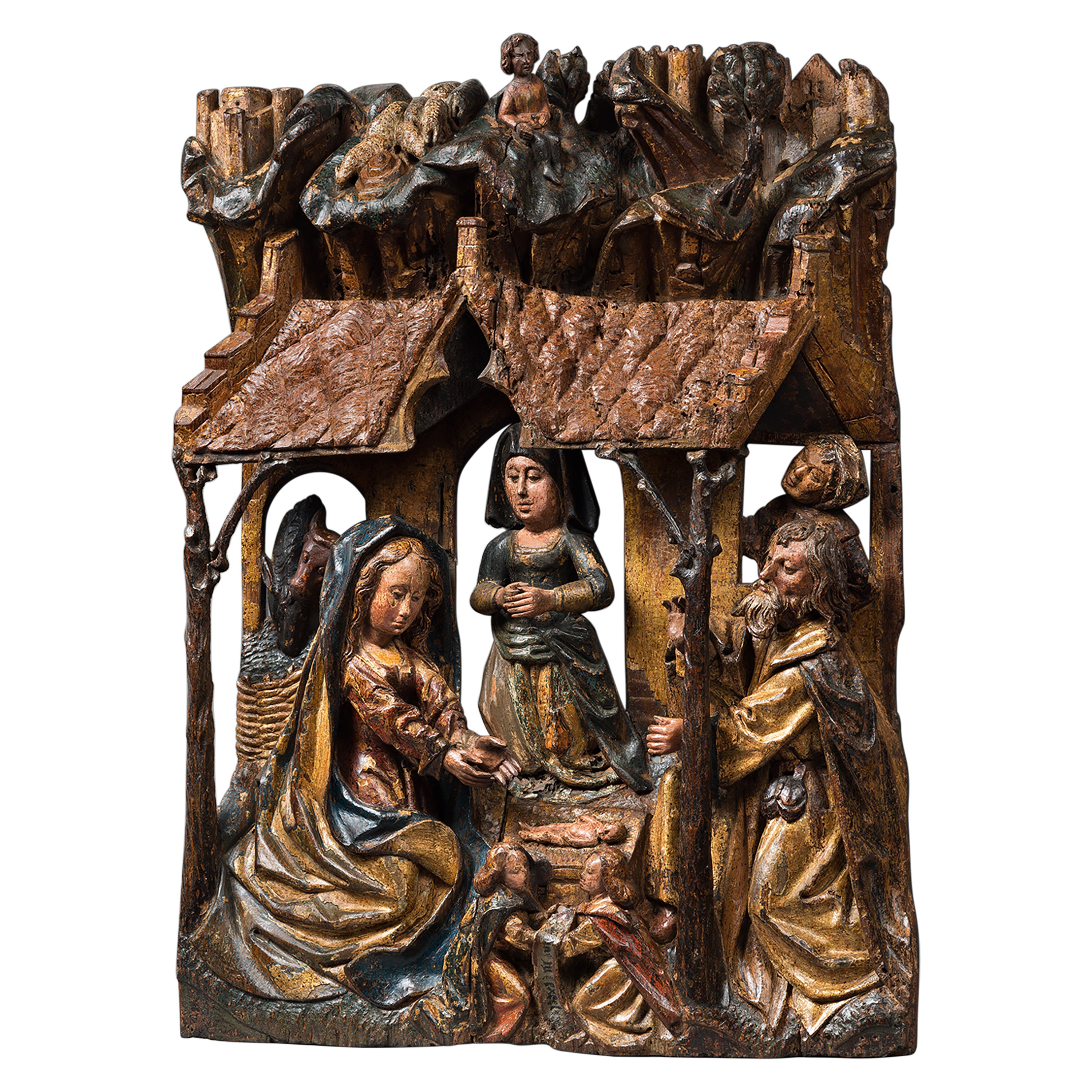
While the birth of Christ is briefly told in the Gospel of Luke (2, 7) it is in the apocryphal texts that we find most of the elements and details that have then inspired artists. As of the 14th century and even more of the 15th century the subject of the Adoration of the Child replaces in Western art the scene of the Birth, much favoured in Byzantine art. Instead of being depicted lying with the new-born swathed in the manger, the Virgin is now kneeling, her hands joined in prayer in front of the naked child. This change was probably hastened by the popularity of the visions of Saint Bridget of Sweden to whom the Virgin allegedly appeared to show how she had given birth to Jesus (Visions, VII, chap. 21).
Sheltered by a thatch-roofed structure the Virgin is kneeling in front of the Child Jesus. She wears a magnificent red dress under a large gold cloak. Her curled blond hair is partially veiled. The newborn is lying on a straw mat. Joseph is depicted with a parted beard and stands opposite from the Virgin. He wears a tunic and a coat with a purse hanging from the belt. His costume reminds us of the long journey him and Mary have accomplished to reach Bethlehem.
Two other women are present. One is looking through the stable’s window to observe the Holy Family while another one kneels in prayer in front of the divine child. The rich costume of the lady might indicate she is a donator.
However they could also both represent the women who took part in the birth of Christ, Zelemi and Salome. Salome, incredulous did not believe in the virginal conception of Mary and she is represented far from the scene. The artist has depicted her with an expression of doubt on her face. Zelemi, on the contrary, is a believer. She is rewarded by a place of honour at the heart of the scene, close to Mary.
To the left the donkey and ox that have accompanied Mary and Joseph to Bethlehem observe quietly the scene.
On the foreground two angels hold a scroll reading an excerpt from the Gloria : “/Gloria/ in excelsis /Deo/.” One of the angels wears a blue cape while the other’s is red Those two colours are very significant as during Middle-Ages blue symbolises hope and red charity. Together they express the hope in redemption thanks to the advent of Christ and his sacrifice to come.
Above the main scene, up a cliff, a small shepherd lets his herd of sheep graze amidst the trees. He is framed by two walled cities.
This wood carving is the work of a very skilled and inventive artist. The piece bears witness to his exceptional talent. The realism of the scene is emphasised by the amount of details depicted. The refinement of the carving itself is highlighted by the well preserved polychromy.
This key moment of the New Testament is set in a contemporary context thanks to the clothes of the characters and the scenes of rural life. The universal dimension of the scene is intensified while allowing contemporary viewers to grasp its meaning more easily.
This care for details, the picturesque realism as well as the extraordinary rendition of the cloths suggest it was made by a Flemish artist during the late 15th century.
This relief can be compared with the panel of the Nativity from the Saint-Vaast altarpiece made by Jacques Daret between 1433 and 1435, today in Madrid’s Thyssen-Bronemisza Museum.
Literature
Louis Réau, Iconographie de l’Art chrétien...
Category
Antique 15th Century and Earlier Dutch Gothic Figurative Sculptures
Materials
Wood
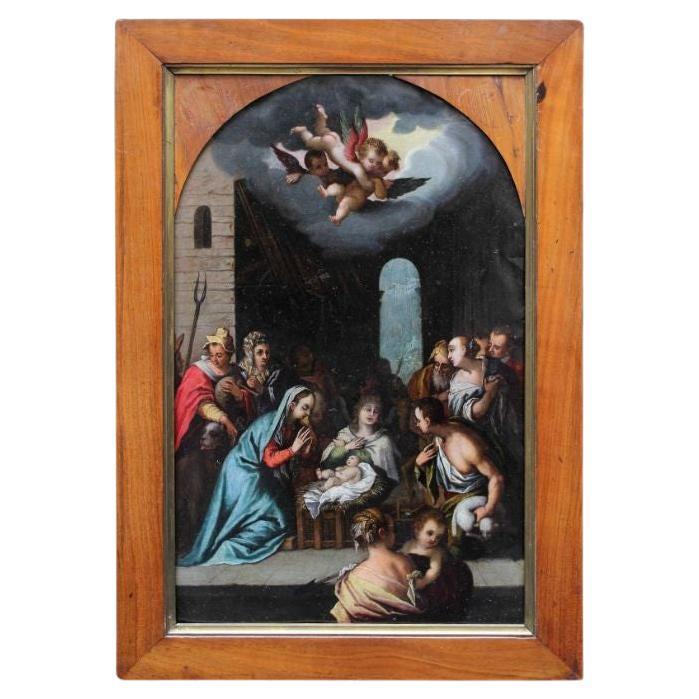
16th Century Adoration of the Shepherds Painting Oil on Copper by Carnevale
By Carnevale Studio
Located in Milan, IT
Domenico Carnevale (Sassuolo, 1524 - Modena, 1579) Adoration of the Shepherds
Oil on copper, 42 x 28 cm
Frame 54 x 36 cm
Expert opinion of Prof. Emilio Negro
The painting represents the Adoration of the Shepherds, the Child in the center, next to the Madonna kneeling in prayer and an angel behind her; towards him in the foreground a woman with a child in her arms, a shepherd with a sheep on the right, a bagpiper on the left and various other male and female characters turn to him. The architectures of the background, between which a glimpse of the landscape can be glimpsed, are hidden in the upper part by the clouds, where a "celestial glory" encamps with three flying angels.
The painting shows mannerist characters that can be traced back to the second half of the sixteenth century, and can be traced back to an author from the Modena area, with stylistic references to the Bolognese Samacchini (1532 - 1577) and Passerotti (1529 - 1592). More precisely, it can be attributed to Domenico Carnevale (1524-1579), one of the most important masters of the sixteenth century active in the local area. The Carnival was formed in Emilia, his homeland, where he worked for many years. However, his works also show a clear Roman influence, dictated by a long experience in the city, during which he also dedicated himself to the restoration of the Sistine Chapel. Trained in the late-mannerist environment of Modena, he is also linked to the Parmesan Corrorese and Ferrarese Dossesque tradition; Carnival also always maintains a slight archaic sentiment in his work,
The main stylistic reference must be identified in a work similar in subject and iconographic setting, coming from the church of the Pio Istituto Orfanelle di San Geminiano di Modena, currently part of the Art Collection of the Province, attributed to the same influence as the Carnival. Another interesting comparison should be identified with A Presentation of Jesus in the Temple...
Category
Antique 16th Century Italian Paintings
Materials
Copper
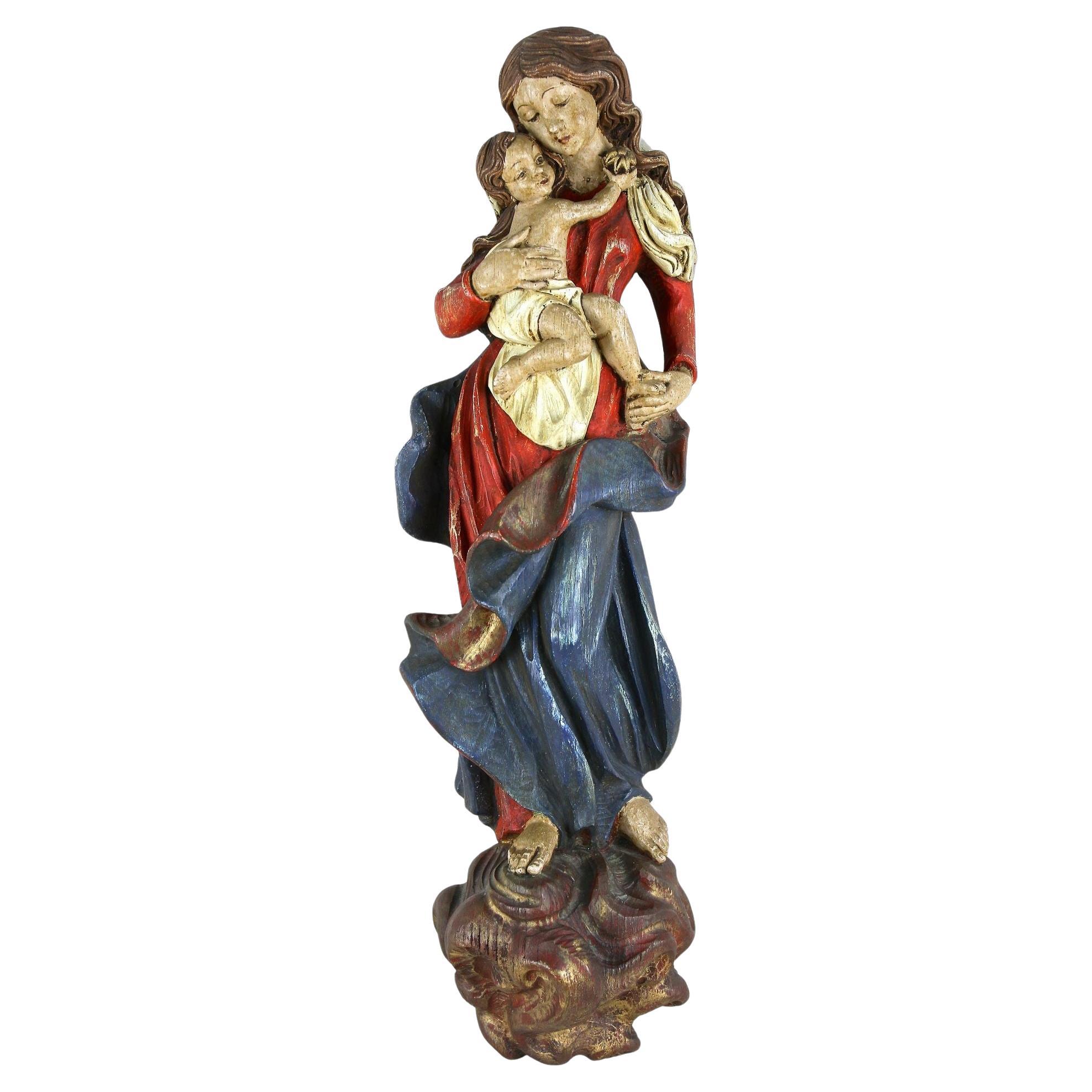
18th Century Polychrome Virgin
Child Wall Sculpture, Handcarved, AT ca. 1760
Located in Lichtenberg, AT
Exceptionally beautiful, polychromed figural baroque wall sculpture from the period around 1760 in Austria. By showing real craftsmanship, this fantastic looking, sacred wall sculptu...
Category
Antique Mid-18th Century Austrian Baroque Wall-mounted Sculptures
Materials
Softwood
