Items Similar to A Dutch Jewish Hospital Charity Container, Netherlands, Circa 1920
Want more images or videos?
Request additional images or videos from the seller
1 of 7
A Dutch Jewish Hospital Charity Container, Netherlands, Circa 1920
$700
£530.18
€608.90
CA$980.93
A$1,066.47
CHF 565.44
MX$12,784.24
NOK 7,186.48
SEK 6,583.79
DKK 4,550.75
About the Item
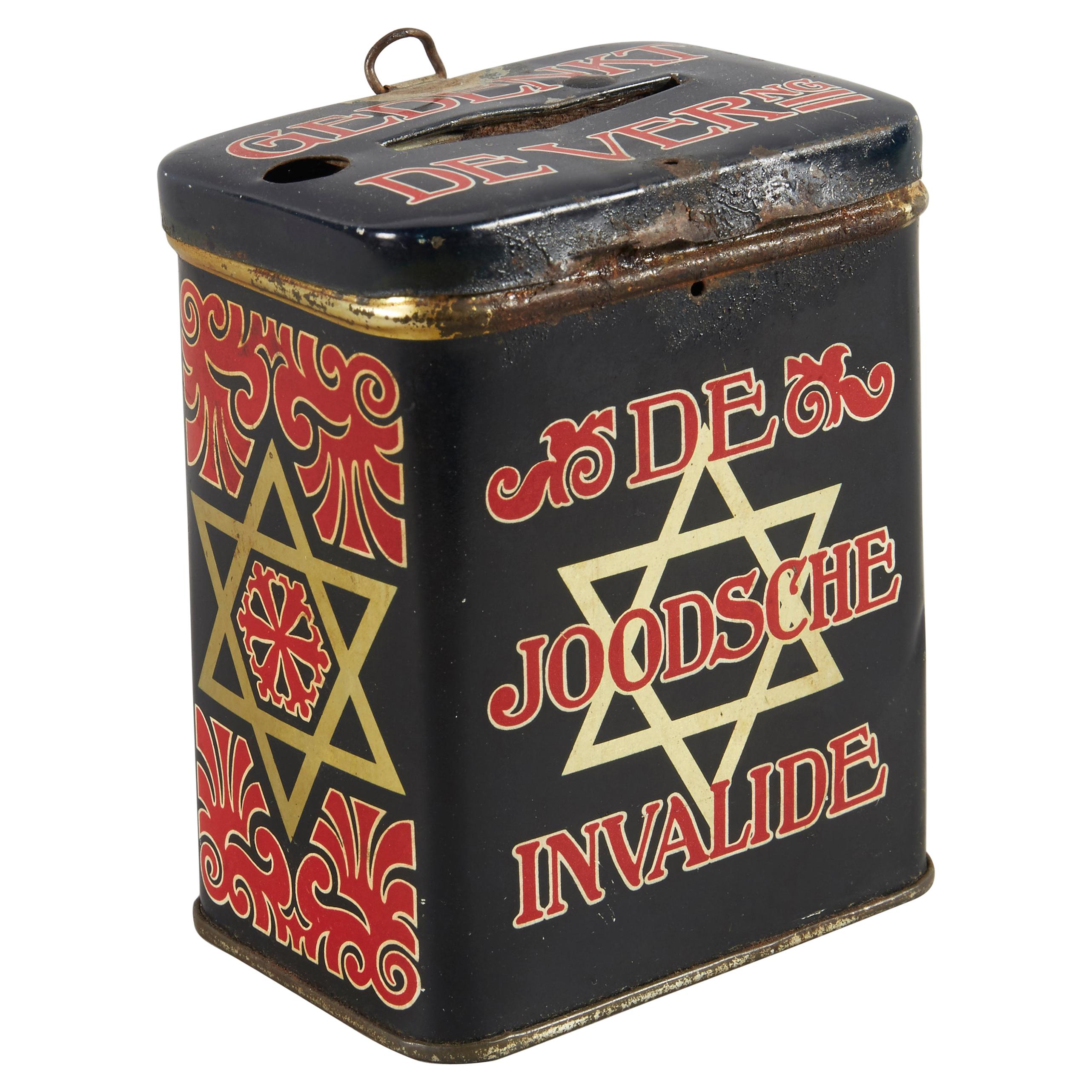
A Dutch Jewish Hospital Charity Container from the Netherlands, circa 1920, is a unique Judaic historical artifact.
This charity container was used to collect donations for a Jewish hospital in the Netherlands. These containers served as a means for the community to contribute funds to support medical care and services for those in need.
The container was a part of the philanthropic efforts within the Dutch Jewish community during the early 20th century. Supporting hospitals and medical institutions was particularly important in Jewish communities, reflecting values of compassion (tzedakah) and communal solidarity.
Charity container is painted black with gold stars of David on the background on all sides. "De Joodsche Invalide" (The Jewish Invalid) is painted in red on both sides with scrolling red designs on the the two smaller sides. At the top, "Gedenkt De Verng" (Thank You Very Much) is written in red with a slot for inserting donations, and a suspension ring used to hang the charity container in public areas.
Historically this charity container was made in the interwar period, a time marked by economic challenges growing antisemitism, and political instability. Such charity containers are now valuable artifacts that provide insights into the charitable practices and community life of Dutch Jews in the early 20th century. They are collected by museums and private collectors interested in Jewish history and material culture.
Numbered 1285 at the bottom.
- Dimensions:Height: 3.94 in (10 cm)Width: 3.04 in (7.7 cm)Depth: 2.09 in (5.3 cm)
- Materials and Techniques:
- Place of Origin:
- Period:
- Date of Manufacture:1920 s
- Condition:Wear consistent with age and use.
- Seller Location:New York, NY
- Reference Number:1stDibs: LU5281240024112
About the Seller
5.0
Recognized Seller
These prestigious sellers are industry leaders and represent the highest echelon for item quality and design.
Established in 2006
1stDibs seller since 2020
152 sales on 1stDibs
Typical response time: 18 hours
- ShippingRetrieving quote...Shipping from: Pomona, NY
- Return Policy
More From This Seller
View AllEarly 20th Century Dutch Tin Charity Box
Located in New York, NY
Black, red, and gold painted tin charity box, The Netherlands, circa 1915.
Used for collecting funds for the Jewish hospital.
Decorated with Stars of ...
Category
Early 20th Century Dutch Decorative Boxes
Materials
Metal
A Turkish Or-A
Haïm National Israelite Hospital Charity Container, Circa 1930
Located in New York, NY
A charity container for the Turkish Or-A'Haïm National Israelite Hospital from circa 1930 is a historically significant artifact reflecting efforts to support healthcare and charitab...
Category
Vintage 1930s Turkish Religious Items
Materials
Tin
A Tin Charity Container, Belgium Early 20th Century
Located in New York, NY
A tin charity container for Kollel Shomrei HaChomot in Belgium from the early 20th century was used to collect donations for this religious institution comprising several schools, an...
Category
Early 20th Century Belgian Religious Items
Materials
Tin
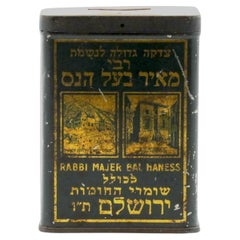
A Keren Hayeshuv Charity Container, Israel Circa 1940
Located in New York, NY
A Keren Hayeshuv charity container from Israel circa 1940 is an artifact tied to the early years of the State of Israel and its efforts to support Jewish settlement and development.
Keren Hayeshuv, which translates to "The Settlement Fund," was an organization established in Israel during the pre-statehood period and continued its activities after the establishment...
Category
Vintage 1940s Israeli Religious Items
Materials
Tin

A Moroccan Charity Container, Circa 1920
Located in New York, NY
This Moroccan charity container from around 1920 is a unique artifact that represents the containers that were often used for collecting donations or contributions for various charit...
Category
Vintage 1920s Moroccan Religious Items
Materials
Tin
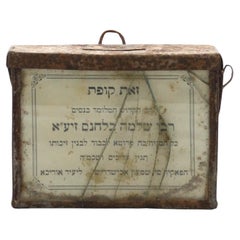
A Kollel America Charity Container, New York Circa 1930
Located in New York, NY
A Kollel America Tiferet Jerusalem Charity Container from New York circa 1930 is tied to the charitable activities of Jewish immigrant communities in America raising donations for ca...
Category
Early 20th Century American Religious Items
Materials
Tin
You May Also Like
extremely rare Algerian Judaica silver, jewish Dowry box early 19th century
Located in Tel Aviv - Jaffa, IL
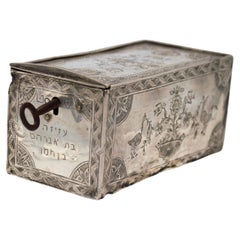
Amazing and scarce JUDAICA object, we have here one of the most touching jewish objects we had for a long time, this small silver dowry box was made in Algeria in the early 19th century, it is all covered with symbols of jewish faith and of couples, the sliding lid has 2 flanking birds with hamsa (protective hand) on each side and a flower vase in the middle.
one side shows two flanking lions with a tree in the middle and the other side shows again two big and two small birds with a flower bowl in the middle, front side has a key hole and next to it there is the Hebrew inscription ס״ט״" which says Siman tov or in English "a good sign" it is taken from the wedding blessing, underneath the lock there is another inscription with the name ״עזיזה בת אברהם בן חמו״ which is the name of the bride, her father and her grandfathers name.
the box is full marked a lot of times with the silversmith mark, every side of the box is marked.
this box was probably ordered by the grooms family to hold the jewelry they are giving to the bride as dowry, this type of objects are rare and there are just a few of them on museum collections.
DOWRY (Heb. נְדֻנְיָה), the property a wife brings to her husband at marriage; the Yiddish equivalent, nadn, is from the same root. The custom of nedunyah became clearly defined and institutionalized only in the talmudic period. In biblical times, mohar (מֹהַר), whereby the groom bought his wife from her father (Gen. 24:53; Ex. 22:15–16; Hos. 3:2), was the accepted practice. It was then customary that the groom give the bride gifts, and that she bring certain property to her husband's home upon marriage: slaves, cattle, real estate, etc. (cf. Gen. 24:59–61; 29; Judg. 1:14ff.; I Kings 9:16). Evidence of the custom of nedunyah is to be found in Tobit (7:14; 8:21) and in the Assuan papyri (Cowley, Aramaic, nos. 15, 18). Gradually, mohar was superseded by the ketubbah custom according to which the husband merely assumed the responsibility of compensation to his wife in case he divorced her: he had to pay her 200 zuzim if she had been a virgin at the time of marriage, and 100 zuzim if a widow or divorcée (see *Ketubbah).
By talmudic times, the institution of nedunyah was prevalent; the father gave a dowry to the bride since the daughter was excluded from paternal inheritance. Fifty zuzim (equivalent to the worth of 180 grams of silver) was the minimum amount a father was obliged to give to his daughter (Ket. 6:5). Parents usually gave much more, according to their social standing. Community funds provided the dowry for an orphan or a very poor girl (ibid.; cf. Sh. Ar., YD 251:8). In case of her father's death, the brothers of a minor girl were obliged to give her the minimum dowry, and the court estimated how much her father would have given her above the minimum dowry. The sum was then taken out of the father's estate and given to the daughter upon majority (Ket. 6:6; 68a–69b). In the absence of such an estimate, each daughter was entitled to receive one-tenth of the value of her father's estate in money, or in valuables (Yad, Ishut, 20:4–7; Sh. Ar., EH 113:4). If the father was unable or unwilling to pay the promised dowry at the betrothal ceremony, the groom could refuse to marry his bride (Ket. 13:5; Ket. 108b–109a). Insistence on exact payment of the promised dowry, however, was frowned upon by later rabbinic authorities (Rema to Sh. Ar., EH 2:1). In certain communities it was customary for the groom's father to make a dowry contribution equal to that of the bride's father (Ket. 102b). The dowry, whether given in real estate, slaves, money, or chattel was recorded in the marriage contract (the ketubbah) and in some instances one-third or one-fifth of the actual value of the dowry was added to the sum mentioned in the ketubbah. Based upon a decree enacted by *Simeon b. Shetah (first century C.E.), the Talmud ruled that the husband and his entire property were liable for compensation as stipulated in the ketubbah, either in case he died (when she collected the sum specified in the ketubbah from the heirs) or in case he divorced his wife (Ket. 82b). For the status of the dowry and the husband's rights and obligations, see below. The rabbinic enactments (Takkanot Shum) by R. Jacob *Tam and by the rabbinic synod of the communities of Speyer, Worms, and Mainz (Germany) stipulated that if a woman died...
Category
Antique Mid-19th Century Algerian Tribal Art
Materials
Silver
Lidded box by Just Andersen, 1920s, Denmark
By Just Andersen
Located in Værløse, DK
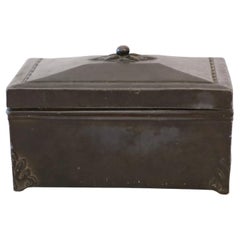
A lidded metal casket made by Just Andersen in the 1920s. It is early work by the Danish designer and a timeless piece for a beautiful home.
* A metal casket / jewellery box with a...
Category
Vintage 1920s Danish Decorative Boxes
Materials
Metal
Large Antique Tobacco Tin Box, 1930s 1940s
Located in Greven, DE
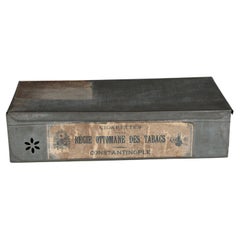
Antique Tobacceo Box from France.
Category
Vintage 1930s French Decorative Boxes
Materials
Tin
Large 1930s Tin Box "Kaffee-Schilling", Schilling
Sohn Bremen Vintage Tin Can
Located in Greven, DE
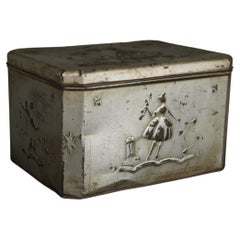
Antique Tin Box from "Kaffee-Schilling" Bremen.
Category
20th Century German Decorative Boxes
Materials
Tin
Dutch 18th Century Copper Tobacco Box
Located in Delft, NL
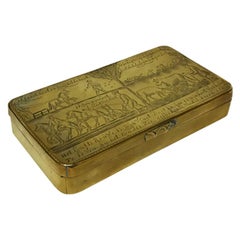
A Dutch 18th century copper tobacco box
A beautiful Dutch 18th century copper tobacco box with engraved on both sides and old Dutch text. The copper box is lined with tin on the ins...
Category
Antique 18th Century Dutch Tobacco Accessories
Materials
Tin, Copper
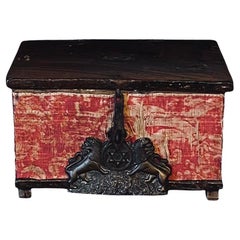
Antique Extremely Rare Judaica Tzedakah Synagoge Charity Box 16th Century
Located in Doha, QA
This 16th century Tzedakah Charity Box is an incredibly rare and unique museum quality piece. It’s made out of walnut wood and has an original 16th century silk material all over it from outside as well as in the inside, bronze plug in the front and the Star of David with two lions from the left and right side of the Star. There are also two round bronze handles to lift the box from both sides. The Tzedakah Box...
Category
Antique 16th Century Spanish Gothic Historical Memorabilia
Materials
Metal
More Ways To Browse
Antique Hospital
Interwar Period
Antique Furniture Containers
Used Hospital Furniture
Antique Hospital Furniture
Antique Dutch Tins
Jewish Religious Items
Used Processional Cross
Wooden Christ
Agnus Dei
Antique Quran
Before Christ
English Bible
Wood Tabernacle
Carved Wood Religious Figure
Jesus Crucified
Religious Santos
Antique Bible Book