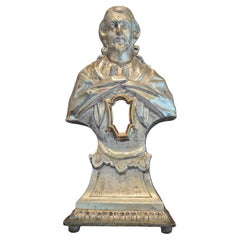
Want more images or videos?
Request additional images or videos from the seller
1 of 21
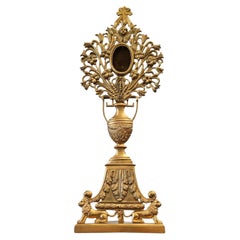
European Gothic Religious Gilt Metal Reliquary Altar Monstrance
$950List Price
About the Item
- Dimensions:Height: 11 in (27.94 cm)Width: 4.75 in (12.07 cm)Depth: 4 in (10.16 cm)
- Style:Gothic (In the Style Of)
- Materials and Techniques:
- Place of Origin:
- Period:
- Date of Manufacture:20th Century
- Condition:Wear consistent with age and use. A superb example, in overall great original vintage condition. Presents splendidly. May have minor wear commensurate with age, use, handling.
- Seller Location:Forney, TX
- Reference Number:1stDibs: LU5977246836062
About the Seller
4.8
Platinum Seller
Premium sellers with a 4.7+ rating and 24-hour response times
Established in 2013
1stDibs seller since 2021
317 sales on 1stDibs
Typical response time: 1 hour
Authenticity Guarantee
In the unlikely event there’s an issue with an item’s authenticity, contact us within 1 year for a full refund. DetailsMoney-Back Guarantee
If your item is not as described, is damaged in transit, or does not arrive, contact us within 7 days for a full refund. Details24-Hour Cancellation
You have a 24-hour grace period in which to reconsider your purchase, with no questions asked.Vetted Professional Sellers
Our world-class sellers must adhere to strict standards for service and quality, maintaining the integrity of our listings.Price-Match Guarantee
If you find that a seller listed the same item for a lower price elsewhere, we’ll match it.Trusted Global Delivery
Our best-in-class carrier network provides specialized shipping options worldwide, including custom delivery.You May Also Like
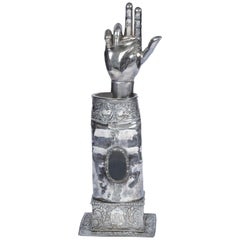
Rare 17th Century Silver Reliquary Arm Monstrance
Located in Amsterdam, NL
A rare silver reliquary arm with relic bone, with the coat-of-arms of Cosme Roger (1671-1710), bishop of Lombez, France, with original bone relic
Poss...
Category
Antique Late 17th Century Italian Renaissance Religious Items
Materials
Sterling Silver
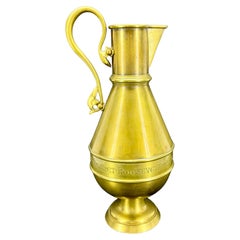
Large Religious Gothic Brass Water Jug Marked Roosevelt
Located in Haddonfield, NJ
Substantial Gothic Revival brass jug marked with names Margaret, Philip and Roosevelt as well as maker J&R Lamb New York. Certainly religious in nature with the cross inscribed arou...
Category
Late 20th Century American Gothic Religious Items
Materials
Brass
$320 Sale Price
33% Off
H 21.5 in W 11 in D 9 in
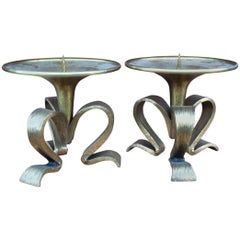
Large Pair Gothic Revival Arts
Crafts Brass Table or Altar Candlesticks
Located in Lisse, NL
Large and heavy pair of altar candle sticks.
These handcrafted and heavy candleholders are made around 1930 by H. v/d Heijden. With beautiful scro...
Category
Mid-20th Century Dutch Gothic Candlesticks
Materials
Brass
$1,859
Free Shipping
H 10.5 in Dm 10.5 in
18th Century French Giltwood Architectural Monstrance
Located in Dallas, TX
More information coming soon…
A beautiful and towering French monstrance, measuring 37 inches tall. Hand-carved in the 1700s, the giltwood architec...
Category
Antique 18th Century French Gothic Religious Items
Materials
Silk, Upholstery, Wood, Giltwood

English Gothic Oak Altar
Located in Queens, NY
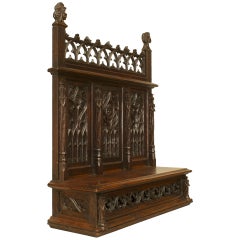
English Gothic style (19th Cent) dark oak table top altar with a filigree shelf under 3 tracery carved panels with an open lattice gallery
Category
Antique 19th Century British Religious Items
Materials
Oak
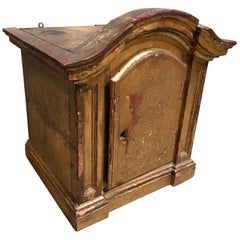
Italian Gilt Reliquary Box
Located in Dallas, TX
This 18th century Italian gilded reliquary box is made to contain a personal relic or shine. It has brackets for wall mounting. The front of the door has...
Category
Antique 18th Century Italian Religious Items
Materials
Giltwood
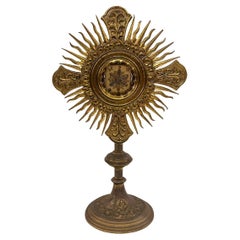
Antique Gilt Bronze Reliquary
Located in New York, NY
A late 19th Century French gilt bronze reliquary with removable glass insets that hold an embroidered sachet.
Measurements:
Height: 14.5"
Diameter: 9"
Category
Antique Late 19th Century French Religious Items
Materials
Bronze
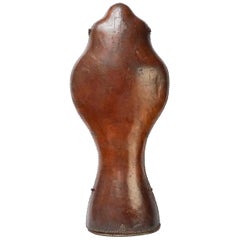
18th Century French Cuir-ciselé Extra Large Reliquary Chalice or Monstrance Case
Located in Haarlem, NL
Large decorative antique 18th century 2-piece reliquary or monstrance case to hold a religious relic.
This is a large case, 87cm high, 38cm wide and 20cm deep (34.3" x 15" x 7.9")...
Category
Antique 18th Century French Religious Items
Materials
Leather, Damask, Wood
$2,000 Sale Price
20% Off
H 34.26 in W 14.97 in D 7.88 in
Large Antique French Gilt Bronze Gothic Altar Jesus Statue Griffin Candlestick
Located in Portland, OR
A fine & large 33" tall antique French Gothic ecclesiastical gilt bronze "Vive Jesus" candlestick, circa 1890.
The candlestick is very finely cast of heavy gilt bronze, the top havin...
Category
Antique 1890s French Gothic Revival Religious Items
Materials
Bronze
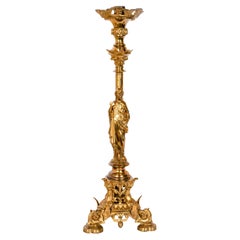
$1,250
H 33 in W 11 in D 11.5 in
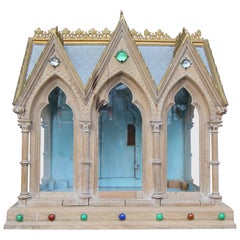
Late 19th Century Gothic Revival Reliquary Casket
Located in Dusseldorf, DE
A Gothic Revival reliquary. Circa late 19th / early 20th century. Made of solid oak with fine carving.
Reliquaries have been used to store relics since the Middle Ages. In sacred architecture they are often located behind the main altar in the chancel. In addition to classical, often church-like caskets, anthropomorphic, so-called "speaking" reliquaries were also made, which already inform the viewer about their contents through their own design. Mostly they were made of precious metals and decorated with rich sculptural ornaments or precious stones. One of the most famous examples of reliquaries is the Epiphany shrine of Nicholas of Verdun from the late 12th or early 13th century in Cologne Cathedral.
The reliquary offered here has an architectural structure with a rectangular ground plan. The three-sided glazed box with a dormer roof rests on a plinth.
A total of 8 columns of Corinthian order form the arcades which are crowned on both long sides by 3 lancets each and enclose the lancet windows...
Category
Antique Late 19th Century German Gothic Revival Religious Items
Materials
Glass, Oak
More From This Seller
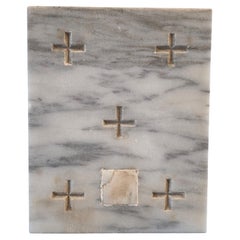
View AllAntique Religious Carved Marble Church Reliquary Altar Stone
Located in Forney, TX
A scarce carved marble altar stone fragment, most likely Italian, the rectangular consecrated Carrara marble panel serves as a reliquary containing important relics, adorned with cro...
Category
Antique 19th Century Classical Roman Religious Items
Materials
Carrara Marble
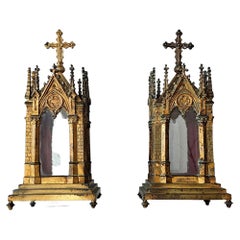
Fine 19th Century French Neo-Gothic Gilt Metal Cathedral Church Reliquary Pair
Located in Forney, TX
A stunning pair of very fine quality French Neo-Gothic gilt metal church reliquaries. circa 1860s
Most impressive objets d’art, born in France in the second half of the 19th century, most likely Parisian gilded bronze and brass ormolu work, exceptionally executed sculptural form, the exquisitely detailed architectural cathedral shaped case having a removable pointed steeple roof with cross finial, opening to relic display case surrounded on all sides by original glazed glass panes, stepped base, rising on disc feet. Signed, stamped by maker / bronzier "BC" (unknown) model "5096" and other faint marks to lid interiors.
Additional photos available upon request
Dimensions: (approx)
14.75" High, 6.75" Wide, 6.75" Deep; 13.25 lbs total
History:
A reliquary (also referred to as a shrine, by the French term châsse or monstrance) is a container for important religious relics.
The earliest reliquaries were essentially boxes, either simply box-shaped or based on an architectural design, taking the form of a model of a church with a pitched roof. These latter are known by the French term chasse, and typical examples from the 12th to 14th century have wooden frameworks with gilt-copper plaques nailed on, decorated in champlevé enamel. Limoges was the largest production centre; NB the English usage differs from that of the French châsse, which denotes large size rather than shape.
Relics of the True Cross became very popular from the 9th century onward and were housed in magnificent gold and silver cross-shaped reliquaries decorated with enamels and precious stones. From about the end of the 10th century, reliquaries in the shape of the relics they housed also became popular; hence, for instance, the skull of Pope Alexander I was housed in a head-shaped reliquary. Similarly, the bones of saints were often housed in reliquaries that recalled the shape of the original body part, such as an arm or a foot.
A philatory is a transparent reliquary designed to contain and exhibit the bones and relics of saints. This style of reliquary has a viewing portal to view the relic inside. The feretrum was a medieval form of reliquary or shrine containing the sacred effigies and relics of a saint.
During the later Middle Ages, the monstrance form, primarily used for consecrated hosts, was sometimes used for reliquaries. These housed the relic in a rock crystal, or glass capsule mounted on a column above a base, enabling the relic to be displayed to the faithful. Reliquaries in the form of large pieces of metalwork jewellery also appeared around this time, housing tiny relics such as pieces of the Holy Thorn, notably the Holy Thorn Reliquary now in the British Museum.
Condition:
Superb museum quality examples, in excellent original unrestored antique condition with beautifully aged patina. Wear consistent with age and use. Heavily patinated - scattered oxidation. Overall wonderful examples.
Typically reliquaries were not sold in pairs, so to find a matching pair such as this is exceptionally rare.
Worldwide shipping available
Local pickup available near Dallas, Texas
Additional:
We here at Lynx Hollow Antiques love religious antiques, from Christian tabernacles, Catholic altarpiece, life-size Buddhist temple sculptures, Hindu votive offerings, 16th century Islamic mosque architectural salvaged windows...
Category
Antique Mid-19th Century French Gothic Revival Religious Items
Materials
Brass, Bronze
Fine 19th Century European Gilt Bronze Ormolu Monstrance Reliquary
Located in Forney, TX
A scarce fine quality neoclassical Empire style vasiform gilt bronze ormolu church religious relic altar monstrance reliquary.
Exquisitely hand-crafted in Continental Europe in the second half of the 19th century, most likely French Napoleon III Period (1852-1870), having a fanned cross crest, above winged angel mask, central oval display...
Category
Antique 19th Century European Empire Sculptures and Carvings
Materials
Bronze, Ormolu
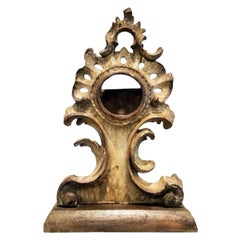
Important Early 18th Century Italian Carved Monstrance Reliquary Tabernacle
Located in Forney, TX
Important and historic, acquired from the estate of legendary American businessman, the late T. Boone Pickens, we're proud to offer this exceptional carved giltwood reliquary - monstrance from the early 18th century.
Elaborately hand carved in period Rococo - Rocaille taste, with superb scrollwork, openwork, fanciful acanthus leaf and shell, ornate detailing, polychrome painted warm pastel colors, now beautifully distressed, muted tones, with remnants of gold gilded accents.
Pieces such as this were used in early churches for convenient exhibition or public display of some object of piety and other important religious relics...
Category
Antique Early 18th Century Italian Rococo Religious Items
Materials
Giltwood
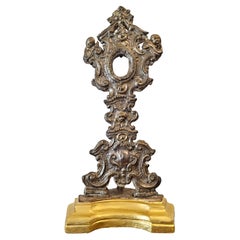
18th/19th Century Italian Baroque Silvered Metal Altar Monstrance Reliquary
Located in Forney, TX
A stunning antique Italian Baroque style silvered metal gilded wood monstrance reliquary. circa 1770-1820
Handmade in Italy in the late 18th / early 19th century, commissioned by the church to display an important religious relic, sculptural painted wood form, mounted with decorative silver repousse metal facing, open oval window where the philatory relic was once housed, rising on a gold gilt painted shaped plinth base.
Dimensions: (approx)
17" High, 8" Wide, 5" Deep, 1.25lbs
History:
Reliquaries (also referred to as a shrine or châsse in French), are containers used to protect and display relics. A portable reliquary may be called a fereter, and a chapel in which it is housed a feretory. A monstrance, also known as an ostensorium (or an ostensory), is a vessel used in Roman Catholic, Old Catholic, High Church Lutheran and Anglican churches for the display on an altar of some object of piety, such as the consecrated Eucharistic host during Eucharistic adoration or Benediction of the Blessed Sacrament. It is also used as reliquary for the public display of relics of some saints.
The use of reliquaries became an important part of Christian practices from at least the 4th century, initially in the Eastern Churches, which adopted the practice of moving and dividing the bodies of saints much earlier than the West, probably in part because the new capital of Constantinople, unlike Rome, lacked buried saints. Relics are venerated in the Oriental Orthodox, Eastern Orthodox, Roman Catholic and some Anglican Churches. Reliquaries provide a means of protecting and displaying relics. While frequently taking the form of caskets, they range in size from simple pendants or rings to very elaborate ossuaries.
The relics were enshrined in containers crafted of or covered with gold, silver, gems, and enamel. These objects constituted a important form of artistic production across Europe and Byzantium throughout the Middle Ages.
Many were designed with portability in mind, often being exhibited in public or carried in procession on the saint's feast day or on other holy days. Pilgrimages often centered on the veneration of relics. The faithful often venerate relics by bowing before the reliquary or kissing it; those churches which observe the veneration of relics distinguish between the honor given to the saints and the worship that is due to God alone.
Sixteenth-century reformers such as Martin Luther opposed the use of relics since many had no proof of historical authenticity and objected to a cult of saints. Many reliquaries, particularly in northern Europe, were destroyed by Calvinists or Calvinist sympathizers during the Reformation...
Category
Antique Early 19th Century Italian Baroque Sculptures and Carvings
Materials
Metal
Antique Italian Carved Silvered Gilt Wood Altar Reliquary Bust Sculpture 18th C.
Located in Forney, TX
Italy, late 18th century, church altar reliquary, hand carved solid wood, gesso, and silver leaf, in Baroque taste, finely detailed figural bust form, with hollowed central relic com...
Category
Antique Late 18th Century Italian Baroque Religious Items
Materials
Gold Leaf, Silver Leaf