Items Similar to 19th Century English Globe by Renowned Cartographers John Newton and Son
Want more images or videos?
Request additional images or videos from the seller
1 of 21
19th Century English Globe by Renowned Cartographers John Newton and Son
$66,763.82
£49,000
€56,904.01
CA$91,908.75
A$100,474.28
CHF 53,155.42
MX$1,202,336.30
NOK 676,326.36
SEK 619,108.36
DKK 425,037.74
About the Item
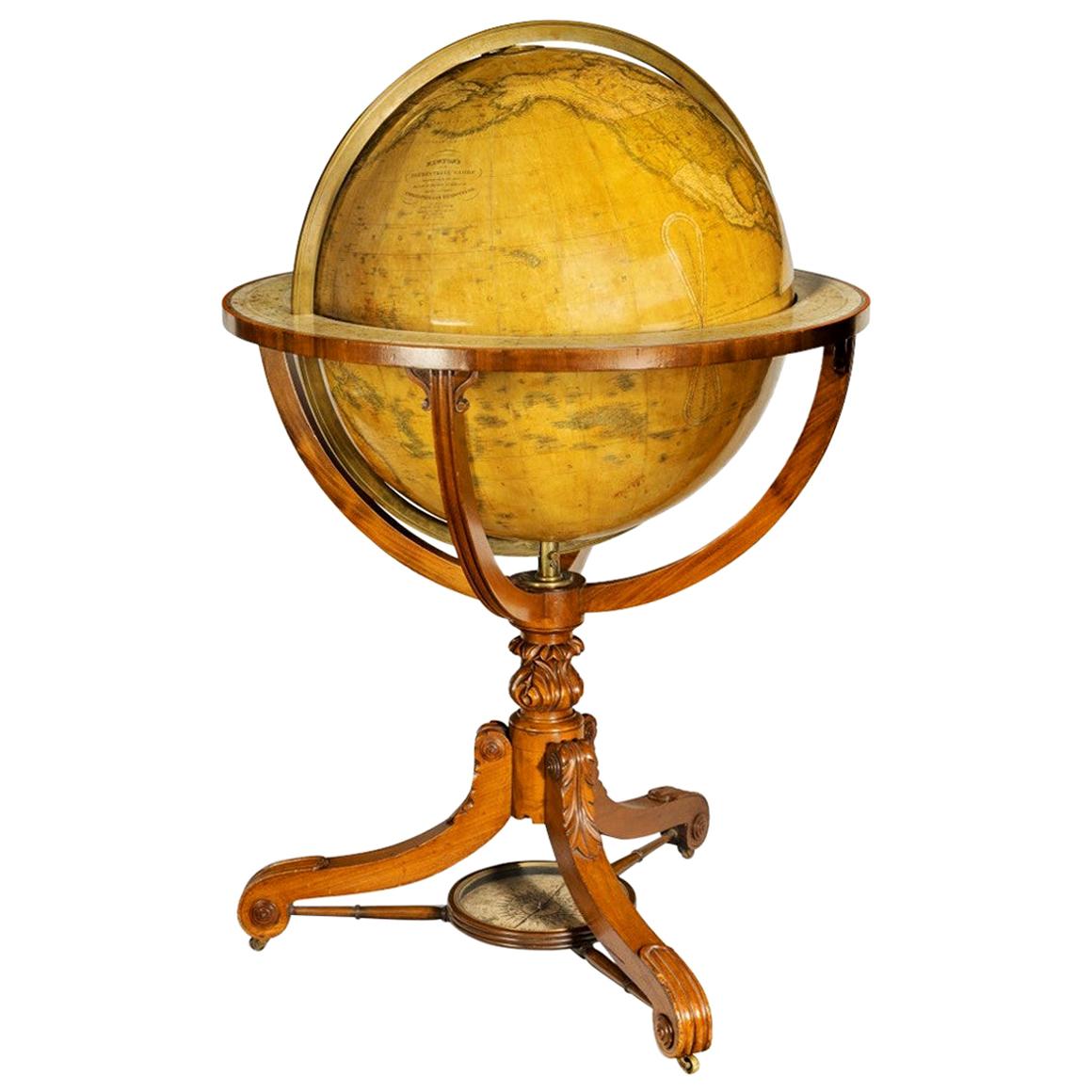
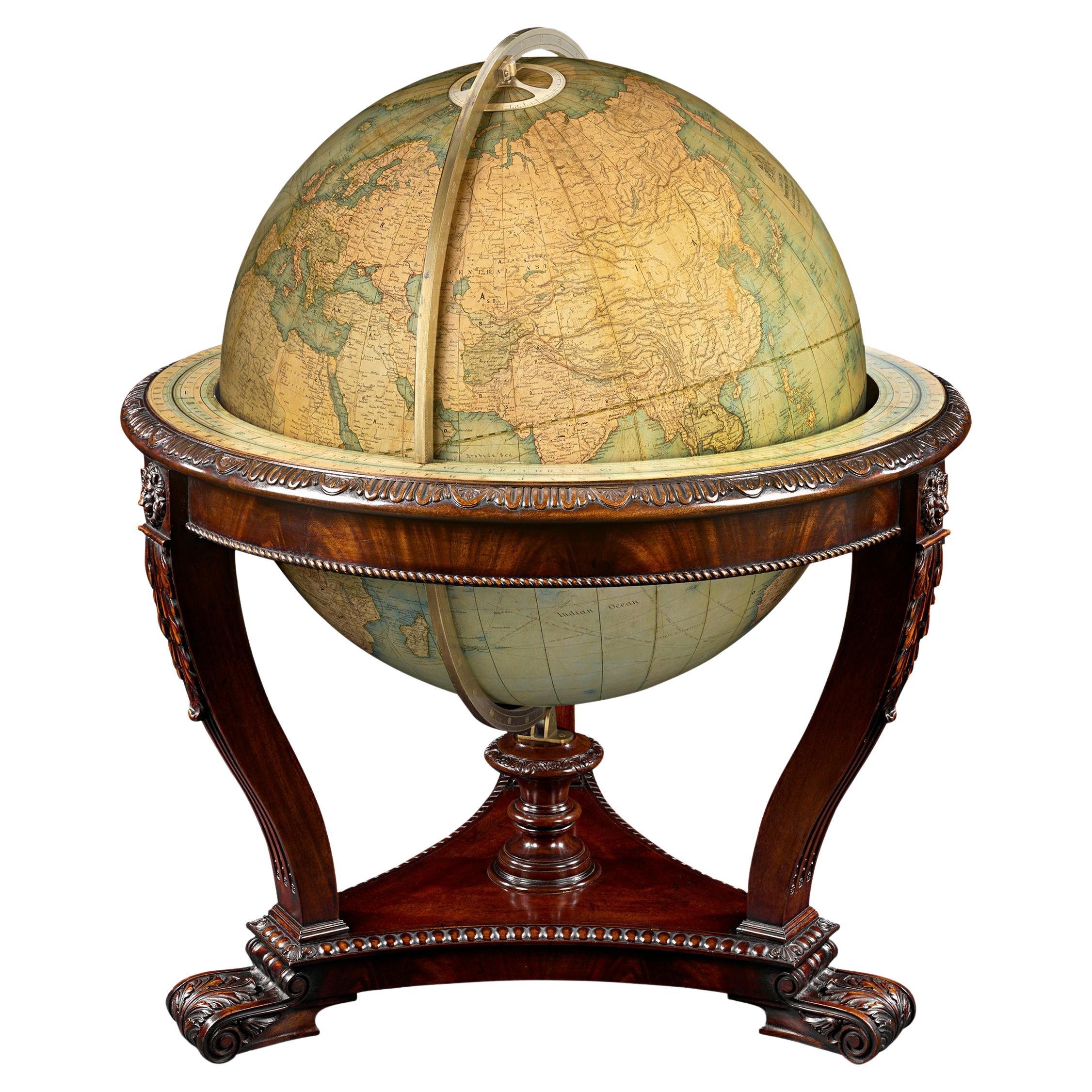
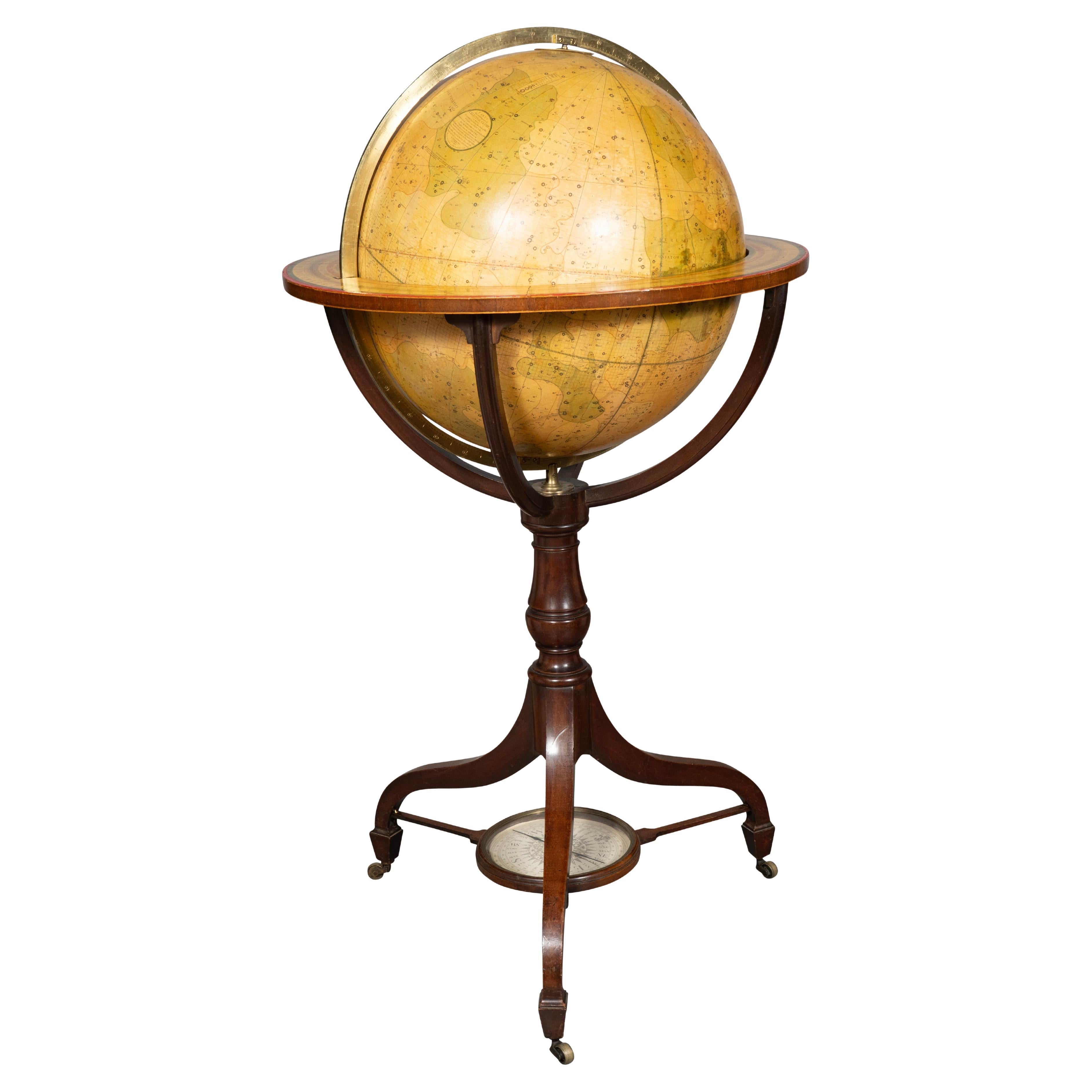
An extremely rare and important 21 inch English globe by renowned cartographers John Newton and Son, one of the most important globe makers of early 19th century England. Representing the terrestrial landscapes, this sphere rests in its gorgeous mahogany Stand, displaying a rich patina. Newton and Son were also one of the few firms to combine instruments with globes. In this globe, the compass is set in the base of the stand to complete the design, while a tilting angle of 90 degrees on this globe makes for ease of viewing. This globe is even more unusual for its size: Not only were globes rarely crafted with a 21 inch diameter, but the surface area of a globe this size is an incredible 307% larger than that of a more common 12 inch globe. To own these globes was to have a wealth of information at one’s fingertips. Rendered in painstaking detail, this globe presents scientific understanding of the world and sky that would have been invaluable to all areas of business, including shipping, geography, and especially exploration. Terrestrial: circa 1852. The firm of Newton
Son is considered to be among the leading manufacturers of Fine 19th century globes and are well represented in museums around the world. During the 19th century, the firm, led by the Newton family of cartographers, occupied a leading position the production of globes in London, crafting floor standing, table and pocket globes. Its founder was John Newton, the product of generations of globe making apprenticeships. Founded in 1780, Newton
Son published its first globe in 1783, a pocket globe using copper plates struck by the legendary Nathaniel Hill in 1754.
- Creator:Newton and Son (Maker)
- Dimensions:Height: 42 in (106.68 cm)Width: 27 in (68.58 cm)Depth: 27 in (68.58 cm)
- Materials and Techniques:
- Place of Origin:
- Period:
- Date of Manufacture:1852
- Condition:Wear consistent with age and use.
- Seller Location:Southall, GB
- Reference Number:1stDibs: LU5808224930162
About the Seller
5.0
Vetted Professional Seller
Every seller passes strict standards for authenticity and reliability
Established in 1956
1stDibs seller since 2021
76 sales on 1stDibs
Typical response time: 9 hours
- ShippingRetrieving quote...Shipping from: London, United Kingdom
- Return Policy
More From This Seller
View AllAntique French Liquor Caddie, 19th Century
Located in Southall, GB
A spectacular 19th century mahogany circular inlaid liquor caddie. The caddie is inlaid throughout, and stands on four beautifully floral cast mounted Or...
Category
Antique 19th Century French Barware
Materials
Ormolu
English Bracket Clock, 19th Century
Located in Southall, GB
A fine quality 19th century English bracket clock of the Georgian era. The classical styled numerals and gilt topped case are surmounted by a floral sculpture. Marked on the face 'Le...
Category
Antique 19th Century European Mantel Clocks
Materials
Bronze
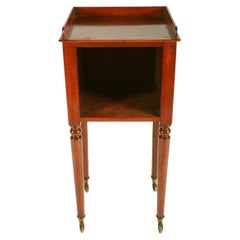
Victorian Bedside Cabinet, 19th Century
Located in Southall, GB
Victorian Mahogany bedside cabinet
A mid 19th century Victorian mahogany open front bedside cabinet.
The cabinet has a gallery back and stands on four turned legs with brass ca...
Category
Antique 19th Century English Cabinets
Materials
Mahogany
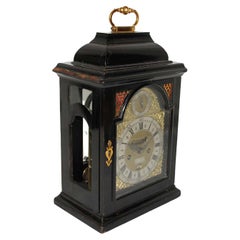
Early 18th Century Francis Gregg English Bracket Clock
Located in Southall, GB
Francis Gregg, London. A fine table clock. The break arch brass dial with silvered chapter ring, matted centre, calendar aperture and false pendulum aperture with silvered cartouche ...
Category
Antique Early 18th Century English Mantel Clocks
Materials
Wood
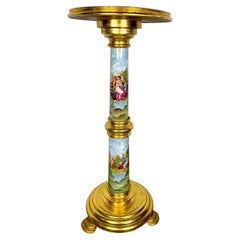
19th Century Sevres Style Porcelain Pedestal
Located in Southall, GB
This outstanding pedestal beautifully exhibits the style and grace of the famed Sèvres porcelain manufactory. This exceptional piece features a lustrous light blue base, which provid...
Category
Antique Late 19th Century French Empire Porcelain
Materials
Porcelain
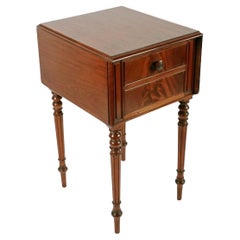
George IV Mahogany Bedside Cabinet, 19th Century
Located in Southall, GB
George IV Mahogany bedside cabinet
A George IV mahogany drop leaf bedside cabinet.
The cabinet has a mock drawer front that falls forward to open and has a knob handle with a t...
Category
Antique 19th Century English Cabinets
Materials
Mahogany
You May Also Like
Large and Extremely Rare Terrestrial Globe by Newton
By Newton Globes - Planer
Newton
Located in Lymington, Hampshire
A large and extremely rare 24-inch terrestrial globe by Newton
Our most magnificent and rare globes were a pair of 24-inch Newton globes.
These too were updated in 1852 (terre...
Category
Antique Mid-19th Century English Globes
Materials
Mahogany
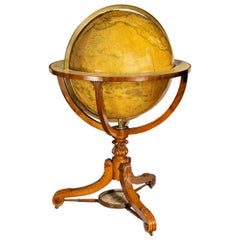
Early 20th Century American Library Globe
Located in Norwell, MA
Fine library globe with makers logo from Atlas School Supply Co., Chicago. Hardwood base with rich finish and nice detail. Celestial globe with equ...
Category
Vintage 1920s North American Maps
Materials
Wood
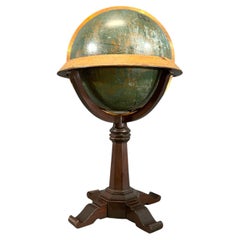
Antique 19th Century Smiths Terrestrial Globe By George Philips
Son Ltd c.1890
By George Philip
Son
Located in Royal Tunbridge Wells, Kent
Antique 19th Century English terrestrial globe made by George Philips and Son. Set on a walnut stand. This piece makes a striking addition to any library or serves as a decorative ye...
Category
20th Century British Other Globes
Materials
Walnut
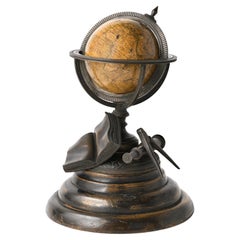
Miniature Terrestrial Globe Newton
Son London, Post 1833, Ante 1858
By Newton and Son
Located in Milano, IT
Miniature Terrestrial Globe
Newton
Son
London, post 1833, ante 1858
Paper, papier-mâché, bronze and wood
It measures: sphere diameter 2.95 in (7.6 cm); diameter of the wooden base 6.02 in (15.3 cm); height 8.36 in (21.24 cm).
Weight: 2,067 lb.
State of conservation: the globe still bears its original paint, but has various small gaps, abrasions and stains on the surface.
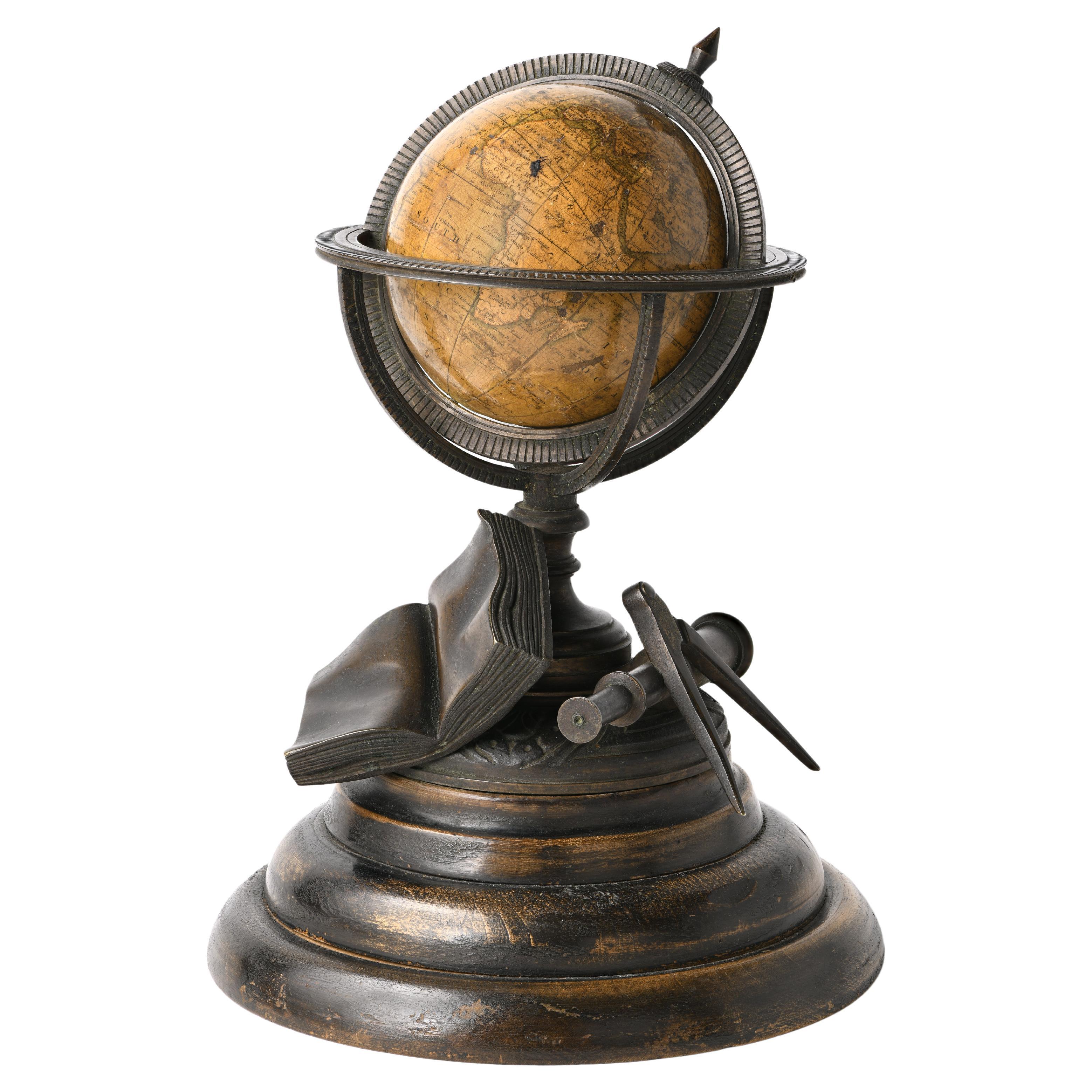
The globe is hinged with two pins at the meridian circle, which is in turn inserted perpendicular to the horizon circle; this is supported by four semi-arches connected at the bottom by a small goblet-shaped foot, resting on a wooden bell-shaped base.
Apart from the wooden base, the entire support structure is made of bronze; on the foot there are the scale reproductions of a compass, a telescope and an open book.
The sphere is made of papier-mâché and is covered with twelve printed paper gores.
In the North Pacific Ocean the globe bears a cartouche with the inscription (about 30% of the writing is illegible, but the missing parts can be easily integrated based on the rest):
NEWTON’S
New
Improved
TERRESTRIAL
Globe
Published by Newton
Son
66 Chancery Lane
LONDON
On the globe, much of central Africa is empty and the great lakes Tanganyika and Victoria are not marked (Europeans would begin to explore the area after 1858). Canada is called "British Territory" and Alaska "Russian Territory" (it would become part of the United States in 1867). Australia already bears its modern name (until 1829 it had been called New Holland) and its coasts are completely designed; Tasmania is listed as an island (Matthew Flinders circumnavigated it in 1798). The routes of Cook's various voyages are plotted; both the route followed by Biscoe in 1831 and the "Land of Enderby" which he discovered on the coast of Antarctica, south of Africa, are marked.
Bibliography
P. Van der Krogt, Old Globes...
Category
Antique 1840s English Early Victorian Maps
Materials
Bronze
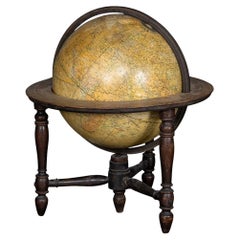
Terrestrial Globe by W.
A.K. Johnston
By W.
A.K. Johnston
Located in New Orleans, LA
Measuring a monumental 30 inches in diameter, this impressive globe was crafted by the renowned firm W. & A.K. Johnston. Founded in 1825, the Johnston firm is considered the foremost...
Category
Antique 19th Century English Victorian Globes
Materials
Brass
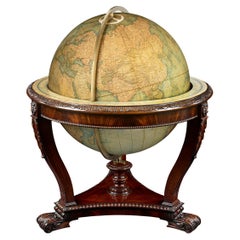
George III Celestial Floor Globe By J&W Cary
Located in Essex, MA
Carys New and Improved Celestial globe. Dated 1799. Cary was one of Englands leading globe makers of the late 18th century. Set in a mahogany stand with three saber legs and joined b...
Category
Antique Late 18th Century English George III Globes
Materials
Brass
More Ways To Browse
Used Furniture Newton
Globe On Stand Floor Globe
Standing Globes
Pocket Globe
Antique Pocket Globe
Antique Floor Globe
19th Century Telescope
Antique Aneroid Barometer
Human Bone
19th Century Thermometer
19th Thermometer
Antique Weighing Scales
Antique Armillary Sphere
Antique Brass Lenses
Antique Brass Sign
Antique Glass Thermometer
Weather Instruments
Weighing Scales