Items Similar to A Copernican armillary sphere, Paravia, Milan, Italy 1930
Want more images or videos?
Request additional images or videos from the seller
1 of 21
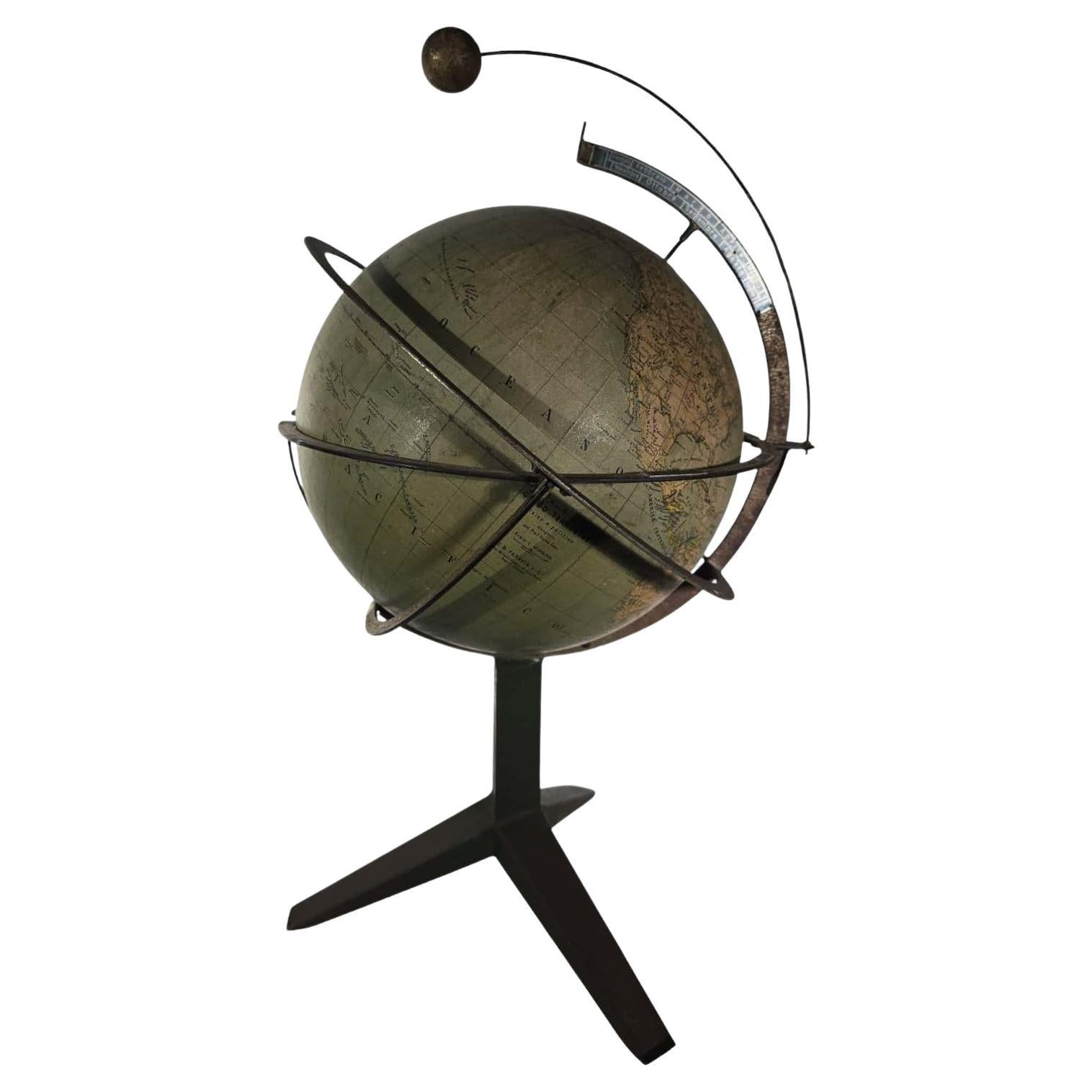
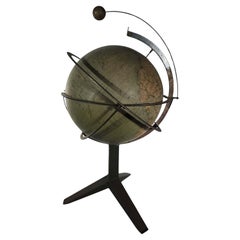
A Copernican armillary sphere, Paravia, Milan, Italy 1930
$5,382.27
£3,996.64
€4,500
CA$7,394.43
A$8,039.24
CHF 4,262.41
MX$96,370.09
NOK 54,173.09
SEK 49,629.91
DKK 34,304.44
About the Item
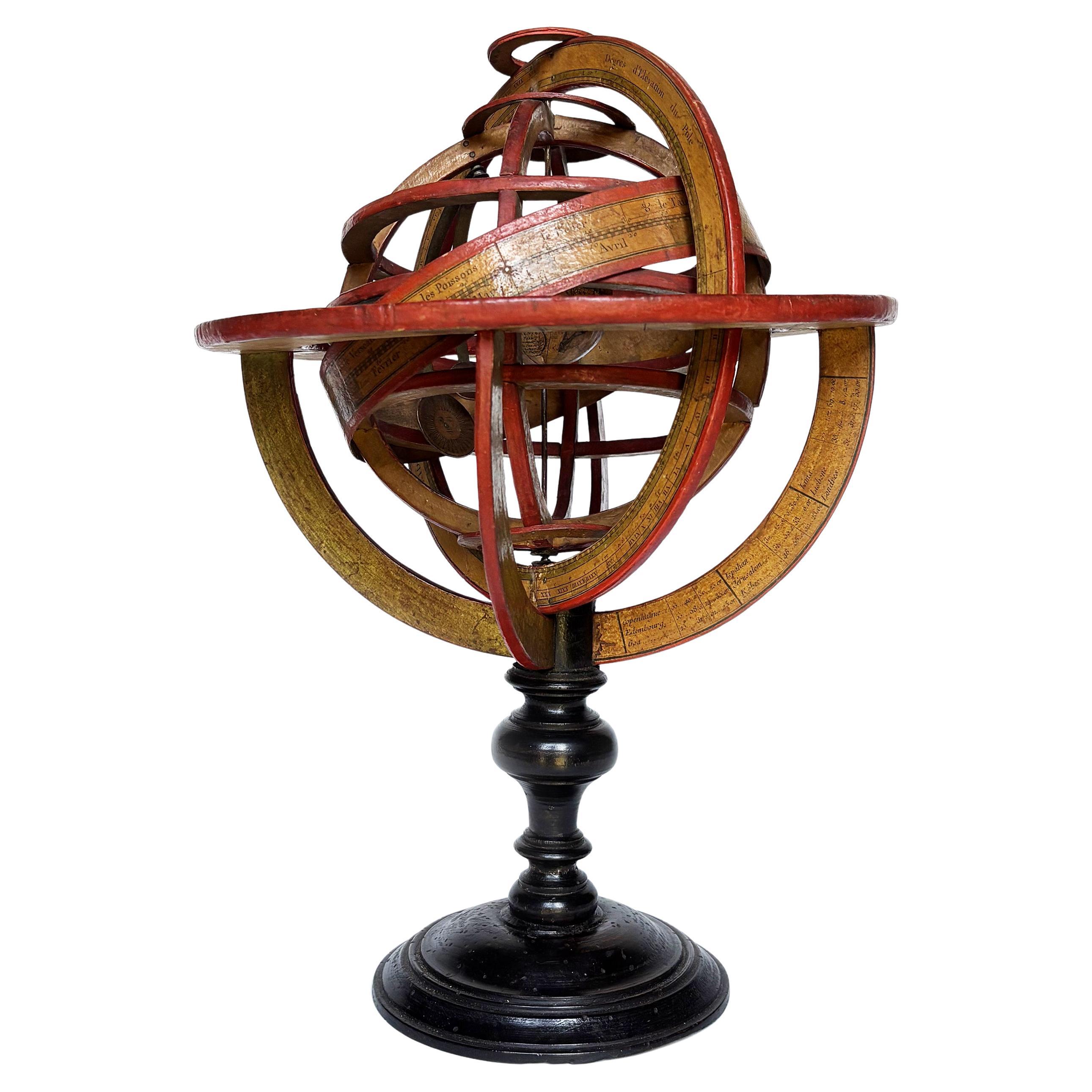
A Copernican armillary sphere made of iron, paper, brass and wood, with the Sun inside, and the Earth on the outside, made of wood and covered with paper. Pedestal made of turned and ebonized wood. Large equatorial ring in metal with engraved and water-colored paper, indicating the months and signs of the zodiac. Inside, an iron ring with the degrees of elevation of the pole, the two smaller rings indicating the northern and southern Arctic Circle, two rings indicating the Tropic of Cancer and Capricorn, an equatorial ring and a ring indicating the months of the year and their zodiac signs. Outside, along the graduated copper axis, we find the Earth, with the possibility of being moved to the 4 points: North, South, East, West, depending on the movement of the seasons. Instrument for educational use. Paravia, Milan, Italy circa 1930.
- Dimensions:Height: 12.5 in (31.75 cm)Width: 19.75 in (50.17 cm)Depth: 13.25 in (33.66 cm)
- Materials and Techniques:
- Place of Origin:
- Period:
- Date of Manufacture:1930
- Condition:Wear consistent with age and use.
- Seller Location:Milan, IT
- Reference Number:1stDibs: LU917142984242
About the Seller
5.0
Gold Seller
Premium sellers maintaining a 4.3+ rating and 24-hour response times
Established in 1991
1stDibs seller since 2011
261 sales on 1stDibs
Typical response time: 4 hours
- ShippingRetrieving quote...Shipping from: Milan, Italy
- Return Policy
More From This Seller
View AllA paradoxical orrery that demonstrates the earth-moon system. Italy circa 1860.
Located in Milan, IT
A paradoxical orrery that demonstrates the earth-moon system and its movement. The base of the planetarium is made of fruit wood, circular in shape with three bell-shaped wood feet. ...
Category
Antique Mid-19th Century Italian Scientific Instruments
Materials
Brass
A terrestrial seven inches globe, signed Felix Delamache, France 1845.
By Félix Delamarche
Located in Milan, IT
Engraved wooden and paper maché globe. Equator resting on four quarter meridians on a turned black fruit wooden base with moved profile and circular base.
The globe is composed of tw...
Category
Antique 1840s Italian Scientific Instruments
Materials
Wood, Paper
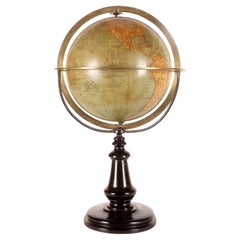
A terrestral globe signed Périgot, published by Delagrave, Paris 1880.
Located in Milan, IT
A Medium-sized terrestrial globe, made of papier-mâché, finished with pastille and completed by the application of paper spindles imprinted with intaglio printing. Color touch-ups. T...
Category
Antique Late 19th Century French Scientific Instruments
Materials
Brass
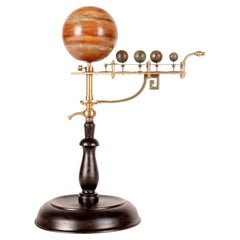
Rare paradoxical planetarium of Jupiter and the Medici satellites, France 1840.
Located in Milan, IT
This rare paradoxical planetarium demonstrates the rotation and revolution motion of the system of the planet Jupiter and the Medici satellites. The base is made of ebonized fruit wo...
Category
Antique Mid-19th Century French Scientific Instruments
Materials
Brass
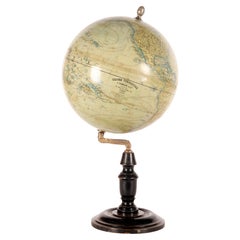
A terrestral globe signed J. Lebegue
C, Paris France 1880.
Located in Milan, IT
A Medium-sized terrestrial globe, made of papier-mâché, finished with pastille and completed by the application of paper spindles imprinted with intaglio printing. Color touch-ups. F...
Category
Antique Late 19th Century French Scientific Instruments
Materials
Fruitwood
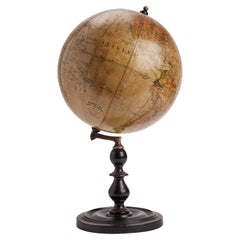
Terrestrial globe published by Ernst Schotte
co, Germany 1890.
Located in Milan, IT
Terrestrial globe in watercolored paper, fixed with an inclined axis through a small brass arm, mounted on a black turned fruit wood base. Published by Ernst Schotte & Co. Berlin, Ge...
Category
Antique Late 19th Century German Scientific Instruments
Materials
Brass
You May Also Like
20th Century Steel
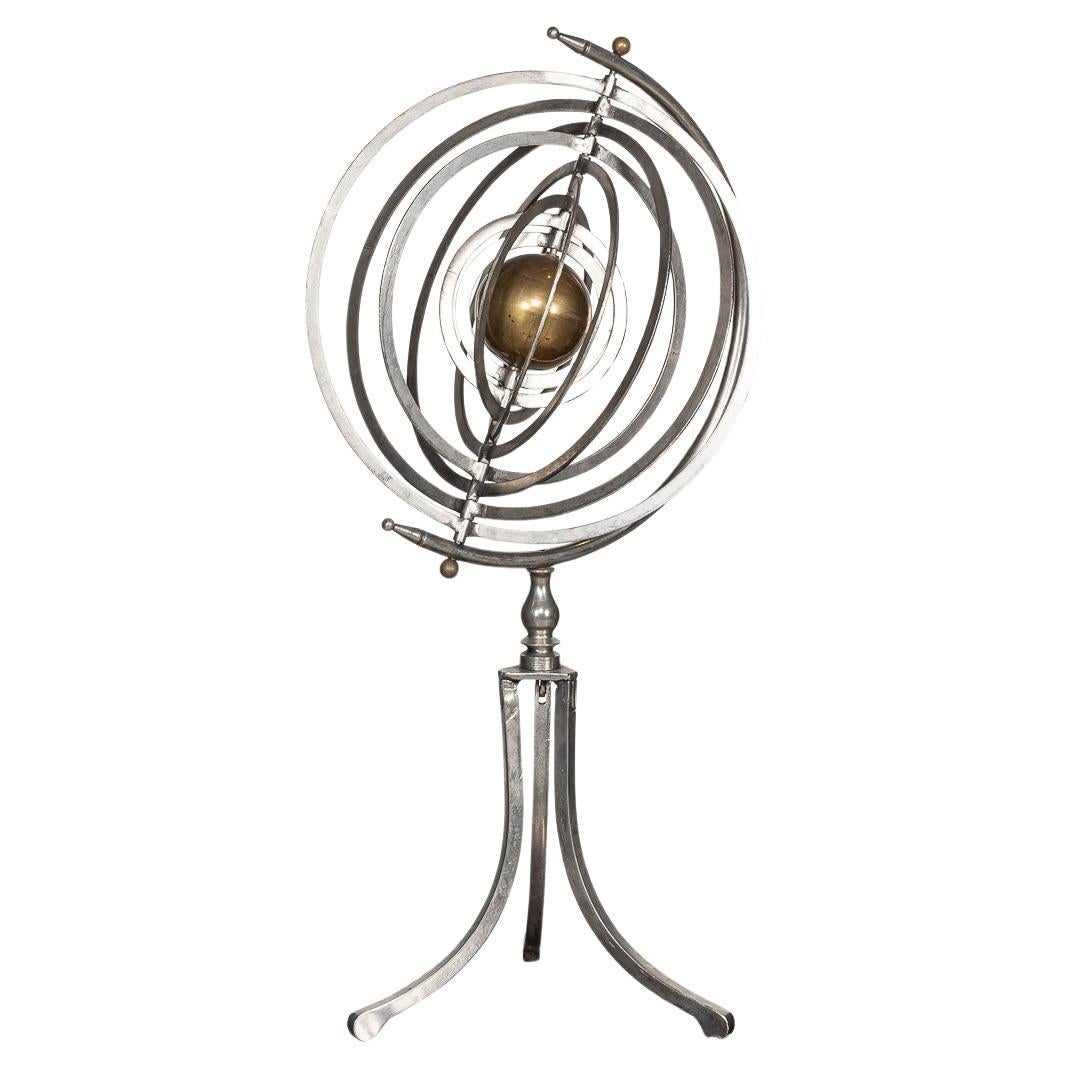
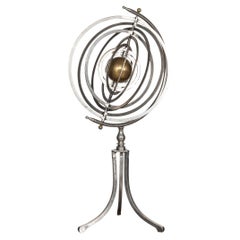
Brass Copernican Armillary Sphere c.1930
Located in Royal Tunbridge Wells, Kent
A 20th Century Copernican Armillary Sphere crafted in polished steel and brass. This instrument illustrates the celestial motion of the solar system, with origins tracing back to anc...
Category
20th Century European Other Scientific Instruments
Materials
Brass, Steel
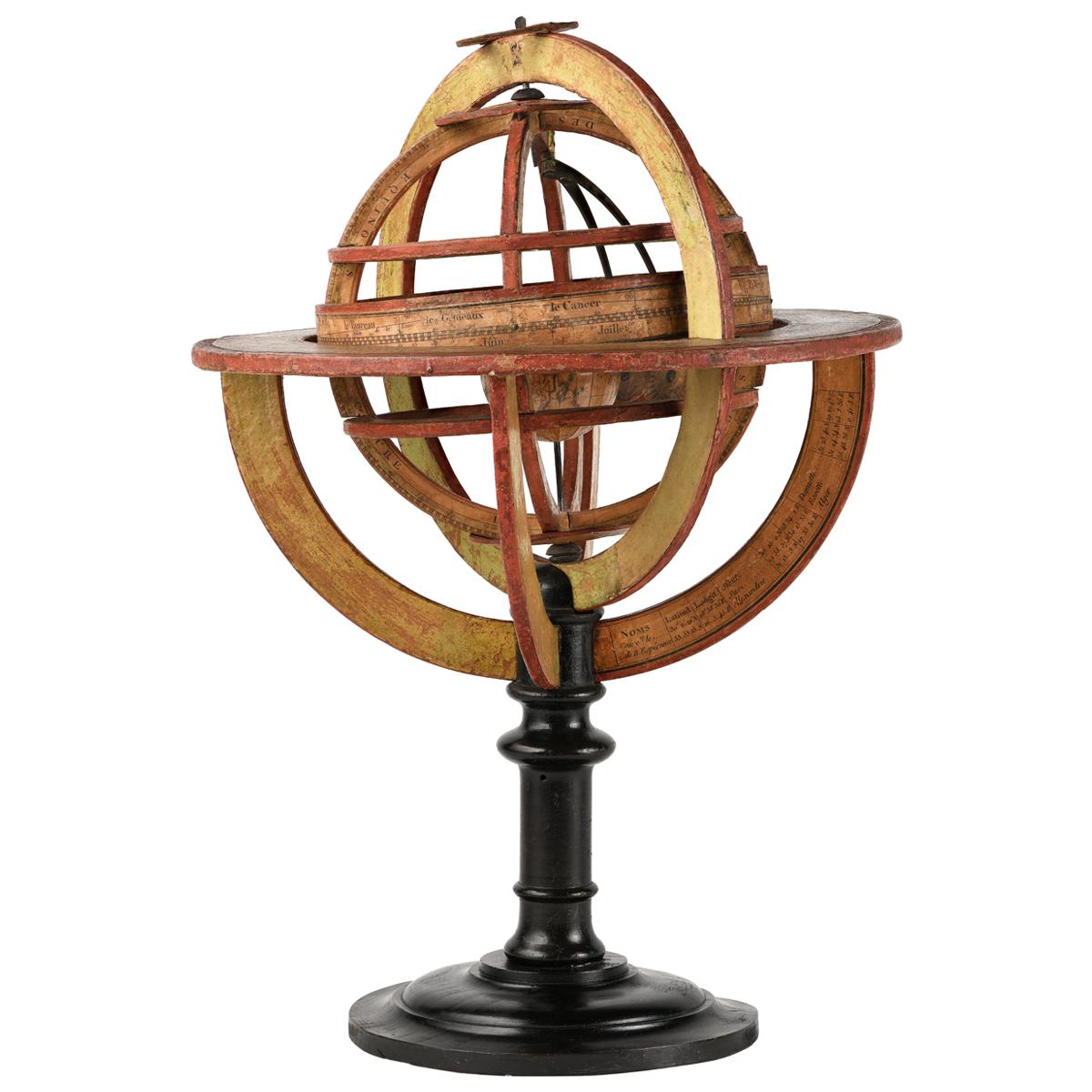
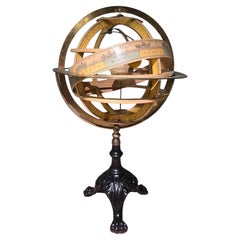
Ptolemaic Armillary Sphere Charles-François Delamarche Paris, 1805-1810 Circa
By Charles Francois Delamarche
Located in Milano, IT
Charles-François Delamarche
Ptolemaic armillary sphere
Paris, circa 1805-1810
Wood and papier-mâché
covered with printed and partly hand-coloured paper
It measures 15.74” in height, ...
Category
Antique Early 1800s French Empire Scientific Instruments
Materials
Paper, Wood

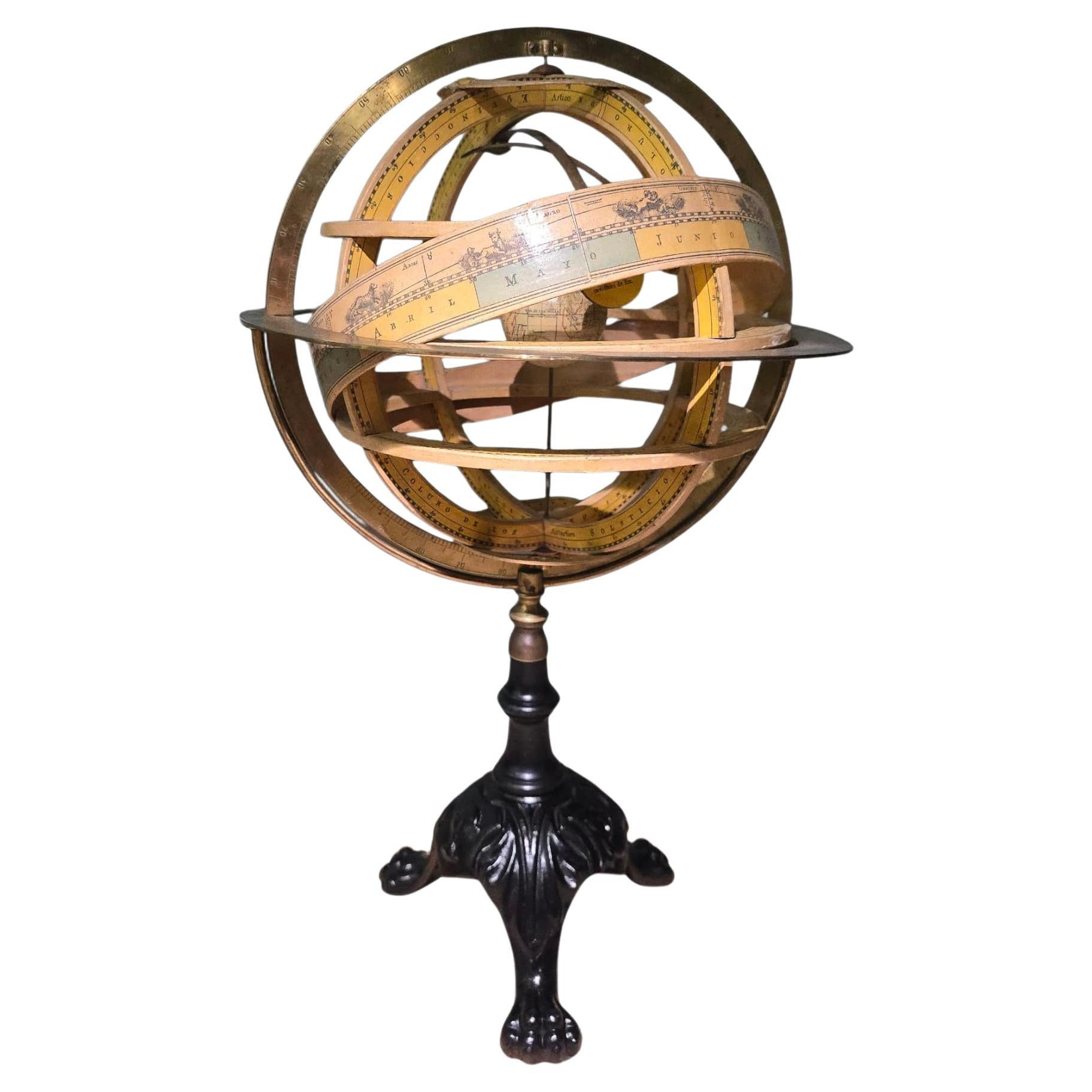
Rare 19th-Century Armillary Sphere by Faustino Paluzie — Barcelona, circa 1880
Located in Madrid, ES
Exceptional and very rare armillary sphere made in Barcelona around 1880 by Faustino Paluzie, one of the most important Spanish makers of scientific and didactic instruments of the 1...
Category
Antique Mid-19th Century Scientific Instruments
Materials
Metal
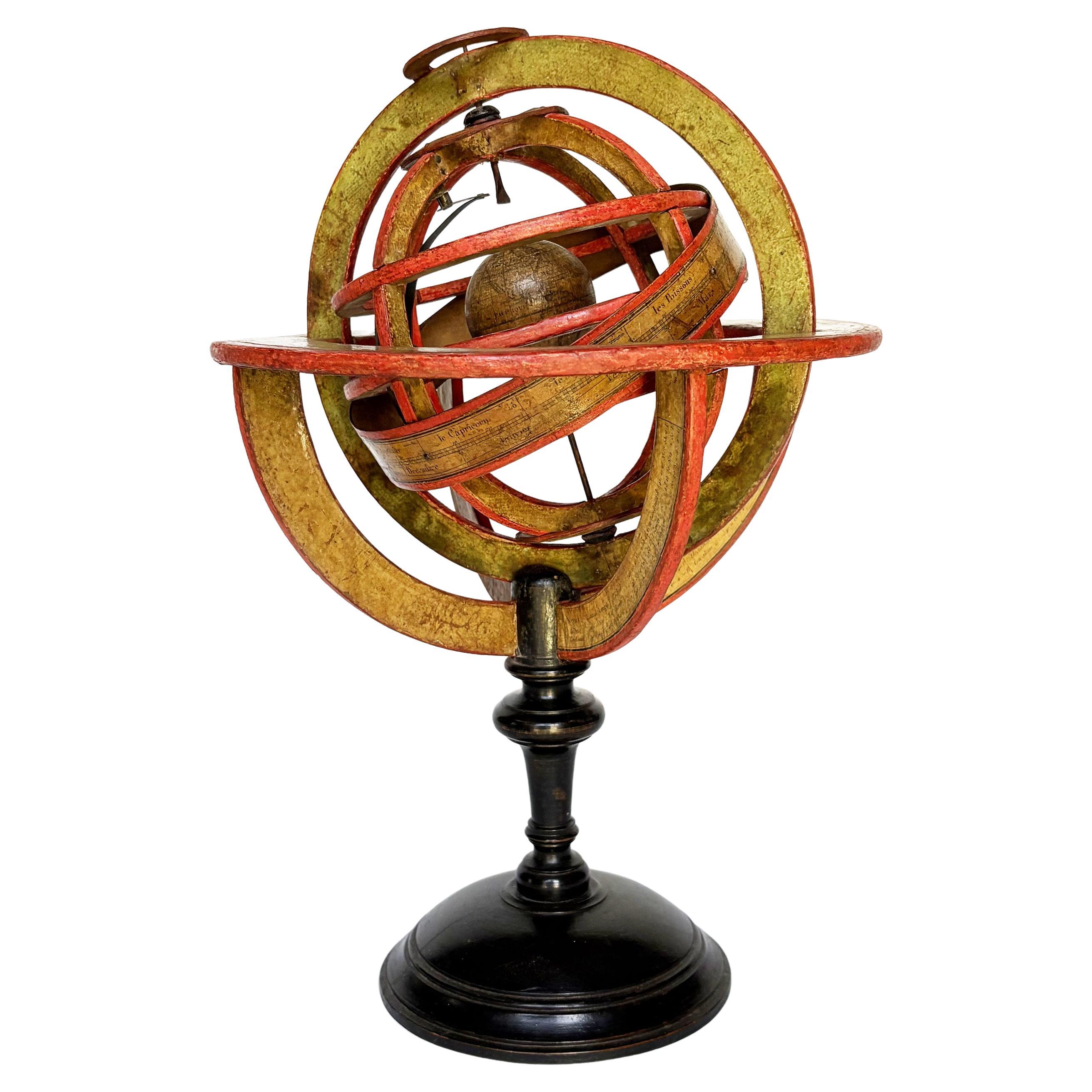
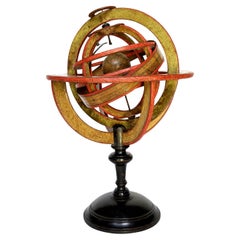
Ptolemaic Armillary Sphere, Charles-François Delamarche, Paris, ante 1798
By Charles Francois Delamarche
Located in Milano, IT
Ptolemaic armillary sphere
Charles-François Delamarche
Paris, ante 1798
Wood and papier-mâché
covered with printed and partly hand-colored paper
It measures 16.37 in in height x Ø 10.94 in (41.60 cm - Ø 27.80 cm)
It weights 2.33 lb (1,058 g)
State of conservation: consistent with its age and use, the paper shows some signs of use, stains and abrasions.
The sphere is Ptolemaic, with the Earth placed at its center, surrounded by the Moon and the Sun mounted on two metal arms.
The sphere is composed of six horizontal and two vertical rings (armillae), each bearing graduations and its own name.
The first horizontal ring is illegible. The others, in descending order are: North Pole, Tropic of Cancer, Equator, Tropic of Capricorn, South Pole.
The vertical rings consist of two double meridians.
The sphere is then connected to the large meridian by two pins, a vertical ring inserted perpendicularly into the circle of the Horizon, in turn supported by four semicircles connected to the turned and black-stained wooden base.
Each element is covered with printed paper. It contains various pieces of information: latitudes, length of days, names and zodiac symbols, calendar, wind directions, etc.
The vertical circles mention the latitudes and longitudes of different cities: Rome, Bordeaux, Madrid, Boston, Batavia (Jakarta), Acapulco, etc.
Even the small terrestrial globe is covered with printed paper: continents and oceans appear with numerous geographical markings indicating the most recent explorations.
In the Pacific Ocean, west of South America bears the following inscription:
GLOBE
TERRESTRIAL
à Paris
chez Delamarche Géog
Rue du Foin Jacques
Au Collège de
M.e Gervais
The North American coasts are well delineated and California appears correctly as a peninsula - reports from Spanish explorers in the region had given rise to confusion as to whether it was connected to the mainland or not. The geographical nature of California was confirmed after the explorations of Juan Bautista de Anza (1774-1776).
Alaska is not described and is only partially traced; it would become part of the United States in 1867.
Various Pacific islands are indicated.
Australia (the name definitely used from 1824) is called "Nouvelle Hollande."
Tasmania is still represented as a peninsula and this is an important detail for the dating of our armillary sphere.
The island is separated from Australia by Bass Strait, which was crossed by Matthew Flinders for the first time in 1798, showing that it was not a peninsula. Delamarche certainly would not have waited a long time to update such an important geographical datum: presumably he did so shortly after receiving the news.
Charles-François Delamarche (1740-1817) founded his laboratory around 1770 and, in a few years, he became the most famous French cartographer and globe maker between the 18th and 19th centuries. After having acquired the laboratory of the late Didier Robert de Vaugondy (1723-1786; himself a renowned cartographer who continued the family business founded by his grandfather Nicolas Sanson in the seventeenth century) and after having purchased, between 1788 and around 1800, the businesses of Jean-Baptiste Fortin (1750-1831) and Jean Lattré (around 1750-1800), he began to call himself "Successeur de MM. Sanson and Robert de Vaugondi, Géographes du Roi and de M. Fortin, Ingénieur-mécanicien du Roi pour les globes et les sphères."
Thus, at the end of the eighteenth century, Delamarche possessed the warehouse stocks, as well as the manufacturing skills of the globes of his main rivals in Paris.
In addition to this aggressive acquisition policy, the key to its success also lay in the combination of high-quality cartography combined with extremely attractive globes and armillary spheres; and, of course, its famous red paint finishing touch.
His laboratory was located on Rue de Foin St Jacques "au Collège Me. (or "Mtre") Gervais" in the Latin Quarter of Paris until around 1805, when he moved to rue du Jardinet No. 13.
On the death of Charles-François in 1817, the reins of the company passed to his son Félix (1779-1835), who continued to publish, often in collaboration with the engraver Charles Dien, Sr. In 1835 the company first moved to rue du Jardinet No. 12 and a little later to rue du Battoir No. 7.
Bibliography:
Dekker, Elly, et al. Globes at Greenwich...
Category
Antique 1790s French Other Scientific Instruments
Materials
Wood, Paper
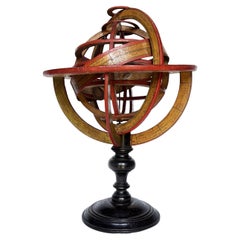
Ptolemaic Armillary Sphere, Charles-François Delamarche, Paris, ante 1798
By Charles Francois Delamarche
Located in Milano, IT
Ptolemaic armillary sphere
Charles-François Delamarche
Paris, ante 1798
Wood and papier-mâché
covered with printed and partly hand-colored paper
It measures 15.55 in in height x Ø 10...
Category
Antique 1790s French Other Scientific Instruments
Materials
Wood, Paper
Antique Orrery – Tellurium by Paravia, Torino (1900, Italy)
Located in Madrid, ES
Rare and collectible orrery (tellurium) produced by the renowned Italian maker Paravia, Torino in 1900. This finely crafted planetary model illustrates the Earth-Sun-Moon system, dem...
Category
Early 20th Century Scientific Instruments
Materials
Paper
More Ways To Browse
Anatomical Eye
Anatomical Torso
Antique Apothecary Scale
Antique Astronomical Instruments
Antique Dental Instrument
Antique Human Bones
Antique Medical Devices
Antique Wooden Spools
Apothecary Scales Antique
Black Forest Thermometer
Boxed Boat Compass
Carpentry Tools
Peugeot Coffee Grinders
Peugeot Coffee
Pressure Gauge
Ross London
Ship Barometer
Surveyors Level