1790s Scientific Instruments
to
5
3
9
3
2
134
627
837
9
378
302
63
34
41
32
39
30
53
37
27
9
9
4
3
2
1
9
6
3
2
9
9
9
3
1
Period: 1790s
Ptolemaic Armillary Sphere, Charles-François Delamarche, Paris, ante 1798
Located in Milano, IT
Ptolemaic armillary sphere
Charles-François Delamarche
Paris, ante 1798
Wood and papier-mâché
covered with printed and partly hand-colored paper
It measures 15.55 in in height x Ø 10...
Category
French Other Antique 1790s Scientific Instruments
Materials
Wood, Paper
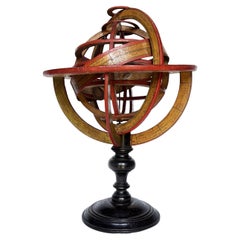
Terrestrial Globe By Félix Delamarche, Also Known As Charles-François Delamarche
Located in Dallas, TX
This antique terrestrial table globe is a French example attributed to the celebrated cartographer Félix Delamarche, whose firm was renowned for producing high quality, geographicall...
Category
French Antique 1790s Scientific Instruments
Materials
Wood, Paper
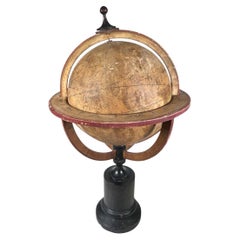
Ptolemaic Armillary Sphere, Charles-François Delamarche, Paris, ante 1798
Located in Milano, IT
Ptolemaic armillary sphere
Charles-François Delamarche
Paris, ante 1798
Wood and papier-mâché
covered with printed and partly hand-colored paper
It measures 16.37 in in height x Ø 10.94 in (41.60 cm - Ø 27.80 cm)
It weights 2.33 lb (1,058 g)
State of conservation: consistent with its age and use, the paper shows some signs of use, stains and abrasions.
The sphere is Ptolemaic, with the Earth placed at its center, surrounded by the Moon and the Sun mounted on two metal arms.
The sphere is composed of six horizontal and two vertical rings (armillae), each bearing graduations and its own name.
The first horizontal ring is illegible. The others, in descending order are: North Pole, Tropic of Cancer, Equator, Tropic of Capricorn, South Pole.
The vertical rings consist of two double meridians.
The sphere is then connected to the large meridian by two pins, a vertical ring inserted perpendicularly into the circle of the Horizon, in turn supported by four semicircles connected to the turned and black-stained wooden base.
Each element is covered with printed paper. It contains various pieces of information: latitudes, length of days, names and zodiac symbols, calendar, wind directions, etc.
The vertical circles mention the latitudes and longitudes of different cities: Rome, Bordeaux, Madrid, Boston, Batavia (Jakarta), Acapulco, etc.
Even the small terrestrial globe is covered with printed paper: continents and oceans appear with numerous geographical markings indicating the most recent explorations.
In the Pacific Ocean, west of South America bears the following inscription:
GLOBE
TERRESTRIAL
à Paris
chez Delamarche Géog
Rue du Foin Jacques
Au Collège de
M.e Gervais
The North American coasts are well delineated and California appears correctly as a peninsula - reports from Spanish explorers in the region had given rise to confusion as to whether it was connected to the mainland or not. The geographical nature of California was confirmed after the explorations of Juan Bautista de Anza (1774-1776).
Alaska is not described and is only partially traced; it would become part of the United States in 1867.
Various Pacific islands are indicated.
Australia (the name definitely used from 1824) is called "Nouvelle Hollande."
Tasmania is still represented as a peninsula and this is an important detail for the dating of our armillary sphere.
The island is separated from Australia by Bass Strait, which was crossed by Matthew Flinders for the first time in 1798, showing that it was not a peninsula. Delamarche certainly would not have waited a long time to update such an important geographical datum: presumably he did so shortly after receiving the news.
Charles-François Delamarche (1740-1817) founded his laboratory around 1770 and, in a few years, he became the most famous French cartographer and globe maker between the 18th and 19th centuries. After having acquired the laboratory of the late Didier Robert de Vaugondy (1723-1786; himself a renowned cartographer who continued the family business founded by his grandfather Nicolas Sanson in the seventeenth century) and after having purchased, between 1788 and around 1800, the businesses of Jean-Baptiste Fortin (1750-1831) and Jean Lattré (around 1750-1800), he began to call himself "Successeur de MM. Sanson and Robert de Vaugondi, Géographes du Roi and de M. Fortin, Ingénieur-mécanicien du Roi pour les globes et les sphères."
Thus, at the end of the eighteenth century, Delamarche possessed the warehouse stocks, as well as the manufacturing skills of the globes of his main rivals in Paris.
In addition to this aggressive acquisition policy, the key to its success also lay in the combination of high-quality cartography combined with extremely attractive globes and armillary spheres; and, of course, its famous red paint finishing touch.
His laboratory was located on Rue de Foin St Jacques "au Collège Me. (or "Mtre") Gervais" in the Latin Quarter of Paris until around 1805, when he moved to rue du Jardinet No. 13.
On the death of Charles-François in 1817, the reins of the company passed to his son Félix (1779-1835), who continued to publish, often in collaboration with the engraver Charles Dien, Sr. In 1835 the company first moved to rue du Jardinet No. 12 and a little later to rue du Battoir No. 7.
Bibliography:
Dekker, Elly, et al. Globes at Greenwich...
Category
French Other Antique 1790s Scientific Instruments
Materials
Wood, Paper
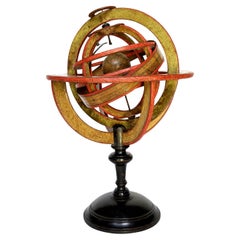
Antique Three-Draw Telescope, English, Walnut, Brass, Navigation, Georgian, 1790
Located in Hele, Devon, GB
This is an antique three-draw telescope. An English,walnut and brass navigational or astronomical instrument by Lincoln of London, dating to the Georgian period, circa 1790.
Perfect for bird watching, landscape appreciation, wildlife, or maritime observation. Equally suitable for observing the night sky.
A fine and tactile example of Georgian optical craftsmanship
Crafted with a striking walnut main barrel, displaying warm amber tones
Walnut exhibits a fine grain pattern, with minimal wear commensurate with gentle use
Features three smoothly operating brass draw tubes, with bright golden hues
Engraved to the rear barrel with 'Lincoln, London' – a noted maker of the period
Fitted with a push-type dust cover to protect the 40mm primary objective lens
Bright, functional optics with a clear image – suited for both display and gentle use
A handsome piece for the collector of nautical antiques or scientific instruments
Supplied with a London Fine oak and brass 'Captain's Stand' for display
Further enhanced with the original leather carry sleeve, in lightly time worn order
Elegant and evocative, this Georgian telescope...
Category
British Georgian Antique 1790s Scientific Instruments
Materials
Brass
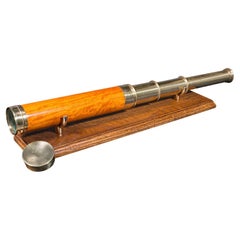
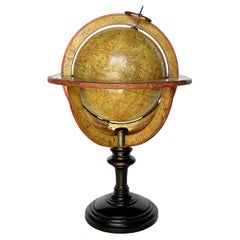
Celestial Table Globe, Charles-François Delamarche, Paris, 1791
Located in Milano, IT
Celestial table globe
Charles-François Delamarche
Paris, 1791
It measures: 17.13 in in height, Ø max 27.7 in; the sphere Ø 7.09 in
(h 43.5 cm x Ø max 27.7 cm; the sphere Ø 18 cm).
W...
Category
French Other Antique 1790s Scientific Instruments
Materials
Metal
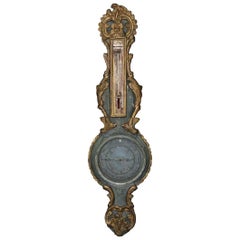
18th Century French Louis XVI Giltwood Barometer
Located in Sheffield, MA
A stunningly beautiful 18th century French gold gilt barometer is a weather instrument with mercury-filled glass thermometer still in working order...
Category
French Louis XVI Antique 1790s Scientific Instruments
Materials
Wood
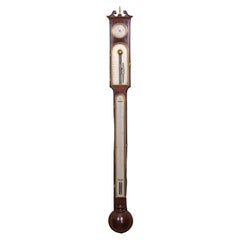
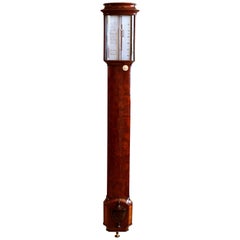
18th Century English Mahogany Cased Stick Barometer by Dolland of London
By Dolland
Located in Dublin, IE
An exceptional late 18th century mahogany cased stick barometer by Dolland of London, The mahogany case of a very solid construction and with a superbly made turned mahogany cistern ...
Category
English Georgian Antique 1790s Scientific Instruments
Materials
Steel
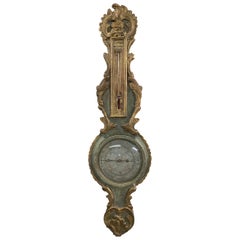
18th Century French Louis XVI Giltwood Barometer
Located in Sheffield, MA
A stunningly beautiful 18th century French gold gilt barometer is a weather instrument with mercury-filled glass thermometer still in working order...
Category
French Louis XVI Antique 1790s Scientific Instruments
Materials
Wood
Important Georgian Mahogany Mercury Stick Barometer by Stott, Dumfries
Located in Norwich, GB
Fine Georgian mahogany bow fronted stick barometer. Bow fronted glass set in front of the silvered register plate with sliding vernier controlled by an ivory turned knob. Concertina ...
Category
English Georgian Antique 1790s Scientific Instruments
Materials
Mahogany, Ivory
Related Items
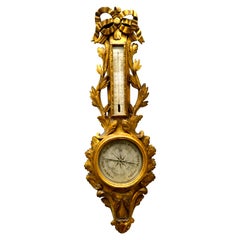
18th Century Louis XVI Giltwood Wall Barometer
Located in Vancouver, British Columbia
A beautifully carved and giltwood 18th century Louis XVI wall barometer having its original mercury tube and mechanism but presently with the mercury missing.
Category
French Louis XVI Antique 1790s Scientific Instruments
Materials
Giltwood

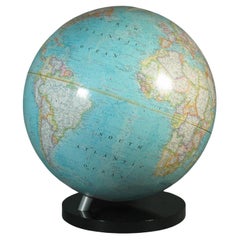
16-Inch Terrestrial Globe 1986 National Geographic
Located in Ottawa, Ontario
A 16-INCH TERRESTRIAL GLOBE 1986
NATIONAL GEOGRAPHIC
Large terrestrial globe with paper gores
on a stylish black lucite base
scale 1: 31,350,000
18" inches, (45.5cm.) high.
16" in...
Category
American Modern 1790s Scientific Instruments
Materials
Metal
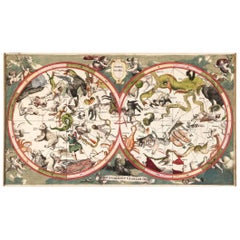
Decorative Antique Celestial Map – Zodiac, Stars
Hemel Globe, 1720
Located in Langweer, NL
Antique Celestial Map – Hemel Globe, Zodiac & Constellations by Halma, 1720
This striking double-hemisphere celestial chart, titled Hemel Globe...
Category
Dutch Antique 1790s Scientific Instruments
Materials
Paper
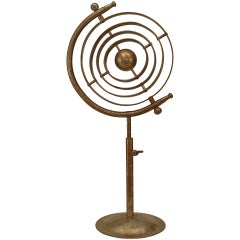
Italian Renaissance Chrome Armillary
Located in Queens, NY
Italian Renaissance-style (20th Century) chrome armillary globe with a rust patina.
Category
American Renaissance Revival 1790s Scientific Instruments
Materials
Chrome
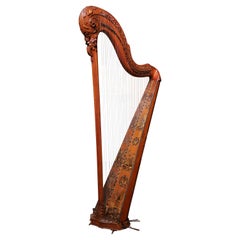
18th Century Louis XVI French Chinoiserie Carved Walnut Pedal Harp
Located in Dallas, TX
Decorate a living room or music salon with this exquisite 18th-century pedal harp. Crafted in France circa 1780, this Louis XVI single-action harp features 36 replaced strings over a...
Category
French Louis XV Antique 1790s Scientific Instruments
Materials
Maple
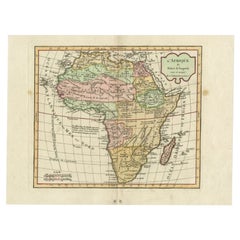
Antique Map of Africa by Delamarche, 1806
Located in Langweer, NL
Antique map titled 'L'Afrique'.
Decorative map of Africa by Robert de Vaugondy, revised and published by Delamarche. Source unknown, to be determined.
Artists and Engravers: Charl...
Category
Antique 1790s Scientific Instruments
Materials
Paper
Ptolemaic Armillary Sphere Charles-François Delamarche Paris, 1805-1810 Circa
Located in Milano, IT
Charles-François Delamarche
Ptolemaic armillary sphere
Paris, circa 1805-1810
Wood and papier-mâché
covered with printed and partly hand-coloured paper
It measures 15.74” in height, ...
Category
French Empire Antique 1790s Scientific Instruments
Materials
Paper, Wood

$10,722
H 15.75 in Dm 11.03 in
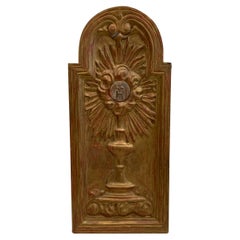
18th Century Italian Tabernacle Door Fragment
Located in San Angelo, TX
18th Century Italian Tabernacle Door Fragment. Unique piece that can go anywhere. Perfect for a sculpture on the wall in a hallway or niche.
Category
Italian Antique 1790s Scientific Instruments
Materials
Gold Leaf
$1,036 Sale Price
20% Off
H 24.87 in W 11.13 in D 0.75 in
Large and Extremely Rare Terrestrial Globe by Newton
By Newton Globes - Planer
Newton
Located in Lymington, Hampshire
A large and extremely rare 24-inch terrestrial globe by Newton
Our most magnificent and rare globes were a pair of 24-inch Newton globes.
These too were updated in 1852 (terre...
Category
English Antique 1790s Scientific Instruments
Materials
Mahogany
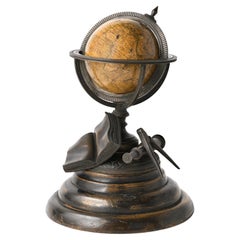
Miniature Terrestrial Globe Newton
Son London, Post 1833, Ante 1858
Located in Milano, IT
Miniature Terrestrial Globe
Newton
Son
London, post 1833, ante 1858
Paper, papier-mâché, bronze and wood
It measures: sphere diameter 2.95 in (7.6 cm); diameter of the wooden base 6.02 in (15.3 cm); height 8.36 in (21.24 cm).
Weight: 2,067 lb.
State of conservation: the globe still bears its original paint, but has various small gaps, abrasions and stains on the surface.
The globe is hinged with two pins at the meridian circle, which is in turn inserted perpendicular to the horizon circle; this is supported by four semi-arches connected at the bottom by a small goblet-shaped foot, resting on a wooden bell-shaped base.
Apart from the wooden base, the entire support structure is made of bronze; on the foot there are the scale reproductions of a compass, a telescope and an open book.
The sphere is made of papier-mâché and is covered with twelve printed paper gores.
In the North Pacific Ocean the globe bears a cartouche with the inscription (about 30% of the writing is illegible, but the missing parts can be easily integrated based on the rest):
NEWTON’S
New
Improved
TERRESTRIAL
Globe
Published by Newton
Son
66 Chancery Lane
LONDON
On the globe, much of central Africa is empty and the great lakes Tanganyika and Victoria are not marked (Europeans would begin to explore the area after 1858). Canada is called "British Territory" and Alaska "Russian Territory" (it would become part of the United States in 1867). Australia already bears its modern name (until 1829 it had been called New Holland) and its coasts are completely designed; Tasmania is listed as an island (Matthew Flinders circumnavigated it in 1798). The routes of Cook's various voyages are plotted; both the route followed by Biscoe in 1831 and the "Land of Enderby" which he discovered on the coast of Antarctica, south of Africa, are marked.
Bibliography
P. Van der Krogt, Old Globes...
Category
English Early Victorian Antique 1790s Scientific Instruments
Materials
Bronze
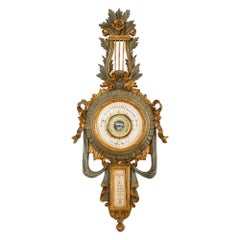
19th Century Italian Carved Louis XVI Style Giltwood Barometer
Located in Rio Vista, CA
Gorgeous late 19th century gilt wood barometer thermometer made in Italy in the Louis XVI or baroque taste. The large barometer features a large carve...
Category
Italian Louis XVI Antique 1790s Scientific Instruments
Materials
Metal, Brass
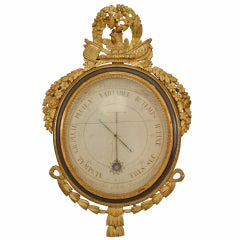
French Louis XVI Barometer
Located in Queens, NY
French Louis XVI (18th Century) barometer with original scientific illustrations and mercury vial framed with gilt foliate carvings & ebonized ...
Category
French Louis XVI Antique 1790s Scientific Instruments
Materials
Giltwood, Glass
Previously Available Items
Louis XVI Giltwood Barometer
Located in Essex, MA
This is decorative and doesn't function. Circular glass covered dial with directional and grisaille painted dial. The crest featuring a pair of birds often associated with marriage. ...
Category
French Louis XVI Antique 1790s Scientific Instruments
Materials
Glass, Giltwood
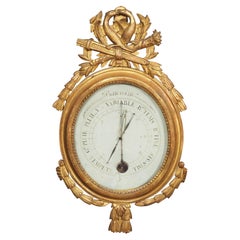
Louis XVI Giltwood Barometer
Located in Essex, MA
Oval with a ribbon bow over an oval glass fronted barometer with grisaille painted panel with metal directionals. Inscribed Selon Torricelli.
Category
French Louis XVI Antique 1790s Scientific Instruments
Materials
Giltwood
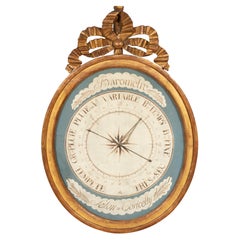
Bronze mortar. Carlos Fenollera, Valencia, Spain, 1790.
Located in Madrid, ES
Pharmacy mortar. Bronze. Carlos Fenollera, Valencia, Spain, 1790.
Bibliography: VVAA "The Faculty of Medicine of Valencia". University of Valencia, publication services. P. 128-129.
Mortar made in bronze with a mouth exvased towards the outside and a frustoconical body that has a forehead with reliefs of female grotesques (bust of a lady and architectural lower part) united by laurel garlands and two lion protomes on the sides that would serve as handles; In this area is the word Ano (under one of the lions) and the number 1790 (under the other head) relative to the date of manufacture. Flanking this decoration are two inscriptions in capital letters enhanced with smooth moldings (“From the public laboratory of chemistry of the Ylle University of Vaia” followed by a cross; Carlos Fenollera me f, with stars between some words). It is known of a Carlos Fenollera, a master bell ringer, who succeeded Josef Pérez in 1796 as a machinist at the University of Valencia, working for the Professors of Mechanics and Astronomy, initially repairing machines and instruments, their maintenance, etc. Likewise, there is knowledge of the proposal for a laboratory (leading in its time) located in the Colegio de Santo...
Category
Spanish Neoclassical Antique 1790s Scientific Instruments
Materials
Bronze
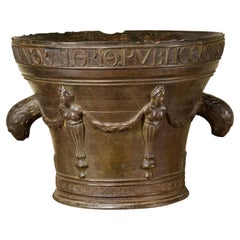
Antique George III Quality Mahogany Banjo Barometer
Located in Suffolk, GB
Antique George III quality mahogany banjo barometer having a quality mahogany case with a swan neck pediment and the original turned finial, circular shaped silvered engraved dial wi...
Category
English George III Antique 1790s Scientific Instruments
Materials
Mahogany
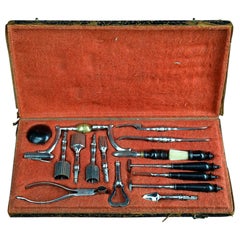
Late 18th Century Royal Stamped Trepanning Set
Located in London, GB
Late 18th century royal stamped trepanning set
We are proud to offer a rare, complete trepanning set dated from the late 18th century, punch...
Category
French Antique 1790s Scientific Instruments
Materials
Metal, Brass
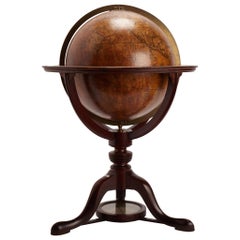
Terrestrial Globe Signed Cary, London, 1798
By Cary
Located in Milan, IT
Large 'Papier Machè' terrestrial globe (12" diameter), with gores printed in calcography a color finished, on a wooden tripod. One compass joints the three feet. Brass meridian. Make...
Category
British Antique 1790s Scientific Instruments
Materials
Brass
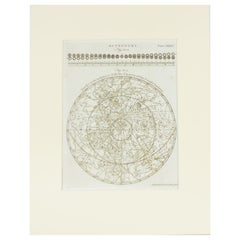
Set of 10 Astronomy Prints by A.Bell, 18th Century
Located in St Annes, Lancashire
Wonderful set of 10 copper-plate engravings. All related to astronomy and geography
Drawn and engraved by A.Bell.
Published circa 1790
Unframed.
Free shipping.
Category
English Georgian Antique 1790s Scientific Instruments
Materials
Paper

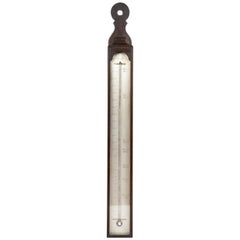
Georgian III Mahogany Thermometer by John Dollond
Located in Lymington, Hampshire
A Georgian III mahogany thermometer by John Dollond, of slender rectangular form, the top of the frame removable to aid the cleaning of the glass, with a silvered register engraved t...
Category
English Antique 1790s Scientific Instruments
Materials
Mahogany
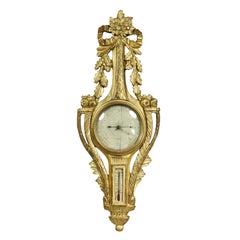
Louis XVI Giltwood Barometer
Located in Essex, MA
With ribbon crest and trailing leaves joining a glass covered painted dial and lower thermometer.
Category
French Louis XVI Antique 1790s Scientific Instruments
Materials
Giltwood
Set 24 18th Century Astronomy Prints by A.Bell
Located in St Annes, Lancashire
Wonderful set of 24 copperplate engravings.
After the drawings by A.Bell.
Published circa 1790
Matted or mounted. Unframed.
The measurement given below is the size of the...
Category
English Georgian Antique 1790s Scientific Instruments
Materials
Paper
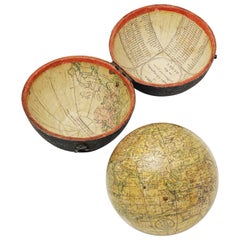
18th Century English Pocket Globe by John and William Cary, 1791
By Cary’s
Located in Milano, IT
John and William Cary
Pocket globe
London, 1791
The pocket globe is contained in its original case, which itself is covered in shark skin.
There are various gaps in the origina...
Category
English George III Antique 1790s Scientific Instruments
Materials
Shagreen, Paper
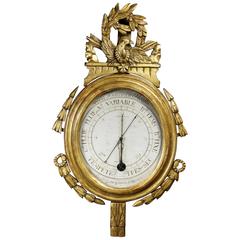
Louis XVI Giltwood Barometer
Located in Essex, MA
With bird and laurel leaf crest over a painted dial within a molded frame with mounted trailing bellflowers ending with a tassel.
Category
French Louis XVI Antique 1790s Scientific Instruments
Still Thinking About These?
All Recently ViewedMore Ways To Browse
3 Draw Brass Telescope
Anatomical Wax
Antique Brass Ruler
Antique Brass Scoop
Antique Brass Sundials
Antique Magnetic Compass
Antique Monocular
Antique Oil Pumps
Antique Portuguese Scales
Antique Surveyor Compass
Antique Wooden Compass
Avery Brass Scales
Big Eye Binoculars
Botanical Flower Model
Brain Model
Brass Compass And Case
Brass Surveyors Level
German Telescope