Late 18th Century Scientific Instruments
to
3
28
14
43
11
9
1
1
1
134
630
839
8
380
302
62
34
40
33
38
30
54
37
26
9
31
21
11
8
7
41
17
16
11
3
43
43
43
3
1
1
1
1
Period: Late 18th Century
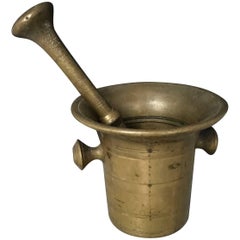
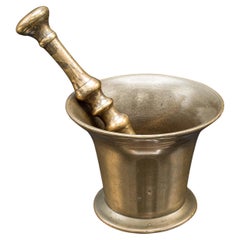
Antique Hand-Crafted Solid Bronze Mortar with Pestle and Great Original Patina
Located in Lisse, NL
Decorative and tactile, late 18th century mortar set.
Mortars have been used for centuries by private people and by people in certain trades. In the kitche...
Category
European Antique Late 18th Century Scientific Instruments
Materials
Bronze
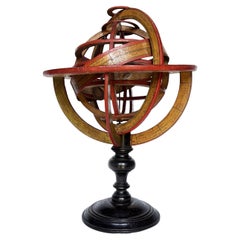
Ptolemaic Armillary Sphere, Charles-François Delamarche, Paris, ante 1798
Located in Milano, IT
Ptolemaic armillary sphere
Charles-François Delamarche
Paris, ante 1798
Wood and papier-mâché
covered with printed and partly hand-colored paper
It measures 15.55 in in height x Ø 10...
Category
French Other Antique Late 18th Century Scientific Instruments
Materials
Wood, Paper
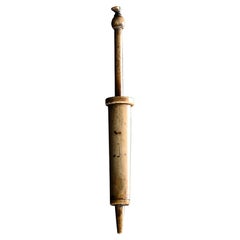
18th Century Medical Syringe
Located in London, GB
18th Century Medical Syringe
For historical medical use and dating from the 18th century, and certainly from the beginning of the 18th century. This hand-crafted example is made to...
Category
Unknown Antique Late 18th Century Scientific Instruments
Materials
Natural Fiber
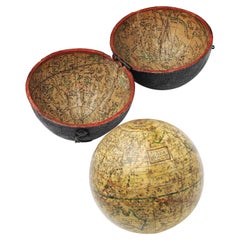
English Pocket Globe, London, Circa 1775-1798
By Herman Moll
Located in Milano, IT
Pocket globe
London, between 1775 and 1798
Re-edition of the globe of Hermann Moll (1678-1732) dated 1719
The globe is contained in its original case, which itself is covered in shark skin.
There are slight gaps in the original paint on the sphere. The case no longer closes.
The sphere measures 2.7 in (7 cm) in diameter whereas the case measures 2.9 in (7.4 cm) in diameter.
lb 0.22 (kg 0.1)
The globe is made up of twelve printed paper gores aligned and glued to the sphere.
In the North Pacific Ocean there is a cartouche with the inscription:
A Correct
Globe
with the new
Discoveries.
The celestial globe is depicted on the inside of the box and is divided into two hemispheres with the cartouche:
A correct globe
with ye new cons
relations of Dr.
Halley & c.
It shows the ecliptic divided into the days of the zodiacal calendar and the constellations represented as animals and mythological figures.
On the globe are delineated the equinoctial line, divided by degrees and hours, the ecliptic and the meridian (passing west of Greenwich). The continents are shaded and outlined in pink, green and yellow. It shows: the Cook routes; a wind rose in the Southern Indian Ocean; Antarctica without land; Africa with Negroland (Hermann Moll is considered the first geographer to name the West African region in his 1727 map. (Encyclopaedia Britannica, ed. 1902, under "States of Central Africa"); Tartary in Central Asia; the Mogul kingdom in northern India; in North America only New England, Virginia, Carolina, Florida, Mississippi are identified; California is already a peninsula; the northwest coast of America is "unknown parts" (Alaska is not described and it is only partially delineated, it was to become part of the United States in 1867); Mexico is named "Spain"; Central South America "Amazone America". Australia (which was to be so named after 1829) is called New Holland. The route of Admiral Anson is traced (1740) and the trade winds are indicated by arrows. (See Van der Krogt, P., Old Globes in the Netherlands, Utrecht 1984, p. 146 and Van der Krogt, P. - Dekker, E., Globes from the Western World, London 1993, pp. 115.)
Elly Dekker, comparing Moll’s 1719 globe and his re-edition (of which the one described above is a sample), identifies the differences between them: the two editions are quite similar to each other, but in the "anonymous" globe, compared to the previous globe of 1719, California looks like a proper peninsula - the reports of the Spanish explorers of the region had given rise to uncertainty over whether it was connected to the mainland or not. The geographical nature of California was confirmed after the explorations of Juan Bautista de Anza (1774-1776). The routes of Dampier's journey were partially erased and the route of Captain James Cook's first voyage was superimposed on them, and the geography of Australasia was adapted accordingly, including the denomination of the Cook Strait. See Dekker, Elly, Globes at Greenwich, 1999.
An important ante quem element is represented by Tasmania: it is not separated from Australia by the Bass Strait...
Category
English George III Antique Late 18th Century Scientific Instruments
Materials
Shagreen, Paper
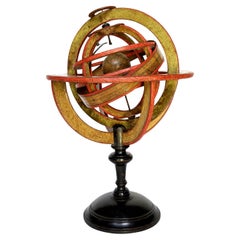
Ptolemaic Armillary Sphere, Charles-François Delamarche, Paris, ante 1798
Located in Milano, IT
Ptolemaic armillary sphere
Charles-François Delamarche
Paris, ante 1798
Wood and papier-mâché
covered with printed and partly hand-colored paper
It measures 16.37 in in height x Ø 10.94 in (41.60 cm - Ø 27.80 cm)
It weights 2.33 lb (1,058 g)
State of conservation: consistent with its age and use, the paper shows some signs of use, stains and abrasions.
The sphere is Ptolemaic, with the Earth placed at its center, surrounded by the Moon and the Sun mounted on two metal arms.
The sphere is composed of six horizontal and two vertical rings (armillae), each bearing graduations and its own name.
The first horizontal ring is illegible. The others, in descending order are: North Pole, Tropic of Cancer, Equator, Tropic of Capricorn, South Pole.
The vertical rings consist of two double meridians.
The sphere is then connected to the large meridian by two pins, a vertical ring inserted perpendicularly into the circle of the Horizon, in turn supported by four semicircles connected to the turned and black-stained wooden base.
Each element is covered with printed paper. It contains various pieces of information: latitudes, length of days, names and zodiac symbols, calendar, wind directions, etc.
The vertical circles mention the latitudes and longitudes of different cities: Rome, Bordeaux, Madrid, Boston, Batavia (Jakarta), Acapulco, etc.
Even the small terrestrial globe is covered with printed paper: continents and oceans appear with numerous geographical markings indicating the most recent explorations.
In the Pacific Ocean, west of South America bears the following inscription:
GLOBE
TERRESTRIAL
à Paris
chez Delamarche Géog
Rue du Foin Jacques
Au Collège de
M.e Gervais
The North American coasts are well delineated and California appears correctly as a peninsula - reports from Spanish explorers in the region had given rise to confusion as to whether it was connected to the mainland or not. The geographical nature of California was confirmed after the explorations of Juan Bautista de Anza (1774-1776).
Alaska is not described and is only partially traced; it would become part of the United States in 1867.
Various Pacific islands are indicated.
Australia (the name definitely used from 1824) is called "Nouvelle Hollande."
Tasmania is still represented as a peninsula and this is an important detail for the dating of our armillary sphere.
The island is separated from Australia by Bass Strait, which was crossed by Matthew Flinders for the first time in 1798, showing that it was not a peninsula. Delamarche certainly would not have waited a long time to update such an important geographical datum: presumably he did so shortly after receiving the news.
Charles-François Delamarche (1740-1817) founded his laboratory around 1770 and, in a few years, he became the most famous French cartographer and globe maker between the 18th and 19th centuries. After having acquired the laboratory of the late Didier Robert de Vaugondy (1723-1786; himself a renowned cartographer who continued the family business founded by his grandfather Nicolas Sanson in the seventeenth century) and after having purchased, between 1788 and around 1800, the businesses of Jean-Baptiste Fortin (1750-1831) and Jean Lattré (around 1750-1800), he began to call himself "Successeur de MM. Sanson and Robert de Vaugondi, Géographes du Roi and de M. Fortin, Ingénieur-mécanicien du Roi pour les globes et les sphères."
Thus, at the end of the eighteenth century, Delamarche possessed the warehouse stocks, as well as the manufacturing skills of the globes of his main rivals in Paris.
In addition to this aggressive acquisition policy, the key to its success also lay in the combination of high-quality cartography combined with extremely attractive globes and armillary spheres; and, of course, its famous red paint finishing touch.
His laboratory was located on Rue de Foin St Jacques "au Collège Me. (or "Mtre") Gervais" in the Latin Quarter of Paris until around 1805, when he moved to rue du Jardinet No. 13.
On the death of Charles-François in 1817, the reins of the company passed to his son Félix (1779-1835), who continued to publish, often in collaboration with the engraver Charles Dien, Sr. In 1835 the company first moved to rue du Jardinet No. 12 and a little later to rue du Battoir No. 7.
Bibliography:
Dekker, Elly, et al. Globes at Greenwich...
Category
French Other Antique Late 18th Century Scientific Instruments
Materials
Wood, Paper
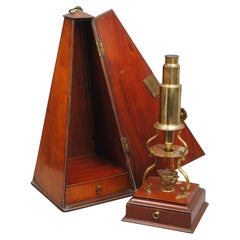
A Fine Adams, London Culpepper Microscope
Located in Lincolnshire, GB
A late 18th century brass lacquered Culpepper design microscope by Adams, London in the original mahogany case. The two drawers contain a good selection of lenses and accessories.
Th...
Category
English Antique Late 18th Century Scientific Instruments
Materials
Brass
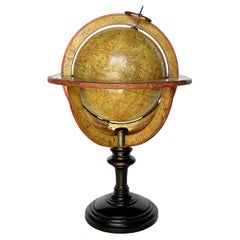
Celestial Table Globe, Charles-François Delamarche, Paris, 1791
Located in Milano, IT
Celestial table globe
Charles-François Delamarche
Paris, 1791
It measures: 17.13 in in height, Ø max 27.7 in; the sphere Ø 7.09 in
(h 43.5 cm x Ø max 27.7 cm; the sphere Ø 18 cm).
W...
Category
French Other Antique Late 18th Century Scientific Instruments
Materials
Metal
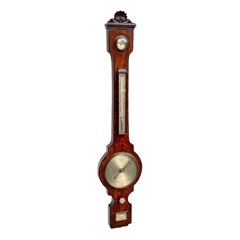
George III Mahogany Banjo Barometer Edinburgh
Located in Huntington, NY
George III Mahogany Banjo Barometer By Edie & Son. Edinburgh
Alexander James Adie FRSE MWS (7 November 1775, Edinburgh – 4 December 1858, Edinburgh) was a Scottish maker of medical ...
Category
English George III Antique Late 18th Century Scientific Instruments
Materials
Brass
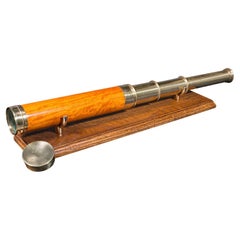
Antique Three-Draw Telescope, English, Walnut, Brass, Navigation, Georgian, 1790
Located in Hele, Devon, GB
This is an antique three-draw telescope. An English,walnut and brass navigational or astronomical instrument by Lincoln of London, dating to the Georgian period, circa 1790.
Perfect for bird watching, landscape appreciation, wildlife, or maritime observation. Equally suitable for observing the night sky.
A fine and tactile example of Georgian optical craftsmanship
Crafted with a striking walnut main barrel, displaying warm amber tones
Walnut exhibits a fine grain pattern, with minimal wear commensurate with gentle use
Features three smoothly operating brass draw tubes, with bright golden hues
Engraved to the rear barrel with 'Lincoln, London' – a noted maker of the period
Fitted with a push-type dust cover to protect the 40mm primary objective lens
Bright, functional optics with a clear image – suited for both display and gentle use
A handsome piece for the collector of nautical antiques or scientific instruments
Supplied with a London Fine oak and brass 'Captain's Stand' for display
Further enhanced with the original leather carry sleeve, in lightly time worn order
Elegant and evocative, this Georgian telescope...
Category
British Georgian Antique Late 18th Century Scientific Instruments
Materials
Brass
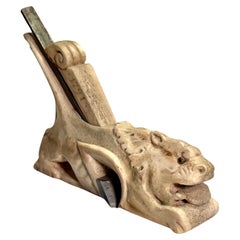
18th Century Carpenters Hand Plane Tool, Signed and Dated 1791
Located in Haddonfield, NJ
Rare Museum-level 18th Century carpenters tool, an antler hand plane, hand-carved to look like a lion. Signed with initials and dated 1791.
Category
Scandinavian Folk Art Antique Late 18th Century Scientific Instruments
Materials
Metal

$1,400 Sale Price
56% Off
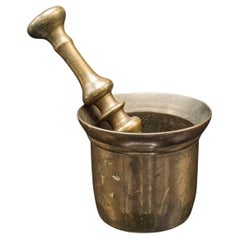
Antique Kitchen Mortar
Pestle, English, Bronze, Apothecary, Chemist, Georgian
Located in Hele, Devon, GB
This is an antique kitchen mortar and pestle. An English, bronze apothecary or chemist's shop aid, dating to the Georgian period, circa 1780.
Useful kitchen or apothecary aid from ...
Category
British Georgian Antique Late 18th Century Scientific Instruments
Materials
Bronze
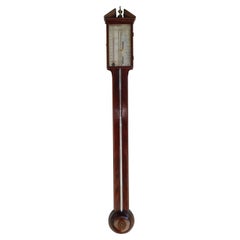
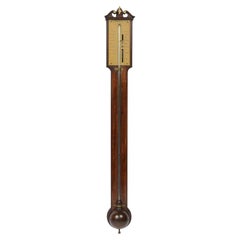
English Mahogany Steel Engraved Stick Barometer Signed F. Tarone, Circa 1780
Located in Charleston, SC
English mahogany stick Barometer with a broken arch pediment, brass urn finial, Satin wood string inlay, hinged glass door revealing a numeral steel engraved dial with original mounted thermometer and barometric pressure gauge. Signed F. Tarone. Late 18th Century Barometer...
Category
English Sheraton Antique Late 18th Century Scientific Instruments
Materials
Steel
Antique Apothecary Mortar
Pestle, English, Bronze, Chemist Shop Aid, Georgian
Located in Hele, Devon, GB
This is an antique apothecary mortar and pestle. An English, bronze chemist's shop aid, dating to the Georgian period, circa 1800.
Quality Georgian apothecary aid with superb finis...
Category
British Georgian Antique Late 18th Century Scientific Instruments
Materials
Bronze
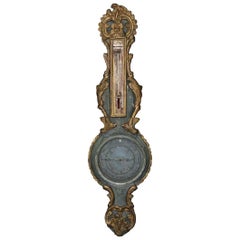
18th Century French Louis XVI Giltwood Barometer
Located in Sheffield, MA
A stunningly beautiful 18th century French gold gilt barometer is a weather instrument with mercury-filled glass thermometer still in working order...
Category
French Louis XVI Antique Late 18th Century Scientific Instruments
Materials
Wood
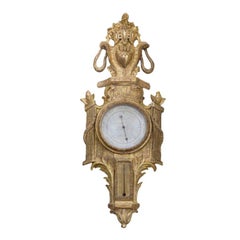
Louis XVI Giltwood Barometer
Located in Kittery Point, ME
Of typical form‚ the giltwood body centered by a circular barometer dial flanked by pillars ending in flame‚ above a thermometer flanked by foliate branches‚ surmounted by swags.
Category
French Louis XVI Antique Late 18th Century Scientific Instruments
Materials
Wood
$12,500
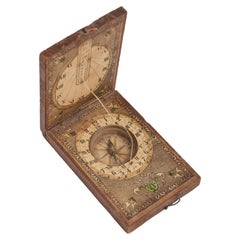
: Wooden pocket diptych sundial Ernst Christoph Stocket. Germany 1780 - 1811.
Located in Milan, IT
Wooden pocket diptych sundial Ernst Christoph Stocket - type, Bavaria. A folding wooden sundial is partially covered in paper with engraved/printed decorations and text. A compass is...
Category
German Antique Late 18th Century Scientific Instruments
Materials
Wood, Paper
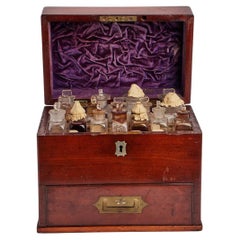
Travel pharmacy in mahogany wood and brass, England 1790.
Located in Milan, IT
Travel pharmacy. Box in Mogano Sipo ( Entandrophragma utile ) wood and brass with recessed handles on both sides and a drawer on the front. The upper level opens, inside it there are...
Category
English Antique Late 18th Century Scientific Instruments
Materials
Brass
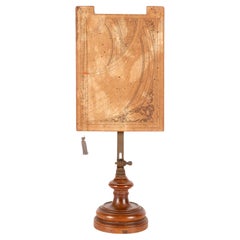
Italian-transalpine time dial paper on wood board. Giusti, Nerici, Italy 1781.
Located in Milan, IT
An Italian and transalpine hour dial in paper printed on a fruitwood board. The base, in turned boxwood, has a wavy profile and distinct edge, at the top of which is mounted the rect...
Category
Italian Antique Late 18th Century Scientific Instruments
Materials
Brass
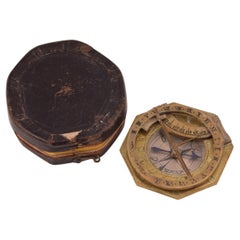
Sundial and Compass with Case, Schrettegger, Johan, Augsburg, Germany, Ca 1800
Located in Madrid, ES
Sundial and compass with case. Bronze. SCHRETTEGGER, Johan. Augsburg, Germany, around 1800.
Sundial with a polygonal shape made of bronze, engraved with plant elements on the front,...
Category
German Neoclassical Antique Late 18th Century Scientific Instruments
Materials
Bronze, Other
A trunk style travel apotecary cabinet in mahogany wood and brass, England 1790.
Located in Milan, IT
English travelling apothecary made of mahogany Sipo mahogany (Entandrophragma utile) and brass with a rectangular base, a front drawer, an opening to...
Category
English Antique Late 18th Century Scientific Instruments
Materials
Brass

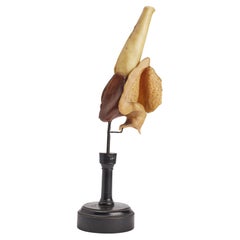
Anatomical model: a thyroid, Germany end of 18th century.
Located in Milan, IT
Coloured wax anatomic model depicting an human organ: Thyroid mounted on black painted wooden base. Germany end of XVIII sec.
Category
German Antique Late 18th Century Scientific Instruments
Materials
Wood
Late 18th Century Lacquered Brass Table Telescope
Located in Huntington, NY
Late 18th century lacquered brass table telescope.
Category
English George III Antique Late 18th Century Scientific Instruments
Materials
Brass
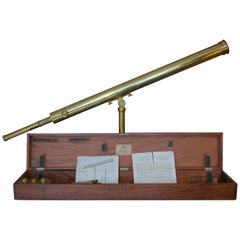
$4,368 Sale Price
20% Off
18th Century mahogany and brass telescope by Nairne
Blunt of London
Located in Martlesham, GB
18th Century mahogany and brass telescope by Nairne & Blunt of London, having a mahogany barrel with a thumb wheel to the side of the main barrel, supported on a solid brass tripod s...
Category
British Georgian Antique Late 18th Century Scientific Instruments
Materials
Mahogany
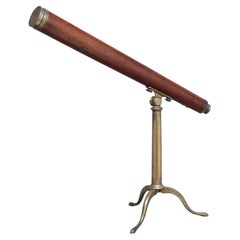
18th Century Gold French Gilded Wood Barometer, Antique Parisian Thermometer
Located in West Palm Beach, FL
A rare antique finely worked French barometer with lyre shaped crest thermometer above a large hexagonal framed barometer. The Parisian décor piece is m...
Category
French Empire Antique Late 18th Century Scientific Instruments
Materials
Giltwood
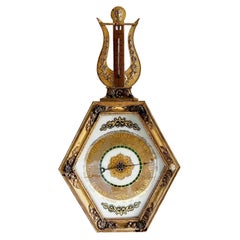
18th Century English Mahogany Cased Stick Barometer by Dolland of London
By Dolland
Located in Dublin, IE
An exceptional late 18th century mahogany cased stick barometer by Dolland of London, The mahogany case of a very solid construction and with a superbly made turned mahogany cistern ...
Category
English Georgian Antique Late 18th Century Scientific Instruments
Materials
Steel
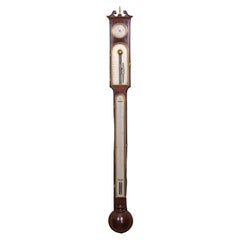
Stick Barometer Mahogany Board Antique Weather Measuring Instrument J. Ramsden
By Jesse Ramsden
Located in Milan, IT
Stick barometer mounted on a mahogany board complete with vernier reading the variation of atmospheric pressure signed by Jesse Ramsden, end of the 18th century.
Very good condition...
Category
Antique Late 18th Century Scientific Instruments
Materials
Wood
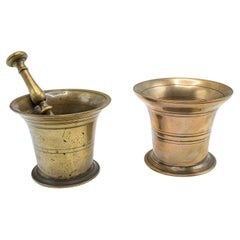
Antique Mortar and Pestle Duo, English, Brass, Apothecary, Jardiniere, Georgian
Located in Hele, Devon, GB
This is an antique mortar and pestle duo. An English, polished brass apothecary dish or decorative jardiniere pot, dating to the Georgian period, circa 1800.
Dashing Georgian morta...
Category
British Georgian Antique Late 18th Century Scientific Instruments
Materials
Brass
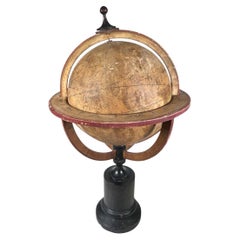
Terrestrial Globe By Félix Delamarche, Also Known As Charles-François Delamarche
Located in Dallas, TX
This antique terrestrial table globe is a French example attributed to the celebrated cartographer Félix Delamarche, whose firm was renowned for producing high quality, geographicall...
Category
French Antique Late 18th Century Scientific Instruments
Materials
Wood, Paper
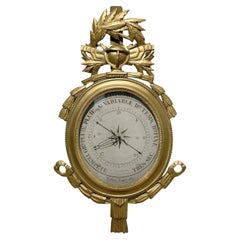
18th Century French Louis XVI Period Gilded Barometer by Evangelista Torricelli
By Evangelista Torricelli
Located in West Palm Beach, FL
A gold, large antique French Louis XVI period barometer, signed by Torricelli in gilded wood and of oval shape with original scientific illustrations, in good condition. The detailed wall décor piece is consisting its original glass. Framed with gilt foliate trim and important pediment. Minor fading, due to age. Wear consistent with age and use, circa 1750, France.
The Italian scientist Evangelista Torricelli...
Category
French Louis XVI Antique Late 18th Century Scientific Instruments
Materials
Giltwood
Rare George III Celestial Pocket Globe by Cary, London
By Cary
Located in Oxfordshire, United Kingdom
A fine and rare 3" celestial pocket globe by G & W Cary, Strand, London circa 1791, housed in its original sharkskin case.
A companion globe to terrestrial globes of this type we...
Category
English George III Antique Late 18th Century Scientific Instruments
Materials
Plaster
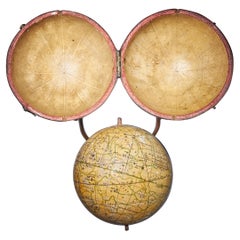
18th Century French Louis XVI Giltwood Barometer
Located in Sheffield, MA
A stunningly beautiful 18th century French gold gilt barometer is a weather instrument with mercury-filled glass thermometer still in working order...
Category
French Louis XVI Antique Late 18th Century Scientific Instruments
Materials
Wood
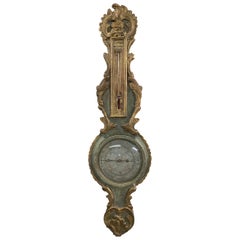
Gustavian brass box with perpetual calender based on the rune staff
Located in Knivsta, SE
Gustavian brass box with perpetual calender based on the rune staff. The box is from the late 18th Century and was used as a perpetual calendar and...
Category
Swedish Gustavian Antique Late 18th Century Scientific Instruments
Materials
Brass
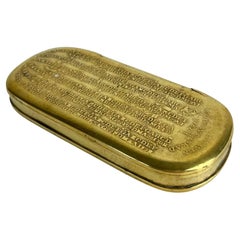
Alnmått (Cubit measure) in Birch with a Noble Crown. Gustavian, dated 1783
Located in Knivsta, SE
Rare Alnmått (Cubit measure) made in Birch with a Noble Crown. From the Gustavian period of the late 1700s, roughly corresponding to the Louis XVI period in France, made in Sweden an...
Category
Swedish Gustavian Antique Late 18th Century Scientific Instruments
Materials
Brass
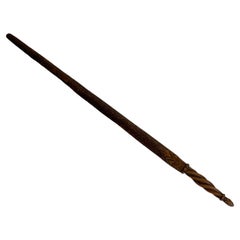
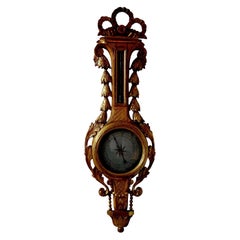
18th Century French Louis XVI Giltwood Barometer
Located in Houston, TX
Lovely period French Louis XVI giltwood barometer with beautiful patina. This antique French Louis XVI gilt wood barometer will add a touc...
Category
French Louis XVI Antique Late 18th Century Scientific Instruments
Materials
Giltwood
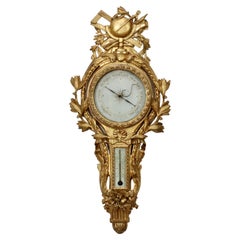
Louis XVI Gilt-Wood Barometer
Thermometer, France c. 1780
Located in Atlanta, GA
A Louis XVI Period Barometer & Thermometer Combination, originating in France & dating from the last quarter of the 18th century. The workings enclosed by a gilt-wood case with carve...
Category
French Louis XVI Antique Late 18th Century Scientific Instruments
Materials
Glass, Giltwood
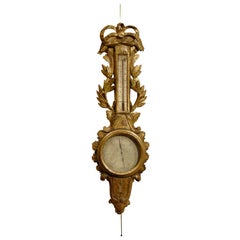
Late 18th Century French Giltwood Barometer
Located in Essex, MA
Period late 18th century giltwood barometer. Original gilding. Carved overall with globe, and navigation instruments. Foliate and neoclassical motifs. Maker signed.
Category
French Louis XVI Antique Late 18th Century Scientific Instruments
Materials
Giltwood
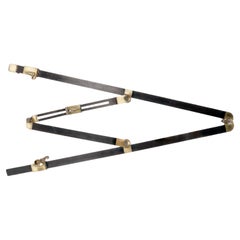
Ebony, brass and ivory pantograph, signed Lennel, Paris 1780.
Located in Milan, IT
Brass and ebony wood pantograph, in its original mahogany box. The wheels are made of ivory. The instrument shows the signature of the maker Lennel à La Sphére à Paris. France 1780. ...
Category
French Antique Late 18th Century Scientific Instruments
Materials
Brass
Important Georgian Mahogany Mercury Stick Barometer by Stott, Dumfries
Located in Norwich, GB
Fine Georgian mahogany bow fronted stick barometer. Bow fronted glass set in front of the silvered register plate with sliding vernier controlled by an ivory turned knob. Concertina ...
Category
English Georgian Antique Late 18th Century Scientific Instruments
Materials
Mahogany, Ivory
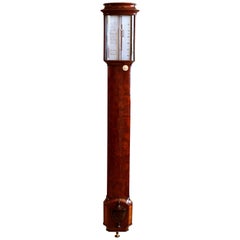
French Louis XVI Carved Giltwood Mercury Barometer
Located in Norwich, GB
Louis XVI carved giltwood and painted mercury wheel barometer.
Eight inch circular painted wood register dial with central rosette within the scale calibrated from 27-28-29 and ...
Category
French Louis XVI Antique Late 18th Century Scientific Instruments
Materials
Giltwood
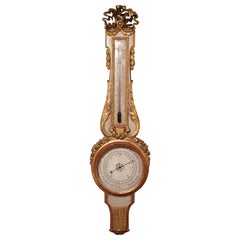
Antique 18th Century French Bronze Scientific Silk-Weighing Instrument 1789-1795
Located in New Orleans, LA
Rare antique 18th century French Lyonnaise bronze scientific Instrument used for weighing Silk, in anchor form, 1789-1795. Made by "J. Berthaud et Cie...
Category
French Antique Late 18th Century Scientific Instruments
Materials
Bronze
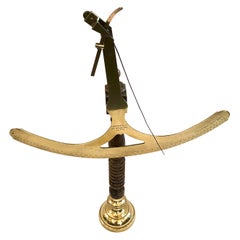
Good 18th Century Bronze Sundial By Miller And Adie, Edinburgh
Located in Lincolnshire, GB
A finely engraved 18th century, 15" diameter bronze sundial signed Miller & Adie, Edinburgh with good patina and the original gnomon.
Category
Scottish Antique Late 18th Century Scientific Instruments
Materials
Bronze
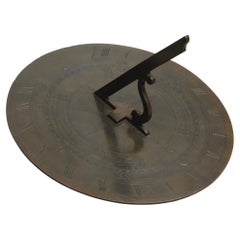
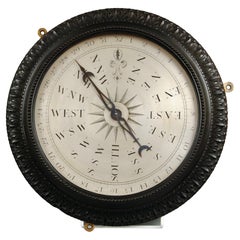
Very Rare Wind Vane Dial in the Manner of Whitehurst
Located in Lincolnshire, GB
A George III period carved mahogany wind vane dial. The silvered engraved dial with all the points of a compass housed in the finely carved mahogany frame, ...
Category
English Antique Late 18th Century Scientific Instruments
Materials
Glass, Mahogany
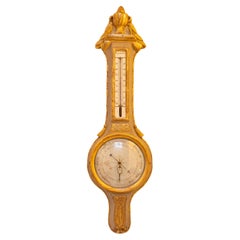
Louis XVI Period Giltwood Barometer
Located in Ross, CA
This beautifully carved Louis XVI barometer follows the designs of Evangelista Torricelli, an Italian physicist who was a student of Galileo and...
Category
French Louis XVI Antique Late 18th Century Scientific Instruments
Materials
Glass, Giltwood
$3,840 Sale Price
40% Off
Still Thinking About These?
All Recently ViewedMore Ways To Browse
Antique Oil Pumps
Antique Portuguese Scales
Antique Surveyor Compass
Antique Wooden Compass
Avery Brass Scales
Big Eye Binoculars
Botanical Flower Model
Brain Model
Brass Compass And Case
Brass Surveyors Level
German Telescope
Japanese Vintage Camera
Large Coffee Grinder
Nikon Binoculars
Paper Dispenser
Small Antique Compass
Small Telescope
Stanley Tool