Items Similar to Small chrome-plated brass pocket compass for the U.S. Army in 1917
Want more images or videos?
Request additional images or videos from the seller
1 of 10
Small chrome-plated brass pocket compass for the U.S. Army in 1917
$896.42
£670.35
€750
CA$1,235.88
A$1,356.40
CHF 712.81
MX$16,140.94
NOK 9,111.84
SEK 8,326.42
DKK 5,715.31
About the Item
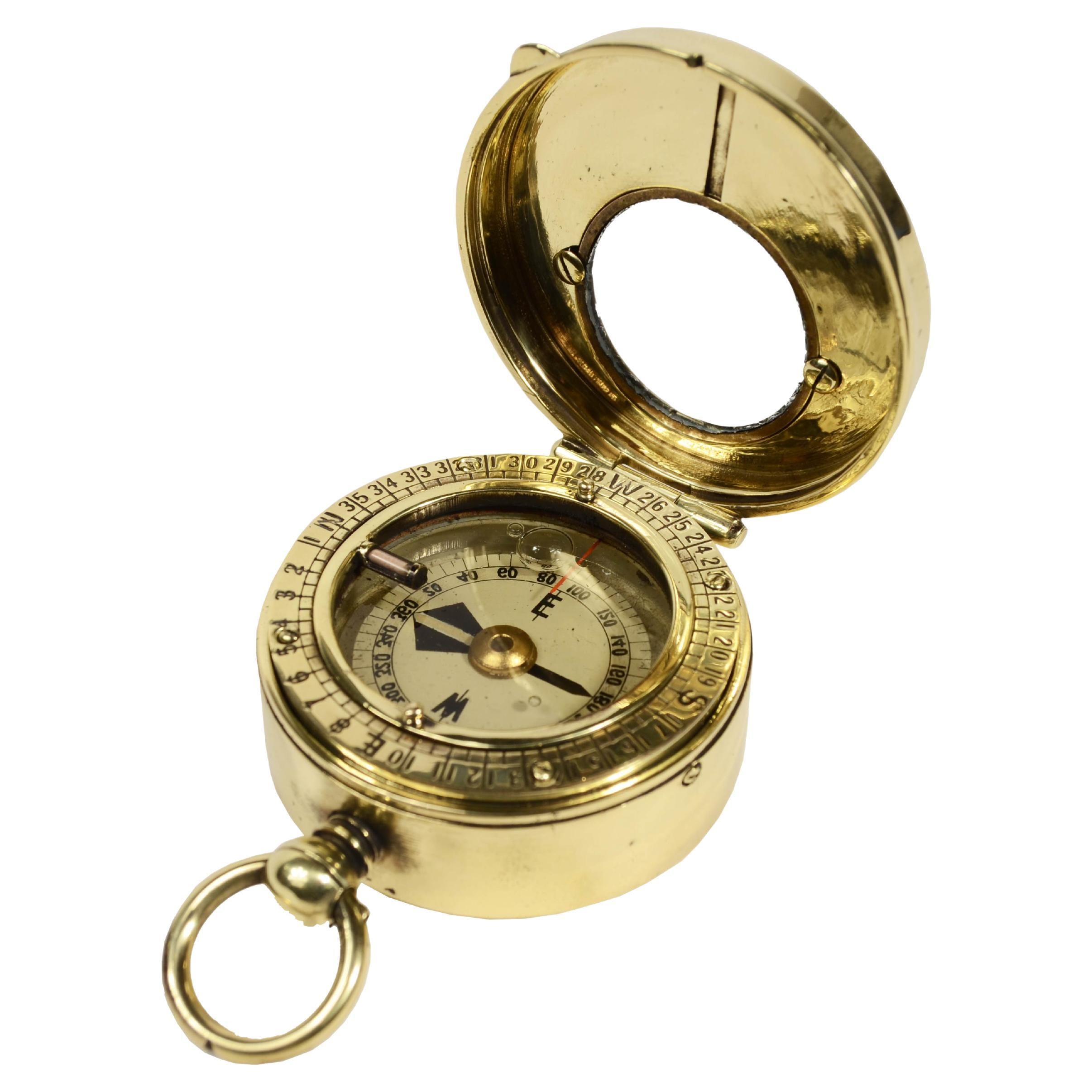
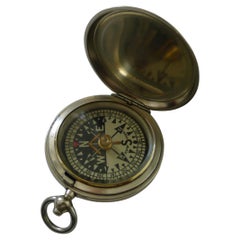
Small chrome-plated brass pocket and travel compass, issued to the U.S. Army during World War I; cover reads ENG. DEPT. U.S.A. 1917.
Pocket compass in the shape of an onion clock, equipped with a lid that opens with a button located inside the ring; when the lid is closed, a mechanism is operated that blocks the needle to shelter it from movement.
The instrument consists of a magnetized needle free to rotate in a horizontal plane marking the direction of magnetic north.
Signed Usanite N.Y. Taylor Rochester Pat Apr 20-1915.
Good condition, signs of use, slight oxidation inside the compass fully functional. Measures cm 4.5x1.2 - inches 1.8x0.4.
The last photo is the gift box.
The Usanite model was supplied to the U.S. Army Engineering Department as a pocket compass during World War I.
It seems that the etymology of the name Usanite originated from Use at night, to be used at night, as if the compass had the characteristics for nighttime use.
Taylor Instrument began operations in Rochester in 1851, producing thermometers; in 1900 it acquired the English company Short
Mason famous for its precision instruments.
The Greeks and the Romans were still unaware of the possibility of harnessing magnetic fields for orientation, while it seems that this possibility was already somewhat known to the Chinese: around 2600 B.C. Emperor Hoang-Ti was able to overcome Prince Tchi-Yeou in battle thanks to a "magic" chariot, the See-Nan (chariot pointing south). The emperor, thanks to this device, identified the enemy's escape route, despite the fact that the enemy had concealed it through a blanket of smoke: fixed on the chariot was a human-shaped wooden silhouette that rotated on itself and, with its arm outstretched, always pointed south (pointing south of course was also pointing north at the same time, but south was considered by the Chinese to be the most important cardinal point). The Chinese also used their discoveries related to magnetic fields as a form of entertainment and spectacle: they would throw magnetized arrows as if they were dice, and these would line up in a south-north direction as if by magic, which greatly impressed and amazed the spectators.
- Dimensions:Height: 0.4 in (1.02 cm)Diameter: 1.8 in (4.58 cm)
- Materials and Techniques:
- Period:1910-1919
- Date of Manufacture:1917
- Condition:Wear consistent with age and use.
- Seller Location:Milan, IT
- Reference Number:1stDibs: LU1020246924812
About the Seller
5.0
Vetted Professional Seller
Every seller passes strict standards for authenticity and reliability
Established in 1999
1stDibs seller since 2014
400 sales on 1stDibs
Typical response time: 4 hours
- ShippingRetrieving quote...Shipping from: Milan, Italy
- Return Policy
More From This Seller
View AllSmall mahogany and brass compass in use by British aviation officers 1915
Located in Milan, IT
Small mahogany wood and brass pocket compass in use by British aviation officers during World War I complete with eight-wind rose with goniometric circle and compass needle block for...
Category
Vintage 1910s Aviation Objects
Materials
Wood
8253 Sinclair Haymarket London Signature Liquid Sensing Pocket Compass
Located in Milan, IT
Signed Sinclair Haymarket London liquid-detecting pocket compass in use by British army officers during World War I. This is a small vintage compass typically used in recreational sa...
Category
Vintage 1910s Nautical Objects
Materials
Brass
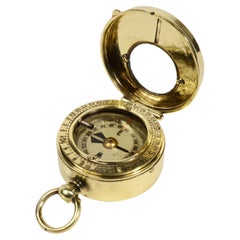
Liquid-filled compass on gimbal and mounted on mahogany wood plank
Located in Milan, IT
Liquid compass on gimbals and mounted on shaped mahogany wood plank. English manufacture of the late 19th century. The compass consists of a cylindrical-shaped vessel made of brass a...
Category
Antique Late 19th Century Nautical Objects
Materials
Brass
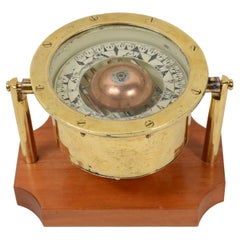
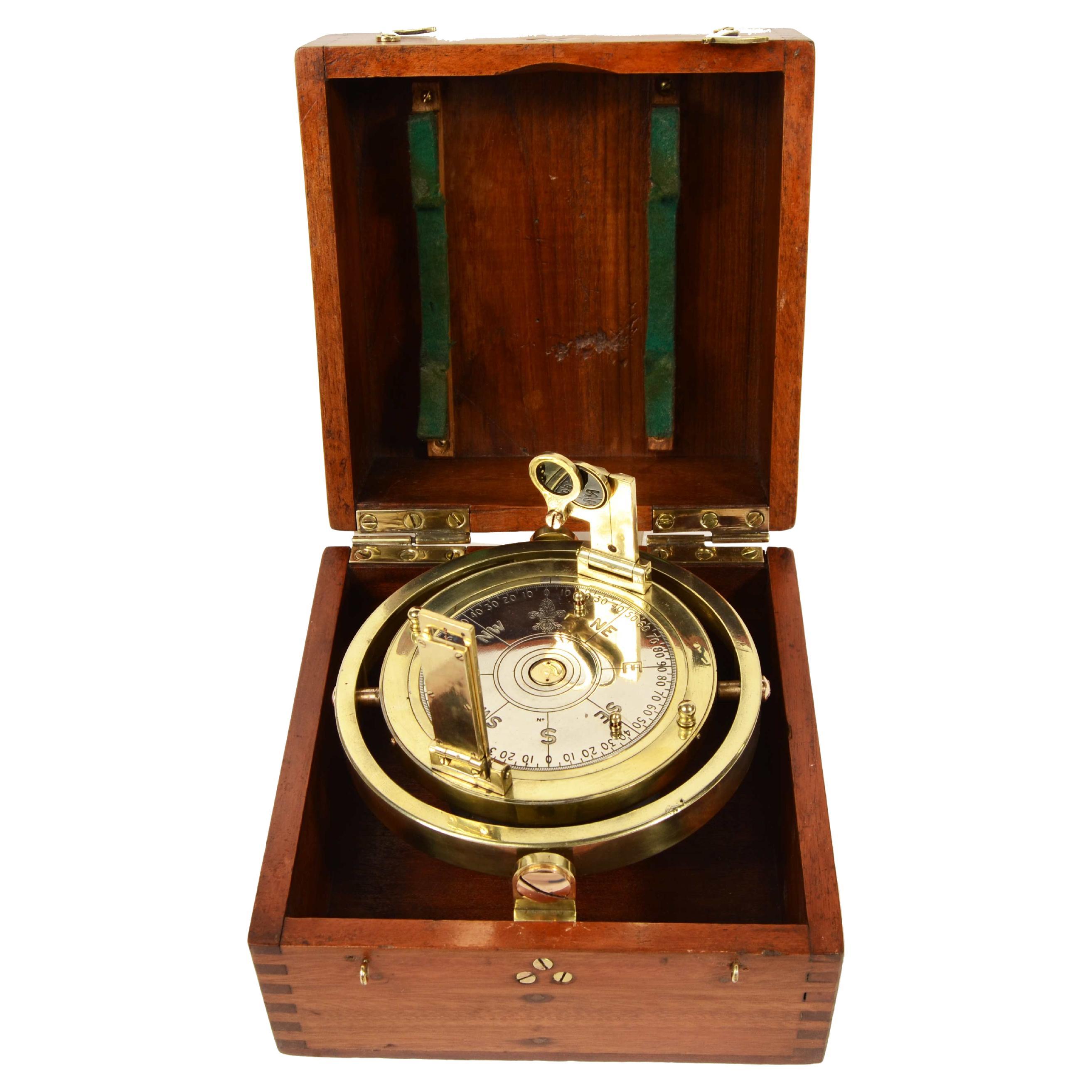
English Pelorus brass from the second half of the 19th century, on cardan joint
Located in Milan, IT
English Pelorus brass from the second half of the 19th century, mounted on gimbals within its original mahogany wood box with brass hinges and locking hooks.
The instrument has an...
Category
Antique 1870s Nautical Objects
Materials
Brass
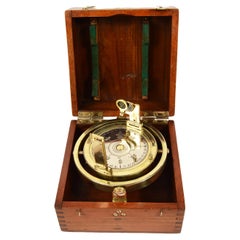
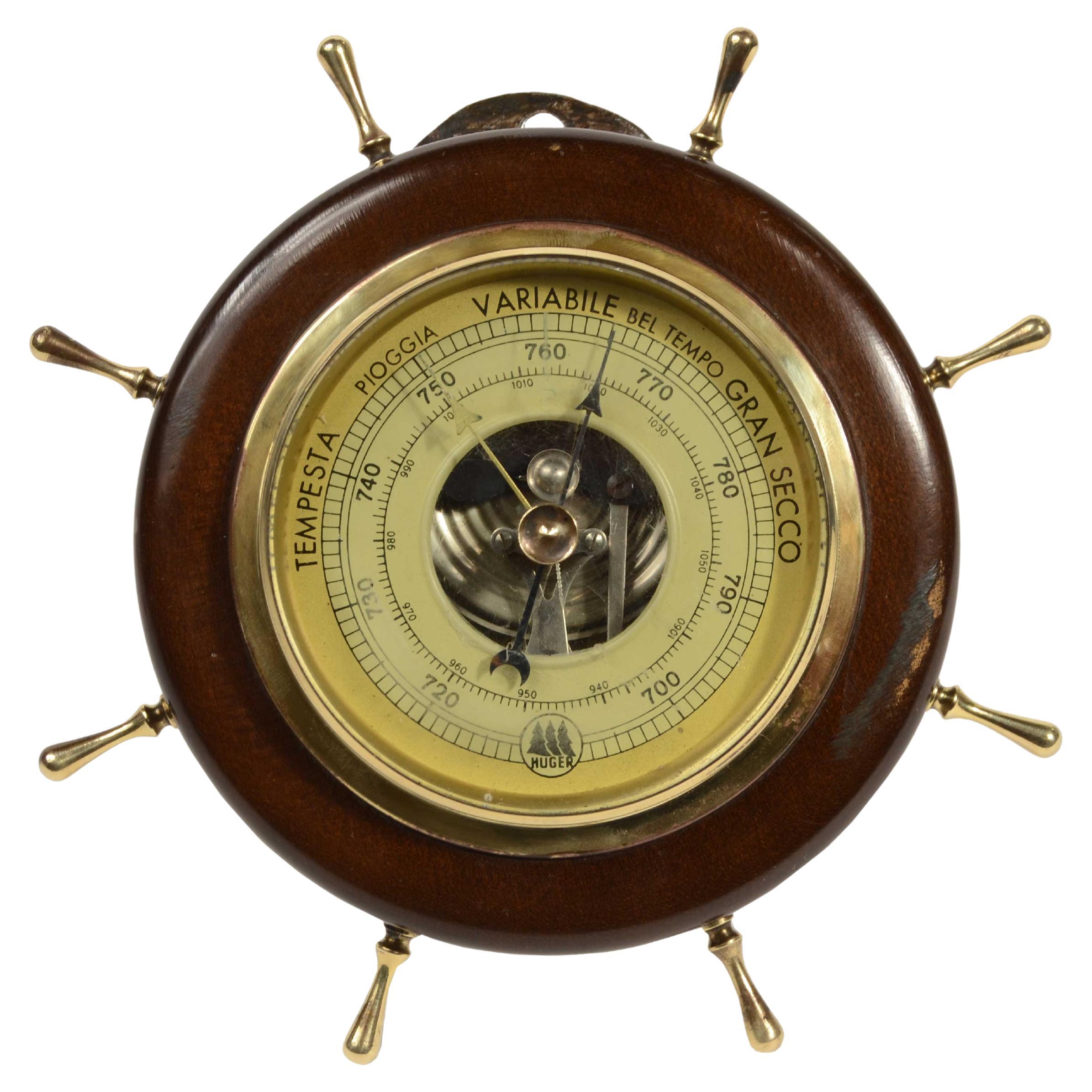
Small Italian aneroid wooden wall barometer in the shape of a rudder 1950s
Located in Milan, IT
Small wood and brass wall-mounted aneroid barometer in the shape of an eight-ankle rudder, with weather indications in Italian, signed Huger of the 1950s. This is an instrument whose...
Category
Mid-20th Century Scientific Instruments
Materials
Wood
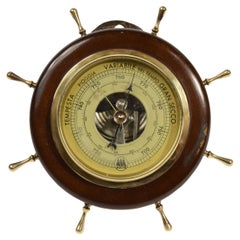
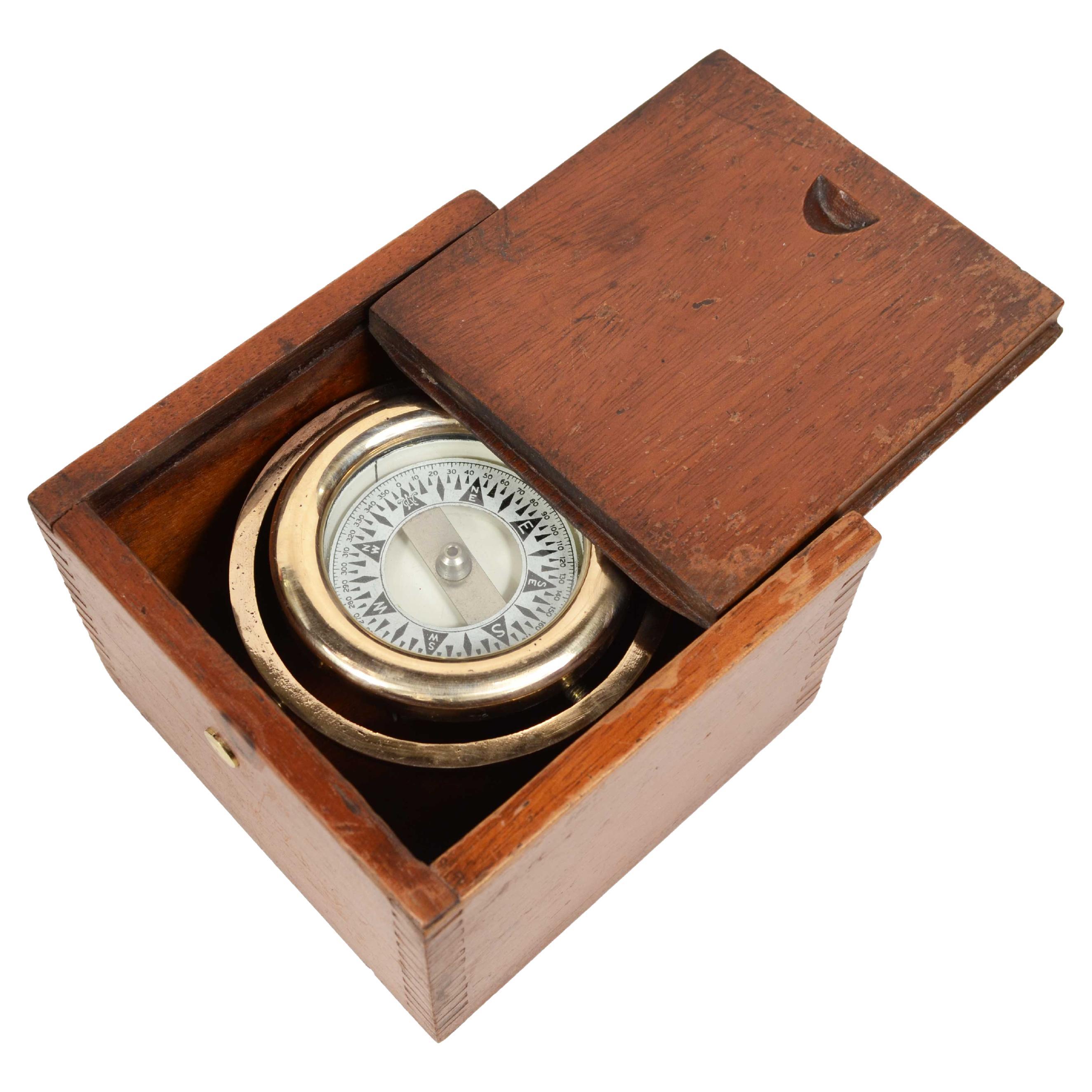
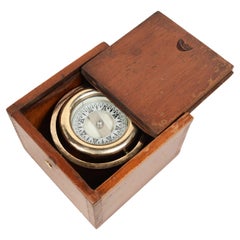
Nautical magnetic compass made USA 1930s original wooden box
Located in Milan, IT
Nautical magnetic compass, made in the USA in the 1930s.
Bon état. Housed in its original box with wooden slot lid and mounted on gimbal.
Box measures 12x12x8.5 cm - inches 4.8x4.8x...
Category
Vintage 1930s Nautical Objects
Materials
Brass
You May Also Like
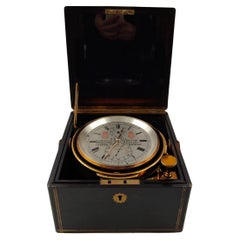
Cronometro da marina, SEWILL, Inghilterra fine XIX secolo
By Sewill
Liverpool
Located in Vicenza, VI
Cronometro da marina prodotto da Sewill, custodito in una cassa cubica in legno di palissandro, con spigoli e filettature in ottone, di dimensioni 18x18x19 cm. È dotato di due coperc...
Category
Antique Late 19th Century English Other Nautical Objects
Materials
Brass
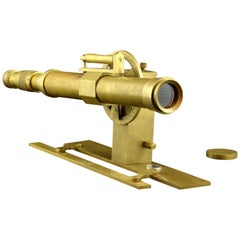
Decorative Alidade, Metal, 20th Century
Located in Madrid, ES
It has a cover to protect the lens made of the same gold metal in which the rest of the instrument is made. The lines, pure and clean, are the protagonists, and make it a great opti...
Category
20th Century Unknown Other Scientific Instruments
Materials
Metal, Other
Old Compass reproduction 1944 London, brown Color
Located in Auribeau sur Siagne, FR
Old Compass reproduction 1944 London, brown Color
Category
20th Century English Scientific Instruments
Materials
Metal
$133 Sale Price
20% Off
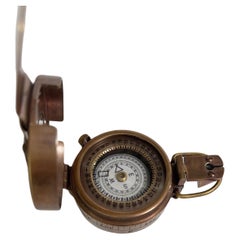
Antique English Nickel Cased Compass Reg. No. For 1903 - WW1 Military Issue
Located in Bath, GB
A handsome cased World War One issued compass with hinged lid, the little button on the top used to open; just like a full hunter pocket watch. The front is stamped with the war off...
Category
Vintage 1910s Scientific Instruments
Materials
Nickel
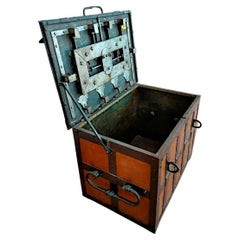
Antique chest safe from the 17th century
Located in Cesena, FC
Antique chest safe from the 17th century, made of wrought iron.
Antique wrought iron safe chest from 1600, studded, with working mechanism
For key insertion there is a dungeon mecha...
Category
Antique 18th Century and Earlier Italian Trunks and Luggage
Materials
Iron
Portable Universal Equinoctial Dial
Located in Madrid, ES
This is an instrument that consists of a brass base and a brass stand on which a semi-circular metal dial plate and gnomon are attached. The base is circular and has a felt bottom. I...
Category
Antique Early 1900s Scientific Instruments
Materials
Brass