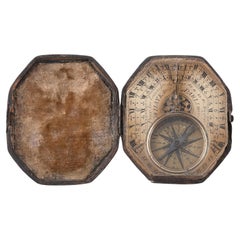
Items Similar to UNIVERSAL EQUINOCTIAL RING SUN DIAL NICOLAS BION, PARIs, CIRCA 1700
Want more images or videos?
Request additional images or videos from the seller
1 of 9
UNIVERSAL EQUINOCTIAL RING SUN DIAL NICOLAS BION, PARIs, CIRCA 1700
$13,655
£10,214.15
€11,400
CA$18,815.94
A$20,683.30
CHF 10,858.64
MX$245,939.32
NOK 139,449.55
SEK 127,023.47
DKK 86,879.82
About the Item
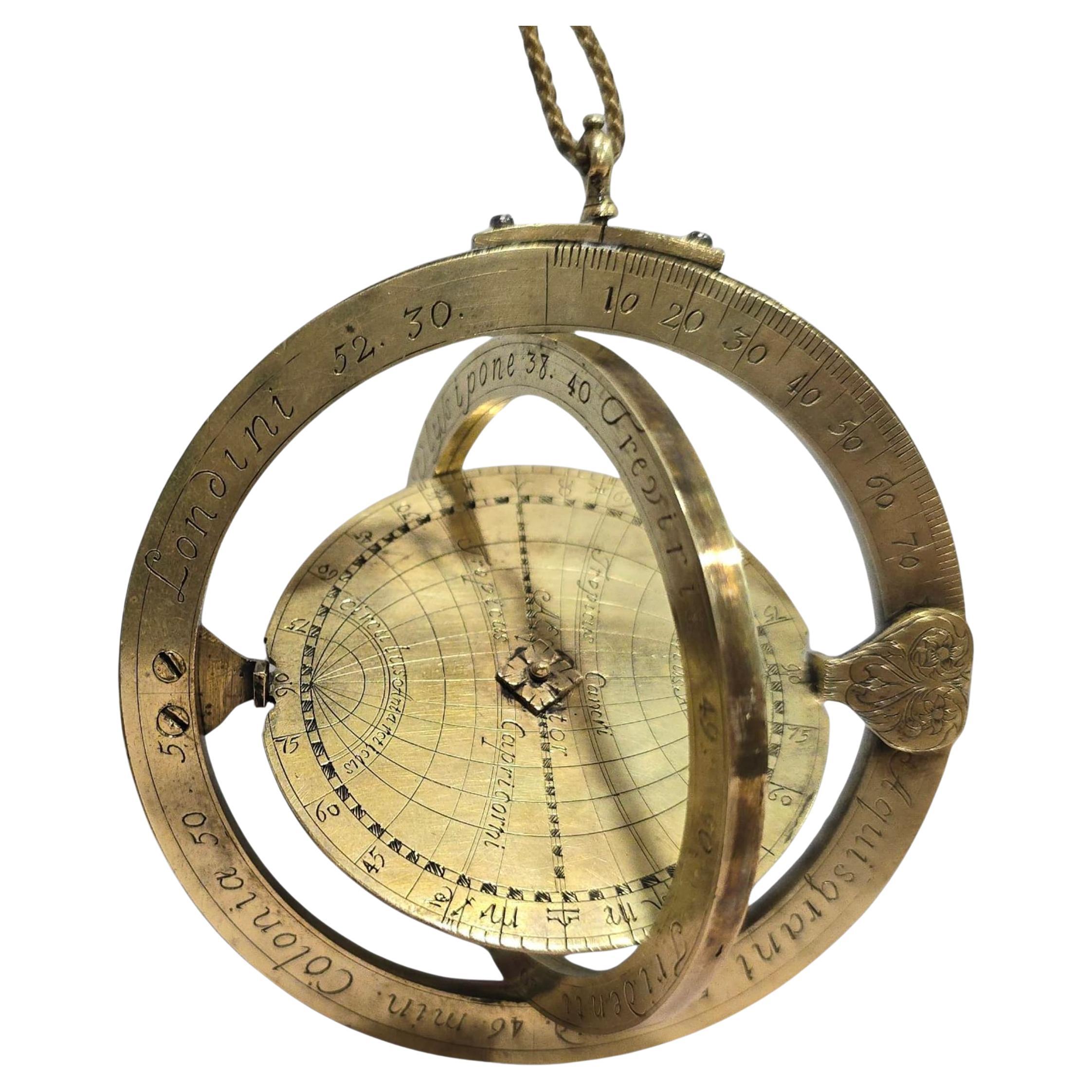
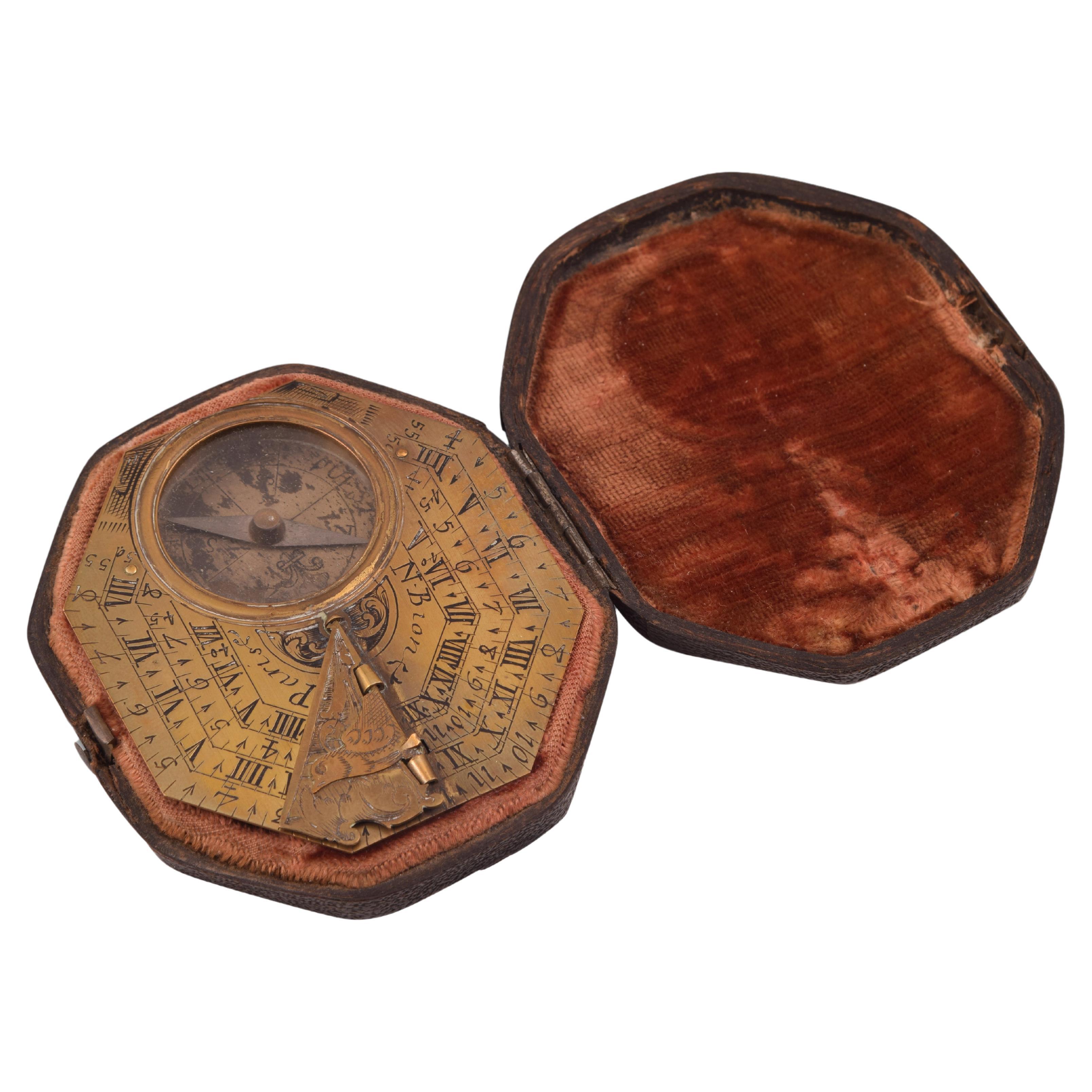
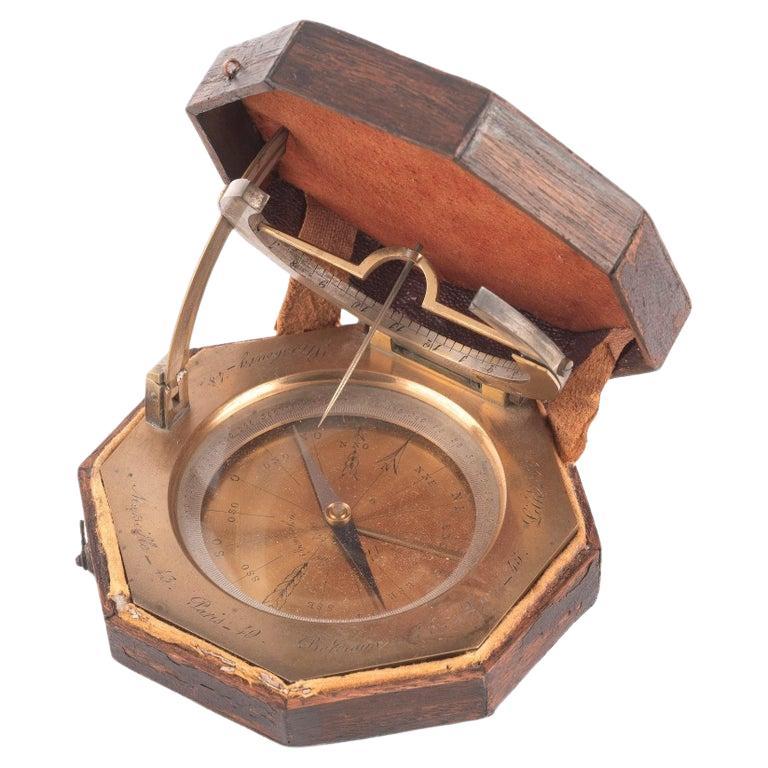
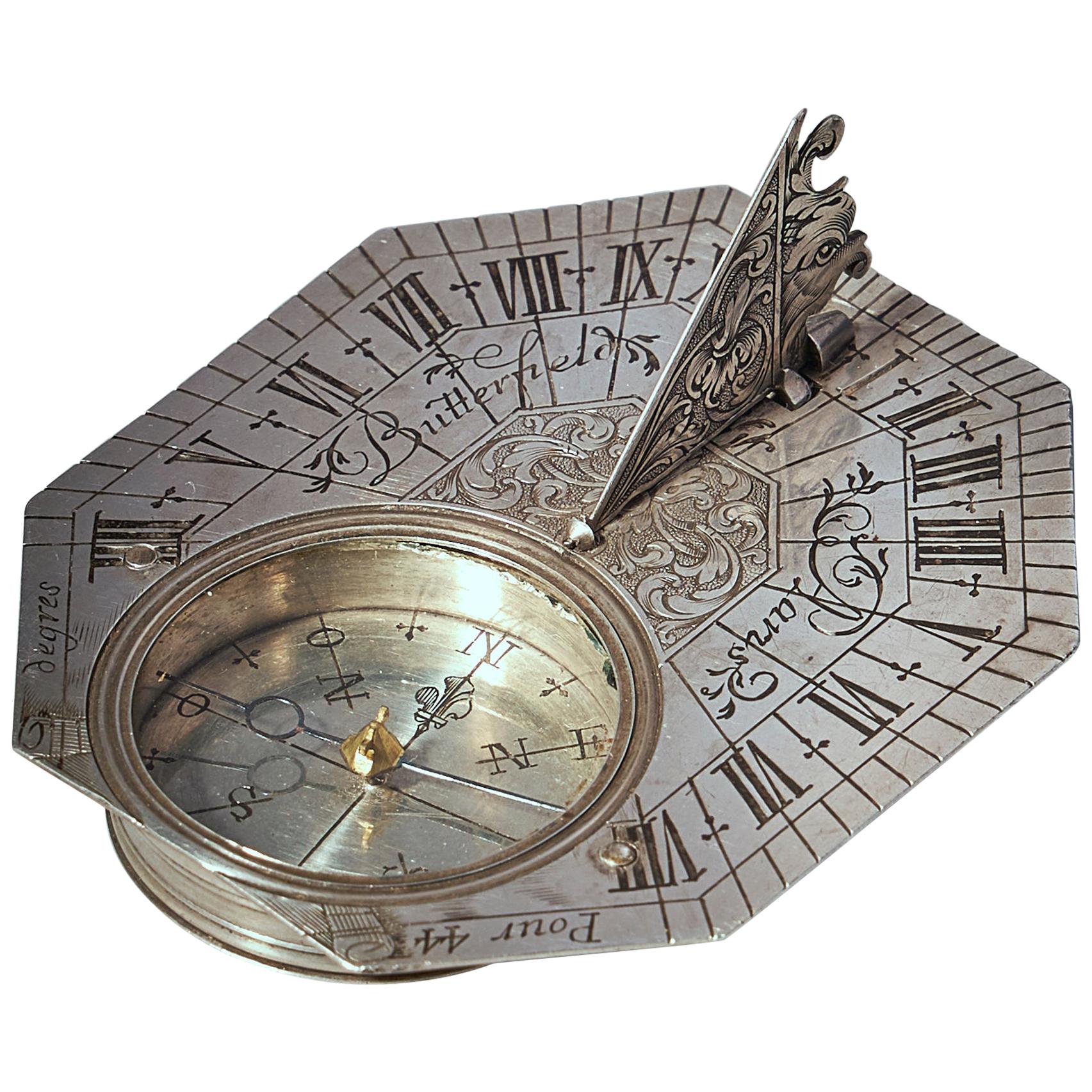
UNIVERSAL EQUINOCTIAL RING SUN DIAL NICOLAS BION, PARIS, CIRCA 1700
A RARE EQUINOCTIAL RING
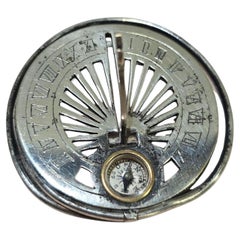
signed "N Bion A PARIS", around 1700, made IN BRONZE composed of meridian and equatorial rings, latitude engraved with European city names alternating with flower motifs. Rotary bridge with month scale and zodiacal dial decorated with engraved scroll patterns. Scale of latitudes with a scale of degrees numbered 0-90° reading to one degree. Time divisions engraved in Arabic characters (I-XII x 2)
Beautiful instrument signed by Nicolas BION (1652-1733) King's engineer for mathematical INSTRUMENTS
SIZE:9 CM DIAMETER
- Dimensions:Height: 0.4 in (1 cm)Diameter: 3.55 in (9 cm)
- Materials and Techniques:
- Period:Early 17th Century
- Date of Manufacture:1690
- Condition:
- Seller Location:Madrid, ES
- Reference Number:1stDibs: LU5779247331582
About the Seller
4.8
Platinum Seller
Premium sellers with a 4.7+ rating and 24-hour response times
Established in 2005
1stDibs seller since 2021
395 sales on 1stDibs
Typical response time: 1 hour
- ShippingRetrieving quote...Shipping from: Madrid, Spain
- Return Policy
More From This Seller
View AllPlanispheric Astrolabe – Equinoctial Dial, late 16th–early 17th century
Located in Madrid, ES
Origin: Probably Southern Germany (Nuremberg or Augsburg) or the Flemish region (Louvain or Antwerp).
Date: circa 1580–1620
Material: finely engraved brass
Diameter: 9 cm
A beautifu...
Category
Antique 16th Century Scientific Instruments
Materials
Brass
18th Century Octagonal Brass Sundial Signed “Johan Schrettegger
Located in Madrid, ES
Exceptional 18th-century octagonal brass sundial, signed “Johan Schrettegger, Augsburg”, featuring a blued steel needle, a folding latitude arc engraved 10°–90°, and an engraved equi...
Category
Antique 18th Century Scientific Instruments
Materials
Brass
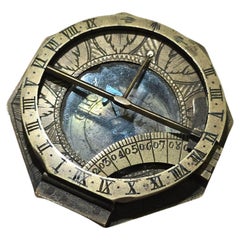
19th Century Silvered and Engraved Bronze Portable Sundial
Located in Madrid, ES
Elegant 19th-century portable sundial crafted in bronze, partially silvered and finely engraved with precise calibrations and decorative detailing.
This compact timekeeping instrumen...
Category
Antique 1810s Scientific Instruments
Materials
Brass
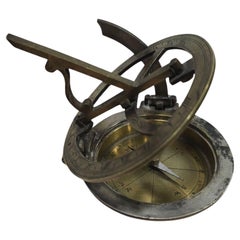
Engraved Brass Portable Sundial Signed “Menant à Paris”
Located in Madrid, ES
Elegant portable brass sundial, finely engraved and signed “Menant à Paris”, demonstrating the precision and artistry of French scientific instrument making.
This compact and beautif...
Category
Antique 1740s Scientific Instruments
Materials
Brass
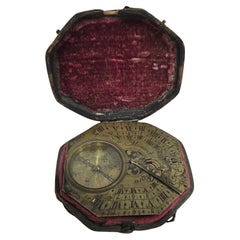
19th Century Portable Wooden Sundial
Located in Madrid, ES
Charming portable sundial crafted in engraved wood, dating from the 19th century.
This compact timekeeping instrument exemplifies the practical elegance and craftsmanship of traditio...
Category
Antique Mid-19th Century Scientific Instruments
Materials
Fruitwood
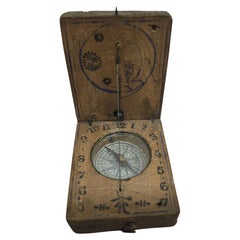
19th Century Silvered Pocket Sundial
Located in Madrid, ES
Elegant 19th-century pocket sundial, designed to be worn or carried, made of silvered metal with finely engraved details.
This compact and functional timepiece reflects the refinemen...
Category
Antique Mid-19th Century Scientific Instruments
Materials
Brass
You May Also Like
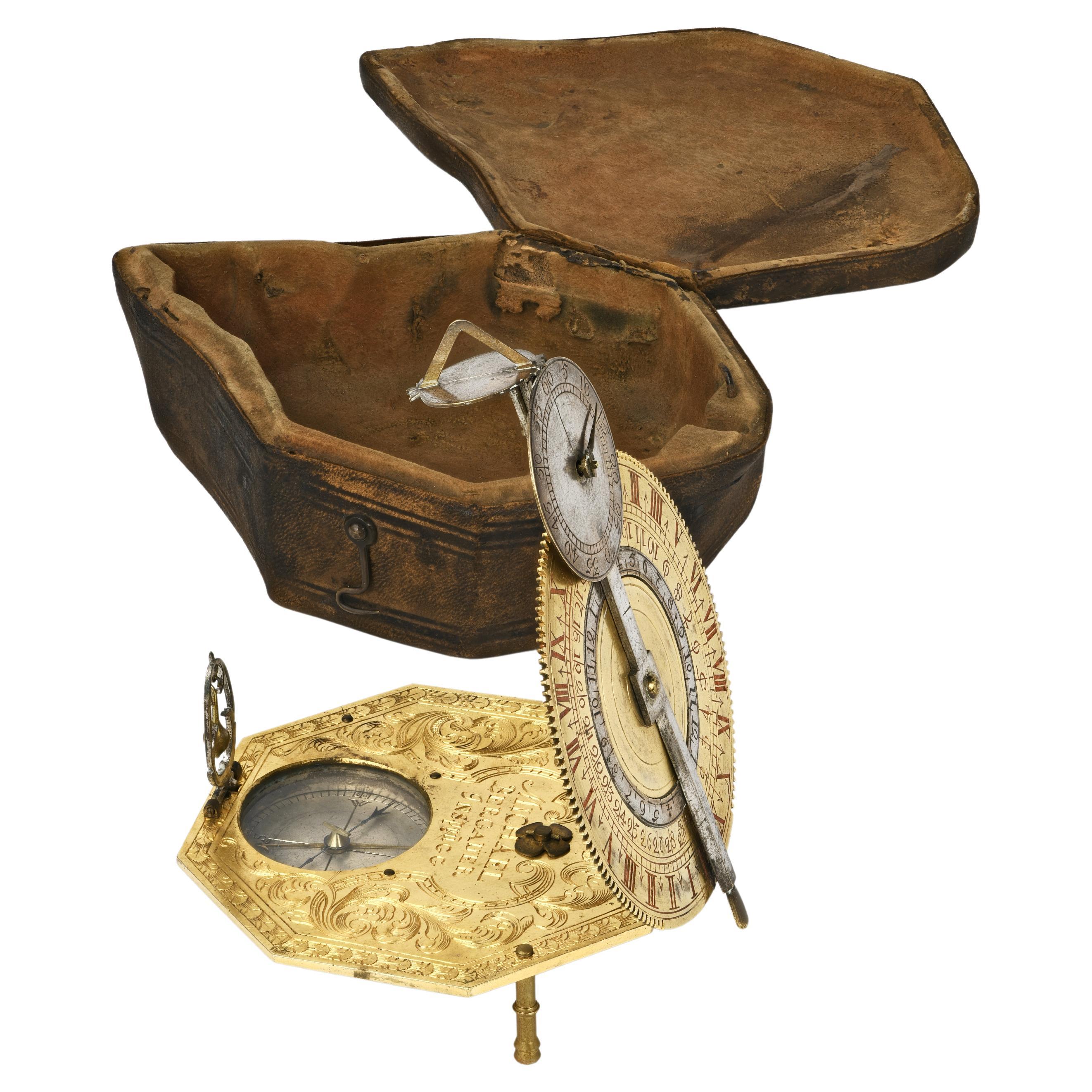
Mechanical Equatorial Sundial, Johann Michael Bergauer, Ante 1745
By Johann Michael Bergauer
Located in Milano, IT
Johann Michael Bergauer (Simonsfeld, 1676 - Innsbruck, 1745 circa)
Mechanical equatorial sundial
Signed: Michael Bergauer Insprugg? Innsbruck?
Ante 1745
Gilded and silvered brass; glass.
Measures: closed 1.29 x 3.50 x 4.92 in (33 x 89 x 125 mm); open 5.19 x 3.50 x 3.81 in (132 x 89 x 97 mm).
Weight: the sundial 0.49 lb (224 g); the case 0, 20 lb (95 g)
Original wooden case covered in brown leather.
State of conservation: very good. It has some signs of use. The spring that allowed for the two parts of the instrument to remain open is missing (absent even in the comparative specimens kept in museums).
The sundial is composed of two overlapping plates hinged together on the north edge.
The base plate is octagonal and is supported by three turned legs. The upper face is gilded and a compass with a magnetic variation index has been inserted. The rest of the surface is occupied by a rich decoration of engraved scrolls, centered around the inscription “Michael Bergauer Insprugg”. A foldable oval support with a plumb-bob is attached with a hinge on the southern edge. On the reverse of the base plate a table of the latitudes of some European cities (expanded with the vertical writing “Meiland 40” on the edge and “Rome” deleted) and of Jerusalem has been engraved. A Cam marked for 0 °-70 ° is applied near the northern edge. This can be adjusted to change the inclination of the upper plate according to the latitude; originally a spring, now lost, made it possible to keep the two plates of the clock open.
The second plate is round, has a toothed edge and measures 3.26 in (83 mm) in diameter: it is slightly smaller than the octagonal base which it rests upon and overlaps when the instrument is closed.
The recto is gilded and there are three concentric graduated circles engraved on it:
- the outermost is the equatorial hour dial, numbered I-XII, I-XII;
- the second-one is that of days 1-30 of the lunar month and has “Aetas lunae” engraved on it;
- the third, silvered, is a subsidiary hour dial, with double numbering 1-12; originally it could have been rotated.
The engravings of the first two circles are enameled in red.
In the center - on the polar axis - there is an alidade, at the end of which is associated the silvered minute dial. This, in turn, is welded, perpendicularly, to a small disc, also silvered, with a triangular gnomon. The plate, alidade and minute dial are connected to each other by toothed mechanisms.
Below is the procedure for measuring the time:
1) Adjust the Cam under the base of the clock, based on the latitude of your location;
2) Place the watch on a flat surface using the plumb-bob and with the side closest to the compass facing south;
3) Keeping the instrument still, manually rotate the alidade until the shadow cast by the triangular gnomon on the small silvered disc falls on the line marked below it;
4) The hour and minutes can therefore be read on the hour and minute dials set on the alidade respectively.
Johann Michael Bergauer, who sometimes only signs his works as Michael Bergauer, was born in Simonsfeld, north of Vienna. His apprenticeship as a watchmaker took place in Landshut and he probably worked as a laborer in Augsburg before becoming a watchmaker at the court of Karl Philipp von der Pfalz in Innsbruck in 1708. In the following years, his repeated attempts to obtain Innsbruck citizenship are documented and, in 1721, he is listed as a resident. In 1724 he was admitted to the guild of watchmakers, with which however he had continuous problems. In 1732 he presented a "masterpiece". This is the last reference to his business; he must have died before or in 1745 because in that year his widow appealed to the City Council.
The mechanical sundial...
Category
Antique 1730s Austrian Baroque Scientific Instruments
Materials
Brass
Sundial with Compass and Case, Bronze, Bion, Nicholas, Paris, 18th Century
By Nicholas Bion
Located in Madrid, ES
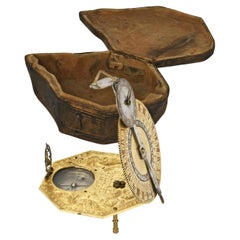
Sundial with compass and case. Bronze. BION, Nicholas. Paris, 18th century.
Polygonal sundial with a bird-shaped gnomon and engraved triangular piece, which presents, on one side, ...
Category
Antique 18th Century French Neoclassical Scientific Instruments
Materials
Bronze, Other
A Brass Pocket Equinoctial Dial French 1780ca
Located in Firenze, IT
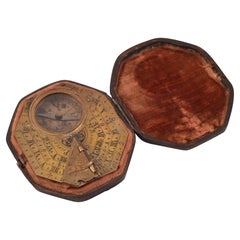
With hinged gnomon, hour ring and latitude arc, silvered compass rose with two inset bubble levels, raised on three levelling screws, in velvet lined and shaped leather covered case,...
Category
Antique 1780s French Neoclassical Desk Accessories
Materials
Brass
Rare Silver Pocket Sundial and Compass by Michael Butterfield, Paris, circa 1700
By Butterfield Paris
Located in Oxfordshire, United Kingdom
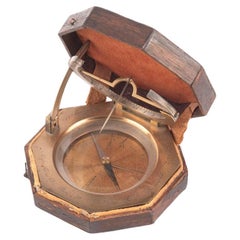
A beautiful, rare solid silver Anglo-French octagonal pocket sundial with compass by Michael Butterfield, circa 1700.
The sundial is made for a latitude of 44° and could be used in places in the south of France such as Avignon and elsewhere along this parallel. The elaborately engraved base plate has a Roman chapter ring on which the gnomon (a triangular flap) casts its shadow. It is signed by the maker in the following manner: Butterfield A Paris. On one side is a glazed recessed compass with a blued steel hand to position the instrument in such a way that the time can be read. The hinged triangular gnomon is richly engraved and in the shape of a bird’s head. The folding gnomon and cut corners enable the dial to be carried in the pocket.
The underside shows the latitudes of various Southern-French places in the relevant areas
Its maker Michael Butterfield was an English instrument maker who based himself in 'Le Quay de l'Horloge' of Paris from circa 1685. These types of dials, often replicated by other makers, became known as Butterfield Dials...
Category
Antique Late 17th Century French Louis XIV Carriage Clocks and Travel Cl...
Materials
Silver
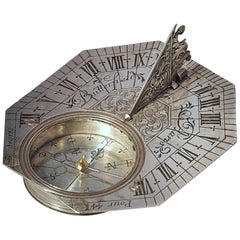
Sundial and Compass with Case, Schrettegger, Johan, Augsburg, Germany, Ca 1800
Located in Madrid, ES
Sundial and compass with case. Bronze. SCHRETTEGGER, Johan. Augsburg, Germany, around 1800.
Sundial with a polygonal shape made of bronze, engraved with plant elements on the front,...
Category
Antique Late 18th Century German Neoclassical Scientific Instruments
Materials
Bronze, Other
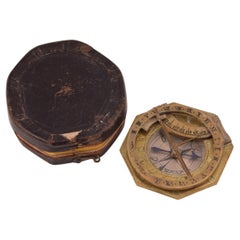
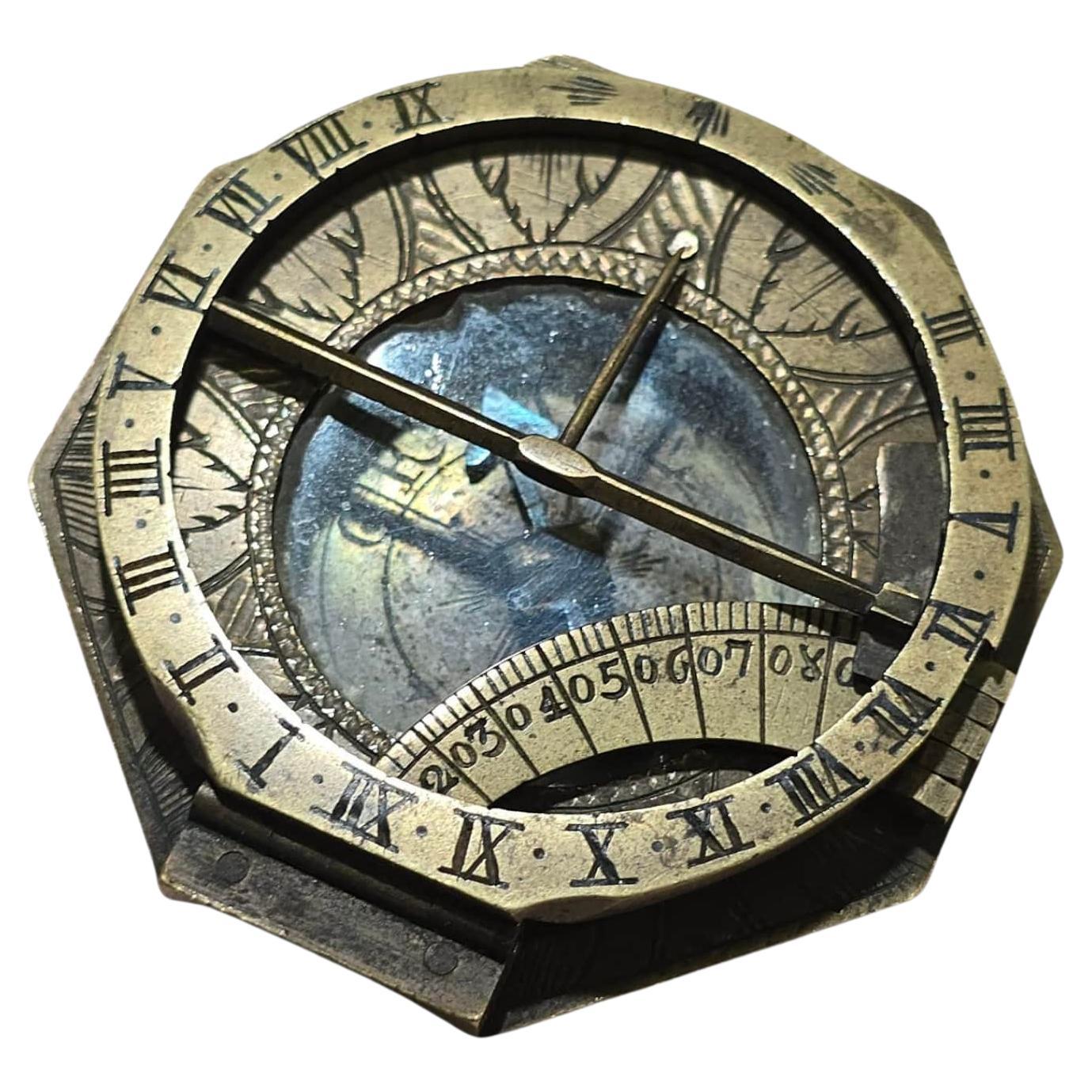
A Thomas Haye Brass Butterfield-Type Pocket Sundial French Early 18th century
Located in Firenze, IT
Period: XVIII century.
Provenance: French, signed Haye.
Dimensions: 8 cm x 5,9 cm
Signed HAYE A PARIS, octagonal brass dial engraved, inset compass, mounted with hinged gnomon with ...
Category
Antique Early 18th Century French Baroque Boxes and Cases
Materials
Brass