Fruitwood Toys and Dolls
to
5
5
1
3
1
1
3,263
323
297
130
104
2
1
1
1
1
5
5
5
Material: Fruitwood
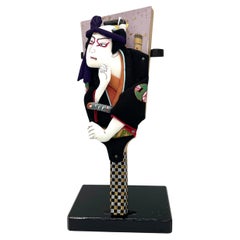
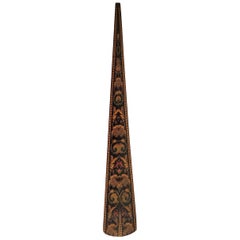
Vintage Japanese Kabuki Oshie Hagoita Paddle 1990s
Located in Paris, FR
This is a handcrafted Kabuki Hagoita.
This striking Japanese hagoita features a dramatic three-dimensional relief of a Kabuki actor, rendered with exquisite textile layering and tra...
Category
Late 20th Century Japanese Showa Fruitwood Toys and Dolls
Materials
Cotton, Silk, Boxwood, Fruitwood
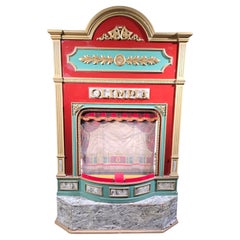
Rare 19th Century Automaton Theater
Located in Madrid, ES
This important and rare automaton theater dates from the late 19th century and features both its original mechanical system and later electrical modifications.
Materials: Constructe...
Category
1890s Antique Fruitwood Toys and Dolls
Materials
Fruitwood
A wooden sculpture depicting a prancing carousel horse, Italy 1750.
Located in Milan, IT
Italian wooden sculpture depicting a carousel horse launched in the act of ramping. Pale fruitwood. Modern metal base. The measurement refers to the horse only. Italy mid-18th century.
Category
Mid-18th Century Italian Antique Fruitwood Toys and Dolls
Materials
Metal

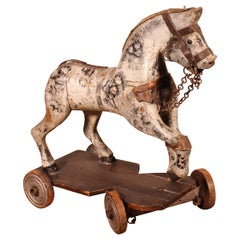
19th Century Polychrome Wooden Horse
Located in Brussels, Brussels
Elegant little carved wooden horse from the 19th century in polychrome wood
Very beautiful polychromy which has a lot of charm
Old child's toy with the front wheels which moves
...
Category
19th Century British Aesthetic Movement Antique Fruitwood Toys and Dolls
Materials
Fruitwood
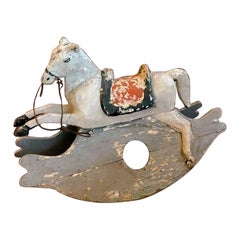
Cavallino a dondolo del 1800 in cartapesta e legno laccato
Located in Cesena, FC
Cavallino a dondolo del 1800 in cartapesta e legno laccato – pezzo raro, incantevole e di notevole valore decorativo
Splendido cavallino a dondolo originale dell’Ottocento, realizza...
Category
Late 19th Century Antique Fruitwood Toys and Dolls
Materials
Fruitwood, Lacquer
Related Items
Rare 19th Century English Tunbridgeware Hair Pin or Slide
Located in Dallas, TX
PRESENTING an EXTREMELY UNIQUE and RARE 19C British Tunbridgeware Hair Pin/Bobbin or Slide.
This slide is unlike any of it’s kind we have seen before, it is a VERY RARE survivor.
From circa 1860 – 80 and made in Tunbridge Wells, England.
Made of walnut with gorgeous marquetry inlay on the entirety of the front with classic Tunbridgeware micro-mosaic all over the front. The rear is walnut.
The marquetry inlay appears to be various different woods, namely, maple, walnut and satinwood.
Would have been worn in a Lady’s hair bun with the micro-mosaic facing forward.
This would have belonged to a VERY ELEGANT LADY in the mid to late 19th Century.
Tunbridge ware is a form of decoratively inlaid woodwork, typically in the form of boxes, that is characteristic of Tonbridge and the spa town of Royal Tunbridge Wells in Kent in the 18th and 19th centuries. The decoration typically consists of a mosaic of many very small pieces of different coloured woods that form a pictorial vignette. Shaped rods and slivers of wood were first carefully glued together, then cut into many thin slices of identical pictorial veneer with a fine saw. Elaborately striped and feathered bandings for framing were pre-formed in a similar fashion.
There is a collection of Tunbridge ware in the Tunbridge Wells Museum and Art Gallery in Tunbridge Wells.
The famous makers of Tunbridge ware were in the Tunbridge Wells area of Kent; their most notable work was from circa 1830-1900.
Early makers of Tunbridge ware, in Tunbridge Wells in the mid-18th century, were the Burrows family, and Fenner and Co. In the 19th century, around 1830, James Burrows invented a technique of creating mosaics from wooden tesserae. Henry Hollamby, apprenticed to the Burrows family, set up on his own in 1842 and became an important manufacturer of Tunbridge ware, employing about 40 people.
Edmund Nye (1797–1863) and his father took over the Fenner company when William Fenner retired in 1840, after 30 years in partnership with him. Thomas Barton (1819–1903), previously apprenticed at the Wise factory, joined the Nyes in 1836, and worked as Nye’s designer; he took over the business in 1863 and continued there until his death.
In Tonbridge (near to Tunbridge Wells), George Wise (1703–1779) is known to have had a business in 1746. It continued with his son Thomas, and Thomas’s nephew George (1779–1869), who took over in 1806. In its early years the company made articles such as workboxes and tea caddies with prints of popular views; later items had pictures created from mosaics. Their workshop in Tonbridge, Wise’s Tunbridge Ware Manufactory, was next to the Big Bridge over the Medway; the building was demolished in 1886 to widen the approach to the bridge.
Tunbridge ware became popular with visitors to the spa town of Tunbridge Wells, who bought them as souvenirs and gifts. Articles included cribbage boards, paperweights, writing slopes, snuffboxes and glove boxes.
At the Great Exhibition of 1851, Tunbridge ware by Edmund Nye, Robert Russell and Henry Hollamby was shown; Edmund Nye received a commendation from the judges for his work. He exhibited a table depicting a mosaic of a ship at sea; 110,800 tesserae were used in making the picture.
The manufacturers of Tunbridge ware were cottage industries, and they were no more than nine in Tunbridge Wells and one in Tonbridge. The number declined in the 1880s; competent craftsmen were hard to find, and public tastes changed. After the death of Thomas Barton in 1903 the only surviving firm was Boyce, Brown and Kemp, which closed in 1927.
Marquetry was an old technique which was continued by Nye and Barton to create images such as birds or butterflies.
‘Green Oak’ as caused by the fungus Chlorociboria aeruginascens.
Stickware and half-square mosaic was invented by James Burrows in about 1830: a bunch of wooden sticks of different colours, each having triangular or diamond-shaped cross section, were tightly glued together; in the case of stickware, the resulting block was dried, then turned to form an article such as the base of a pincushion. For half-square mosaic, thin slices were taken from the composite block, and applied to a surface.
Tesselated mosaic, was a development by James Burrows of half-square mosaic; it was adopted by George Wise and Edmund Nye. Minute tesserae were used to form a wide variety of geometric and pictorial designs.
Many sorts of wood were used for the various colours; about 40 were in regular use. Only natural colors were used; green was provided by “green oak”, produced by the action of fungus on fallen oak. Designs for articles were often taken from designs of Berlin wool work.
Category
Late 19th Century English High Victorian Antique Fruitwood Toys and Dolls
Materials
Satinwood, Walnut

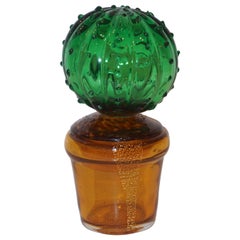
1990s Vintage Italian Vivid Green Murano Glass Small Cactus Plant in Gold Pot
Located in New York, NY
1990s Italian highly collectible Venetian glass cactus of limited edition, entirely handcrafted in Murano, with modern Minimalist design blown by Formia, in a lifelike organic modern...
Category
1990s Italian Organic Modern Fruitwood Toys and Dolls
Materials
Gold
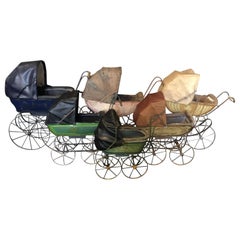
Set of 6 Rare French 19th Century Antique Doll Carriages
Located in Hopewell, NJ
Bought in the south of France this set of antique doll carriages are an enchanting collection with wooden handles, original paint, and working wh...
Category
19th Century French Antique Fruitwood Toys and Dolls
Materials
Metal
La Ley Del Deseo / The Law of Desire
Located in London, GB
Original Spanish film poster from the 1987 comedy, Thriller Atame! / Tie Me Up Tie Me Down. This film was written and directed by Pedro Almodóvar...
Category
1980s Spanish Vintage Fruitwood Toys and Dolls
Materials
Paper

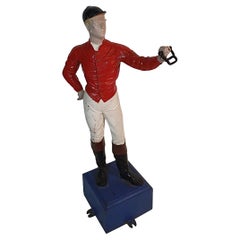
Very Rare 19th Century Cast Iron Jockey Hitching Post
Located in Dublin, IE
A very rare 19th century cast iron equine hitching post in the form of a jock-ey. The jockey is classically dressed in the 19th century riding attire, com-prising of a black riding hat, red jacket and cream jodhpurs. The jockey is poised on a moulded blue plinth...
Category
19th Century English Antique Fruitwood Toys and Dolls
Materials
Iron
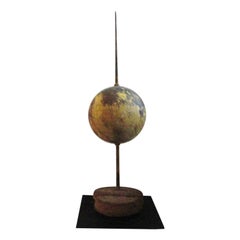
Rare 19th Century Large Original Painted Lightning Rod on Stand
Located in Los Angeles, CA
Fantastic folky oversized 19th century mustard over copper Lightning rod ball on a professional iron stand. The base is a plank of original work that the...
Category
19th Century American Folk Art Antique Fruitwood Toys and Dolls
Materials
Copper
$700 Sale Price
71% Off
H 36 in W 14 in D 14 in
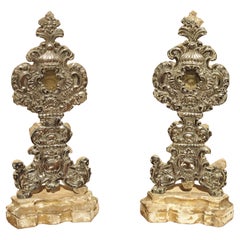
Pair of Silvered Wooden Reliquaries from France, Circa 1750
Located in Dallas, TX
This pair of silvered wooden reliquaries are from France, circa 1750. The backs are still preserved by wax seals, indicating that the relics were never removed.
Each reliquary has...
Category
Mid-18th Century French Antique Fruitwood Toys and Dolls
Materials
Silver
$2,400 / set
H 13.25 in W 6.375 in D 2.5 in
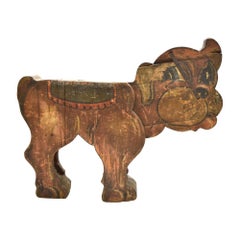
Spanish, 1850s Fair Carousel Wooden Dog
Located in Marbella, ES
Spanish, vintage hand painted wooden dog with stuck out tongue, from an old fair ground Carousel.
Category
Mid-19th Century Spanish Mid-Century Modern Antique Fruitwood Toys and Dolls
Materials
Wood
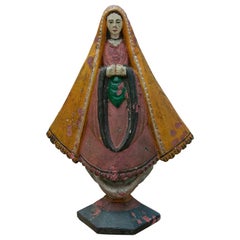
19th Century Mexican Wooden Hand-Painted Virgin with Child in Arms
Located in Marbella, ES
19th century Mexican wooden hand-painted virgin with child in arms.
Category
Late 20th Century Mexican Fruitwood Toys and Dolls
Materials
Wood
$1,911
H 11.03 in W 8.27 in D 3.15 in
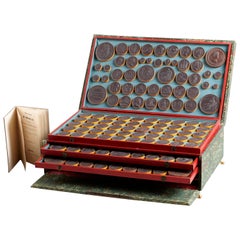
Rare French, Early 19th Century Napoleonic Medal Cabinet
Located in Worpswede / Bremen, DE
Rare French early 19th century Napoleonic medal cabinet on four gilt bronze pawfeet, a hinged door to the top and front opening to reveal four drawers containing 184 very fine bronzed plaster medals...
Category
Early 19th Century French Empire Antique Fruitwood Toys and Dolls
Materials
Plaster, Wood, Paper
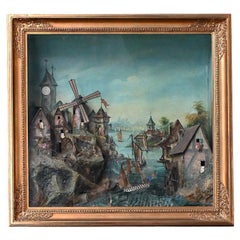
A rare mid-19th century French Louis Philippe musical automaton framed wall cloc
Located in London, GB
A rare mid-19th century French Louis Philippe musical automaton framed wall clock
A picturesque and highly decorative example of a rare mid-19th century French Louis Philippe musical automaton framed wall clock. A 5-cm enamel dial with Roman numerals in a hand painted church behind houses with an automaton watermill and windmill, with papier Mache 3D hills in the foreground with metal staircase...
Category
1880s European Early Victorian Antique Fruitwood Toys and Dolls
Materials
Wood, Paper
$5,254
H 24 in W 26 in D 7 in
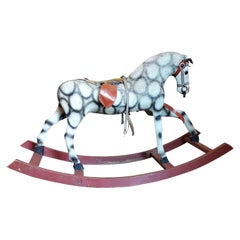
Antique Carved Painted Wooden Childs Rocking Horse
Located in Forney, TX
A charming and whimsical hand carved and painted wooden and fur fabric rocking horse with untouched, unrestored, elegantly aged patina.
Very unique pattern and beautiful complime...
Category
Early 20th Century Fruitwood Toys and Dolls
Materials
Fabric, Wood, Paint
Previously Available Items
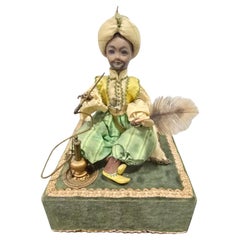
Antique Smoking Turkish Automaton
Located in Madrid, ES
Antique Smoking Turkish Automaton
A fascinating 20th-century automaton depicting a seated Turkish figure smoking a shisha. This automaton is in perfec...
Category
1940s Vintage Fruitwood Toys and Dolls
Materials
Fruitwood
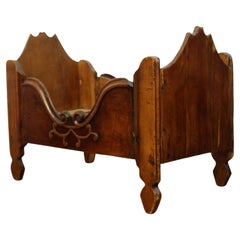
19th Century, Country French Directoire Period Infant
s Bed
Located in Chapel Hill, NC
Late 19th-early 19th century country French Directoire period infant's bed. Ideal for a doll collection or beloved mini-canine or cat. Fruitwood. Nicely molded throughout. The sides ...
Category
19th Century French Directoire Antique Fruitwood Toys and Dolls
Materials
Fruitwood
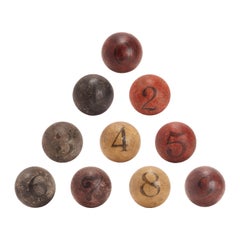
10 Spheres Weighting Only Twice and Try to Find the Heaviest One, France 1900
Located in Milan, IT
The ball weight riddle. There are 10 painted wood balls available, same circumference, all of them, numbered from 0 to 9, 9 of which have the same weight and only one weight more tha...
Category
1890s French Antique Fruitwood Toys and Dolls
Materials
Fruitwood
H 5.5 in W 5.5 in D 5.5 in
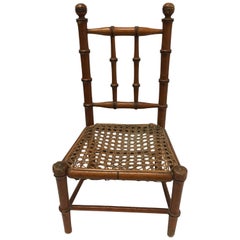
19th Century French Miniature Fruitwood Faux Bamboo and Cane Doll Chair
Located in Stamford, CT
19th century French miniature fruitwood faux bamboo carved wood chair with original caned seat. Seat is 6" H.
Category
Mid-19th Century French Rustic Antique Fruitwood Toys and Dolls
Materials
Cane, Fruitwood