1 of 12
English Educational Table Globe by E.J. Arnold
Sons Ltd. Leeds
$1,230.03List Price
About the Item
- Creator:E. Arnold (Manufacturer)
- Dimensions:Height: 14 in (35.56 cm)Width: 8 in (20.32 cm)Depth: 8 in (20.32 cm)
- Materials and Techniques:
- Place of Origin:
- Period:
- Date of Manufacture:1930
- Condition:Wear consistent with age and use. Minor losses.
- Seller Location:Suffolk, GB
- Reference Number:Seller: LVS11911stDibs: LU1049017896901
Authenticity Guarantee
In the unlikely event there’s an issue with an item’s authenticity, contact us within 1 year for a full refund. DetailsMoney-Back Guarantee
If your item is not as described, is damaged in transit, or does not arrive, contact us within 7 days for a full refund. Details24-Hour Cancellation
You have a 24-hour grace period in which to reconsider your purchase, with no questions asked.Vetted Professional Sellers
Our world-class sellers must adhere to strict standards for service and quality, maintaining the integrity of our listings.Price-Match Guarantee
If you find that a seller listed the same item for a lower price elsewhere, we’ll match it.Trusted Global Delivery
Our best-in-class carrier network provides specialized shipping options worldwide, including custom delivery.You May Also Like
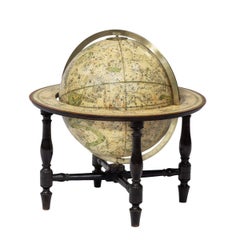
Celestial Table Globe by Harris and Son
Located in Lymington, Hampshire
A 12 inch celestial table globe by Harris and Son, the horizon ring, with the original papers, set on four turned mahogany legs, the label statin...
Category
Antique 1810s English Globes
Materials
Mahogany
1950
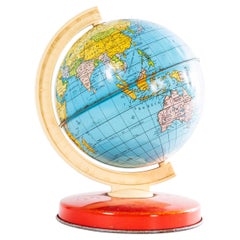
s Simple Educational World Globe
Located in Hook, Hampshire
1950’s Simple Educational World Globe.
Good version of the classic 50’s world globe. Tin base and globe.
Workshop Report:
Our workshop team inspect every product and carry out any ...
Category
Vintage 1950s Globes
Materials
Tin
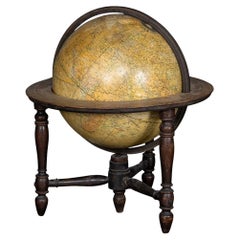
Antique 19th Century Smiths Terrestrial Globe By George Philips
Son Ltd c.1890
By George Philip
Son
Located in Royal Tunbridge Wells, Kent
Antique 19th Century English terrestrial globe made by George Philips and Son. Set on a walnut stand. This piece makes a striking addition to any library or serves as a decorative ye...
Category
20th Century British Other Globes
Materials
Walnut
$5,733
H 16.93 in Dm 16.93 in
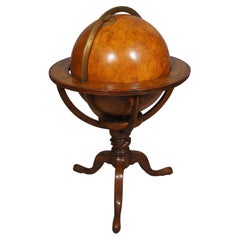
English Celestrial Table Globe By R.B Bate, London
Located in Essex, MA
!2 inch celestrial globe "The New Twelve Inch British Celestrial Globe". With a mahogany tripod base.
Category
Antique 1820s English Regency Globes
Materials
Mahogany, Paper
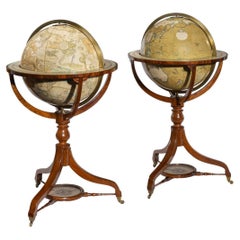
Pair of 18 Inch Floor Standing Globes by C Smith
Son
Located in Lymington, Hampshire
A pair of 18 inch floor standing globes by C Smith & Son, each set into a mahogany stand with a turned baluster support and three legs centred on a compass, on...
Category
Antique 1840s English Globes
Materials
Mahogany
Newton and Son Pocket Globe and Case
By Newton and Son
Located in Spencertown, NY
The terrestrial globe is 3 inches in diameter contained within a turned mahogany box with cover. The seas in light green and land masses in darker green.
Dimension of Globe 3" Diame...
Category
Antique Mid-19th Century English Victorian Globes
Materials
Fruitwood, Paper
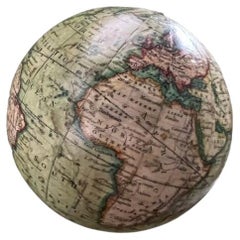
A pair of Newton and Son ‘New
Improved’ 15 inch globes
Located in Lymington, Hampshire
Each of these globes is set into a walnut stand with burr walnut veneers to the frieze and a solid turned and gadrooned walnut bluster support. This is raised on three acanthus carv...
Category
Antique 1860s English Globes
Materials
Walnut
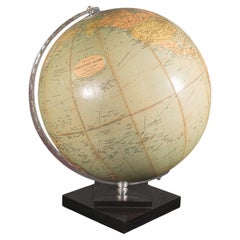
Vintage Table Globe, English, World Map, 13.5 Inch Diameter, Cartography, C.1960
Located in Hele, Devon, GB
This is a vintage table globe. An English, paper finished world map with chrome meridian, dating to the mid 20th century, circa 1960.
Fascinating mid-cent...
Category
Vintage 1960s British Mid-Century Modern Globes
Materials
Chrome
$1,575
H 16.34 in W 13.39 in D 13.39 in
Newton
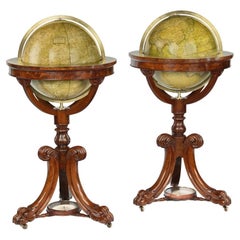
Sons Late George III Terrestrial and Celestial Mahogany Library Globes
By Newton and Son
Located in West Palm Beach, FL
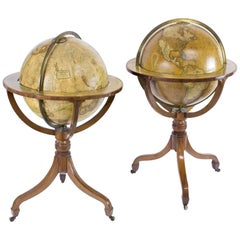
Fine pair of Newton & Sons late George III 20 inch terrestrial and celestial tripod mahogany library globes, London, second quarter of the 19th century,
the terrestrial globe, dated...
Category
Antique 1830s Globes
Materials
Wood
$125,000
H 32 in Dm 20 in
English Pocket Globe, London, Circa 1775-1798
By Herman Moll
Located in Milano, IT
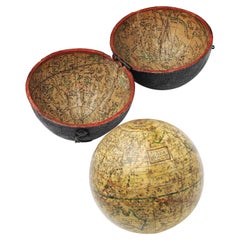
Pocket globe
London, between 1775 and 1798
Re-edition of the globe of Hermann Moll (1678-1732) dated 1719
The globe is contained in its original case, which itself is covered in shark skin.
There are slight gaps in the original paint on the sphere. The case no longer closes.
The sphere measures 2.7 in (7 cm) in diameter whereas the case measures 2.9 in (7.4 cm) in diameter.
lb 0.22 (kg 0.1)
The globe is made up of twelve printed paper gores aligned and glued to the sphere.
In the North Pacific Ocean there is a cartouche with the inscription:
A Correct
Globe
with the new
Discoveries.
The celestial globe is depicted on the inside of the box and is divided into two hemispheres with the cartouche:
A correct globe
with ye new cons
relations of Dr.
Halley & c.
It shows the ecliptic divided into the days of the zodiacal calendar and the constellations represented as animals and mythological figures.
On the globe are delineated the equinoctial line, divided by degrees and hours, the ecliptic and the meridian (passing west of Greenwich). The continents are shaded and outlined in pink, green and yellow. It shows: the Cook routes; a wind rose in the Southern Indian Ocean; Antarctica without land; Africa with Negroland (Hermann Moll is considered the first geographer to name the West African region in his 1727 map. (Encyclopaedia Britannica, ed. 1902, under "States of Central Africa"); Tartary in Central Asia; the Mogul kingdom in northern India; in North America only New England, Virginia, Carolina, Florida, Mississippi are identified; California is already a peninsula; the northwest coast of America is "unknown parts" (Alaska is not described and it is only partially delineated, it was to become part of the United States in 1867); Mexico is named "Spain"; Central South America "Amazone America". Australia (which was to be so named after 1829) is called New Holland. The route of Admiral Anson is traced (1740) and the trade winds are indicated by arrows. (See Van der Krogt, P., Old Globes in the Netherlands, Utrecht 1984, p. 146 and Van der Krogt, P. - Dekker, E., Globes from the Western World, London 1993, pp. 115.)
Elly Dekker, comparing Moll’s 1719 globe and his re-edition (of which the one described above is a sample), identifies the differences between them: the two editions are quite similar to each other, but in the "anonymous" globe, compared to the previous globe of 1719, California looks like a proper peninsula - the reports of the Spanish explorers of the region had given rise to uncertainty over whether it was connected to the mainland or not. The geographical nature of California was confirmed after the explorations of Juan Bautista de Anza (1774-1776). The routes of Dampier's journey were partially erased and the route of Captain James Cook's first voyage was superimposed on them, and the geography of Australasia was adapted accordingly, including the denomination of the Cook Strait. See Dekker, Elly, Globes at Greenwich, 1999.
An important ante quem element is represented by Tasmania: it is not separated from Australia by the Bass Strait...
Category
Antique Late 18th Century English George III Globes
Materials
Shagreen, Paper
Still Thinking About These?
All Recently ViewedMore Ways To Browse
Arnold And Son
World Globe
Used World Globes
Terrestrial Globes
Celestial Globe
Antique Celestial Globe
Globe On Stand
Luigi Xv
Globe On Stand Floor Globe
Show Globe
Earth Globe
Used Furniture Columbus
Vintage Replogle Globes
Black Globes
Antique World Globes
Small Antique Globes
Antique Globes On Stands
Celestial Sphere