Want more images or videos?
Request additional images or videos from the seller
1 of 5
Fine 18th Century English Terrestrial Pocket Globe by Cary, London, 1791
$20,318.51List Price
About the Item
- Creator:Cary’s (Maker)
- Dimensions:Height: 3 in (7.62 cm)Diameter: 3 in (7.62 cm)
- Style:George III (Of the Period)
- Materials and Techniques:
- Place of Origin:
- Period:
- Date of Manufacture:1791
- Condition:Wear consistent with age and use. Globe and hemispheres good with wear commensurate with age. Case good with the usual wear.
- Seller Location:Oxfordshire, GB
- Reference Number:1stDibs: LU4936221671152
About the Seller
5.0
Recognized Seller
These prestigious sellers are industry leaders and represent the highest echelon for item quality and design.
1stDibs seller since 2019
24 sales on 1stDibs
Typical response time: 14 hours
Associations
LAPADA - The Association of Arts
Antiques Dealers
Authenticity Guarantee
In the unlikely event there’s an issue with an item’s authenticity, contact us within 1 year for a full refund. DetailsMoney-Back Guarantee
If your item is not as described, is damaged in transit, or does not arrive, contact us within 7 days for a full refund. Details24-Hour Cancellation
You have a 24-hour grace period in which to reconsider your purchase, with no questions asked.Vetted Professional Sellers
Our world-class sellers must adhere to strict standards for service and quality, maintaining the integrity of our listings.Price-Match Guarantee
If you find that a seller listed the same item for a lower price elsewhere, we’ll match it.Trusted Global Delivery
Our best-in-class carrier network provides specialized shipping options worldwide, including custom delivery.You May Also Like
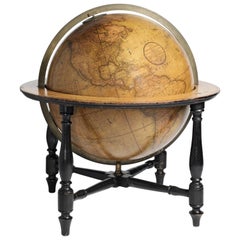
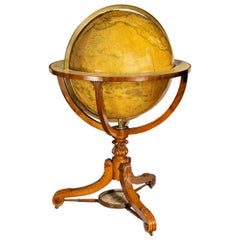
18-inch Globe, Cary
s, London, 1840
By Cary’s
Located in Milano, IT
John and William Cary
Updated by George and John Cary
Terrestrial Globe
London, 1840
lb 22 (kg 10)
Slight surface abrasions due to use. A small crack on the horizon circle.
The globe rests in its original Dutch style stand with four supporting turned wood columns.
It measures 26 in in height x 23.6 in in diameter with the diameter of the sphere measuring 18 in; 66 cm in height x 60 cm in diameter with the diameter of the sphere measuring 45.72 cm.
The 18 inch...
Category
Antique 1840s English Early Victorian Globes
Materials
Paper, Wood
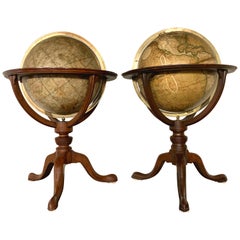
Pair of 19th Century English J
W Cary Celestial/Terrestrial Table Model Globes
By John
William Cary
Located in Milford, NH
A fine assembled pair of 12-inch English table model globes on stands manufactured by J & W. Cary, the left globe with cartouche labeled “The New Celestial Globe, on which are correc...
Category
Antique Early 19th Century English Globes
Materials
Brass
$18,900 / set
H 25 in Dm 16.5 in
English Pocket Globe, London, Circa 1775-1798
By Herman Moll
Located in Milano, IT
Pocket globe
London, between 1775 and 1798
Re-edition of the globe of Hermann Moll (1678-1732) dated 1719
The globe is contained in its original case, which itself is covered in shark skin.
There are slight gaps in the original paint on the sphere. The case no longer closes.
The sphere measures 2.7 in (7 cm) in diameter whereas the case measures 2.9 in (7.4 cm) in diameter.
lb 0.22 (kg 0.1)
The globe is made up of twelve printed paper gores aligned and glued to the sphere.
In the North Pacific Ocean there is a cartouche with the inscription:
A Correct
Globe
with the new
Discoveries.
The celestial globe is depicted on the inside of the box and is divided into two hemispheres with the cartouche:
A correct globe
with ye new cons
relations of Dr.
Halley & c.
It shows the ecliptic divided into the days of the zodiacal calendar and the constellations represented as animals and mythological figures.
On the globe are delineated the equinoctial line, divided by degrees and hours, the ecliptic and the meridian (passing west of Greenwich). The continents are shaded and outlined in pink, green and yellow. It shows: the Cook routes; a wind rose in the Southern Indian Ocean; Antarctica without land; Africa with Negroland (Hermann Moll is considered the first geographer to name the West African region in his 1727 map. (Encyclopaedia Britannica, ed. 1902, under "States of Central Africa"); Tartary in Central Asia; the Mogul kingdom in northern India; in North America only New England, Virginia, Carolina, Florida, Mississippi are identified; California is already a peninsula; the northwest coast of America is "unknown parts" (Alaska is not described and it is only partially delineated, it was to become part of the United States in 1867); Mexico is named "Spain"; Central South America "Amazone America". Australia (which was to be so named after 1829) is called New Holland. The route of Admiral Anson is traced (1740) and the trade winds are indicated by arrows. (See Van der Krogt, P., Old Globes in the Netherlands, Utrecht 1984, p. 146 and Van der Krogt, P. - Dekker, E., Globes from the Western World, London 1993, pp. 115.)
Elly Dekker, comparing Moll’s 1719 globe and his re-edition (of which the one described above is a sample), identifies the differences between them: the two editions are quite similar to each other, but in the "anonymous" globe, compared to the previous globe of 1719, California looks like a proper peninsula - the reports of the Spanish explorers of the region had given rise to uncertainty over whether it was connected to the mainland or not. The geographical nature of California was confirmed after the explorations of Juan Bautista de Anza (1774-1776). The routes of Dampier's journey were partially erased and the route of Captain James Cook's first voyage was superimposed on them, and the geography of Australasia was adapted accordingly, including the denomination of the Cook Strait. See Dekker, Elly, Globes at Greenwich, 1999.
An important ante quem element is represented by Tasmania: it is not separated from Australia by the Bass Strait...
Category
Antique Late 18th Century English George III Globes
Materials
Shagreen, Paper
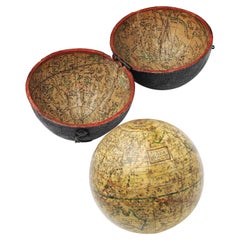
Pocket Globe by Nathaniel Hill, London 1754
Located in Milano, IT
Nathaniel Hill
Pocket globe
London, 1754
The globe is contained in its original case, which itself is covered in shark skin.
There are slight gaps in the original paint on the sphere. The case no longer closes.
The sphere measures 2.6 in (6.8 cm) in diameter whereas the case measures 2.9 in (7.4 cm) in diameter.
lb 0.24 (kg 0.11)
The globe is made up of twelve printed paper gores aligned and glued to the sphere.
In the North Pacific Ocean there is a scroll with the inscription:
A
New
terrestrial
Globe
by
Nath. Hill,
1754.
The celestial globe is depicted on the inside of the box.
On the terrestrial globe much of central and southern Africa is empty. North America bears only the name of some British colonies. It shows California as a peninsula and the northwest coast of America as "unknown parts" (Alaska is not described and is only partially delineated; it would become part of the United States in 1867). The route of Admiral Anson is traced (1740) and the trade winds are indicated by arrows. Australia, still named New Holland (the new name would be introduced in 1829), is part of the west coast. (See Van der Krogt, P., Old Globes in the Netherlands, Utrecht 1984, p. 146 and Van der Krogt, P. - Dekker, E., Globes from the Western World, London 1993, p. 115.)
Nathaniel Hill (London, news from 1746 to 1768) had impeccable professional credentials: he had done his apprenticeship with Richard Cushee, who at the time was carrying out surveying work for John Senex's Surrey map...
Category
Antique 1750s English George II Globes
Materials
Shagreen, Paper
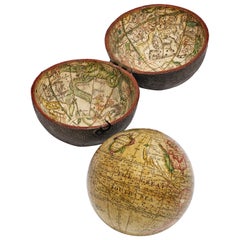
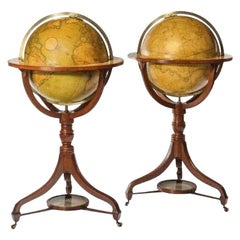
Fine Pair of Cary’s Floor Standing Library Globes
By Cary’s
Located in Lymington, Hampshire
The terrestrial with cartouche printed “Cary’s new terrestrial globe exhibiting the tracks and discoveries made by Captain Cook; also those of Captain Vancouver on the North West Coa...
Category
Antique 1810s British Globes
Materials
Oak
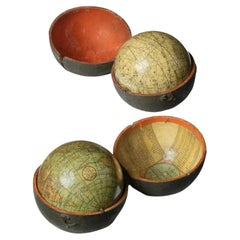
Pair of George III 3 inch pocket globes by J
W Cary, one dated 1791
Located in Lymington, Hampshire
The terrestrial globe is applied with 12 engraved and hand-coloured gores and signed in a circular cartouche ‘Cary’s Pocket Globe, Agreeable to the Latest Discoveries. Pubd. by J. & ...
Category
Antique 1790s English Globes
Materials
Shagreen
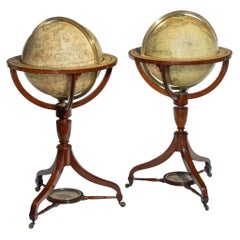
Fine Pair of Floor Globes by J
G Cary, Dated 1820 and 1833
By George
John Cary
Located in Lymington, Hampshire
A fine pair of 15 inch floor globes by J & G Cary, dated 1820 and 1833, each set into a mahogany stand with a vase shaped support and three legs centred on a compass, one with a labe...
Category
Antique Early 19th Century English Regency Globes
Materials
Mahogany
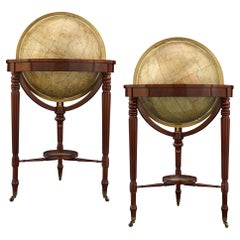
William IV Terrestrial And Celestial Floor Globes By J. W. Cary
By John
William Cary
Located in New Orleans, LA
This stately pair of William IV Terrestrial and Celestial Globes was crafted by the esteemed mapmaking firm J. & W. Cary, exuding the essence of late Regency-era elegance. Beyond the...
Category
Antique 19th Century English Regency Globes
Materials
Mahogany
$198,500 / set
H 47 in W 31 in D 31 in
Large and Extremely Rare Terrestrial Globe by Newton
By Newton Globes - Planer
Newton
Located in Lymington, Hampshire
A large and extremely rare 24-inch terrestrial globe by Newton
Our most magnificent and rare globes were a pair of 24-inch Newton globes.
These too were updated in 1852 (terre...
Category
Antique Mid-19th Century English Globes
Materials
Mahogany
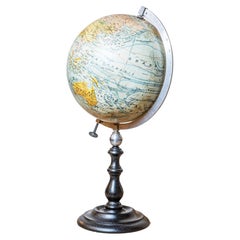
Small French 20th Century Terrestrial Globe on Turned Black Wooden Base
Located in Atlanta, GA
A small French terrestrial globe from the 20th century, with metal protractor and circular black wooden base. Created in France during the 20th century, this terrestrial globe is con...
Category
20th Century French Scientific Instruments
Materials
Metal
More From This Seller
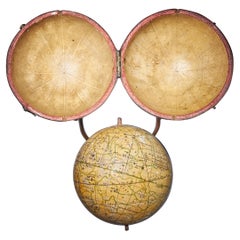
View AllRare George III Celestial Pocket Globe by Cary, London
By Cary
Located in Oxfordshire, United Kingdom
A fine and rare 3" celestial pocket globe by G & W Cary, Strand, London circa 1791, housed in its original sharkskin case.
A companion globe to terrestrial globes of this type we...
Category
Antique Late 18th Century English George III Aviation Objects
Materials
Plaster
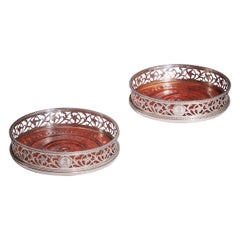
A Fine Pair of 18th Century George III Silver Engraved Open Fret Wine Coasters
By John Hutson
Located in Oxfordshire, United Kingdom
A fine pair of 18th century George III silver engraved open fret wine coasters, dated 1786, London.
By John Hutson.
Each with a central engraved roundel incorporating a well depi...
Category
Antique 18th Century English George III Sterling Silver
Materials
Silver
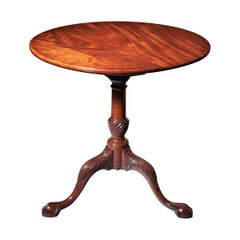
A Fine 18th Century George II Mahogany Tripod Table, Circa 1760
By Thomas Chippendale
Located in Oxfordshire, United Kingdom
This 18th century George II table features a beautifully crafted one piece circular top made from one piece of richly grained figured mahogany, showcasing the natural luster and patt...
Category
Antique 18th Century English George II Side Tables
Materials
Mahogany
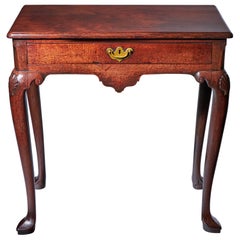
Fine and Rare 18th Century George I Virginia Walnut Side Table, circa 1725
Located in Oxfordshire, United Kingdom
The moulded edge top sits over a canted frieze fitted with a long drawer finely lined in oak retaining original hardware above a similarly conforming shaped central apron. Raised on ...
Category
Antique Early 18th Century English Georgian Side Tables
Materials
Oak, Walnut
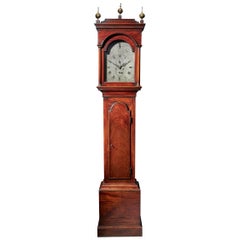
Fine George III 18th Century Period Mahogany Longcase Clock by Tomas Fowle
Located in Oxfordshire, United Kingdom
A fine George III period mahogany longcase clock of excellent colour, patination and proportions, circa 1780-1790
Surmounted with three ball and spike brass finials, the inverted ...
Category
Antique Late 18th Century English Chippendale Grandfather Clocks and Lon...
Materials
Mahogany
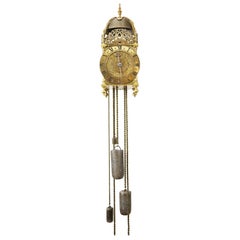
17th Century Lantern Alarm Clock by Johannes Quelch, Oxford
Located in Oxfordshire, United Kingdom
An English 17th century lantern clock made of brass and iron, circa 1665-1670. The clock consists of going and striking trains, as well as a...
Category
Antique 17th Century British Baroque Wall Clocks
Materials
Brass
Still Thinking About These?
All Recently ViewedMore Ways To Browse
Sandwich Islands
Pocket Globe
Antique Pocket Globe
Terrestrial Globe Mid Century
Used Furniture Columbus
Vintage Replogle Globes
Black Globes
Antique World Globes
Small Antique Globes
Antique Globes On Stands
Celestial Sphere
Library Globe
French Terrestrial Globe
Atlas Globe
Globes Terrestres Vintage
Armillary Globe
Brass World Globe
Standing Globes