Items Similar to A fine J.S. Cox terrestrial pocketglobe in its stand.
Video Loading
Want more images or videos?
Request additional images or videos from the seller
1 of 9
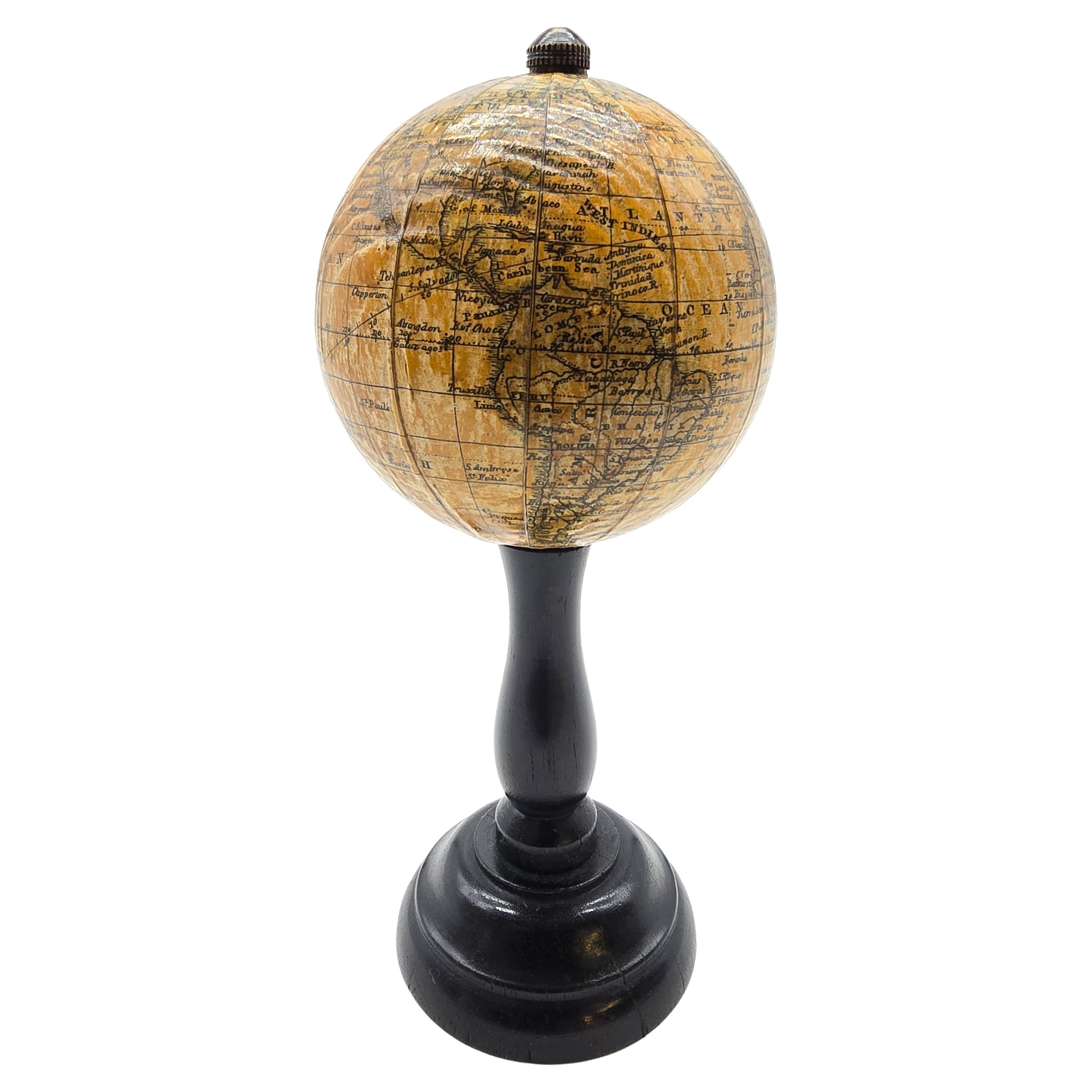
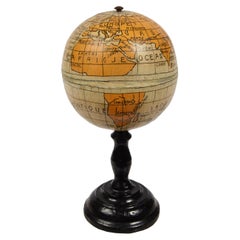
A fine J.S. Cox terrestrial pocketglobe in its stand.
$11,242.60
£8,401.28
€9,500
CA$15,654.76
A$16,822.69
CHF 9,026.35
MX$198,161.01
NOK 113,496.33
SEK 103,678.17
DKK 72,419.23
About the Item
A fine James S. Cox terrestrial pocketglobe.
3 inch pocketglobe (7.6cm).
6.3 inches (16cm) high in its stand.
Title on the cartouche:
“Cox’s Terrestrial Globe. (2nd edition) 1838”.
Condition.
This delightful pocket (or miniature) globe has a delightful aged patina that is normal and is entirely consistent with a globe of this age. The globe is in very good overall condition; there are a few minor flaws and blemishes, but nothing major or serious. There are some slight discolorations to some extremities of some gores where they intersect, or where the gores do not fit perfectly. There is some minor loss to gores to the southern coast of Australia (mostly to the southern ocean), and similar to some regions leading to the Arctic Circle. The lovely dark mahogany stands and feet are in excellent condition, as is the graduated half-brass meridian circle.
How were old globes made?
Antique globes were made from a variety of materials. A laminated linen ball is divided into two halves to form the Erdapfel. The globe is reinforced with wood and overlaid with a map painted in sections. The map is drawn on paper, then pasted on a layer of parchment around the globe to give a 3D effect. A globe typically consists of 12 gores.
Description.
3” English miniature pocketglobe, mounted on a mahogany stand with turned mahogany columns and trifolium bases with balled feet.
It features metal pinions, and the globe itself is set in a graduated half-brass meridian circle. This attractive terrestrial globe was made when English globes were among the very finest in Europe and in the world. Information was pouring in from all parts of the British Empire, and the British nations were eager to view all the latest explorations and discoveries firsthand. Maps and globes were an effective and excellent way of fulfilling this desire and need.
This globe features faint original outline colouring that usually delineates countries, or any significant global borders or major boundaries. Most of the geography displayed would be recognizable to today’s student of the subject, although some antiquated geographical terminology is still used. For instance; Canada is still categorised as ‘British Territories’; Texas was then a fledgling republic under Sam Houston; California was still ruled by Mexico until it became a state in 1850; Australia was also called New Holland, and the entire eastern coast of the continent is labelled New South Wales; Tasmania was still called Van Diemen's Land; Parts of Central Asia were known as the Chinese Empire; while portions of western Russia were labelled as Tartary; India was Hindostan; Thailand as Siam; Myanmar was known as Burmah. The globe title is pasted with a red border in the North Pacific Ocean. The globe is so full of place names - both coastal and internal that at first glance it all looks too much to take in. In addition, there are lakes, islands, rivers, and mountains.
Running along the coastlines of western Europe, western Africa, and in the Atlantic Ocean, you will view the tracks of John Gore in 1780. John Gore was born in the then British Colony of Virginia in 1729 or 1730, died in 1790, and circumnavigated the globe four times. Gore’s experience in the Pacific and knowledge of Tahiti led to him being called up to join Cook’s 1768 Endeavour voyage to record the Transit of Venus. In 1776, Gore once again answered the call from Cook and the Admiralty and joined HMS Resolution as First Lieutenant for Cook's third voyage. Following Cook's death in Hawaii, Charles Clerke, captain of Resolution's sister ship HMS Discovery, took command. Gore then assumed command of Discovery in Clerke's place. When Clerke himself died shortly after, Gore took responsibility for the entire expedition and brought the ships home to England in October 1780.
This is a wonderful opportunity to acquire an inexpensive, beautifully made globe that is fast approaching 200 years old. Globes of yesteryear are a fascinating document of science and technology, produced by highly specialised craftsmen, scholars, and gifted amateurs.
Globes.
Historically, globes are among the most ancient scientific instruments known to man. They can be dated back over two millennia, and are still manufactured to this day. The earliest tradition of globe making is mainly concerned with celestial globes – man has always been fascinated and drawn to the heavens above. Celestial globes have always enjoyed a precedence over terrestrial globes. In fact, doubts about the feasibility of a terrestrial globe were firmly expressed by the Greek geographer Strabo, who wrote that such a globe would only make sense if its diameter were approximately 10 feet, presumably because only then could it furnish sufficient geographical detail! The great second-century Egyptian mathematician, astronomer, astrologer, and geographer, Claudius Ptolemy, also considered the large size of a globe to be somewhat of an obstacle, and noted a further shortcoming of a terrestrial globe – that one could not view the whole world on it in a single glance. As a result, terrestrial globes were not as popular until much later.
The eighteenth and nineteenth centuries are recognized as the high points of English globe-making, and this globe illustrates this fact admirably. Many English globes were exported to the continent and throughout the world, many finding their way into famous scientific institutions, libraries, and into the stately homes of gentlemen and aristocrats.
The real beauty of globes is that they can be considered to be “all things to all men”; to some they are useful and practical educational tools, (3D maps perhaps); to some others as beautiful and useful scientific instruments; and to more, they may be seen purely as decorative, beautiful pieces of furniture; to be envied and enjoyed, but more importantly, and above all, to be admired by all.
- Creator:J I Cox (Designer)
- Dimensions:Height: 6.3 in (16.01 cm)Width: 1 in (2.54 cm)Depth: 3 in (7.62 cm)
- Style:British Colonial (Of the Period)
- Materials and Techniques:
- Period:
- Date of Manufacture:1838
- Condition:Wear consistent with age and use.
- Seller Location:ZWIJNDRECHT, NL
- Reference Number:1stDibs: LU9419248337732
About the Seller
No Reviews Yet
Vetted Professional Seller
Every seller passes strict standards for authenticity and reliability
Established in 2004
1stDibs seller since 2023
Typical response time: 2 hours
- ShippingRetrieving quote...Shipping from: ZWIJNDRECHT, Netherlands
- Return Policy
More From This Seller
View AllExtremely rare George III Miniature Terrestrial three-inch table Globe
By John
William Cary
Located in ZWIJNDRECHT, NL
Publisher: John
Wiliam Cary
Place / Date: London, 1791
Comprising twelve hand-coloured gores, annotated with equinoctial graduated in degrees and hours and ecliptic graduated ...
Category
Antique 1790s English George III Globes
Materials
Hardwood, Paper
A scarce and beautiful miniature celestial globe produced in Amsterdam.
By Gerard and Leonard Valk
Located in ZWIJNDRECHT, NL
Novus Globus / COELESTIS / Auct. Et Edit. / GERH. Et LEONH. VALK / Amstelodami
Diameter globe: 3 inches / 7.6 cm. - Total height: 5,91 inches / 15 cm.
A scarce and beautiful minia...
Category
Antique Early 18th Century Dutch Colonial Globes
Materials
Plaster, Hardwood

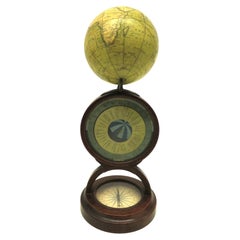
An English POCKET GLOBE with dial for time zones
By Newton and Son
Located in ZWIJNDRECHT, NL
NEWTON & SON (fl.1840-61)
AN ENGLISH POCKET GLOBE WITH A DIAL FOR TIME ZONES, CIRCA 1835
A previously unrecorded stand for an early-19th-century English globe.
A 3-inch (7.6cm.) di...
Category
Antique 1830s British Other Globes
Materials
Mahogany
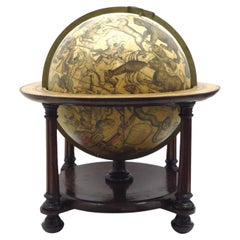
A beautiful Celestial Table Globe produced by Gerard
Leonard Valk
By Gerard and Leonard Valk
Located in ZWIJNDRECHT, NL
A magnificent and very rare early 18th century celestial table globe produced by Gerard and Leonard Valk. Established at the end of the previous ...
Category
Antique Early 18th Century Dutch Dutch Colonial Globes
Materials
Other
$189,349 Sale Price
20% Off
Free Shipping
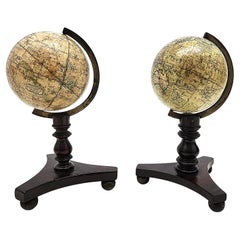
Lovely pair of English miniature globes on carved wooden stands
By Newton and Son
Located in ZWIJNDRECHT, NL
“NEWTON’S NEW & IMPROVED TERRESTRIAL and CELESTIAL GLOBES".
PUBLISHED BY NEWTON & SON,
66 CHANCERY LANE, LONDON.”
No date but ca. 1820-1830.
Diameter globes 2.75 inches / Total heig...
Category
Antique 1820s British Victorian Globes
Materials
Wood
$17,514 Sale Price / set
20% Off
Free Shipping
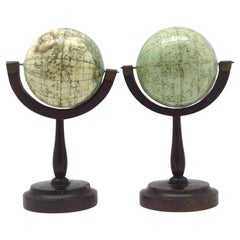
A fine pair of miniature globes on stands
By Karl Muller
Located in ZWIJNDRECHT, NL
A rare pair of miniature terrestrial and celestial globes.
by K. Müller, 1822
Karlsruhe, Germany
Diameter globes: 7 cm. Total high: 14,5 cm.
Each with 12 hand-coloured engraved p...
Category
Antique Early 19th Century German International Style Globes
Materials
Hardwood, Paper
You May Also Like
Terrestrial Globe By J. Forest Paris From The Early 20th Century
Located in Brussels, Brussels
A very beautiful early 20th-century globe, circa 1910, by J. Forest, Paris, scale 1/40,000,000.
The globe has a superb blackened wood base with a fine turning.
very beautiful globe ...
Category
Early 20th Century French Aesthetic Movement Globes
Materials
Paper
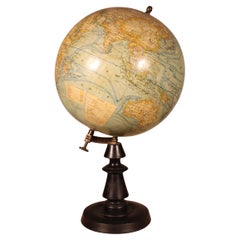
Antique Hammond
s 6-Inch Terrestrial Globe on Stand
By C.S. Hammond
Co.
Located in Philadelphia, PA
Offered here for your consideration is, A fine antique 6-inch terrestrial globe.
Additional Details:
By C.S. Hammond & Co.
The globe likely dates from 1927 to 1930 due to the ...
Category
20th Century Unknown Art Deco Globes
Materials
Wood, Paper
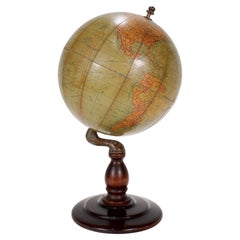
English miniature world desk globe circa 1930
Located in Central England, GB
This lovely vintage miniature desk globe is a very eye-catching and pleasing piece that is tactile in the hand.
The globe is made from wood, and you can clearly see the natural grai...
Category
Early 20th Century British Regency Globes
Materials
Wood
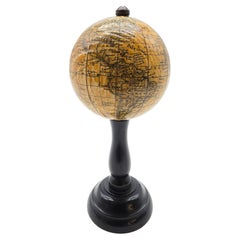
A small didactic terrestrial globe by Columbus, Germany 1920.
Located in Milan, IT
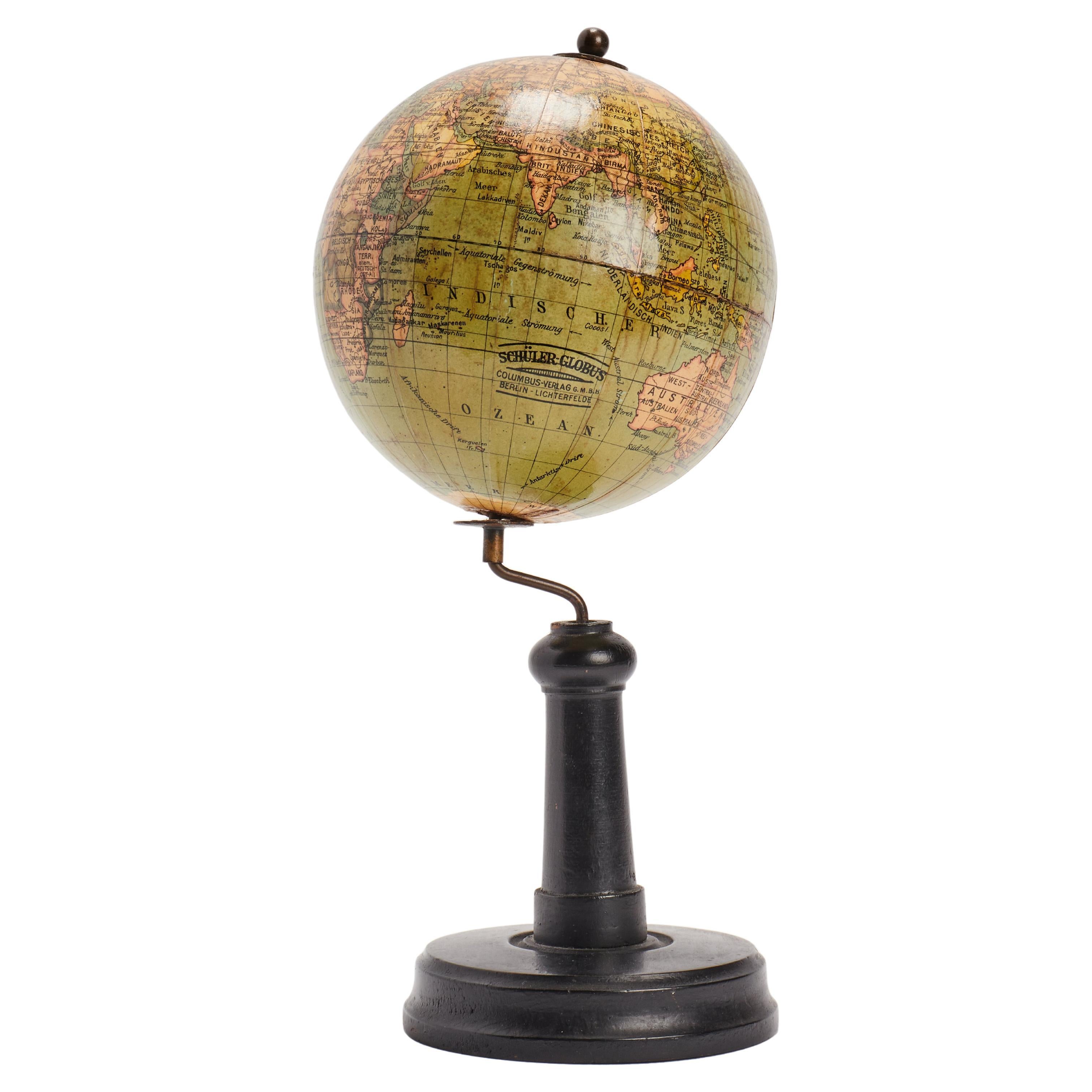
On a wooden base worked on the lathe, with a circular foot, wavy profile and high leg, with original patina, there is a small globe, published by Columbus, Berlin. The globe is made ...
Category
Early 20th Century German Globes
Materials
Paste, Wood, Paper
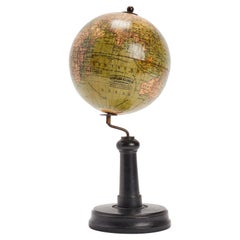
End XIX century Small Terrestrial Globe Signed C.M.C Paris Papier Maché Sphere
Located in Milan, IT
Small terrestrial globe signed C.M.C. Paris, end of XIX century. Papier maché sphere and turned and ebonized wooden base. Height cm 13 - inches 5.1, diameter of sphere cm 6,5 - inche...
Category
Antique 1890s French Globes
Materials
Paper
1950
s Terrestrial Globe by W.
A. K. Johnston
By W.
A.K. Johnston
Located in San Mateo, CA
Terrestrial globe printed by W. & A.K. Johnston Ltd, Edinburgh, Scotland and distributed by Nystrom & Co., Chicago. This globe dates to the 1950's. The globe is metal as is the stand...
Category
Vintage 1950s American Industrial Globes
Materials
Steel