Want more images or videos?
Request additional images or videos from the seller
1 of 3
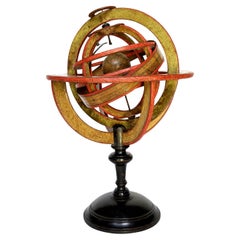
Italian Armillary Sphere
$16,493.14List Price
About the Item
- Creator:Luigi Cervellati (Maker)
- Dimensions:Height: 13.19 in (33.5 cm)Diameter: 10.63 in (27 cm)
- Style:Neoclassical (Of the Period)
- Materials and Techniques:
- Place of Origin:
- Period:
- Date of Manufacture:Circa 1800
- Condition:Wear consistent with age and use. Minor losses.
- Seller Location:Worpswede / Bremen, DE
- Reference Number:Seller: 16241stDibs: LU9814808687
About the Seller
5.0
Recognized Seller
These prestigious sellers are industry leaders and represent the highest echelon for item quality and design.
Established in 1979
1stDibs seller since 2013
28 sales on 1stDibs
Authenticity Guarantee
In the unlikely event there’s an issue with an item’s authenticity, contact us within 1 year for a full refund. DetailsMoney-Back Guarantee
If your item is not as described, is damaged in transit, or does not arrive, contact us within 7 days for a full refund. Details24-Hour Cancellation
You have a 24-hour grace period in which to reconsider your purchase, with no questions asked.Vetted Professional Sellers
Our world-class sellers must adhere to strict standards for service and quality, maintaining the integrity of our listings.Price-Match Guarantee
If you find that a seller listed the same item for a lower price elsewhere, we’ll match it.Trusted Global Delivery
Our best-in-class carrier network provides specialized shipping options worldwide, including custom delivery.You May Also Like
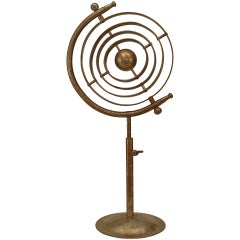
Italian Renaissance Chrome Armillary
Located in Queens, NY
Italian Renaissance-style (20th Century) chrome armillary globe with a rust patina.
Category
20th Century American Renaissance Revival Scientific Instruments
Materials
Chrome
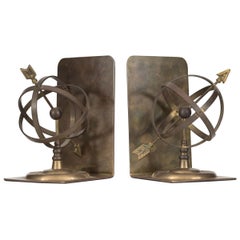
Pairs of Vintage Brass Armillary Sphere Bookends
Located in Queens, NY
2 PAIRS of vintage brass armillary sphere bookends (PRICED PER PAIR)
Condition: Good; Wear consistent with age and use
Category
20th Century Unknown Neoclassical Bookends
Materials
Brass
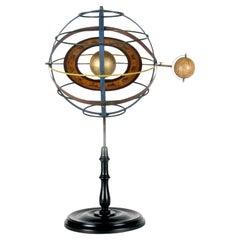
A Copernican armillary sphere, Paravia, Milan, Italy 1930
Located in Milan, IT
A Copernican armillary sphere made of iron, paper, brass and wood, with the Sun inside, and the Earth on the outside, made of wood and covered with paper. Pedestal made of turned and...
Category
Mid-20th Century Italian Scientific Instruments
Materials
Brass, Iron
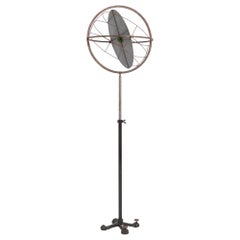
Exclusive Antique Armillary Sphere
Located in Vlimmeren, BE
An armillary sphere is a model of objects in the sky consisting of a spherical framework of rings, centred on the Earth or the Sun, that represent lin...
Category
Antique Mid-19th Century European Industrial Scientific Instruments
Materials
Metal
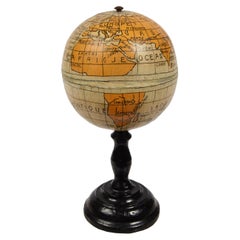
End XIX century Small Terrestrial Globe Signed C.M.C Paris Papier Maché Sphere
Located in Milan, IT
Small terrestrial globe signed C.M.C. Paris, end of XIX century. Papier maché sphere and turned and ebonized wooden base. Height cm 13 - inches 5.1, diameter of sphere cm 6,5 - inche...
Category
Antique 1890s French Globes
Materials
Paper
$1,160
H 5.1 in Dm 2.6 in
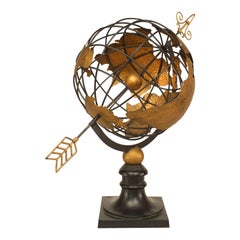
Italian Mid-Century Iron Armillary
Located in Queens, NY
Italian Mid-Century modern painted iron armillary globe with gold Continents supported on a round black base.
Category
20th Century Italian Mid-Century Modern Globes
Materials
Iron
20th Century Steel
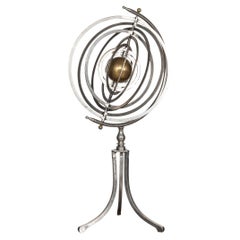
Brass Copernican Armillary Sphere c.1930
Located in Royal Tunbridge Wells, Kent
A 20th Century Copernican Armillary Sphere crafted in polished steel and brass. This instrument illustrates the celestial motion of the solar system, with origins tracing back to anc...
Category
20th Century European Other Scientific Instruments
Materials
Brass, Steel
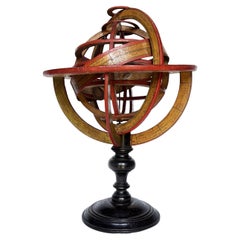
Ptolemaic Armillary Sphere, Charles-François Delamarche, Paris, ante 1798
By Charles Francois Delamarche
Located in Milano, IT
Ptolemaic armillary sphere
Charles-François Delamarche
Paris, ante 1798
Wood and papier-mâché
covered with printed and partly hand-colored paper
It measures 15.55 in in height x Ø 10...
Category
Antique 1790s French Other Scientific Instruments
Materials
Wood, Paper
$11,272
H 15.56 in Dm 10.95 in
Ptolemaic Armillary Sphere, Charles-François Delamarche, Paris, ante 1798
By Charles Francois Delamarche
Located in Milano, IT
Ptolemaic armillary sphere
Charles-François Delamarche
Paris, ante 1798
Wood and papier-mâché
covered with printed and partly hand-colored paper
It measures 16.37 in in height x Ø 10.94 in (41.60 cm - Ø 27.80 cm)
It weights 2.33 lb (1,058 g)
State of conservation: consistent with its age and use, the paper shows some signs of use, stains and abrasions.
The sphere is Ptolemaic, with the Earth placed at its center, surrounded by the Moon and the Sun mounted on two metal arms.
The sphere is composed of six horizontal and two vertical rings (armillae), each bearing graduations and its own name.
The first horizontal ring is illegible. The others, in descending order are: North Pole, Tropic of Cancer, Equator, Tropic of Capricorn, South Pole.
The vertical rings consist of two double meridians.
The sphere is then connected to the large meridian by two pins, a vertical ring inserted perpendicularly into the circle of the Horizon, in turn supported by four semicircles connected to the turned and black-stained wooden base.
Each element is covered with printed paper. It contains various pieces of information: latitudes, length of days, names and zodiac symbols, calendar, wind directions, etc.
The vertical circles mention the latitudes and longitudes of different cities: Rome, Bordeaux, Madrid, Boston, Batavia (Jakarta), Acapulco, etc.
Even the small terrestrial globe is covered with printed paper: continents and oceans appear with numerous geographical markings indicating the most recent explorations.
In the Pacific Ocean, west of South America bears the following inscription:
GLOBE
TERRESTRIAL
à Paris
chez Delamarche Géog
Rue du Foin Jacques
Au Collège de
M.e Gervais
The North American coasts are well delineated and California appears correctly as a peninsula - reports from Spanish explorers in the region had given rise to confusion as to whether it was connected to the mainland or not. The geographical nature of California was confirmed after the explorations of Juan Bautista de Anza (1774-1776).
Alaska is not described and is only partially traced; it would become part of the United States in 1867.
Various Pacific islands are indicated.
Australia (the name definitely used from 1824) is called "Nouvelle Hollande."
Tasmania is still represented as a peninsula and this is an important detail for the dating of our armillary sphere.
The island is separated from Australia by Bass Strait, which was crossed by Matthew Flinders for the first time in 1798, showing that it was not a peninsula. Delamarche certainly would not have waited a long time to update such an important geographical datum: presumably he did so shortly after receiving the news.
Charles-François Delamarche (1740-1817) founded his laboratory around 1770 and, in a few years, he became the most famous French cartographer and globe maker between the 18th and 19th centuries. After having acquired the laboratory of the late Didier Robert de Vaugondy (1723-1786; himself a renowned cartographer who continued the family business founded by his grandfather Nicolas Sanson in the seventeenth century) and after having purchased, between 1788 and around 1800, the businesses of Jean-Baptiste Fortin (1750-1831) and Jean Lattré (around 1750-1800), he began to call himself "Successeur de MM. Sanson and Robert de Vaugondi, Géographes du Roi and de M. Fortin, Ingénieur-mécanicien du Roi pour les globes et les sphères."
Thus, at the end of the eighteenth century, Delamarche possessed the warehouse stocks, as well as the manufacturing skills of the globes of his main rivals in Paris.
In addition to this aggressive acquisition policy, the key to its success also lay in the combination of high-quality cartography combined with extremely attractive globes and armillary spheres; and, of course, its famous red paint finishing touch.
His laboratory was located on Rue de Foin St Jacques "au Collège Me. (or "Mtre") Gervais" in the Latin Quarter of Paris until around 1805, when he moved to rue du Jardinet No. 13.
On the death of Charles-François in 1817, the reins of the company passed to his son Félix (1779-1835), who continued to publish, often in collaboration with the engraver Charles Dien, Sr. In 1835 the company first moved to rue du Jardinet No. 12 and a little later to rue du Battoir No. 7.
Bibliography:
Dekker, Elly, et al. Globes at Greenwich...
Category
Antique 1790s French Other Scientific Instruments
Materials
Wood, Paper
$11,272
H 16.38 in Dm 10.95 in
Ptolemaic Armillary Sphere Charles-François Delamarche Paris, 1805-1810 Circa
By Charles Francois Delamarche
Located in Milano, IT
Charles-François Delamarche
Ptolemaic armillary sphere
Paris, circa 1805-1810
Wood and papier-mâché
covered with printed and partly hand-coloured paper
It measures 15.74” in height, ...
Category
Antique Early 1800s French Empire Scientific Instruments
Materials
Paper, Wood

$10,679
H 15.75 in Dm 11.03 in
More From This Seller
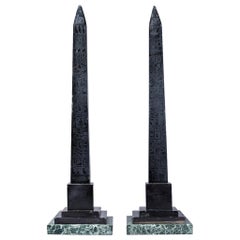
View AllPair of Large 19th Century Italian Grand Tour Black Marble Nero Antico Obelisks
Located in Worpswede / Bremen, DE
A very attractive pair of Italian Grand Tour black marble obelisks. Detailed hieroglyphics to the front side, on a green marble plinth. Minor corner chips to both obelisks, otherwise...
Category
Antique Late 19th Century Italian Grand Tour Architectural Models
Materials
Marble
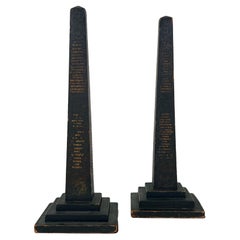
Pair of Italian Black painted Obelisks, Neoclassical 19th Century
Located in Worpswede / Bremen, DE
This is a very decorative pair of 19th-century Italian obelisks; probably a Grand Tour souvenir. They are made of wood, coated in black lacquer, and mounted on a stepped base. Three ...
Category
Antique Late 19th Century Italian Neoclassical Revival Obelisks
Materials
Wood, Lacquer
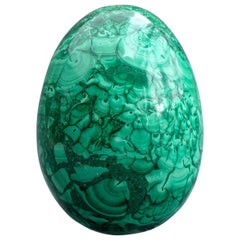
Large Belle Epoque Russian Carved Malachite Egg
Located in Worpswede / Bremen, DE
Impressive and large Russian malachite egg, carved from the solid. A timeless yet historic decorative object, which is a great addition to any sophistica...
Category
Antique Late 19th Century Russian Belle Époque Natural Specimens
Materials
Malachite
$8,187 Sale Price
22% Off
18th Century Louis XVI Ormolu and Marble Obelisk Mantel Clock
Located in Worpswede / Bremen, DE
Signed: Joseph Gay Horloger du Roy A Turin
The movement is contained in a white marble obelisk which is surmounted by an armillary sphere finial. The front with a panel chased wit...
Category
Antique Late 18th Century Italian Louis XVI Mantel Clocks
Materials
Marble, Ormolu

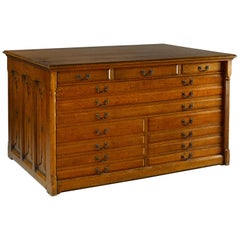
Rare Victorian Mid-19th Century Gothic Revival Library Architects Plan Chest
Located in Worpswede / Bremen, DE
A neo-gothic mid-19th century library plan chest having an arrangement of eleven short and three long drawers to one side, the other side with three short drawers above gothic style linen fold panelling, centred with the carved monogram ‘HP’, further matching panelling to the sides. A stunning plan chest of good propartions and with a nice patina. Provenance: Sherborne School, an independent school in north-west Dorset, England, established in 1550. Among the ‘Old Shirburnians’ are for example the writer John Cowper Powys, the actors Jeremy Irons und Charlie Cox, Chris Martin, leadsinger of the band Coldplay as well as Sheikh Tamim bin Hamad Al Thani...
Category
Antique Mid-19th Century English Gothic Revival Commodes and Chests of D...
Materials
Oak
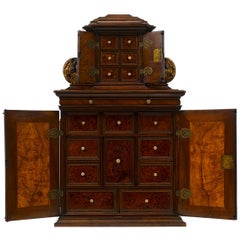
Rare 17th Century Baroque Cabinet, South Germany Probably Augsburg, Wunderkammer
Located in Worpswede / Bremen, DE
A small architectural table cabinet, veneered in walnut and mulberry, the centre doors enclosing an arrangement of nine various sized drawers with bone knobs, behind a central door a...
Category
Antique Late 17th Century German Baroque Cabinets
Materials
Brass
Still Thinking About These?
All Recently ViewedMore Ways To Browse
Moving Rings Ring
Bellerby Globe
Gustav Brueckmann
Nystrom World Globes
Adrian Pearsall Globe
Columbus Duo Globe
Gemstone Globe
Malby Globe
Pearsall Globe
Replogle Globe 1970 S
Slate Globe
Antique Standing Globe
Drinks Cabinet Globe
Gilman Joslin Terrestrial Globe
Globe Radio
J Forrest Globe
Replogle Globe Teak
Wagner Copper