Want more images or videos?
Request additional images or videos from the seller
1 of 16

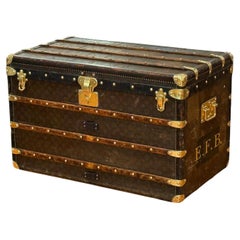
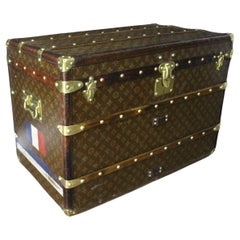
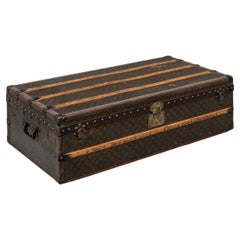
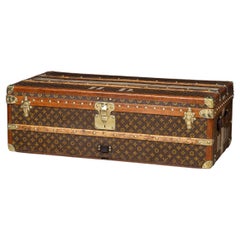
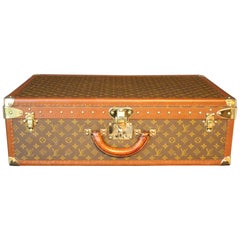
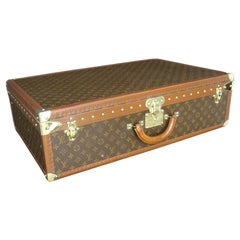
Louis Vuitton 1930 s Brown Leather Travel Trunk

$15,000List Price

You May Also Like

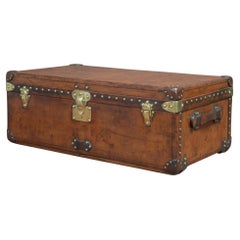
Louis Vuitton Leather Cabin Trunk, circa 1930
By Louis Vuitton
Located in London, GB
A well proportioned natural leather covered Louis Vuitton cabin trunk that has built up an attractive patina with age. Has original leather handles & brass fittings and has its original interior in-tact (including the original tray); Circa 1930. One of the original handle supports is a newly made replacement of the original, that was beyond repair. Provenance: From the collection of Anouska Hempel, noted interior designer, hotelier and taste maker. Dimensions: 91 cm/35⅞ inches (length) x 52 cm/20½ inches (depth) x 34.5 cm/13⅝ inches (height). About Louis Vuitton From humble beginnings, Louis Vuitton laid the foundations for a luggage enterprise serving the upper echelons of 19th-century society. His son, Georges, expanded on his father’s work throughout the 20th century. Louis Vuitton was born on 4 August 1821 in Anchay, a rural village in Eastern France. His father, Xavier Vuitton, was a farmer, his mother, Coronne Gaillard, a milliner. In 1835, aged 13, Vuitton left Anchay on foot for his two-year journey to Paris. He found work as a layetier – a maker of wooden boxes and cases for transporting travelers’ possessions – and was selected as the personal layetier to Empress Eugénie de Montijo, a Spanish Countess and wife of Napoleon III. In 1854, at 4 Rue Neuve de Capucines, Paris, Vuitton launched his enterprise, gaining recognition among Parisian nobility. A second Parisian store opened at 1, Rue Scribe, after the 1871 Siege of Paris. Striped “Rayée” canvas and the first Vuitton Wardrobe Trunk arrived in the 1870s, expanding abroad to 289 Oxford Street, London, and introducing the Damier canvas in the 1880s. Louis Vuitton passed away in 1892, leaving the business to his son, Georges. He set about expanding the family firm even further, selling out at the 1893 Chicago World’s Fair. J.P. Morgan and family became valued clients, and Georges patented the iconic LV monogram design in 1896, paying homage to a medieval Franc box rosette motif from his personal collection. The early 1900s saw the Steamer Bag launch and new premises on the Champs Élysées. Georges was never one to shy away from a bespoke order; customers could, and regularly did, request whatever their heart desired. Legendary commissions included a “Malle Lit” explorer’s camp bed trunk...
Category

Vintage 1930s French Trunks and Luggage

Materials

Brass

Louis Vuitton Leather Cabin Trunk, circa 1930
$25,258
H 13.63 in W 35.88 in D 20.5 in
Antique Louis Vuitton Style Travel Trunk, Vertical Wardrobe, 1930
Located in Linkebeek, BE
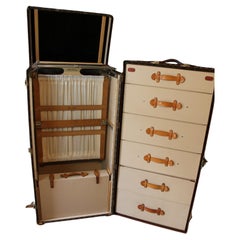
Louis Vuitton Style Travel Trunk Measures : 55,5x47cm H:108cm sold as is - The trunk opens vertically into two parts, one equipped with a wardrobe with hangers and the other with dr...
Category

20th Century Trunks and Luggage

Materials

Metal

Large Louis Vuitton Wardrobe Trunk , Louis Vuitton Trunk, Vuitton Steamer Trunk
By Louis Vuitton
Located in Saint-Ouen, FR
This impressive Louis Vuitton wardrobe features monogramm canvas, lozine trim, LV stamped solid brass lock and studs as well as solid brass corners.It is a big Louis Vuitton tank as ...
Category

21st Century and Contemporary French Trunks and Luggage

Materials

Brass

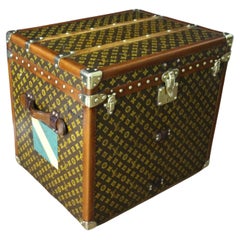
Louis Vuitton Trunk, Louis Vuitton Steamer Trunk, 62 cm Louis Vuitton Hat Trunk
By Louis Vuitton
Located in Saint-Ouen, FR
This beautiful and very rare Louis Vuitton trunk features hand painted stenciled monogram canvas, honey color lozine trim, large leather side handles, sta...
Category

Early 20th Century French Trunks and Luggage

Materials

Brass

Louis Vuitton, Brown Leather, Monogram Canvas, Vintage Steamer Trunk, France
By Louis Vuitton
Located in Manhasset, NY
Louis Vuitton, Steamer Trunk, Distressed Brown Leather, Monogram Canvas, France, Early 20th Century Large vintage steamer or luggage trunk by notorious French fashion house, Louis Vuitton circa 1920s/30s. This example is monogrammed with the original owner's initials and maintains several original interior fittings. The Case has been Professionally restored and refurbished by Louis Vuitton in France, 2024. Shipped via the Louis Vuitton Store...
Category

Vintage 1920s French Modern Trunks and Luggage

Materials

Brass

1920 s Louis Vuitton Trunk, 70 cm Louis Vuitton Steamer Trunk, Vuitton Hat Trunk
By Louis Vuitton
Located in Saint-Ouen, FR
Superb Louis Vuitton steamer trunk featuring stenciled canvas, all leather trim in deep chocolate color, solid brass Louis Vuitton stamped clasps, lock and studs, solid brass corners...
Category

Vintage 1920s French Trunks and Luggage

Materials

Brass

1930’s Louis Vuitton Monogram Cabin Trunk for Restoration
By Louis Vuitton
Located in Bridgeport, CT
A well worn and well-used Vuitton Cabin Trunk from the Golden Age of Travel bearing the marks, tears and losses of a well-travelled piece. Worn label insi...
Category

Vintage 1930s European Hollywood Regency Trunks and Luggage

Materials

Brass

20th Century Louis Vuitton Trunk, France c.1930
By Louis Vuitton
Located in Royal Tunbridge Wells, Kent
An exquisite and complete Louis Vuitton trunk from the early part of the 20th century. An absolutely essential item for elite travellers of its time the trunk is adorned in the iconic LV monogrammed canvas, accented by lozine trim and brass fittings. This trunk stood as the epitome of luxury over 100 years ago, boasting an unparalleled level of sophistication and elegance, it remains a timeless masterpiece that transcends eras. The captivating allure of the Louis Vuitton trunk transforms it into more than a mere luggage accessory; it becomes a focal point for any room. With its impressive dimensions, it is perfectly suited as a striking coffee table, side table, or even as a standalone centrepiece, seamlessly integrating into any interior, whether modern or traditional. An extraordinary piece that not only pays homage to the past but also serves as a statement of unparalleled luxury in the present. A brief history about Louis Vuitton trunks: Louis Vuitton was born in 1821 to a farmer and milliner and came from a long-established working-class family in eastern France. Vuitton grew up understanding the effects of perseverance and a strong work ethic from watching his family. At the age of 16, he made the decision to walk 292 miles from his hometown to Paris to try and make a new life for himself. When he arrived the city was in the midst of industrialization with current modes of transportation evolving quickly allowing for longer journeys. With this came the need for sturdy travel pieces. Vuitton was taken as an apprentice for a successful box maker and packer named Monsieur Marechal. He learned to craft durable containers and how to pack them properly – a well-respected profession at the time.In 1854, years after he had mastered his craft and became well respected for it, Vuitton ventured out on his own to open a shop on Rue Neuve des Capucines. It was here that he began to establish himself as a luggage maker. Then, in 1858, Vuitton designed the first Louis Vuitton steamer trunk. At the time trunks had rounded tops to allow for water to run off but this did not allow for convenient stowage. Vuitton introduced a flat, yet waterproof, trunk that was easily stackable. The first of his trunks were outfitted with a grey canvas referred to as Trianon – it wouldn’t be until several decades later that the signature monogram would be introduced. With a burgeoning business, Vuitton moved his family and workplace to Asniere, where he employed twenty workers to craft his trunks. By 1900 he would have 100 employees, and in 1914 the company would more than double in size. After years of success, Vuitton began to experiment with the design of his luggage by introducing a new striped canvas pattern (1876) and later the still well-known Damier print (1888). The hand-painted patterns were developed to prevent counterfeits. Even in the late 1800s, Louis Vuitton was enough of a status symbol to warrant counterfeiting. In 1886, his son George invented and patented an ingenious locking system that made it impossible to pick the lock of their trunks. This lock is still used today. 1892 would prove to be a time of mourning for the family as Louis Vuitton passed...
Category

20th Century French Other Trunks and Luggage

Materials

Brass

20th Century Louis Vuitton Trunk, France c.1930
$30,051
H 13 in W 39.38 in D 21.26 in
Louis Vuitton Trunk, Louis Vuitton Suitcase, Vuitton Steamer Trunk, Alzer 70
By Louis Vuitton
Located in Saint-Ouen, FR
This piece of luggage is a magnificent Louis Vuitton Alzer monogramm suitcase. This 70 cm suitcase is almost the largest and surely the most luxury one made by Louis Vuitton. It feat...
Category

21st Century and Contemporary French Coffee and Cocktail Tables

Materials

Brass

Louis Vuitton Trunk, Louis Vuitton Suitcase, Vuitton Steamer Trunk, Alzer 75
By Louis Vuitton
Located in Saint-Ouen, FR
This piece of luggage is a magnificent Louis Vuitton Alzer monogramm suitcase. This 75 cm suitcase is almost the largest and surely the most luxury one made by Louis Vuitton. It feat...
Category

21st Century and Contemporary French Coffee and Cocktail Tables

Materials

Brass

More From This Seller

View All
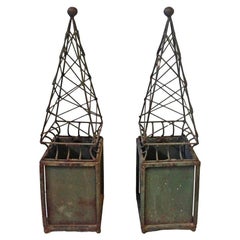
Arturo Pani Mexican Mid-Century Modern Pair of Iron Obelisks
By Arturo Pani
Located in Mexico City, MX
Pair of Mexican Mid-Century Modern iron obelisks. The obelisks show green patina.
Category

Vintage 1960s Mexican Mid-Century Modern Obelisks

Materials

Iron

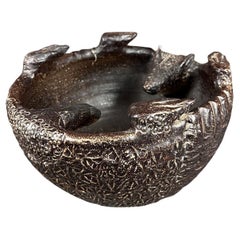
Claudio Jerónimo Brown High Temperatura Ceramic Armadillo Vase
Located in Mexico City, MX
A brown high temperature ceramic vase in shape of an armadillo by Mexican ceramist Claudio Jerónimo. The oval shaped vase shows the armadillo's head and tail on its interior, resembling a position of self-defense. The exterior depicts the animal's bands and scutes that shape its armor skin. The piece is unsigned. Claudio Jerónimo López Cedillo was born in 1959 in Huajuapan de León, Oaxaca, Mexico. He began learning ceramics in 1975 with Japanese ceramics master...
Category

Early 2000s Mexican Post-Modern Animal Sculptures

Materials

Ceramic

Karl Hagenauer Austrian 1930s Art Deco Brass and Ebonized Wood Singing Sailor
By Karl Hagenauer
Located in Mexico City, MX
A 1930's Austrian ebonized wood and brass singing sailor. The sailor has wood body and brass head, hands and feet. Sealed on the bottom.
Category

Vintage 1930s Austrian Art Deco Figurative Sculptures

Materials

Brass

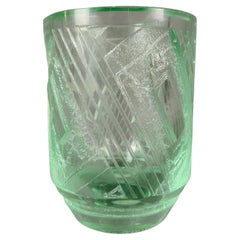
1930 s French Daum Nancy Art Decó Green Pressed Thick Glass Vase
By Daum
Located in Mexico City, MX
A 1930's thick green glass Art Decó vase by Daum Nancy. The vase is decorated with geometric elements. The vase is signed DAUM NANCY FRANCE on the base's edge. Daum is a French glas...
Category

Vintage 1930s French Art Deco Glass

Materials

Glass

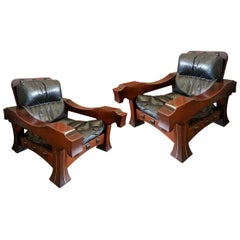
Luciano Frigerio Pair of Italian Mahogany and Black Leather Ussaro Armchairs
By Luciano Frigerio
Located in Mexico City, MX
Massive pair of Italian Mid-Century Modern mahogany and black leather Ussaro armchairs by Luciano Frigerio. The mahogany structure has brass details on the legs.
Category

Vintage 1970s Italian Mid-Century Modern Lounge Chairs

Materials

Brass

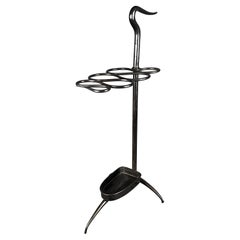
Cesare Lacca 1940s Italian Patinated Bronze Umbrella Stand
By Cesare Lacca
Located in Mexico City, MX
A rare 1950's Italian patinated bronze umbrella stand by Cesare Lacca. The curved stand has a serpentine shaped divider that holds the umbrellas into a deposit attached to curved leg...
Category

Vintage 1950s Italian Mid-Century Modern Umbrella Stands

Materials

Bronze

Still Thinking About These?

All Recently Viewed