Want more images or videos?
Request additional images or videos from the seller
1 of 9
Norfolk Hide Attaché Case, circa 1920
$1,593.09List Price
About the Item
- Dimensions:Height: 4.38 in (11.13 cm)Width: 15.25 in (38.74 cm)Depth: 10.25 in (26.04 cm)
- Materials and Techniques:
- Place of Origin:
- Period:
- Date of Manufacture:circa 1920
- Condition:
- Seller Location:London, GB
- Reference Number:1stDibs: LU960013926822
About the Seller
5.0
Vetted Professional Seller
Every seller passes strict standards for authenticity and reliability
Established in 1989
1stDibs seller since 2013
69 sales on 1stDibs
Associations
LAPADA - The Association of Arts
Antiques Dealers
Authenticity Guarantee
In the unlikely event there’s an issue with an item’s authenticity, contact us within 1 year for a full refund. DetailsMoney-Back Guarantee
If your item is not as described, is damaged in transit, or does not arrive, contact us within 7 days for a full refund. Details24-Hour Cancellation
You have a 24-hour grace period in which to reconsider your purchase, with no questions asked.Vetted Professional Sellers
Our world-class sellers must adhere to strict standards for service and quality, maintaining the integrity of our listings.Price-Match Guarantee
If you find that a seller listed the same item for a lower price elsewhere, we’ll match it.Trusted Global Delivery
Our best-in-class carrier network provides specialized shipping options worldwide, including custom delivery.You May Also Like
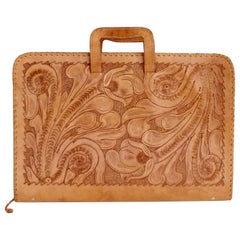
Western Style Hand Tooled Leather Attache Case
Located in Ferndale, MI
Beautiful hand tooled leather attache case with whipstitch detail, retractable handles and full outer zipper closure. The interior has two interio...
Category
Mid-20th Century American Rustic Trunks and Luggage
Materials
Leather
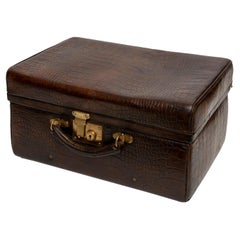
Crocodile Attache Briefcase Overnight Case Original Leather Interior
Located in BUNGAY, SUFFOLK
A fine, 19th century, high quality, crocodile attache, briefcase or overnight case with exposed handle, brass hardware with lock stamped 'secure leve...
Category
20th Century English Art Deco Trunks and Luggage
Materials
Brass
$5,465
H 9.26 in W 18.12 in D 12.6 in
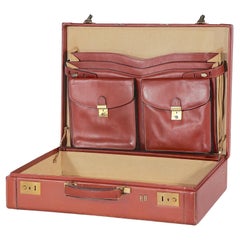
Mid Century Art Deco Hard Case Leather Attache Briefcase after Bally, Hermes
By Hermès, Bally
Located in New York, NY
Exceptional, well crafted vintage hard leather briefcase, attache case in very fine, original, clean and ready to use condition. The case features a fitted interior with saddle bag s...
Category
Mid-20th Century American Mid-Century Modern Trunks and Luggage
Materials
Leather
$295
H 9 in W 17.5 in D 4 in
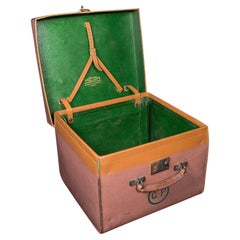
Small Antique Picnic Case, English, Leather, Suitcase, John Pound, Circa 1920
Located in Hele, Devon, GB
This is a small antique picnic case. An English, leather suitcase by John Pound & Co, dating to the early 20th century, circa 1920.
Delightfully distinctive colours to this charmin...
Category
Early 20th Century British Mid-Century Modern Trunks and Luggage
Materials
Leather
$1,810
H 10.44 in W 15.36 in D 15.36 in
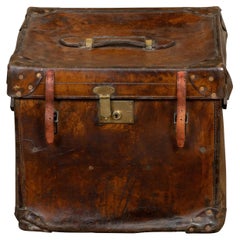
English Victorian Period 1880s Leather Hide Hat Case with Removable Divider
Located in Atlanta, GA
An English Victorian period leather hide hat case from the late 19th century, with G.C monogram, lined in red with removable divider. Created in England durin...
Category
Antique Late 19th Century English Victorian Decorative Boxes
Materials
Brass
$2,850
H 18.5 in W 20.25 in D 18.5 in
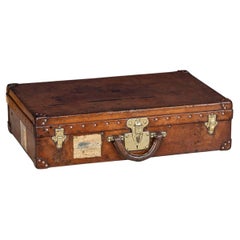
20th Century Louis Vuitton Cow Hide Suitcase, France c.1920
By Louis Vuitton
Located in Royal Tunbridge Wells, Kent
A highly unusual and exceptionally rare Louis Vuitton suitcase, originating from the early years of the 20th century, distinguishes itself not with the globally renowned monogram canvas but with a distinctive covering crafted from a singular piece of cowhide. This unique piece represents a special order from Louis Vuitton, showcasing the brand's historical commitment to utilizing only the finest hides available.
Unlike many of its counterparts, leather trunks and cases of this era often struggle to withstand the test of time, requiring regular treatments to prevent drying and disintegration. Remarkably, this particular example defies the odds, retaining the same supple quality it possessed on the day it first graced the shop floor. This suitcase belongs to Louis Vuitton's collection of "speciality materials," which encompasses a diverse range, including, but not limited to, zinc, copper, crocodile leather, and cow leather.
A brief history about Louis Vuitton trunks: Louis Vuitton was born in 1821 to a farmer and milliner and came from a long-established working-class family in eastern France. Vuitton grew up understanding the effects of perseverance and a strong work ethic from watching his family. At the age of 16, he made the decision to walk 292 miles from his hometown to Paris to try and make a new life for himself. When he arrived the city was in the midst of industrialization with current modes of transportation evolving quickly allowing for longer journeys. With this came the need for sturdy travel pieces.
Vuitton was taken as an apprentice for a successful box maker and packer named Monsieur Marechal. He learned to craft durable containers and how to pack them properly – a well-respected profession at the time.In 1854, years after he had mastered his craft and became well respected for it, Vuitton ventured out on his own to open a shop on Rue Neuve des Capucines. It was here that he began to establish himself as a luggage maker. Then, in 1858, Vuitton designed the first Louis Vuitton steamer trunk. At the time trunks had rounded tops to allow for water to run off but this did not allow for convenient stowage. Vuitton introduced a flat, yet waterproof, trunk that was easily stackable. The first of his trunks were outfitted with a grey canvas referred to as Trianon – it wouldn’t be until several decades later that the signature monogram would be introduced.
With a burgeoning business, Vuitton moved his family and workplace to Asniere, where he employed twenty workers to craft his trunks. By 1900 he would have 100 employees, and in 1914 the company would more than double in size. After years of success, Vuitton began to experiment with the design of his luggage by introducing a new striped canvas pattern (1876) and later the still well-known Damier print (1888). The hand-painted patterns were developed to prevent counterfeits. Even in the late 1800s, Louis Vuitton was enough of a status symbol to warrant counterfeiting. In 1886, his son George invented and patented an ingenious locking system that made it impossible to pick the lock of their trunks. This lock is still used today.
1892 would prove to be a time of mourning for the family as Louis Vuitton passed...
Category
20th Century French Other Trunks and Luggage
Materials
Brass
$4,362
Free Shipping
H 6.7 in W 25.99 in D 16.93 in
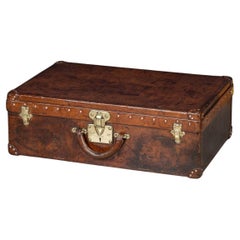
20th Century Louis Vuitton Cow Hide Suitcase, France c.1920
By Louis Vuitton
Located in Royal Tunbridge Wells, Kent
A highly unusual and exceptionally rare Louis Vuitton suitcase, originating from the early years of the 20th century, distinguishes itself not with the globally renowned monogram canvas but with a distinctive covering crafted from a singular piece of cowhide. This unique piece represents a special order from Louis Vuitton, showcasing the brand's historical commitment to utilizing only the finest hides available.
Unlike many of its counterparts, leather trunks and cases of this era often struggle to withstand the test of time, requiring regular treatments to prevent drying and disintegration. Remarkably, this particular example defies the odds, retaining the same supple quality it possessed on the day it first graced the shop floor. This suitcase belongs to Louis Vuitton's collection of "speciality materials," which encompasses a diverse range, including, but not limited to, zinc, copper, crocodile leather, and cow leather.
A brief history about Louis Vuitton trunks: Louis Vuitton was born in 1821 to a farmer and milliner and came from a long-established working-class family in eastern France. Vuitton grew up understanding the effects of perseverance and a strong work ethic from watching his family. At the age of 16, he made the decision to walk 292 miles from his hometown to Paris to try and make a new life for himself. When he arrived the city was in the midst of industrialization with current modes of transportation evolving quickly allowing for longer journeys. With this came the need for sturdy travel pieces.
Vuitton was taken as an apprentice for a successful box maker and packer named Monsieur Marechal. He learned to craft durable containers and how to pack them properly – a well-respected profession at the time.In 1854, years after he had mastered his craft and became well respected for it, Vuitton ventured out on his own to open a shop on Rue Neuve des Capucines. It was here that he began to establish himself as a luggage maker. Then, in 1858, Vuitton designed the first Louis Vuitton steamer trunk. At the time trunks had rounded tops to allow for water to run off but this did not allow for convenient stowage. Vuitton introduced a flat, yet waterproof, trunk that was easily stackable. The first of his trunks were outfitted with a grey canvas referred to as Trianon – it wouldn’t be until several decades later that the signature monogram would be introduced.
With a burgeoning business, Vuitton moved his family and workplace to Asniere, where he employed twenty workers to craft his trunks. By 1900 he would have 100 employees, and in 1914 the company would more than double in size. After years of success, Vuitton began to experiment with the design of his luggage by introducing a new striped canvas pattern (1876) and later the still well-known Damier print (1888). The hand-painted patterns were developed to prevent counterfeits. Even in the late 1800s, Louis Vuitton was enough of a status symbol to warrant counterfeiting. In 1886, his son George invented and patented an ingenious locking system that made it impossible to pick the lock of their trunks. This lock is still used today.
1892 would prove to be a time of mourning for the family as Louis Vuitton passed...
Category
20th Century French Other Trunks and Luggage
Materials
Brass
$4,365
Free Shipping
H 8.67 in W 25.99 in D 16.93 in
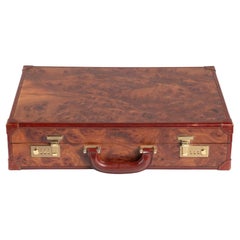
MOMODESIGN Italy Burlwood
Leather Attaché Briefcase
Located in Stamford, CT
MOMODESIGN, an esteemed Italian company renowned for its avant-garde designs spanning fashion, accessories, and automotive adornments, originally gained prominence under its former m...
Category
Vintage 1970s Italian Modern Trunks and Luggage
Materials
Leather, Burl
Crocodile Attache Portfolio with Inside Zipper Pocket
Located in Los Angeles, CA
Crocodile attache portfolio with inside zipper pocket - A fabulous vintage crocodile portfolio / attache from Mexico - great for carrying everythin...
Category
20th Century Mexican Trunks and Luggage
Materials
Crocodile
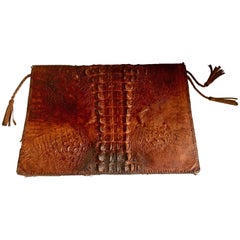
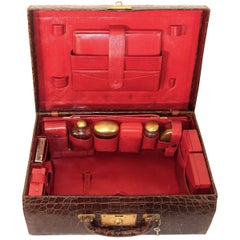
Art Deco Brown Vintage Alligator Leather Case, 1920s
Located in Vienna, AT
Art Deco alligator traveling grooming leather case is lined with red leather and features various compartments replete with glass bottles with gold lids, leather boxes, flacons and a...
Category
Vintage 1920s English Art Deco Trunks and Luggage
Materials
Alligator
More From This Seller
View AllTan Leather Case, circa 1910
Located in London, GB
An excellent sturdy tan leather case with solid brass catch and original leather lining with pockets and sleeves to accommodate fittings (now missing). The fittings that remain are t...
Category
Vintage 1910s British Trunks and Luggage
Materials
Brass
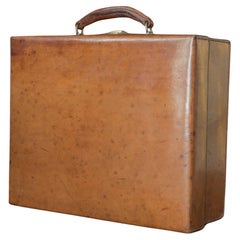
Mid Tan Leather Case, Circa 1930
Located in London, GB
Attractive hide leather case, ideal for an overnight or weekend away. Has a sturdy handle, brass catches, re-lined cloth lining to the interior and unusually, no initials. Circa 1930...
Category
Vintage 1930s British Trunks and Luggage
Materials
Brass
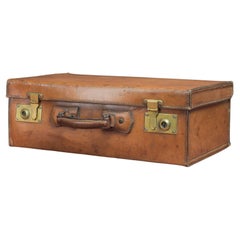
Chalons Steamer Trunk, circa 1915
Located in London, GB
A wonderful trunk by the French Grand Magasin, Chalons, of Alexandria Egypt. With brass fittings, and original interior lining and key, circa 1915.
Dimens...
Category
Vintage 1910s French Trunks and Luggage
Materials
Brass
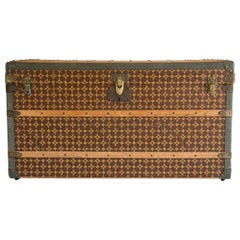
Leather Triple Hat Bucket, circa 1900
Located in London, GB
A fantastic gentleman's leather hat bucket with brass catch and original quilted silk lining to the interior that would hold two top hats, or a bowler and a top hat, plus space in the lid for an opera hat...
Category
Antique Early 1900s British Trunks and Luggage
Materials
Brass
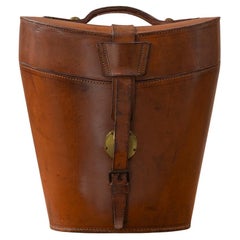
Louis Vuitton Leather Cabin Trunk, circa 1930
By Louis Vuitton
Located in London, GB
A well proportioned natural leather covered Louis Vuitton cabin trunk that has built up an attractive patina with age. Has original leather handles & brass fittings and has its original interior in-tact (including the original tray); Circa 1930. One of the original handle supports is a newly made replacement of the original, that was beyond repair.
Provenance: From the collection of Anouska Hempel, noted interior designer, hotelier and taste maker.
Dimensions: 91 cm/35⅞ inches (length) x 52 cm/20½ inches (depth) x 34.5 cm/13⅝ inches (height).
About Louis Vuitton
From humble beginnings, Louis Vuitton laid the foundations for a luggage enterprise serving the upper echelons of 19th-century society. His son, Georges, expanded on his father’s work throughout the 20th century.
Louis Vuitton was born on 4 August 1821 in Anchay, a rural village in Eastern France. His father, Xavier Vuitton, was a farmer, his mother, Coronne Gaillard, a milliner. In 1835, aged 13, Vuitton left Anchay on foot for his two-year journey to Paris. He found work as a layetier – a maker of wooden boxes and cases for transporting travelers’ possessions – and was selected as the personal layetier to Empress Eugénie de Montijo, a Spanish Countess and wife of Napoleon III.
In 1854, at 4 Rue Neuve de Capucines, Paris, Vuitton launched his enterprise, gaining recognition among Parisian nobility. A second Parisian store opened at 1, Rue Scribe, after the 1871 Siege of Paris. Striped “Rayée” canvas and the first Vuitton Wardrobe Trunk arrived in the 1870s, expanding abroad to 289 Oxford Street, London, and introducing the Damier canvas in the 1880s.
Louis Vuitton passed away in 1892, leaving the business to his son, Georges. He set about expanding the family firm even further, selling out at the 1893 Chicago World’s Fair. J.P. Morgan and family became valued clients, and Georges patented the iconic LV monogram design in 1896, paying homage to a medieval Franc box rosette motif from his personal collection.
The early 1900s saw the Steamer Bag launch and new premises on the Champs Élysées. Georges was never one to shy away from a bespoke order; customers could, and regularly did, request whatever their heart desired. Legendary commissions included a “Malle Lit” explorer’s camp bed trunk...
Category
Vintage 1930s French Trunks and Luggage
Materials
Brass
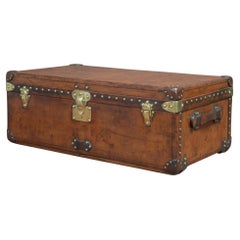
Exceptionally Large Louis Vuitton Wardrobe Trunk, circa 1955
By Louis Vuitton
Located in London, GB
A rare, very large scale brass bound Louis Vuitton wardrobe trunk in LV Monogram with lozine trim and original interior fittings providing hanging space; circa 1955. Has the original...
Category
Vintage 1950s French Trunks and Luggage
Materials
Metal, Brass
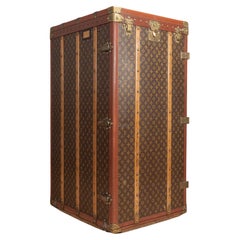
Still Thinking About These?
All Recently ViewedMore Ways To Browse
Norfolk Furniture
Attache Case
Leather Attache Case
Vintage Louis Vuitton Trunks
Metal Trunk
Antique French Trunks
Leather Luggage Vintage
Vintage Travel Trunks
Louis Vuitton Monogram Trunks
Antique Chests And Trunks
Antique Travel Trunk
Brown Leather Suitcases
Louis Vuitton Leather Trunk
Wooden Trunk Used
Steamer Trunk Luggage
Louis Vuitton Steamer Trunks
Antique England Trunk
Antique Steamer Trunks