Rugs and Carpets

to
26
Width
to
Length
to
550
90
4
141
18
9
2
1
21
69
554
15
49
2
1
1
2
2
2
637
490
296
72
3
577
23
644
594
615
621
511
449
55
50
96
29
13
11
2
Rugs and Carpets For Sale
Search Within: Ikat
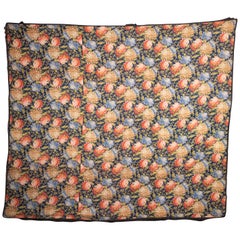
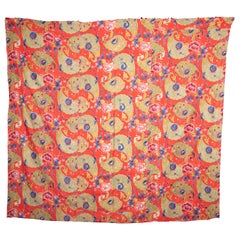
Russian Printed Cotton Fabric Panel, Mid-20th Century or Earlier
Located in Istanbul, TR
These type of Russian prints that are also called 'trade cloth' since they were made for Central Asian markets. They were used to make blankets and dresses, and also used for the lin...
Category

Mid-20th Century Russian Rugs and Carpets

Materials

Cotton

Russian Printed Cotton Fabric Panel, Mid-20th Century or Earlier
Located in Istanbul, TR
These type of Russian prints that are also called 'trade cloth' since they were made for Central Asian markets. They were used to make blankets and dresses, and also used for the lin...
Category

Mid-20th Century Russian Rugs and Carpets

Materials

Cotton

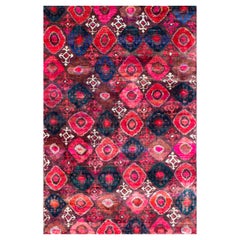
Transitional Red Burgundy Pink Blue Natural Silk Eco-Friendly Hand-Knotted Rug
Located in New York, NY
The Rumi collection master weavers artfully re-spin and hand knot the finest remnants of sustainable sari-silk to create the breakthrough Rumi Silk collection. These remarkable patte...
Category

2010s Indian Organic Modern Rugs and Carpets

Materials

Silk

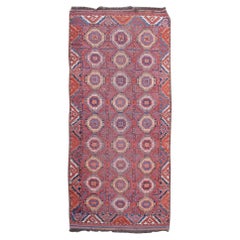
Ersari Long Rug, 19th Century
Located in San Francisco, CA
Ersari Long Rug, 19th Century Woven along the banks of the Oxus River in Central Asia, this long and narrow Bashir carpet represents a distinctive form of Turkmen weaving. The town ...
Category

19th Century Central Asian Antique Rugs and Carpets

Materials

Wool

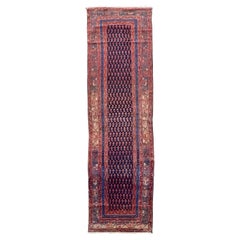
Antique Northwest Persian Runner circa 1930
Located in Morton Grove, IL
A handsome dark blue runner hand woven in north western Iran.Featuring elegantly curved boteh that are simply drawn; complexities are ruled out by the difficult ikat technique. The p...
Category

1930s Persian Vintage Rugs and Carpets

Materials

Wool

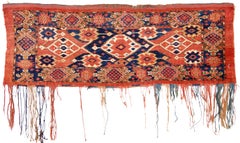
Late 19th Century Red and Blue Bashir Torba Bag
Located in San Francisco, CA
This Central Asian tent bag was most likely woven in the Middle Amu Darya area of what is now Uzbekistan. Structurally, it uses white cotton, hand-spun weft w...
Category

19th Century Antique Rugs and Carpets

Materials

Wool

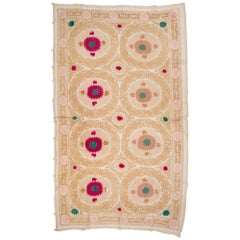
Decorative Large mid 20th C. Suzani from Uzbekistan
Located in Istanbul, TR
Uzbek Suzani, a captivating textile art form originating from Central Asia, embodies a rich tapestry of culture and craftsmanship. The word "suzani" translates to "needlework" in Per...
Category

Mid-20th Century Uzbek Suzani Rugs and Carpets

Materials

Cotton

Doris Leslie Blau Vintage Indian Dhurrie Rug
Located in New York, NY
Vintage Indian Dhurrie rug Size: 10'0" × 15'4" (304 × 467 cm). This vintage Indian Dhurrie rug exemplifies quiet elegance through a refined and earthy color palette. The expansive fl...
Category

Mid-20th Century Indian Mid-Century Modern Rugs and Carpets

Materials

Cotton

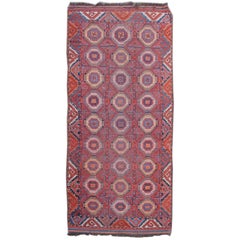
Red Bashir Ersari Long Rug with Tiled Octagons, 19th Century
Located in San Francisco, CA
Red Bashir Ersari Long Rug with Tiled Octagons, 19th Century Woven along the banks of the Oxus River in Central Asia, this long and narrow Bashir carpet represents a distinctive for...
Category

1870s Uzbek Antique Rugs and Carpets

Materials

Wool

Mid-20th Century Handmade Turkish Flat-Weave Kilim Accent Carpet
Located in New York, NY
A vintage Turkish flat-weave Kilim accent carpet in gallery format handmade during the mid-20th century. Measures: 5' 3" x 9' 10" Knotted pile rugs are just one small part of a vast universe of textile techniques suitable for heavy use. If you can imagine it, some weaver has tried it out. Pieces can be roughly divided into those reversible from the start and those never, or at least not initially, reversible. Thus kilims are considered reversible, while everything else is not. Kilims are tapestry woven rugs with both sides the same, in either slit technique where colors change, or with various methods of avoiding slits. Slit tapestry weave goes back to ancient times and Coptic Egyptian...
Category

Mid-20th Century Turkish Modern Rugs and Carpets

Materials

Wool

Contemporary Handmade Turkish Flat-Weave Kilim Large Room Size Carpet
Located in New York, NY
A modern Turkish flat-weave Kilim large room size carpet handmade during the 21st century. Measures: 13' 9" x 16' 8" Flat-weave rugs carpets: Knotted pile rugs are just one small part of a vast universe of textile techniques suitable for heavy use. If you can imagine it, some weaver has tried it out. Pieces can be roughly divided into those reversible from the start and those never, or at least not initially, reversible. Thus, kilims are considered reversible, while everything else is not. Kilims are tapestry woven rugs with both sides the same, in either slit technique where colors change, or with various methods of avoiding slits. Slit tapestry weave goes back to ancient times and Coptic...
Category

21st Century and Contemporary Turkish Modern Rugs and Carpets

Materials

Wool

Contemporary Handmade Persian Flat-Weave Kilim Accent Rug
Located in New York, NY
A modern Persian flat-weave Kilim accent rug handmade during the 21st century. Measures: 3' 5" x 6' 8" Flat-weave rugs carpets: Knotted pile rugs are just one small part of a vast universe of textile techniques suitable for heavy use. If you can imagine it, some weaver has tried it out. Pieces can be roughly divided into those reversible from the start and those never, or at least not initially, reversible. Thus, kilims are considered reversible, while everything else is not. Kilims are tapestry woven rugs with both sides the same, in either slit technique where colors change, or with various methods of avoiding slits. Slit tapestry weave goes back to ancient times and Coptic Egyptian...
Category

21st Century and Contemporary Persian Modern Rugs and Carpets

Materials

Wool

Contemporary Handmade Turkish Flat-Weave Kilim Geometric Large Room Size Carpet
Located in New York, NY
A modern Turkish flatweave Kilim room size carpet handmade during the 21st century with a geometric design in colorful tones perfect for a children's playroom. Measures: 12' 2" x 15' 1" Knotted pile rugs are just one small part of a vast universe of textile techniques suitable for heavy use. If you can imagine it, some weaver has tried it out. Pieces can be roughly divided into those reversible from the start and those never, or at least not initially, reversible. Thus kilims are considered reversible, while everything else is not. Kilims are tapestry woven rugs with both sides the same, in either slit technique where colors change, or with various methods of avoiding slits. Slit tapestry weave goes back to ancient times and Coptic Egyptian...
Category

21st Century and Contemporary Turkish Modern Rugs and Carpets

Materials

Wool

Early 20th Century Handmade East Turkestan Saph Khotan Runner
Located in New York, NY
An antique East Turkestan Saph Khotan rug in runner format handmade during the early 20th century. Measures: 2' 2" x 9' 3" Central Asian Rugs Carpets: Central Asia is a vast area stretching from Northeastern Persia to western China, and from northern Afghanistan to the southern edge of Russia. The carpets can be usefully divided into three groups: the nomadic Turkmen rugs of Turkmenistan, northern Afghanistan, and northeastern Persia; the non-Turkmen tribal pieces from Kazakhstan, Uzbekistan, and Kirghizstan; and the urban creations of Khotan, Yarkand, and Kashgar, oasis cities of Western China (Xinjiang Province). Commercially, the most important group is from Khotan, the easternmost of the Chinese Turkestan cities. The craft of rug weaving is primarily in the hands of Muslim Uighurs. Khotan carpets mix purely Central Asian design themes with Chinese elements. Native Khotan devices include pomegranate trees, upright flowers, round medallions, and yellow or red grounds. Chinese motives include triangular fretwork corners, swastika fretwork, and Yun-Tsao Tou (clouds and rain) diagonally striped polychrome borders. Cotton foundations, asymmetrical (Persian) knots, and medium weaves are standard. Some vintage Khotan are in horizontal, pictorial layouts with multiple various vases and plants. Saphs (multiple prayer niche panel carpets) are also a Khotan specialty. Others employ stepped and layered lozenge medallions, singly or in pairs. Still others, almost all antique, feature a stylized version of the allover Persian Herati design. Many of the oldest pieces employ brown wool wefts. Antique and vintage Khotans are almost always in the k’ang (double square) layout, conforming to the local household plans. Only relatively recently has the 6’ by 12’ or 7’ by 16’ format been replaced by the 9’ by 12’ size. As a result, an antique room size Khotan carpet is very uncommon. Reds are cinnamon, tomato and rust, never wine reds, crimson, or scarlet. Yarkand, farther west on the old Silk Road specializes in multi-medallion long carpets while Kashgar, farthest west and most under Persian influence, has traditionally knotted allover pattern pieces with finer weaves, often with silk piles, and enriched with medal thread, on cotton foundations. Extant Kashgars go back to the 17th century, but the carpet craft in Chinese Turkestan must be much older as fragments have been recovered from local tombs of the early C.E. period. Kashgars are the rarest of all East Turkestan rugs. Most available vintage East Turkestan carpets are interwar Khotans, many with pleasingly soft decorative palettes. The non-Turkmen nomads include the Kazakh, Kirghiz, Uzbek, and Karakalpak groups. Like the Turkmen, they were once all seasonally migratory, dwelling in round felt tents (yurts), but have been settled, at least partially, in the villages, and have taken up crafts and agriculture instead of sheep herding. As a result, carpet production has transitioned from domestic tent use to commercial sale, but the roots of long traditions are still evident. The Uzbeks weave...
Category

Early 20th Century East Turkestani Folk Art Rugs and Carpets

Materials

Wool

Tribal Mid-20th Century Handmade Persian Turkoman Runner
Located in New York, NY
A vintage Persian tribal Turkoman rug in runner format handmade during the mid-20th century. Although this rug is of Persian origin, the roots of Turkoman rugs originated in the Central Asian region. Measures: 1' 6" x 10' 4" Central Asian Rugs Carpets: Central Asia is a vast area stretching from Northeastern Persia to western China, and from northern Afghanistan to the southern edge of Russia. The carpets can be usefully divided into three groups: the nomadic Turkmen rugs of Turkmenistan, northern Afghanistan, and northeastern Persia; the non-Turkmen tribal pieces from Kazakhstan, Uzbekistan, and Kirghizstan; and the urban creations of Khotan, Yarkand, and Kashgar, oasis cities of Western China (Xinjiang Province). Commercially, the most important group is from Khotan, the easternmost of the Chinese Turkestan cities. The craft of rug weaving is primarily in the hands of Muslim Uighurs. Khotan carpets mix purely Central Asian design themes with Chinese elements. Native Khotan devices include pomegranate trees, upright flowers, round medallions, and yellow or red grounds. Chinese motives include triangular fretwork corners, swastika fretwork, and Yun-Tsao Tou (clouds and rain) diagonally striped polychrome borders. Cotton foundations, asymmetrical (Persian) knots, and medium weaves are standard. Some vintage Khotan are in horizontal, pictorial layouts with multiple various vases and plants. Saphs (multiple prayer niche panel carpets) are also a Khotan specialty. Others employ stepped and layered lozenge medallions, singly or in pairs. Still others, almost all antique, feature a stylized version of the allover Persian Herati design. Many of the oldest pieces employ brown wool wefts. Antique and vintage Khotans are almost always in the k’ang (double square) layout, conforming to the local household plans. Only relatively recently has the 6’ by 12’ or 7’ by 16’ format been replaced by the 9’ by 12’ size. As a result, an antique room size Khotan carpet is very uncommon. Reds are cinnamon, tomato and rust, never wine reds, crimson, or scarlet. Yarkand, farther west on the old Silk Road specializes in multi-medallion long carpets while Kashgar, farthest west and most under Persian influence, has traditionally knotted allover pattern pieces with finer weaves, often with silk piles, and enriched with medal thread, on cotton foundations. Extant Kashgars go back to the 17th century, but the carpet craft in Chinese Turkestan must be much older as fragments have been recovered from local tombs of the early C.E. period. Kashgars are the rarest of all East Turkestan rugs. Most available vintage East Turkestan carpets are interwar Khotans, many with pleasingly soft decorative palettes. The non-Turkmen nomads include the Kazakh, Kirghiz, Uzbek, and Karakalpak groups. Like the Turkmen, they were once all seasonally migratory, dwelling in round felt tents (yurts), but have been settled, at least partially, in the villages, and have taken up crafts and agriculture instead of sheep herding. As a result, carpet production has transitioned from domestic tent use to commercial sale, but the roots of long traditions are still evident. The Uzbeks weave...
Category

Mid-20th Century Persian Tribal Rugs and Carpets

Materials

Wool

Early 20th Century Handmade East Turkestan Pomegranate Khotan Runner
Located in New York, NY
An antique East Turkestan Khotan rug in runner format with a pomegranate design handmade during the mid-20th century. Measures: 2' 2" x 7' 6" Central Asian Rugs Carpets: Central Asia is a vast area stretching from Northeastern Persia to western China, and from northern Afghanistan to the southern edge of Russia. The carpets can be usefully divided into three groups: the nomadic Turkmen rugs of Turkmenistan, northern Afghanistan, and northeastern Persia; the non-Turkmen tribal pieces from Kazakhstan, Uzbekistan, and Kirghizstan; and the urban creations of Khotan, Yarkand, and Kashgar, oasis cities of Western China (Xinjiang Province). Commercially, the most important group is from Khotan, the easternmost of the Chinese Turkestan cities. The craft of rug weaving is primarily in the hands of Muslim Uighurs. Khotan carpets mix purely Central Asian design themes with Chinese elements. Native Khotan devices include pomegranate trees, upright flowers, round medallions, and yellow or red grounds. Chinese motives include triangular fretwork corners, swastika fretwork, and Yun-Tsao Tou (clouds and rain) diagonally striped polychrome borders. Cotton foundations, asymmetrical (Persian) knots, and medium weaves are standard. Some vintage Khotan are in horizontal, pictorial layouts with multiple various vases and plants. Saphs (multiple prayer niche panel carpets) are also a Khotan specialty. Others employ stepped and layered lozenge medallions, singly or in pairs. Still others, almost all antique, feature a stylized version of the allover Persian Herati design. Many of the oldest pieces employ brown wool wefts. Antique and vintage Khotans are almost always in the k’ang (double square) layout, conforming to the local household plans. Only relatively recently has the 6’ by 12’ or 7’ by 16’ format been replaced by the 9’ by 12’ size. As a result, an antique room size Khotan carpet is very uncommon. Reds are cinnamon, tomato and rust, never wine reds, crimson, or scarlet. Yarkand, farther west on the old Silk Road specializes in multi-medallion long carpets while Kashgar, farthest west and most under Persian influence, has traditionally knotted allover pattern pieces with finer weaves, often with silk piles, and enriched with medal thread, on cotton foundations. Extant Kashgars go back to the 17th century, but the carpet craft in Chinese Turkestan must be much older as fragments have been recovered from local tombs of the early C.E. period. Kashgars are the rarest of all East Turkestan rugs. Most available vintage East Turkestan carpets are interwar Khotans, many with pleasingly soft decorative palettes. The non-Turkmen nomads include the Kazakh, Kirghiz, Uzbek, and Karakalpak groups. Like the Turkmen, they were once all seasonally migratory, dwelling in round felt tents (yurts), but have been settled, at least partially, in the villages, and have taken up crafts and agriculture instead of sheep herding. As a result, carpet production has transitioned from domestic tent use to commercial sale, but the roots of long traditions are still evident. The Uzbeks weave...
Category

Early 20th Century East Turkestani Modern Rugs and Carpets

Materials

Wool

Contemporary Turkish Flat-Weave Kilim Large Room Size Carpet
Located in New York, NY
A modern Turkish flat-weave Kilim large room size carpet handmade during the 21st century. Measures: 13' 2" x 16' 6" Flat-weave rugs carpets: Knotted pile rugs are just one small part of a vast universe of textile techniques suitable for heavy use. If you can imagine it, some weaver has tried it out. Pieces can be roughly divided into those reversible from the start and those never, or at least not initially, reversible. Thus, kilims are considered reversible, while everything else is not. Kilims are tapestry woven rugs with both sides the same, in either slit technique where colors change, or with various methods of avoiding slits. Slit tapestry weave goes back to ancient times and Coptic...
Category

21st Century and Contemporary Turkish Modern Rugs and Carpets

Materials

Wool

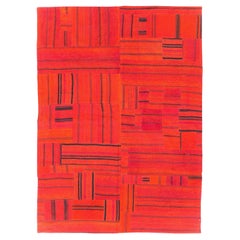
21st Century Red Patchwork Style Turkish Flat-Weave Kilim Accent Carpet
Located in New York, NY
A modern Patchwork style accent carpet handmade using vintage Turkish flat-weave Kilim rugs from the mid-20th century that have been overdyed red and stitched together. Measures: 5' 2" x 7' 2" Flat-weave rugs carpets: Knotted pile rugs are just one small part of a vast universe of textile techniques suitable for heavy use. If you can imagine it, some weaver has tried it out. Pieces can be roughly divided into those reversible from the start and those never, or at least not initially, reversible. Thus, kilims are considered reversible, while everything else is not. Kilims are tapestry woven rugs with both sides the same, in either slit technique where colors change, or with various methods of avoiding slits. Slit tapestry weave goes back to ancient times and Coptic Egyptian...
Category

21st Century and Contemporary Turkish Modern Rugs and Carpets

Materials

Wool

Mid-20th Century Handmade Turkish Flat-Weave Kilim Room Size Carpet
Located in New York, NY
A vintage Turkish flat-weave Kilim room size carpet handmade during the mid-20th century. Measures: 10' 1" x 14' 0" Flat-weave rugs carpets: Knotted pile rugs are just one small part of a vast universe of textile techniques suitable for heavy use. If you can imagine it, some weaver has tried it out. Pieces can be roughly divided into those reversible from the start and those never, or at least not initially, reversible. Thus, kilims are considered reversible, while everything else is not. Kilims are tapestry woven rugs with both sides the same, in either slit technique where colors change, or with various methods of avoiding slits. Slit tapestry weave goes back to ancient times and Coptic Egyptian weavers used it for ornaments on garments and larger wall hangings. Slits can be avoided by dovetailing of colors (warp sharing) or by interlocking the wefts. The Navajo weavers of the Southwest practice the first while the fine shawl weavers of Kashmir and Kerman employed the second. Interlocking produces a one-faced fabric, with smooth and rough, ridged faces. The typical Turkish, Caucasian, or Persian rustic kilim shows slits, but never long ones. Aubusson French carpets are also slit tapestries and the long color transitions are sewn up as part of the regular maintenance. Some kilims are very fine. The best antique urban Sehna (Senna) kilims on wool, cotton or silk warps approximate the comparable rugs in refinement and are the most desirable of all Persian kilims. Although the various flatweave techniques are usually expressed in geometric, simple, often repeating, patterns, Sehna kilims demonstrate that even the most intricate designs can be effectively rendered in flat-stich. The term ‘kilim’ has been extended to cover any pileless, weft-faced heavy textile. Thus, the sectioned and joined northeastern Persian horizontally striped wool rugs are called ‘kilims’. So are the plain-weave end finishes of pile rugs. All these are weft-faced, weft patterned flatweaves. These sectioned pieces are woven not on a frame loom, but one steadied by the weaver at one end and with the warps fastened down at the other. Only relatively recent have these tribal pieces become available. They are used as floorcoverings, hangings, room dividers, furniture covers. They are mostly bitonal in shades of natural dark brown and beige. Some more recent pieces show weaver innovations with ikat and moire effects. Work proceeds quickly and a skilled weaver can complete a thirty foot strip in almost no time. Wefts, the elements added as weaving progresses, play an essential part in what is a flatweave. The best-known example of an extra-weft, wrapping technique is on Caucasian and tribal Persian Soumaks, where a pattern weft wraps around the fixed warp, changing as weaving progresses. Soumaks can be large carpets, Kuba in the Caucasus, small bag faces (Caucasian and Persian Shah Savan saddle bags), or cover scatter rugs (Persian Afshars). The Soumak technique is fast, and a weaver can work much more quickly than tying knots. The left-over wefts are cut off on the back, so the front and back are initially different. As a Soumak on the floor gets used, these weft yarns wear away and the two sides converge although the exact texture remains distinct. There are other ways of pattern by weft. Often on smaller tribal pieces, the pattern weft(s) is (are) part of the weft structure, moving in an out, and holding the whole thing together. These wefts can be complementary or added (supplementary), continuous across the flatweave or cut off as they travel unneeded across the verso. Supplementary weft flatweaves are often very compact and substantial. The nomadic Turkmen and Balouch tribes employ both supplementary and complementary weft techniques on their pieces. Supplementary wefts are often raised on the recto (front) while complementary wefts are flat to the surface. Tribal Kurds employ this extra-wefting technique. The Balouch of Pakistan use complementary wefts almost exclusively on their small woven paraphernalia like salt bags. Flatweave techniques may be combined on a single piece. Afshar rugs employ plain-weave end strips, preceded by Soumak bands, with pile sections between. The large Bakhtiari saddlebags feature Soumak work, pile “islands” an areas of plain-weave. Qashqai rugs and kilims frequently displays checkerboard end strips in continuous, complementary wefting. Another distinct flatweave type is the jajim (jijim, cecim) in which a pattern is added with colored wefts as the weaving of the plain-weave ground progresses. Here the wefts are discontinuous and the pattern stands proud from the voided ground. Often made in two pieces on narrow looms and edge-sewn together, these may have geometric patterns. The term ‘jajim’ also refers to the assembled warp-faced strip and stripe covers from the Shah Savan of northwest Persia, the pattern is defined by warps alone, usually in plain stripes, but sometimes in designs of ladders, snakes, human figures and various animals. Here the color changing warps are continuous. Most are wool, a few are silk. Better to call these something else. Indian ‘Dhurries’ are all cotton kilims and ‘shatrangis’ employ wool wefts on cotton warps. Dhurries are slitless. The cotton texture is more appropriate to the humid and warm climate of the Indian subcontinent. Modern Dhurries...
Category

Mid-20th Century Turkish Modern Rugs and Carpets

Materials

Wool

Mid-20th Century Handmade Turkish Flat-Weave Kilim Room Size Carpet
Located in New York, NY
A vintage Turkish flat-weave Kilim room size carpet handmade during the mid-20th century. Measures: 10' 7" x 13' 7" Flat-weave rugs carpets: Knotted pile rugs are just one small part of a vast universe of textile techniques suitable for heavy use. If you can imagine it, some weaver has tried it out. Pieces can be roughly divided into those reversible from the start and those never, or at least not initially, reversible. Thus, kilims are considered reversible, while everything else is not. Kilims are tapestry woven rugs with both sides the same, in either slit technique where colors change, or with various methods of avoiding slits. Slit tapestry weave goes back to ancient times and Coptic Egyptian weavers used it for ornaments on garments and larger wall hangings. Slits can be avoided by dovetailing of colors (warp sharing) or by interlocking the wefts. The Navajo weavers of the Southwest practice the first while the fine shawl weavers of Kashmir and Kerman employed the second. Interlocking produces a one-faced fabric, with smooth and rough, ridged faces. The typical Turkish, Caucasian, or Persian rustic kilim shows slits, but never long ones. Aubusson French carpets are also slit tapestries and the long color transitions are sewn up as part of the regular maintenance. Some kilims are very fine. The best antique urban Sehna (Senna) kilims on wool, cotton or silk warps approximate the comparable rugs in refinement and are the most desirable of all Persian kilims. Although the various flatweave techniques are usually expressed in geometric, simple, often repeating, patterns, Sehna kilims demonstrate that even the most intricate designs can be effectively rendered in flat-stich. The term ‘kilim’ has been extended to cover any pileless, weft-faced heavy textile. Thus, the sectioned and joined northeastern Persian horizontally striped wool rugs are called ‘kilims’. So are the plain-weave end finishes of pile rugs. All these are weft-faced, weft patterned flatweaves. These sectioned pieces are woven not on a frame loom, but one steadied by the weaver at one end and with the warps fastened down at the other. Only relatively recent have these tribal pieces become available. They are used as floorcoverings, hangings, room dividers, furniture covers. They are mostly bitonal in shades of natural dark brown and beige. Some more recent pieces show weaver innovations with ikat and moire effects. Work proceeds quickly and a skilled weaver can complete a thirty foot strip in almost no time. Wefts, the elements added as weaving progresses, play an essential part in what is a flatweave. The best-known example of an extra-weft, wrapping technique is on Caucasian and tribal Persian Soumaks, where a pattern weft wraps around the fixed warp, changing as weaving progresses. Soumaks can be large carpets, Kuba in the Caucasus, small bag faces (Caucasian and Persian Shah Savan saddle bags), or cover scatter rugs (Persian Afshars). The Soumak technique is fast, and a weaver can work much more quickly than tying knots. The left-over wefts are cut off on the back, so the front and back are initially different. As a Soumak on the floor gets used, these weft yarns wear away and the two sides converge although the exact texture remains distinct. There are other ways of pattern by weft. Often on smaller tribal pieces, the pattern weft(s) is (are) part of the weft structure, moving in an out, and holding the whole thing together. These wefts can be complementary or added (supplementary), continuous across the flatweave or cut off as they travel unneeded across the verso. Supplementary weft flatweaves are often very compact and substantial. The nomadic Turkmen and Balouch tribes employ both supplementary and complementary weft techniques on their pieces. Supplementary wefts are often raised on the recto (front) while complementary wefts are flat to the surface. Tribal Kurds employ this extra-wefting technique. The Balouch of Pakistan use complementary wefts almost exclusively on their small woven paraphernalia like salt bags. Flatweave techniques may be combined on a single piece. Afshar rugs employ plain-weave end strips, preceded by Soumak bands, with pile sections between. The large Bakhtiari saddlebags feature Soumak work, pile “islands” an areas of plain-weave. Qashqai rugs and kilims frequently displays checkerboard end strips in continuous, complementary wefting. Another distinct flatweave type is the jajim (jijim, cecim) in which a pattern is added with colored wefts as the weaving of the plain-weave ground progresses. Here the wefts are discontinuous and the pattern stands proud from the voided ground. Often made in two pieces on narrow looms and edge-sewn together, these may have geometric patterns. The term ‘jajim’ also refers to the assembled warp-faced strip and stripe covers from the Shah Savan of northwest Persia, the pattern is defined by warps alone, usually in plain stripes, but sometimes in designs of ladders, snakes, human figures and various animals. Here the color changing warps are continuous. Most are wool, a few are silk. Better to call these something else. Indian ‘Dhurries’ are all cotton kilims and ‘shatrangis’ employ wool wefts on cotton warps. Dhurries are slitless. The cotton texture is more appropriate to the humid and warm climate of the Indian subcontinent. Modern Dhurries...
Category

Mid-20th Century Turkish Modern Rugs and Carpets

Materials

Wool

Mid-20th Century Handmade Turkish Flat-Weave Kilim Room Size Carpet
Located in New York, NY
A vintage Turkish flat-weave Kilim room size carpet handmade during the mid-20th century. Measures: 10' 7" x 12' 9" Flat-weave rugs carpets: Knotted pile rugs are just one small part of a vast universe of textile techniques suitable for heavy use. If you can imagine it, some weaver has tried it out. Pieces can be roughly divided into those reversible from the start and those never, or at least not initially, reversible. Thus, kilims are considered reversible, while everything else is not. Kilims are tapestry woven rugs with both sides the same, in either slit technique where colors change, or with various methods of avoiding slits. Slit tapestry weave goes back to ancient times and Coptic...
Category

Mid-20th Century Turkish Modern Rugs and Carpets

Materials

Wool

Mid-20th Century Handmade Turkish Flat-Weave Kilim Room Size Carpet
Located in New York, NY
A vintage Turkish flat-weave Kilim room size carpet handmade during the mid-20th century. Measures: 10' 5" x 13' 5" Flat-weave rugs carpets: Knotted pile rugs are just one small part of a vast universe of textile techniques suitable for heavy use. If you can imagine it, some weaver has tried it out. Pieces can be roughly divided into those reversible from the start and those never, or at least not initially, reversible. Thus, kilims are considered reversible, while everything else is not. Kilims are tapestry woven rugs with both sides the same, in either slit technique where colors change, or with various methods of avoiding slits. Slit tapestry weave goes back to ancient times and Coptic Egyptian weavers used it for ornaments on garments and larger wall hangings. Slits can be avoided by dovetailing of colors (warp sharing) or by interlocking the wefts. The Navajo weavers of the Southwest practice the first while the fine shawl weavers of Kashmir and Kerman employed the second. Interlocking produces a one-faced fabric, with smooth and rough, ridged faces. The typical Turkish, Caucasian, or Persian rustic kilim shows slits, but never long ones. Aubusson French carpets are also slit tapestries and the long color transitions are sewn up as part of the regular maintenance. Some kilims are very fine. The best antique urban Sehna (Senna) kilims on wool, cotton or silk warps approximate the comparable rugs in refinement and are the most desirable of all Persian kilims. Although the various flatweave techniques are usually expressed in geometric, simple, often repeating, patterns, Sehna kilims demonstrate that even the most intricate designs can be effectively rendered in flat-stich. The term ‘kilim’ has been extended to cover any pileless, weft-faced heavy textile. Thus, the sectioned and joined northeastern Persian horizontally striped wool rugs are called ‘kilims’. So are the plain-weave end finishes of pile rugs. All these are weft-faced, weft patterned flatweaves. These sectioned pieces are woven not on a frame loom, but one steadied by the weaver at one end and with the warps fastened down at the other. Only relatively recent have these tribal pieces become available. They are used as floorcoverings, hangings, room dividers, furniture covers. They are mostly bitonal in shades of natural dark brown and beige. Some more recent pieces show weaver innovations with ikat and moire effects. Work proceeds quickly and a skilled weaver can complete a thirty foot strip in almost no time. Wefts, the elements added as weaving progresses, play an essential part in what is a flatweave. The best-known example of an extra-weft, wrapping technique is on Caucasian and tribal Persian Soumaks, where a pattern weft wraps around the fixed warp, changing as weaving progresses. Soumaks can be large carpets, Kuba in the Caucasus, small bag faces (Caucasian and Persian Shah Savan saddle bags), or cover scatter rugs (Persian Afshars). The Soumak technique is fast, and a weaver can work much more quickly than tying knots. The left-over wefts are cut off on the back, so the front and back are initially different. As a Soumak on the floor gets used, these weft yarns wear away and the two sides converge although the exact texture remains distinct. There are other ways of pattern by weft. Often on smaller tribal pieces, the pattern weft(s) is (are) part of the weft structure, moving in an out, and holding the whole thing together. These wefts can be complementary or added (supplementary), continuous across the flatweave or cut off as they travel unneeded across the verso. Supplementary weft flatweaves are often very compact and substantial. The nomadic Turkmen and Balouch tribes employ both supplementary and complementary weft techniques on their pieces. Supplementary wefts are often raised on the recto (front) while complementary wefts are flat to the surface. Tribal Kurds employ this extra-wefting technique. The Balouch of Pakistan use complementary wefts almost exclusively on their small woven paraphernalia like salt bags. Flatweave techniques may be combined on a single piece. Afshar rugs employ plain-weave end strips, preceded by Soumak bands, with pile sections between. The large Bakhtiari saddlebags feature Soumak work, pile “islands” an areas of plain-weave. Qashqai rugs and kilims frequently displays checkerboard end strips in continuous, complementary wefting. Another distinct flatweave type is the jajim (jijim, cecim) in which a pattern is added with colored wefts as the weaving of the plain-weave ground progresses. Here the wefts are discontinuous and the pattern stands proud from the voided ground. Often made in two pieces on narrow looms and edge-sewn together, these may have geometric patterns. The term ‘jajim’ also refers to the assembled warp-faced strip and stripe covers from the Shah Savan of northwest Persia, the pattern is defined by warps alone, usually in plain stripes, but sometimes in designs of ladders, snakes, human figures and various animals. Here the color changing warps are continuous. Most are wool, a few are silk. Better to call these something else. Indian ‘Dhurries’ are all cotton kilims and ‘shatrangis’ employ wool wefts on cotton warps. Dhurries are slitless. The cotton texture is more appropriate to the humid and warm climate of the Indian subcontinent. Modern Dhurries...
Category

Mid-20th Century Turkish Modern Rugs and Carpets

Materials

Wool

Mid-20th Century Handmade Turkish Flat-Weave Kilim Accent Carpet
Located in New York, NY
A vintage Turkish flat-weave Kilim accent carpet handmade during the mid-20th century. Measures: 6' 10" x 9' 7" Flat-weave rugs carpets: Knotted pile rugs are just one small part of a vast universe of textile techniques suitable for heavy use. If you can imagine it, some weaver has tried it out. Pieces can be roughly divided into those reversible from the start and those never, or at least not initially, reversible. Thus, kilims are considered reversible, while everything else is not. Kilims are tapestry woven rugs with both sides the same, in either slit technique where colors change, or with various methods of avoiding slits. Slit tapestry weave goes back to ancient times and Coptic Egyptian weavers used it for ornaments on garments and larger wall hangings. Slits can be avoided by dovetailing of colors (warp sharing) or by interlocking the wefts. The Navajo weavers of the Southwest practice the first while the Fine shawl weavers of Kashmir and Kerman employed the second. Interlocking produces a one-faced fabric, with smooth and rough, ridged faces. The typical Turkish, Caucasian, or Persian rustic Kilim shows slits, but never long ones. Aubusson French carpets are also slit tapestries and the long color transitions are sewn up as part of the regular maintenance. Some kilims are very Fine. The best antique urban Sehna (Senna) kilims on wool, cotton or silk warps approximate the comparable rugs in refinement and are the most desirable of all Persian kilims. Although the various flatweave techniques are usually expressed in geometric, simple, often repeating, patterns, Sehna kilims demonstrate that even the most intricate designs can be effectively rendered in flat-stich. The term ‘Kilim’ has been extended to cover any pileless, weft-faced heavy textile. Thus, the sectioned and joined northeastern Persian horizontally striped wool rugs are called ‘kilims’. So are the plain-weave end finishes of pile rugs. All these are weft-faced, weft patterned flatweaves. These sectioned pieces are woven not on a frame loom, but one steadied by the weaver at one end and with the warps fastened down at the other. Only relatively recent have these tribal pieces become available. They are used as floorcoverings, hangings, room dividers, furniture covers. They are mostly bitonal in shades of natural dark brown and beige. Some more recent pieces show weaver innovations with ikat and moire effects. Work proceeds quickly and a skilled weaver can complete a thirty foot strip in almost no time. Wefts, the elements added as weaving progresses, play an essential part in what is a flatweave. The best-known example of an extra-weft, wrapping technique is on Caucasian and tribal Persian Soumaks, where a pattern weft wraps around the fixed warp, changing as weaving progresses. Soumaks can be large carpets, Kuba in the Caucasus, small bag faces (Caucasian and Persian Shah Savan saddle bags), or cover scatter rugs (Persian Afshars). The Soumak technique is fast, and a weaver can work much more quickly than tying knots. The left-over wefts are cut off on the back, so the front and back are initially different. As a Soumak on the floor gets used, these weft yarns wear away and the two sides converge although the exact texture remains distinct. There are other ways of pattern by weft. Often on smaller tribal pieces, the pattern weft(s) is (are) part of the weft structure, moving in an out, and holding the whole thing together. These wefts can be complementary or added (supplementary), continuous across the flatweave or cut off as they travel unneeded across the verso. Supplementary weft flatweaves are often very compact and substantial. The nomadic Turkmen and Balouch tribes employ both supplementary and complementary weft techniques on their pieces. Supplementary wefts are often raised on the recto (front) while complementary wefts are flat to the surface. Tribal Kurds employ this extra-wefting technique. The Balouch of Pakistan use complementary wefts almost exclusively on their small woven paraphernalia like salt bags. Flatweave techniques may be combined on a single piece. Afshar rugs employ plain-weave end strips, preceded by Soumak bands, with pile sections between. The large Bakhtiari saddlebags feature Soumak work, pile “islands” an areas of plain-weave. Qashqai rugs and kilims frequently displays checkerboard end strips in continuous, complementary wefting. Another distinct flatweave type is the jajim (jijim, cecim) in which a pattern is added with colored wefts as the weaving of the plain-weave ground progresses. Here the wefts are discontinuous and the pattern stands proud from the voided ground. Often made in two pieces on narrow looms and edge-sewn together, these may have geometric patterns. The term ‘jajim’ also refers to the assembled warp-faced strip and stripe covers from the Shah Savan of northwest Persia, the pattern is defined by warps alone, usually in plain stripes, but sometimes in designs of ladders, snakes, human figures and various animals. Here the color changing warps are continuous. Most are wool, a few are silk. Better to call these something else. Indian ‘Dhurries’ are all cotton kilims and ‘shatrangis’ employ wool wefts on cotton warps. Dhurries are slitless. The cotton texture is more appropriate to the humid and warm climate of the Indian subcontinent. Modern Dhurries...
Category

Mid-20th Century Turkish Tribal Rugs and Carpets

Materials

Wool

Mid-20th Century Handmade Turkish Flat-Weave Kilim Room Size Carpet
Located in New York, NY
A vintage Turkish flat-weave Kilim room size carpet handmade during the mid-20th century. Measures: 10' 5" x 14' 2" Flat-weave rugs carpets: Knotted pile rugs are just one small part of a vast universe of textile techniques suitable for heavy use. If you can imagine it, some weaver has tried it out. Pieces can be roughly divided into those reversible from the start and those never, or at least not initially, reversible. Thus, kilims are considered reversible, while everything else is not. Kilims are tapestry woven rugs with both sides the same, in either slit technique where colors change, or with various methods of avoiding slits. Slit tapestry weave goes back to ancient times and Coptic...
Category

Mid-20th Century Turkish Modern Rugs and Carpets

Materials

Wool

Mid-20th Century Handmade Persian Flat-Weave Kilim Room Size Carpet
Located in New York, NY
A vintage Persian flat-weave Kilim room size carpet handmade during the mid-20th century. Measures: 8' 5" x 12' 0" Flat-weave Rugs Carpets: Knotted pile rugs are just on...
Category

Mid-20th Century Persian Modern Rugs and Carpets

Materials

Wool

Tribal Mid-20th Century Handmade Turkish Flat-Weave Kilim Throw Rug
Located in New York, NY
A vintage Turkish flat-weave Kilim throw rug handmade during the mid-20th century with a tribal design. Measures: 3' 6" x 5' 0" Flat-weave Rugs Carpets: Knotted pile rug...
Category

Mid-20th Century Turkish Tribal Rugs and Carpets

Materials

Wool

Mid-20th Century Handmade European Flat-Weave Kilim Throw Rug
Located in New York, NY
A vintage European flat-weave Kilim throw rug handmade in Poland during the mid-20th century. Measures: 3' 5" x 5' 11" Flat-weave rugs carpets: Knotted pile rugs are jus...
Category

Mid-20th Century Polish Scandinavian Modern Rugs and Carpets

Materials

Wool

Colorful Mid-20th Century Handmade Turkish Flat-Weave Kilim Square Room Size Rug
Located in New York, NY
A vintage Turkish flat-weave Kilim room-size carpet in square format handmade during the mid-20th century with a colorful contemporary pattern in a tribal manner. The overall effect ...
Category

Mid-20th Century Turkish Modern Rugs and Carpets

Materials

Wool

Swedish Inspired Contemporary Handmade Turkish Flat-Weave Kilim Large Carpet
Located in New York, NY
A modern Turkish flat-weave Kilim large room size carpet handmade during the 21st century inspired by vintage Swedish / Scandinavian Kilims from the mid-20th century period. Measu...
Category

21st Century and Contemporary Turkish Scandinavian Modern Rugs and Carpets

Materials

Wool

Mid-20th Century Handmade Turkish Flat-Weave Kilim Accent Carpet
Located in New York, NY
A vintage Turkish flat-weave Kilim accent carpet handmade during the mid-20th century. Measures: 5' 9" x 7' 10" Flat-weave Rugs Carpets: Knotted pile rugs are just one s...
Category

Mid-20th Century Turkish Modern Rugs and Carpets

Materials

Wool

Colorful Contemporary Handmade Turkish Flat-Weave Kilim Room Size Carpet
Located in New York, NY
A modern Turkish flat-weave Kilim room size carpet handmade during the 21st century with a contemporary and colorful design. Measures: 10' 9" x 13' 5" Flat-weave Rugs Car...
Category

21st Century and Contemporary Turkish Modern Rugs and Carpets

Materials

Wool

Mid-20th Century Handmade Turkish Flat-Weave Kilim Room Size Carpet
Located in New York, NY
A vintage Turkish flat-weave Kilim room size carpet handmade during the mid-20th century. Measures: 10' 1" x 13' 6" Flat-weave Rugs Carpets: Knotted pile rugs are just o...
Category

Mid-20th Century Turkish Modern Rugs and Carpets

Materials

Wool

Mid-20th Century Handmade Turkish Flat-Weave Kilim Room Size Carpet
Located in New York, NY
A vintage Turkish flat-weave Kilim room size carpet handmade during the mid-20th century. Measures: 9' 0" x 12' 2" Flat-weave rugs carpets: Knotted pile rugs are just on...
Category

Mid-20th Century Turkish Modern Rugs and Carpets

Materials

Wool

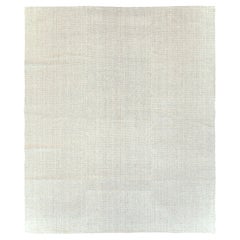
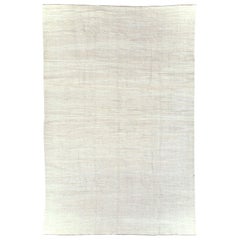
Mid-20th Century Handmade Turkish Flat-Weave Kilim Room Size Carpet in White
Located in New York, NY
A vintage Turkish flat-weave Kilim room size carpet handmade during the mid-20th century in shades of white. Measures: 9' 1" x 13' 10" Flat-weave Rugs Carpets: Knotted p...
Category

Mid-20th Century Turkish Modern Rugs and Carpets

Materials

Wool

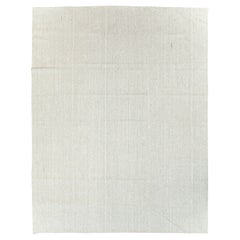
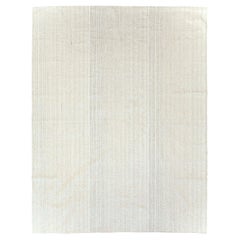
Mid-20th Century Handmade Turkish Flat-Weave Kilim Room Size Carpet in White
Located in New York, NY
A vintage Turkish flat-weave Kilim room size carpet handmade during the mid-20th century with a salt and pepper pattern in white-beige. Measures: 10' 2" x 13' 3" Flat-weave rug...
Category

Mid-20th Century Turkish Modern Rugs and Carpets

Materials

Wool

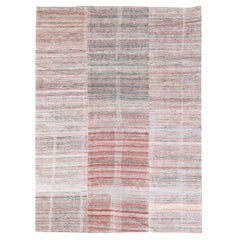
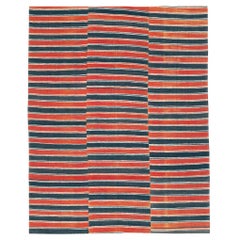
Red Black Mid-20th Century Handmade Turkish Flat-Weave Kilim Accent Rug
Located in New York, NY
A vintage Turkish flat-weave Kilim accent rug handmade during the mid-20th century with an asymmetrical horizontally striped design in shades of red and black. Measures: 5' 9" x 7...
Category

Mid-20th Century Turkish Modern Rugs and Carpets

Materials

Wool

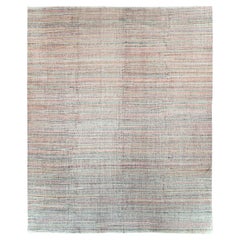
Colorful Contemporary Handmade Turkish Flat-Weave Kilim Large Room Size Carpet
Located in New York, NY
A modern Turkish flat-weave Kilim large room size carpet handmade during the 21st century with a horizontally striped pattern in soft, but colorful tones similar to the style of Amer...
Category

21st Century and Contemporary Turkish Modern Rugs and Carpets

Materials

Wool

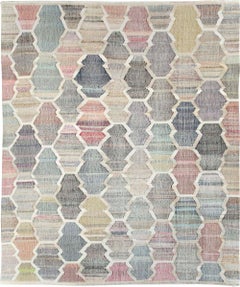
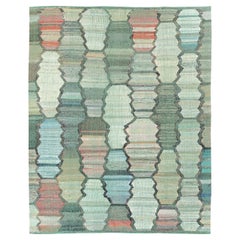
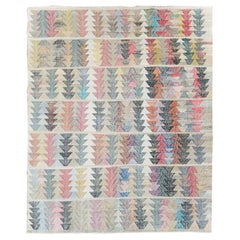
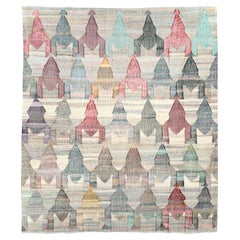
Contemporary Handmade Turkish Flat-Weave Kilim Large Geometric Room Size Carpet
Located in New York, NY
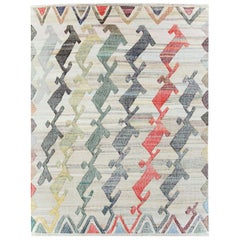
A modern Turkish flat-weave Kilim large room size carpet handmade during the 21st century with a colorful pastel geometric large scale pattern resembling circus tents over a white-be...
Category

21st Century and Contemporary Turkish Modern Rugs and Carpets

Materials

Wool

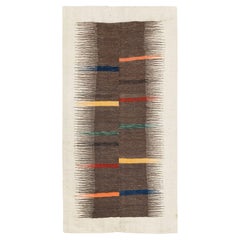
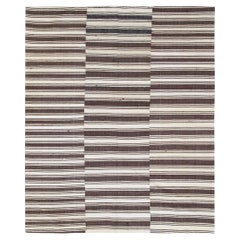
Mid-20th Century Turkish Flat-Weave Kilim Accent Rug in Brown, Cream, Black
Located in New York, NY
A vintage Turkish flat-weave Kilim accent rug handmade during the mid-20th century with an offset horizontally striped pattern in shades of brown, cream, and black. Measures: 6' 2...
Category

Mid-20th Century Turkish Modern Rugs and Carpets

Materials

Wool

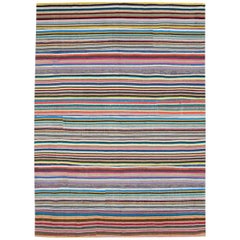
Contemporary Handmade Turkish Flat-Weave Kilim Colorful Room Size Carpet
Located in New York, NY
A modern Turkish flat-weave Kilim room size rug handmade during the 21st century with a colorful horizontally striped pattern. A statement piece with its bright and whimsical colors....
Category

21st Century and Contemporary Turkish Modern Rugs and Carpets

Materials

Wool

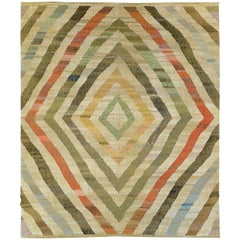
Contemporary Handmade Turkish Flat-Weave Kilim Large Geometric Room Size Carpet
Located in New York, NY
A modern Turkish flat-weave Kilim large room size carpet handmade during the 21st century with a geometric large scale diamond-shaped pattern in earth tones with an overall khaki gre...
Category

21st Century and Contemporary Turkish Modern Rugs and Carpets

Materials

Wool

Contemporary Handmade Turkish Flat-Weave Kilim Geometric Room Size Carpet
Located in New York, NY
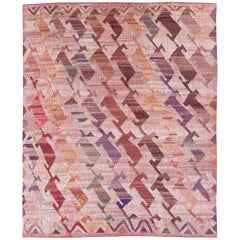
A modern Turkish flat-weave Kilim room size carpet handmade during the 21st century with a large-scale geometric contemporary pattern in jewel tones over a white and beige striated b...
Category

21st Century and Contemporary Turkish Modern Rugs and Carpets

Materials

Wool

Contemporary Handmade Turkish Flat-Weave Kilim Large Geometric Room Size Carpet
Located in New York, NY
A modern Turkish flat-weave Kilim large room size carpet handmade during the 21st century with a large-scale geometric contemporary pattern in ruby red. Measures: 13' 6" x 16' 5" ...
Category

21st Century and Contemporary Turkish Modern Rugs and Carpets

Materials

Wool

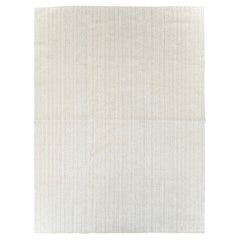
Grey Mid-20th Century Handmade Turkish Flat-Weave Kilim Room Size Carpet
Located in New York, NY
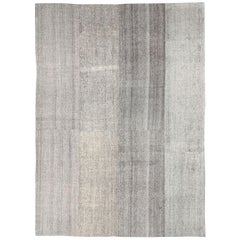
A vintage Turkish flat-weave Kilim room size carpet handmade during the mid-20th century with a salt and pepper design creating an overall grey tone. Measures: 9' 11" x 13' 3" ...
Category

Mid-20th Century Turkish Modern Rugs and Carpets

Materials

Wool

Antique and Vintage Rugs for Sale: Shop Turkish Rugs, Moroccan Rugs, Indian Rugs and Other Rugs on 1stDibs

Good antique rugs and vintage rugs have made their way into homes across the globe, becoming fixtures used for comfort, prayer and self-expression, so choosing the right area rug is officially a universal endeavor.

In modern usage, “carpet” typically denotes a wall-to-wall floor cushioning that is fixed to the floor. Rugs, on the other hand, are designed to cover a specific area and can easily be moved to new locations. However, the terms are interchangeable in many parts of the world, and, in the end, it won’t matter what you decide to call it.

It’s well known that a timeless Persian rug or vintage Turkish rug can warm any interior, but there are lots of other styles of antique rugs to choose from when you're endeavoring to introduce fresh colors and textures to a bedroom or living room.

Moroccan Berber rugs are not all about pattern. In fact, some of the most striking examples are nearly monochrome. But what these rugs lack in complexity, they make up for in brilliant color and subtle variation. Moroccan-style interiors can be mesmerizing — a sitting room of this type might feature a Moroccan rug, carved wooden screens and a tapestry hung behind the sofa.

Handwoven kilim rugs, known for their wealth of rich colors and unique weaving tradition, are pileless: Whereas the Beni Ourain rugs of Morocco can be described as dense with a thick surface or pile, an authentic kilim rug is thin and flat. (The term “kilim” is Turkish in origin, but this type of textile artistry is practiced all across the Balkans, throughout the Arab world and elsewhere.) 

When it comes to eye-catching floor coverings, the distinctive “medallion” pattern of Oushak rugs has two types of rounded shapes alternating against a rich red or blue background created with natural dyes, while the elaborate “star” pattern involves large eight-pointed shapes in diagonal rows alternating with diamonds.  

If you’re looking for something unexpected, find a runner rug that pops in your hallway or on your stairs. Dig for dazzling geometric patterns in our inventory of mid-century modern rugs and carpets, which includes works designed by the likes of Swedish textile masters Märta Måås-Fjetterström, Marianne Richter and other artisans. 

Carpets and rugs have been around for thousands of years. Prehistoric humans turned to animal skin, wool and fur to craft simple fabrics to soften hard terrain. A 2016 study suggests that "cave lions" were hunted for exactly this purpose, and that decorating your cave with their pelts may have conferred strength and prestige. Although many of these early textiles are still in existence, tracing their precise origins is difficult. Carpets quickly became such a valuable trade commodity that the weavings could easily travel far from their places of origin. 

The oldest known carpet was found in southern Siberia. (It may have traveled there from Persepolis in Iran.) For the flat-weave floor rugs crafted by Native Americans, cotton was the primary material before sheep’s wool was introduced in the 16th century. In Europe, carpet-making was fundamental to folk art, and Asian carpets imported to European countries were at one time considered a precious luxury and not intended to remain permanently on the floor. 

With the variety of area rugs and carpets rolled out for you on 1stDibs — a collection that includes traditional, modern, minimalist rugs and other coverings of all kinds — things will be looking up whenever you’re looking down. 

Still Thinking About These?

All Recently Viewed